New York ATV Reciprocity With Other States
New York ATV reciprocity can save a visiting rider from registering the same machine twice, but it does not automatically open every trail or waive New York’s safety and insurance rules. The practical answer depends on where the ATV is registered, whether that registration is valid, and where you plan to ride. Here’s how to sort out those questions before you cross the state line.
What reciprocity means for an out-of-state ATV
Reciprocity is recognition of a registration issued by another jurisdiction. If your ATV is properly registered in your home state and New York recognizes that registration, you may generally use the home-state registration rather than obtaining a New York registration for a visit. You still need to carry proof and follow New York’s rules while riding here.
That is narrower than it may sound. Reciprocity does not mean New York has adopted the laws of your home state, and it does not turn an out-of-state registration into a trail permit. It also does not necessarily help if your home state does not require your machine to be registered, if the registration has expired, or if the vehicle does not qualify as an ATV under New York law.
Think of the questions as separate checks:
- Registration: Is the machine validly registered where it is based, and will New York recognize that registration?
- Insurance: Does the machine have the insurance New York requires for the kind of riding you plan to do?
- Trail access: Does the specific county, club, park, or landowner allow your machine and accept your registration status?
- Rider rules: Do you meet New York’s requirements for age, supervision, helmet use, equipment, and passengers?
A yes to one does not answer the others. For example, a visitor may have valid Pennsylvania registration and still need insurance that satisfies New York law, a local trail permit, and permission to ride a particular trail.
If you’re a New York resident trying to understand the basic registration obligation before considering another state’s plate, start with Do You Need to Register an ATV in New York?. Visitors can also review New York Reciprocity for Out-of-State Registrations for the registration question from the rider’s perspective.
Reciprocity is not permission to ride anywhere
New York does not have one statewide trail pass that gives an ATV access to all public riding areas. Local systems can set their own access conditions. A county trail network, club trail, private park, or town route may require a separate permit, membership, reservation, or proof of insurance.
Even when a trail accepts out-of-state registrations, it may be closed for the season, limited to certain machine types, or open only to riders who follow a landowner agreement. Check the rules for the exact riding area rather than relying on a general statement such as “out-of-state ATVs are welcome.”
This distinction matters especially in areas where trails cross private land. Registration does not give you permission to cross someone else’s property. A trail may be open only along a signed route, and a gate or closure notice can change where you may travel. For more on local access, see New York ATV Reciprocity With Other States and New York Club Trail Rules.
Reciprocity does not change what counts as an ATV
A machine that is registered as an ATV in another state may not fit New York’s definition or qualify for New York registration. That can be a concern with some side-by-sides, wide utility machines, and heavier models. The label used by a manufacturer, seller, or another state is not always decisive for New York purposes.
New York’s machine requirements can include limits on width and weight. If your machine is near a limit, do not assume that its out-of-state plate settles the issue for every New York road or trail. Confirm eligibility and access with the appropriate New York agency and the particular trail operator before traveling. The related guides New York’s 70-Inch Width Limit and New York’s 1,000-Pound Weight Limit explain why a machine’s dimensions can matter.
Check your home-state registration before traveling
The first useful document is the actual registration issued by the state or jurisdiction where the ATV is registered. A sales receipt, bill of sale, insurance card, or online account screenshot may not establish that the registration is current. Bring the official registration document or whatever valid proof your home jurisdiction issues.
Check the following before you load the machine:
- The registration is active for the full period of your trip.
- The vehicle identification number on the paperwork matches the machine.
- The registered owner information is accurate, especially if the ATV is borrowed, leased, or registered to a family member.
- Any plate or decal required by the home jurisdiction is attached in the required place and can be read.
- You can show proof of registration without relying on cell service.
- The machine is an ATV category that New York and the trail operator will accept.
A registration document that is difficult to read, damaged, or kept only in an account you cannot access offline can turn a straightforward stop into a frustrating one. Keep the paperwork protected from rain and mud, but accessible. A simple waterproof document sleeve can help; if you shop for one on Amazon or elsewhere, the useful feature is reliable water protection, not a particular brand or listing.
Keep a digital copy as a backup if your home jurisdiction allows it, but do not assume a photo on your phone replaces the required document. Carry the official proof in the form accepted by the issuing jurisdiction and check whether New York or the trail operator expects a physical document.
Registration from a state with different rules
States do not all register off-road vehicles in the same way. One state may issue a plate, another may issue a decal, and another may use a different system or apply registration requirements only to certain machines. Some jurisdictions may not require registration for a particular ATV at all.
That difference creates a common misunderstanding: “My state doesn’t make me register it, so I can ride it in New York without registering it.” That conclusion is not safe. New York’s treatment can depend on the home jurisdiction’s rules and the machine’s status, and a lack of a home-state document may mean you need to take additional steps before riding here.
If your state does not issue ATV registrations, ask the New York DMV what applies to your situation before traveling. Be ready to describe the machine, where it is normally kept, where you live, and whether your home state requires a permit or other operating credential. The guide What a Visitor Does When Their State Issues No Plate covers this specific problem.
Do not try to solve uncertainty by borrowing a plate or displaying a registration that belongs to another machine. The registration should correspond to the ATV you are bringing. If you are unsure whether your home-state paperwork is sufficient, ask the issuing agency and New York DMV before the trip, and keep a record of the guidance you receive.
A temporary visit versus moving to New York
A visitor’s situation is different from a person who has moved to New York and is keeping the machine here. Reciprocity is meant to address use of a machine registered elsewhere, not to let a resident avoid New York’s registration process indefinitely by keeping an out-of-state registration active.
If you have moved, established residence, or brought an ATV into New York for ongoing use, ask the DMV whether you need to register it in New York and what proof is required. Do not rely on the fact that the machine was legal in your former state. The relevant process may depend on ownership documents, prior registration, the machine’s classification, and whether it has a title.
For help with that situation, read New York ATV Registration After Moving to the State. If the machine came from another state and you are trying to put it on New York records, Registering an Out-of-State Machine in New York explains the paperwork issue.
Separate registration from trail permits and local access
New York has riding areas with different operators and different access rules. A state-recognized registration is not a universal pass. Before leaving home, identify the exact trail system or park and check its current requirements directly.
A county trail network may use its own permit system. A club may maintain trails that are open only to members or permit holders. A private riding park can set its own admission, machine, and operating rules. A town may designate certain roads for ATV use, while nearby roads remain closed. Each access decision is separate from whether the machine is registered.
| What you need to establish | What to check | What registration alone does not prove |
|---|---|---|
| Legal vehicle status | Valid home-state registration and New York recognition | That every New York trail accepts the machine |
| Trail access | The specific county, club, park, or landowner’s rules | That a local permit or membership is unnecessary |
| Road use | Whether the road is legally designated or otherwise open to ATVs | That an ATV may ride on ordinary public roads |
| Insurance | Whether your policy meets New York’s requirements | That your home-state policy automatically qualifies |
| Machine eligibility | New York’s classification and dimensional rules | That another state’s vehicle category controls in New York |
| Rider eligibility | New York age, supervision, helmet, and passenger rules | That your home-state rider privileges carry over |
New York does not issue a single statewide trail pass covering every riding location. County and club arrangements can be quite different, so do not buy a permit based on a trail map from an old trip or an unofficial social media post. Use the current information from the organization that manages the route. The article Why New York Has No Statewide Trail Pass explains why trail access is handled through separate systems.
Verify where a permit applies
A permit may cover only one county system or a defined group of trails. It may not cover neighboring land, a trail in another county, a private park, or a road connection between two trail areas. If your planned route crosses county or club boundaries, check each segment.
Ask the trail operator:
- Is the trail open to visitors with out-of-state registration?
- Is a county permit, club membership, or day pass required?
- Does the permit cover the exact route I plan to ride?
- Are there machine-width, passenger, or age restrictions?
- Are there seasonal closures or temporary landowner closures?
- What proof must I display or carry?
- Is the machine allowed on connecting roads or only on marked trails?
A local permit’s sticker or receipt may need to be displayed in a particular way. Keep purchase confirmation and any permit instructions together. If a permit is issued electronically, save the receipt for offline access and confirm whether the trail operator requires a physical sticker.
Some trail networks use a club relationship as part of access. Membership may help support maintenance or provide access to trails covered by that club’s agreements, but it is not automatically valid for every trail in the region. Check the details before treating club membership as a substitute for a local permit. New York Club Memberships and Trail Access gives more context on the difference.
Road crossings and road riding are separate questions
An out-of-state plate does not make New York public roads generally open to ATV use. Some roads may be designated and posted for ATVs under applicable local rules; other roads are not open. A trail route may also require riders to cross a road at a permitted location without allowing them to travel along the road.
Follow signs and route markings, and do not infer that an unmarked road is open because another rider used it. Confirm the designation with the local authority or trail operator. For the crossing rules, see New York Rules for Crossing a Public Road. For the broader road question, see New York’s Designated and Posted Roads.
New York insurance and riding rules still apply
Registration reciprocity does not exempt a visiting rider from New York’s operating rules. Insurance is one of the most important things to check before traveling. New York has ATV insurance requirements, and a visitor should not assume that a policy is adequate simply because it is valid in the home state.
Contact your insurer before the trip. Explain that the ATV will be operated in New York and ask the insurer to confirm that the policy covers the machine and the intended use there. Ask for proof of coverage you can carry on the ride. If you are borrowing the machine, confirm who is insured and whether the policy covers a different operator.
Do not rely on a verbal assumption such as “the policy covers it everywhere.” Ask the insurer to confirm the details in writing or provide documentation that clearly identifies the coverage. The guides New York ATV Insurance Requirement and Does an Out-of-State Policy Satisfy New York’s ATV Rule? explain why this check matters.
Insurance and land use
The insurance question can depend on where the ATV is operated. New York’s requirements distinguish between riding on your own property and riding elsewhere, and the details can be easy to misapply. A visitor riding on a trail, another person’s land, or a public route should check the applicable insurance obligation rather than treating a private-property exception as a general exemption.
If your trip includes several kinds of riding, such as a private park one day and a county trail the next, confirm that your policy and proof of coverage fit the entire plan. Also check whether the policy covers passengers, borrowed machines, or the type of vehicle you are bringing. The insurer can clarify the policy; the relevant New York rules determine what is legally required.
Insurance proof is not the same as proof of registration. Keep both available. A trail operator or officer may ask for one or both, and an insurance card does not establish that your ATV is registered.
Rider and equipment rules
New York’s rider requirements apply even if your home state has different rules. Review the rules for helmets, passengers, rider age, supervision, lighting, mufflers, and other required equipment before riding. Do not assume that a rider’s age or safety credential accepted at home automatically meets New York requirements.
Passenger rules deserve particular attention. A passenger should not be carried just because the ATV has room on a rack or because the machine has a larger engine. New York requirements can depend on whether the machine was designed and equipped for a passenger. Check New York Passenger Rules on an ATV and Why a Passenger Needs a Factory-Fitted Seat in New York before bringing a second rider.
Check that the machine meets applicable equipment requirements and that its plate or registration identifier remains visible. Mud, a cargo bag, or a poorly mounted bracket can obscure identifying information. Follow the New York rules for plate placement and visibility, along with the requirements of the home jurisdiction. New York Equipment Requirements for ATVs is a useful pre-ride checklist.
If you’re putting together travel supplies, a weather-resistant phone pouch or map holder can be useful for keeping trail directions available, whether you buy one locally or through Amazon. It does not replace an official trail map, permit, or paper registration. In areas with limited cell coverage, download maps and save key contact details before you leave.
Check the state you are coming from
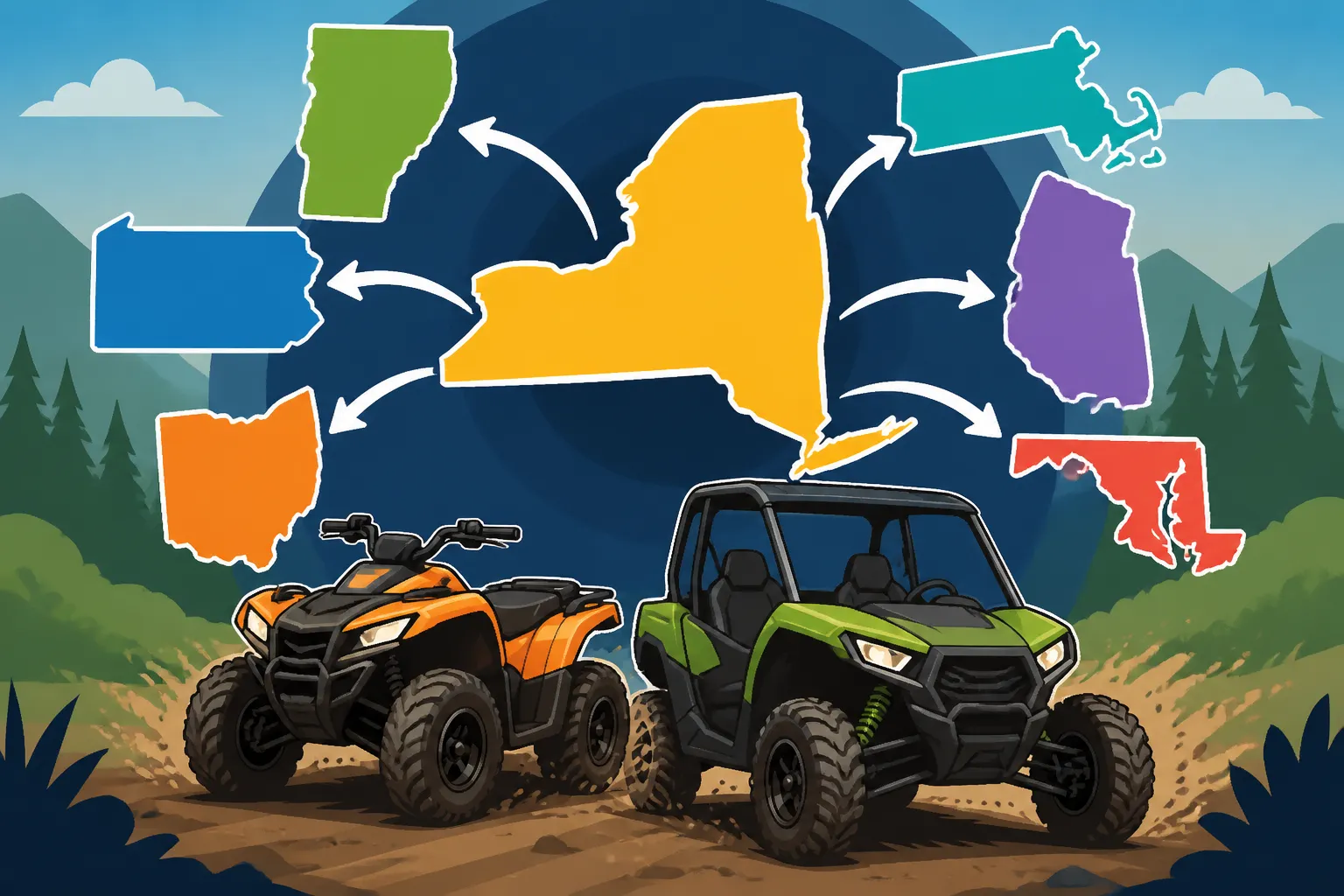
The broad reciprocity principle is useful, but the answer can turn on the issuing state’s registration system and the particular ATV. Do not assume that rules for a neighboring state apply to yours. If your state issues a conventional registration and the ATV’s paperwork is current, your case may be straightforward; if it does not, ask before travel.
Pennsylvania
A Pennsylvania registration does not, by itself, provide permission to ride any New York trail. Confirm the registration is current and applies to the machine, then verify that New York recognizes the documentation for your visit. Carry the registration and proof of insurance.
Trail access remains a separate check. If you plan to ride a county network, club system, or private park, ask whether it accepts the Pennsylvania registration and whether you need a local permit. The guide Riding New York on a Pennsylvania Registration focuses on that cross-border situation.
Vermont
Vermont riders should make the same checks: current registration, accepted proof, qualifying machine, insurance, and local access. A Vermont registration does not replace a New York trail permit or change New York’s helmet, passenger, or equipment rules.
If you keep the machine in New York for an extended period or have moved to New York, ask whether your status has changed from a temporary visit to a New York registration obligation. For a more specific overview, see Riding New York on a Vermont Registration.
Ontario
A visitor bringing an ATV from Ontario should confirm the status and documentation of the machine before crossing the border. Bring the registration or other official documents applicable to the vehicle, along with proof of ownership and insurance. Check whether the exact machine is treated as an ATV for New York purposes and whether the riding area accepts it.
Border-crossing requirements and New York trail access are different matters. A document that helps establish lawful entry or ownership does not automatically qualify as a New York trail permit. See Bringing an Ontario-Plated Quad Across the Border and confirm current requirements with the relevant authorities before departure.
A state with no registration requirement for your machine
This is the situation most likely to surprise a visitor. If your home state does not require that type of ATV to be registered, there may be no out-of-state registration for New York to recognize. Do not conclude that you can simply ride without paperwork. Ask the New York DMV what registration or other documentation is needed for a nonresident in that specific situation.
When you call or submit a question, be precise. Give the machine’s make, model, year, vehicle identification number, home jurisdiction, and the reason it is not registered there. Explain whether you will be visiting briefly or keeping the ATV in New York. This helps distinguish a temporary visit from an ongoing registration issue.
The guide Registering a Quad Brought From a State With No ATV Program discusses this scenario. If the machine is not registered anywhere and you are considering applying in New York, Registering an ATV in New York and New York ATV Registration Paperwork can help you understand the process.
A practical checklist before you load the ATV
A little preparation is easier than sorting out paperwork at a trailhead. Use this checklist for each machine and each rider, especially if several people are traveling with different ATVs.
- Confirm the machine’s registration. Check the expiration date, the VIN, and the registered owner. Bring the official proof.
- Confirm that New York recognizes it. If your state has an unusual registration system or no registration requirement for your machine, ask New York DMV before traveling.
- Check machine eligibility. Confirm that the ATV is acceptable under New York rules and the rules of the riding area, including any width or weight restrictions.
- Call your insurer. Ask whether the policy covers operation in New York and obtain proof of coverage.
- Choose the exact riding area. Identify the county system, club, park, or landowner responsible for the route.
- Check local access requirements. Ask about permits, memberships, day passes, seasonal openings, machine limits, and closures.
- Review rider rules. Check age and supervision requirements, helmet use, passenger eligibility, and equipment rules.
- Plan road connections. Confirm which roads are designated for ATV use and where crossings are allowed.
- Save documents and maps offline. Bring the original required documents, plus backup copies if useful. Do not depend on cell service to retrieve them.
- Recheck conditions before departure. Trails can close because of weather, landowner issues, maintenance, or seasonal conditions.
If you want to organize paperwork in advance, a folder or waterproof sleeve can keep the registration, insurance proof, permit receipt, and emergency contacts together. Amazon and other retailers sell document organizers, but any simple, durable option works if it keeps papers legible and accessible. For trail navigation, use the current map from the organization managing the route rather than relying only on an old saved image or a general map app.
What to carry on the ride
Carry the documents required for the machine and the ride, not just what is convenient to photograph. A practical set may include:
- Home-state registration or accepted proof of registration
- Proof of insurance
- County, club, or park permit information
- Rider identification and any required credentials
- A current trail map or downloaded route information
- Emergency contact details
- The machine’s VIN information, recorded separately in case paperwork is lost
Keep these items protected from water and mud, but do not store them somewhere so inaccessible that you cannot produce them during a stop. If several machines are traveling together, label each document set clearly. A single folder for the group can lead to confusion about which registration belongs to which ATV.
A photo of the VIN and paperwork can be a helpful backup, but it is not a substitute for official proof where a physical document is required. Keep the phone charged and the files available offline. If your route has weak coverage, tell someone where you plan to ride and when you expect to return.
Recheck rules when your plans change
A visit can change after you arrive. A trail may be closed, a group may decide to cross into another county, or weather may push riders to a different area. A permit valid for one system may not cover the new route. Before following a group onto a different trail, ask where it goes and whether your registration and permit are accepted there.
Likewise, do not treat an open gate as proof that the route is open to ATVs. Gates can serve maintenance access, private property, or seasonal operations. Follow signs and current notices from the land manager or club. If an area is closed, turn around rather than looking for an informal bypass.
Common reciprocity mistakes and how to avoid them
Treating a plate as a trail pass
A plate or decal shows a registration status. It does not show that you paid a county permit, joined a club, or have permission to ride private land. Verify local requirements for each riding area.
Assuming your home-state laws control
Once you are riding in New York, New York operating rules apply. Your home state’s helmet, passenger, insurance, or age rules may differ. Review New York requirements before the trip, not after a ranger or officer asks about them.
Assuming insurance travels automatically
A policy may be limited by vehicle type, use, operator, or location. Ask the insurer specifically about New York operation and keep proof with you. If the ATV is borrowed, confirm coverage for the person who will ride it.
Using a registration that belongs to another machine
The paperwork should match the ATV’s identifying information. A similar model or a family member’s registration does not establish that your machine is properly registered. Compare the VIN on the frame with the registration before loading.
Riding a machine that may not qualify
A wide or heavy side-by-side can be accepted in one state and restricted in New York or on a particular trail. Check the actual dimensions and the applicable rules before buying, borrowing, or transporting the machine. A dealer’s assurance that it is “street legal” or “registered as an ATV” somewhere else does not answer New York’s trail-access question.
Confusing a short visit with permanent use
A temporary visitor and a person who has moved to New York may have different registration obligations. If you have changed your residence or keep the ATV in New York, ask the DMV about your status. Avoid treating reciprocity as a way to postpone a registration step that applies to residents.
Relying on old trail information
Trail routes, landowner agreements, permits, and opening dates can change. A route that was open on your last visit may not be open now. Check the current source for the trail system before you travel, and keep a backup plan in case the route is closed.
Waiting until a roadside stop to sort out paperwork
If you cannot produce the registration, insurance proof, or permit information, you may have to stop riding while the issue is clarified. Keep documents with the machine, confirm they match, and make sure every rider knows where they are stored.
For a visitor, the safest approach is straightforward: arrive with current registration, suitable insurance, and the right local access permission; ride only where the route is open; and follow New York rules even if your home state does things differently. If one piece is uncertain, resolve it with the responsible agency, insurer, or trail operator before the trip.
Disclaimer
This article is for general informational purposes only and does not constitute professional advice. Laws, prices and regulations vary by location and change over time. Consult a qualified professional for guidance on your specific situation.