New York ATV Registration After Moving to the State
Moving to a new state is exciting, but it also brings a mountain of paperwork and figuring out new rules, especially when you bring your beloved ATV or side-by-side with you. It can feel like you're starting from scratch, trying to decipher a whole new language of vehicle registration, and the rules for off-road machines are often vastly different from those for your car or truck. This guide is here to cut through the confusion and walk you through the entire process of registering your ATV in New York after you've made the big move, ensuring you're ready to hit the trails legally and without a headache.
Why Moving to New York Changes Everything for Your ATV
You might assume that because your ATV was legally registered in your previous state, it's automatically good to go in New York. Unfortunately, that's often not the case. New York has very specific definitions and requirements for ATVs, and what was perfectly fine in one state might not even qualify as a registrable ATV here. It’s a common pitfall for new residents, and understanding these differences before you head to the DMV can save you a world of frustration.
New York's Unique ATV Definition
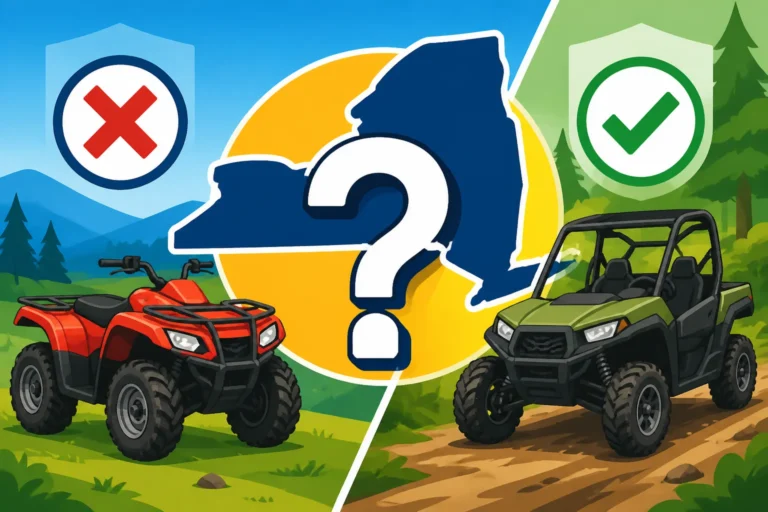
New York State's definition of an All-Terrain Vehicle is quite strict, especially concerning dimensions. Unlike some states that might be more lenient, New York places a hard limit on both width and weight for a machine to be registered as an ATV. Specifically, a machine must be no more than 70 inches wide and weigh no more than 1,000 pounds. This is where many larger side-by-sides (UTVs) and even some utility-focused ATVs from other states run into trouble.
Imagine you're coming from a state where your two-seater side-by-side was happily registered as an ATV, allowing you to hit public trails. You arrive in New York, and suddenly, your cherished machine is deemed too wide or too heavy. This can be a real gut punch for new residents who envisioned exploring New York's beautiful landscapes on their familiar ride. It's crucial to measure your machine thoroughly before you even begin the registration process. You can dive deeper into these specifics by reading about [New York ATV Width Limit for Registration] and [New York ATV Weight Limit for Registration]. If your machine exceeds these limits, it generally cannot be registered as an ATV in New York, meaning it's restricted to private property use only.
No Title, Different Proof of Ownership
Another significant difference that often catches people off guard is New York's stance on ATV titles. Unlike cars and trucks, and many other states that issue titles for ATVs, New York does not. This can be incredibly confusing if you're accustomed to proving ownership with a clean title certificate. Without that familiar piece of paper, what do you use?
The New York DMV relies on other forms of documentation to prove ownership, which can include a manufacturer's statement of origin (MSO), a previous registration from your old state, or a notarized bill of sale. If you're coming from a state that did issue a title, you'll want to bring that along anyway, as it certainly helps establish a clear chain of ownership, even if the New York DMV won't issue a new one. The key is to have a clear and unbroken paper trail. This lack of a title means you need to be extra diligent with your existing paperwork, as detailed in [New York ATV Proof of Ownership Requirements].
Registration, Not Just Riding Permits
In many states, especially if you primarily ride on private land or within designated parks, you might only need a simple permit or sticker to acknowledge your machine's existence. New York, however, generally requires full registration for ATVs that will be operated off your own property, even on private land with permission. This isn't just about trail access; it's about being legal when you transport your machine or if you need to cross a public road.
This means you'll be getting a license plate and a yearly validation sticker, just like a car (though the plate goes on the rear). Thinking you can just buy a trail pass or join a club is a common misconception that can lead to fines if you're stopped. Understanding this requirement from the outset is vital, as simply having an out-of-state registration isn't enough to ride here. If you're wondering, "Do I really need to go through all this?", the answer for most riders is a resounding yes. For more details on when and why you need to register, check out [Do You Need to Register an ATV in New York?].
Gathering Your Documents: What the New York DMV Needs
The New York DMV, like most government agencies, loves its paperwork. Having all your ducks in a row before you walk through the door is absolutely critical to a smooth registration process. Missing even one piece can send you home, forcing you to make another trip and delaying your adventures. It’s an irritating but unavoidable part of the process, so let's get it right the first time.
Proof of Ownership from Your Old State
Since New York doesn't issue ATV titles, the burden of proof for ownership falls heavily on documents from your previous state or your original purchase. This is where things can get tricky. If you're coming from a state that did title ATVs, bring that title with you. Even though New York won't issue one, the previous title provides clear evidence of your ownership history.
If your former state didn't title ATVs, or if your machine is older and titles weren't common when you bought it, you'll need other documentation. A current or expired registration from your previous state is excellent proof, especially if it clearly shows your name and the ATV's Vehicle Identification Number (VIN). An original bill of sale from when you purchased the ATV, especially if it’s notarized or from a reputable dealer, is also very strong evidence. If you’re coming from a state that didn’t issue titles, or if your original bill of sale is long gone, you might need to create a new, formal bill of sale or an affidavit of ownership. Services like LawDepot can provide templates for these types of legal documents, ensuring you have something official to present that clearly states you are the owner and includes all the machine's identifying details. Remember, the DMV needs to see a clear chain of custody. This is especially important for [New York ATV Registration Without a Title].
The MV-51B and Other Forms
The main form you'll be dealing with at the New York DMV for ATV registration is the MV-51B, officially known as the "Certificate of Sale or Transfer." While its name might sound like it's only for a sale, it's the form the DMV uses to record the initial registration of non-titled vehicles, including ATVs, that are being registered by their owners. You'll need to fill out your personal information, the ATV's details (make, model, year, VIN), and provide details of the previous owner if applicable.
One unique New York requirement that often puzzles newcomers is the VIN tracing. The DMV requires a pencil tracing of your ATV's VIN directly onto the MV-51B form. This is a security measure to ensure the VIN on your paperwork matches the physical VIN on your machine. You simply place the form over the VIN plate on your ATV's frame and rub a pencil across it to transfer the impression. Don't forget this step before you head to the DMV! Missing it means another trip back to your garage. Understanding how to correctly fill out this form and handle the tracing is crucial, so be sure to review [New York's Form MV-51B Explained] and [Why New York Wants a Pencil Tracing of the VIN] for all the details.
Insurance Requirements
New York State mandates that all registered ATVs carry liability insurance. This isn't optional; it's a legal requirement before you can even get your plate. The minimum coverage levels are generally $25,000 for bodily injury to one person, $50,000 for bodily injury to two or more people, and $10,000 for property damage. You'll need to provide proof of this insurance at the DMV counter, usually in the form of an insurance card or a declaration page from your policy.
It’s wise to shop around for ATV insurance well before your DMV visit. Not all insurance companies offer ATV coverage in New York, so don't assume your existing auto insurer will cover your off-road machine. While LawDepot won't handle your insurance, having all your ownership documents clear can help streamline the process when you're getting quotes for New York's mandatory coverage. Make sure your policy is active and covers your ATV for operation in New York. You can learn more about the specific requirements by looking into [New York's Mandatory ATV Insurance].
Sales Tax Considerations
When you register your ATV in New York, the DMV will also assess sales tax if it hasn't been paid already. If you purchased your ATV in another state and are moving to New York, you generally owe New York sales tax if the purchase occurred less than 90 days before your move. However, if you've owned the ATV for a longer period and paid sales tax in your previous state, you might receive a credit or even be exempt from paying additional New York sales tax, depending on the rates in both states and the length of your ownership.
It's important to have proof of purchase and proof of any sales tax paid in your previous state readily available. The DMV clerk will be able to determine what, if any, sales tax is due. This can sometimes be a surprise cost for new residents, so factor it into your budget. For a deeper dive into how sales tax applies to your ATV registration, check out [New York ATV Registration and Sales Tax].
Checklist for Your DMV Visit
To make your trip to the DMV as smooth as possible, use this checklist:
| Document/Item | Required for Registration? | Notes |
|---|---|---|
| Proof of Ownership | Yes | Previous state title, registration, or original/notarized bill of sale. Clear VIN and owner name. |
| New York MV-51B Form | Yes | Filled out completely, including all ATV details and your personal information. |
| VIN Tracing | Yes | A pencil rubbing of the ATV's VIN directly onto the MV-51B. Do this before you go! |
| Proof of New York ATV Insurance | Yes | An active insurance card or declaration page showing required minimum liability coverage in New York. |
| Valid Photo ID | Yes | Your New York State driver's license or other acceptable photo identification. |
| Proof of New York Residency | Yes | Utility bill, lease agreement, etc., showing your new New York address. |
| Payment for Fees/Taxes | Yes | Cash, check, or credit/debit card for registration fees, plate fee, and any applicable sales tax. |
| Completed Bill of Sale (if needed) | Recommended | If previous ownership documents are insufficient or informal, a formal bill of sale (like one from LawDepot) can strengthen your ownership claim. |
The In-Person Visit: Navigating the DMV
So you've moved, you've gathered your documents, and you've mentally prepared yourself for the DMV. Walking in with confidence and preparation is key, as the process can sometimes feel overwhelming. Knowing what to expect at each step will make it much less daunting.
Finding Your Local DMV
Not every DMV office handles all types of transactions. While most full-service DMV offices can process ATV registrations, it's always a good idea to call ahead to your local New York DMV or check their website before you make the trip. Some smaller satellite offices might have limited services, and you don't want to waste a journey. You'll want to find a location that can specifically handle "vehicle registrations" or "ATV registrations." Your county DMV office is usually a good bet, but it's worth verifying. For more details on where exactly you can go, refer to [Where to Register an ATV in New York].
Once you've confirmed the location, try to pick a less busy time if possible. Mid-week, mid-morning or mid-afternoon, avoiding lunch rushes and end-of-day crowds, can often lead to a quicker visit.
The VIN Tracing Process (Again)
We mentioned the VIN tracing earlier, but it bears repeating because it's such a common reason for people to be turned away. This isn't just a suggestion; it's a firm requirement. You must have a clear pencil tracing of your ATV's VIN on the MV-51B form. The VIN is typically found stamped on the frame of your ATV, often near the steering head, on a frame rail, or under the seat. It’s a series of 17 characters.
To do it correctly, simply hold the MV-51B form over the VIN plate or stamping, making sure the section for the tracing is directly over the VIN. Then, with a pencil (a soft lead pencil works best), gently rub back and forth across the paper over the VIN. The numbers and letters should transfer onto the form, creating a legible impression. The DMV clerk will scrutinize this tracing to ensure it matches the VIN on your other documents. If it's smudged, incomplete, or missing, you'll be sent home to redo it. It’s a simple step, but easily overlooked, so take your time and make sure it’s clear. Learn more about this specific requirement in [Tracing a Frame Number With a Pencil].
What to Expect at the Counter
When your number is called (or you reach the front of the line), approach the counter with all your documents neatly organized. The clerk will ask for your identification and your stack of paperwork. They will review your proof of ownership, the MV-51B with the VIN tracing, your New York insurance card, and any proof of sales tax paid. Be prepared for questions about your previous state's registration, when you moved, and how long you've owned the ATV. Honesty and clarity are your best tools here.
The clerk will input all your information into their system. This is also when they'll calculate the registration fee and any applicable sales tax. New York ATV registrations expire on August 31st each year, regardless of when you register it, so your initial fee will cover you until the next August 31st. You'll pay a one-time plate fee in addition to the annual registration fee. If everything is in order and all fees are paid, they will issue your registration certificate, your validation decal, and your New York ATV license plate right then and there.
Getting Your Plate and Decal
Congratulations, you've done it! You'll leave the DMV with your new New York ATV registration certificate, a small validation decal, and a shiny new ATV license plate. The plate is typically a standard size for ATVs and motorcycles, and it must be mounted securely on the rear of your ATV. It needs to be clearly visible and kept clean so that it can be easily read by law enforcement.
The small validation decal, which indicates the current registration year, needs to be affixed to your ATV's license plate. There’s usually a designated spot on the plate for it. Make sure it's placed correctly and securely so it doesn't peel off during your rides. It’s important to remember these items are your proof of legal operation in New York. Losing them can be a hassle, so make sure they’re properly installed and you keep your registration certificate safe. More on these specific requirements can be found in [New York ATV Plates and Where They Mount] and [Where to Stick a New York ATV Validation Decal].
Maintaining Your New York ATV Registration
Getting your ATV registered in New York is the first big hurdle, but it's not a one-and-done deal. Like any vehicle registration, it requires annual attention and careful record-keeping to ensure you remain legal to ride on New York's fantastic trails.
Annual Renewals
One of the most important things to remember about New York ATV registration is the renewal date: August 31st. This date is universal for all ATVs registered in the state, regardless of when you initially registered your machine. So, if you register your ATV in June, your first registration will only be valid for a little over two months until the end of August. New York does not prorate registration fees based on the time of year you register, so it’s something to be aware of when planning your move and registration.
You'll receive a renewal notice in the mail from the DMV closer to the expiration date. You can typically renew online, by mail, or in person at a DMV office. Don't let your registration lapse, as riding with an expired registration can lead to fines and other legal trouble. It’s best to get it renewed well before the August 31st deadline to ensure continuous legal operation. Understanding this date is crucial; you can find out more by reading [New York's August 31 Expiration] and [Renewing a New York ATV Registration].
Keeping Proof Handy
Once your ATV is registered and insured, it's absolutely essential to always carry proof of both when you're operating your machine off your own private property. This means having your valid New York ATV registration certificate and your New York ATV insurance card with you on every ride. You never know when you might encounter law enforcement, an accident, or need to verify your vehicle's status for trail access.
I recommend keeping these documents in a waterproof bag or container, secured somewhere on your ATV that's easily accessible but protected from the elements and potential damage. A small, sturdy pouch that attaches to a rack or inside a storage compartment works well. Don't rely on having them in your truck or trailer back at the staging area. When you're on the trail, they need to be on your person or on the machine itself. If you ever need to prove ownership for insurance claims or even just for your own records, having a robust bill of sale or affidavit created through a service like LawDepot can provide an extra layer of security and clarity. For all the specifics on what proof you need and when, check out [New York Registration and Insurance Proof].
Disclaimer
This article is for general informational purposes only and does not constitute professional advice. Laws, prices and regulations vary by location and change over time. Consult a qualified professional for guidance on your specific situation.