Why Parents Share the Liability in New York
Why Parents Share the Liability in New York
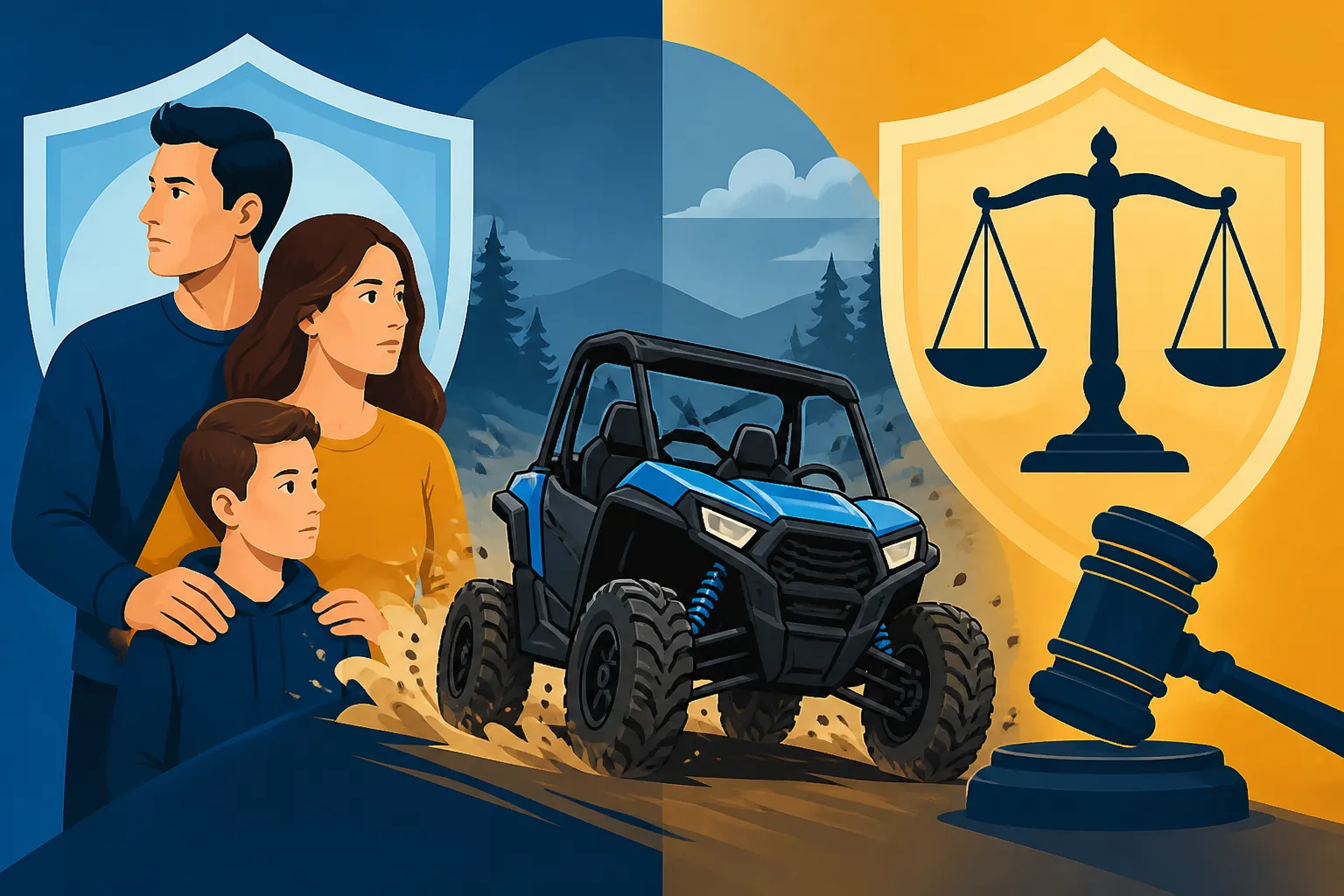
When a child rides an ATV, a parent may be involved in more than choosing the machine or paying for the permit. Age rules, supervision, ownership, insurance and the circumstances of a crash can all affect who is held responsible. The key distinction is that parents are not automatically liable for every mistake a child makes, but their own decisions and duties can create real exposure.
What “sharing liability” means for a parent
“Sharing liability” does not mean New York automatically makes a parent legally responsible for every ATV crash involving their child. A child’s age, what the parent knew, who owned or supplied the machine, whether required supervision was provided, and what caused the injury or damage all matter.
A parent might be involved in a claim in several different ways:
- The parent may have contributed to the risk. For example, a claim could allege that an adult allowed a child to ride a machine or route that was inappropriate, ignored a known mechanical problem, or failed to provide supervision required by the circumstances.
- The parent may own or control the ATV. Ownership alone does not necessarily establish automatic liability for every crash. But permission, maintenance, how the machine was made available, and the applicable rules may all become relevant.
- The parent may have signed paperwork or arranged the ride. A registration, rental agreement, trail permit or release can help show who organized the ride and what responsibilities the adults accepted. Signing a form does not necessarily waive another person’s right to bring a claim.
- The parent may be responsible for a child’s conduct under a specific legal rule. The details depend on the law and facts involved; parenthood itself is not a blanket guarantee of liability.
The everyday meaning of “share” can also be broader than the legal meaning. A parent may pay for a repair, help with an insurance claim, or manage a dispute even when a court has not found the parent legally liable. Those practical responsibilities should not be confused with a legal finding.
A child may also have duties of their own. An ATV operator can be expected to ride safely and obey applicable rules. If a child’s conduct contributes to a crash, that may matter in a claim, but it does not automatically decide whether an adult also contributed.
The safest way to think about the issue is to separate three questions:
- Was the child allowed to operate the machine under the applicable age and supervision rules?
- Did an adult make a decision or omission that contributed to the incident?
- Does insurance apply to this rider, machine, location and type of use?
Those questions often overlap, but they are not interchangeable. A parent may follow an age-related supervision rule and still face questions about an unsafe machine. Conversely, an accident does not prove that a parent was negligent simply because the rider was a minor.
This distinction matters especially when families ride on property owned by someone else, use a club trail, or travel with friends. A parent may have arranged access without controlling every part of the ride. The facts about who chose the route, who was supervising, who maintained the ATV and who gave permission can help clarify each person’s role. For the separate question of lending a machine to another rider, see Are You Liable If You Lend Out Your Quad?.
How age and supervision rules affect the risk
New York has rules for young ATV riders, and a child’s age can change what kind of operation is allowed and what adult supervision is needed. The conditions can depend on where the machine is being used and whether the rider has the required training or certificate. Parents should check the rules that apply to the specific rider and location rather than relying on a general assumption that a child may ride because an adult is nearby.
The details of age limits, permitted operation and adult involvement are covered in New York Rules for Riders Under 16 and New York Supervision Rules for Minors. A safety certificate may also be relevant; see New York ATV Safety Certificate Requirements. These resources address separate requirements, so having a certificate should not be treated as permission to ignore other age, supervision or location rules.
| Situation | What a parent should confirm | Why it matters |
|---|---|---|
| A young rider is operating | The rider’s age, applicable supervision rule and any required certificate | A child’s eligibility can depend on age and conditions, not just parental permission |
| A child is riding on private property | Who owns the land, whether the landowner has given permission, and which rules still apply | Private land does not necessarily remove every legal or safety obligation |
| A child is riding a friend’s machine | Who owns it, who allowed the child to use it, and whether the adult supervising knows the machine | Permission and control may become relevant after a crash |
| A child is carrying a passenger | Whether the machine is designed and equipped for a passenger and whether the rider meets applicable rules | A second rider changes the risks and may be restricted |
| A family is joining a trail ride | Whether the route is open to ATVs and what registration, permit, insurance and rider rules apply | Trail access does not mean every machine or rider is automatically eligible |
“Supervision” is not only about being in the same general area. A parent should consider whether the adult can actually observe the child, communicate with them and intervene if conditions become unsafe. A rider far ahead on a trail, out of sight in a wooded area, or operating while the adult is occupied elsewhere may not receive meaningful supervision, even if the adult is technically present.
The level of supervision should also match the child and the ride. A child who is new to riding, still learning to brake or turn, or unfamiliar with the terrain may need closer attention than a practiced rider on a simple, controlled route. A challenging trail, steep slope, deep mud, poor visibility or other riders moving at speed can change the risk quickly.
A certificate or completed safety course is useful, but it is not a substitute for judgment. Training does not make a machine the right size, guarantee the rider will follow instructions, or establish that a particular route is suitable. Parents can use training as one part of a safety plan, alongside an appropriate machine, protective gear and active supervision.
The same is true for a helmet. Meeting a helmet requirement does not make a high-risk ride safe, and a helmet does not replace other protective equipment or safe operating habits. Make sure protective gear fits the child and is suitable for ATV use. If buying online, including through Amazon, check the applicable safety certification and fit rather than relying only on a product description or age range.
Parents should also pay attention to the difference between permission and supervision. Giving a child permission before a ride does not necessarily mean the parent has supervised the ride in a meaningful way. On the other hand, a parent may arrange supervision by another responsible adult. That does not automatically resolve every issue: the child’s eligibility, the adult’s understanding of the plan, and whether supervision is actually provided still matter.
How a parent’s own decisions can become relevant
After an ATV incident, the focus is usually on the events leading up to it. A claim may ask whether the child operated carelessly, but it may also examine whether an adult’s choices contributed to the danger. The exact legal questions depend on the circumstances, so the following are examples of issues that may warrant attention, not a checklist that proves liability.
Giving permission without considering the rider or conditions
A parent’s decision to let a child ride can become relevant if there are clear reasons the ride was unsafe. Examples might include allowing an inexperienced child to use a machine they cannot control, permitting operation on an unsuitable route, or allowing a ride to continue after the child has shown they cannot handle the conditions.
Permission alone does not prove wrongdoing. A reasonable adult may allow a properly prepared child to ride within the applicable rules, and an unexpected crash may happen despite care. The question is not simply whether the parent said yes; it is whether the choices surrounding the ride were reasonable under the circumstances.
Providing a machine that is unsuitable or not maintained
A child needs a machine they can control. Size, weight, speed, controls, braking, condition and the terrain all matter. A machine that is too powerful or physically difficult to manage may increase the risk, even if it is legally registered.
Maintenance can matter as well. Worn brakes, damaged steering, low tires, a loose throttle or other defects can create hazards. Parents should not assume that a machine is safe just because it starts and runs. A basic inspection before a ride can catch visible problems, while recurring mechanical concerns should be checked by someone qualified to service the machine.
If an adult knows about a defect and still allows a child to ride, that knowledge may be important if the defect contributes to an incident. Keeping maintenance records and addressing problems before the next ride is a practical way to reduce both risk and uncertainty.
Failing to provide appropriate supervision
The word “supervision” can be misunderstood as a one-time instruction: “Stay on the trail” or “Don’t go fast.” Real supervision takes the child’s skill, the route and the changing conditions into account. A parent may need to set limits, remain close enough to respond, and stop the ride if the child is tired, upset or losing control.
A supervising adult should know the route and have a plan for communication, including what to do if the group becomes separated. On a group ride, parents should not assume another adult is watching their child unless that responsibility has been clearly discussed. An adult who agreed to supervise should understand the child’s age, experience and limits.
Allowing an unsafe passenger arrangement
Not every ATV is designed to carry a passenger. Adding a passenger can change balance, handling and stopping distance. A child who is riding with someone else may also be at risk if the machine lacks a proper passenger seat or is not designed for two riders. Parents can review New York Rules for a Child Passenger before allowing a child to ride as a passenger.
Even when a machine is designed for two, passengers need to be able to sit securely and follow instructions. A passenger who shifts suddenly or cannot hold on properly can affect the operator’s control. A parent should not assume that a rack, cargo seat or improvised attachment makes a single-rider machine safe for a child passenger.
Overlooking landowner or trail conditions
Permission to ride on a property or trail does not necessarily mean every route is safe or open. A trail may be closed, muddy, damaged, shared with other users or unsuitable for a young rider. Parents should check current access rules and restrictions instead of relying on a past visit or an informal assumption that the route remains available.
For public and club trails, confirm access requirements before leaving home. Registration, insurance and trail-permit obligations are separate questions, and a permit does not override age or supervision rules. The broader requirements for riding are explained in New York ATV Insurance Requirement and New York ATV Safety Certificate Requirements.
Insurance, ownership and what to do after a crash
Insurance can help manage the financial consequences of a crash, but it is not a substitute for legal compliance or safe riding. A policy may have limits, exclusions or conditions that affect whether a particular incident is covered. Do not assume that a standard home, auto or recreational policy covers every ATV use, every location or a minor rider.
Before a child rides, ask the insurer direct questions about the exact setup:
- Is this specific ATV covered?
- Is a minor in the household covered as an operator?
- Does coverage apply where the family plans to ride?
- Are passengers, borrowed machines or organized rides treated differently?
- What must the family do to maintain coverage?
- What should be reported after an incident, and how soon?
Get clear answers from the insurer and keep the policy information accessible. An insurance card or registration document is not proof that every activity is covered. For registration-related paperwork, see Insurance Proof at the Counter. For a visitor or nonresident rider, the fact that a machine is registered elsewhere does not automatically settle the insurance question.
Ownership can complicate the discussion. The person named on a registration, the person who paid for the machine, the person who maintained it and the adult who gave permission may not all be the same. Those distinctions may matter when an insurer or attorney reviews a claim. Keep purchase and maintenance records, and make sure the adults in the household understand who has authority to lend or operate the ATV.
If a child is involved in a crash, focus first on safety and medical care. Then take practical steps to preserve accurate information:
- Call for emergency help when needed. Do not move an injured person unless leaving them in place creates an immediate danger.
- Report the incident as required. Follow applicable reporting rules and cooperate with responding officials.
- Record basic facts. Note the date, location, people involved, direction of travel, trail or property conditions, weather and any witnesses.
- Photograph the scene and machine when safe. Capture visible damage, signs, trail conditions and relevant equipment without disturbing evidence.
- Notify the insurer promptly. Give a factual account and follow the policy’s reporting instructions. Avoid guessing about fault or making promises about payment.
- Keep records. Save medical documents, repair estimates, photographs, messages, registration papers, permits and insurance correspondence.
- Get legal advice when the injury or claim is serious. A qualified lawyer can review the facts and explain which rules and coverage provisions may apply.
Parents should be careful about giving detailed statements before they understand what happened. That does not mean hiding information or refusing to cooperate. It means sticking to what is known, separating firsthand observations from assumptions, and asking the insurer or a lawyer how to handle formal requests.
An accident does not automatically establish that the parent, child or machine owner was at fault. Nor does the absence of a citation necessarily mean no civil claim can be made. Traffic or recreational enforcement and a civil injury claim are different processes, and they may consider different questions.
The same practical caution applies to releases and waivers. A parent may be asked to sign a document for a club event, rental or organized ride. Read it carefully and ask what it covers. A signature may establish consent to participate or acknowledge certain risks, but it should not be assumed to erase every possible claim or responsibility.
A practical plan before a child rides
Parents can reduce the chance of an avoidable incident by treating each ride as a series of decisions, not as a single permission question. This does not eliminate every risk or guarantee that no claim will follow. It does help make the ride more appropriate for the child and easier to explain if questions arise later.
Before the ride:
- Confirm the child is eligible to operate. Check the rules for the child’s age, certificate status, location and required supervision.
- Match the machine to the rider. The child should be able to reach and operate the controls comfortably, steer, brake and stop without help.
- Inspect the machine. Check brakes, throttle return, steering, tires, controls, lights and visible damage. Do not send a child out on a machine with a known safety problem.
- Set boundaries. Choose where the child may ride, how far they may travel, whether they may ride with others and when they must return.
- Name the supervising adult. Make sure that adult agrees to the role, knows the child’s abilities and can stay attentive.
- Check the route. Confirm it is open, permitted for the machine and appropriate for the rider’s experience.
- Review insurance. Confirm the policy applies to the operator and the planned use.
- Use suitable protective equipment. Check fit and condition, and make sure the child knows how to wear it correctly.
- Explain stop conditions. The ride ends if visibility worsens, the child becomes tired, the machine develops a problem or the route is no longer safe.
- Share an emergency plan. Make sure the child knows how to contact the adult and what to do if separated or injured.
A written household rule can help keep expectations consistent. It might specify that a child rides only on approved routes, only with the assigned adult, and only after the machine has been checked. Clear rules do not replace supervision, but they can prevent misunderstandings between parents, children and other adults.
Parents should also discuss borrowing in advance. A child should not lend the ATV to a friend or switch machines without adult approval. The friend may have different experience, age eligibility or equipment, and the owner may not know whether the friend’s policy covers the ride. One adult’s permission should not be assumed to cover a second rider or a changed route.
The practical goal is not to eliminate all risk; that is impossible with a motorized recreational vehicle. It is to avoid preventable hazards and make sure the child, supervising adult, machine and route are a reasonable match. That approach is more useful than assuming either that parents are liable for everything or that a parent can never be responsible for a child’s ride.
Frequently Asked Questions
Are parents automatically liable if their child crashes an ATV in New York?
No. A parent is not automatically legally responsible merely because the rider is their child. Liability depends on the facts, including the parent’s own conduct, applicable rules, ownership and permission, and what caused the incident.
Can a parent be responsible if the child was supervised?
Supervision is important, but it does not settle every question. A claim could still examine whether the machine was suitable, whether it was safe to operate, whether the route was appropriate, and whether the adult’s decisions contributed to the incident.
Does a child’s safety certificate remove a parent’s responsibility?
A certificate can help satisfy a training-related requirement, but it does not guarantee that every ride is allowed or safe. Parents still need to check the child’s age, supervision requirements, location, machine and insurance.
Will ATV insurance cover a parent if a child causes a crash?
Coverage depends on the policy and the circumstances. Ask the insurer specifically about minor operators, the machine, the location and the planned use. Do not assume another type of household policy applies.
Disclaimer
This article is for general informational purposes only and does not constitute professional advice. Laws, prices and regulations vary by location and change over time. Consult a qualified professional for guidance on your specific situation.