Carrying an Out-of-State Registration
If you’re bringing an ATV into New York, a registration from your home state may be enough for the registration requirement—but it does not grant permission to ride everywhere or replace insurance. The key is to carry valid proof, check whether your machine qualifies as an ATV under New York’s rules, and confirm that your intended roads or trails allow ATV use.
When New York Accepts an Out-of-State Registration
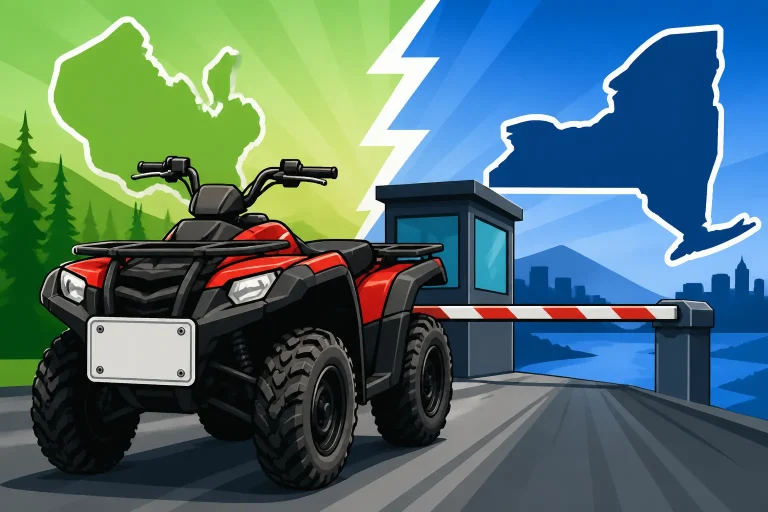
New York honors valid out-of-state ATV registrations, according to the New York State Department of Motor Vehicles. If your registration is current and your machine is registered as an ATV in your home state, you generally do not need to obtain a New York registration just because you are visiting.
That recognition is not unlimited. It applies to a valid ATV registration; it does not by itself establish that every off-road vehicle, including a machine described as a UTV or side-by-side, qualifies for ATV use in New York. The New York State Department of Motor Vehicles defines an ATV by its vehicle type and size, including a maximum width of 70 inches and a maximum weight of 1,000 pounds. If your machine is near either limit, or its registration category is unclear, confirm its classification with the New York State Department of Motor Vehicles before traveling.
The requirement also depends on your home state’s rules. If your home state does not require ATV registration, the New York State Department of Motor Vehicles says you must obtain a New York State ATV registration before operating in New York. Having a bill of sale, insurance card, or other ownership paperwork does not substitute for the registration required in that situation.
For more detail on how the state treats visiting riders, see New York Reciprocity for Out-of-State Registrations and Why an Out-of-State Rider Must Register in New York. Those distinctions matter most when your home state does not issue ATV registrations or when you are unsure whether your paperwork is still valid.
A useful way to think about reciprocity is that New York recognizes a valid registration from another state, but does not waive its other riding rules. You still need to follow New York requirements for insurance, helmets, road crossings, and permitted riding locations. A registration is evidence that the machine is registered; it is not a trail permit or a general authorization to use public land.
Check that the registration is actually valid
Before leaving home, check the expiration date and make sure the document belongs to the ATV you are taking. If you recently bought the machine, transferred it to someone else, or changed its registration, verify that the paperwork reflects the current owner and vehicle. Do not assume that a seller’s old registration covers a new owner or a different machine.
If the machine is registered in a state that does not require registration, the exception does not let you ride in New York without registering. The New York State Department of Motor Vehicles requires a New York registration in that case. See Does New York Honor Another State’s ATV Registration? for more on the difference between a valid out-of-state registration and a state that has no ATV registration requirement.
What to Carry and How to Handle Registration Documents
The New York State Department of Motor Vehicles requires ATV operators to carry the registration document while operating. For a visitor, that means keeping the current out-of-state registration with you on the ride—not merely having it at home, in a trailer, or saved as a photograph that may be hard to access.
Keep the document legible and protected from water, mud, and damage. A sealed pouch or document sleeve can help, especially if you carry papers on the machine. Some riders use a small waterproof holder purchased through retailers such as Amazon, but the important point is that the actual registration remains available and readable. Do not leave the only copy where it could be lost if the ATV is separated from your trailer or parked away from you.
Carry proof that matches the ATV you are riding. If you take more than one machine, make sure you can identify which registration belongs to each one. A group leader should not assume one person’s paperwork covers the other riders’ ATVs.
A registration document is different from an insurance card. The New York State Department of Motor Vehicles requires liability insurance for an ATV operated anywhere in New York State except on the owner’s property. It also says proof of insurance must be shown to a judge, police officer, or a person making a claim of injury or property damage. Carry the insurance evidence separately, and check with your insurer that the policy covers the machine and the intended use in New York. See Insurance a Visitor Must Still Carry and Why the Insurance Rule Catches Visitors Too.
Do not treat a photo of the registration as a guaranteed replacement for the original document. The requirement is to carry the registration document, so bring the document issued for the ATV and keep it accessible. If you are uncertain whether your state’s digital record or temporary paperwork is accepted, confirm the answer with the New York State Department of Motor Vehicles before riding.
Registration does not establish where you can ride
Even with valid registration and insurance, you must check access rules for each road, trail, or property. The New York State Department of Motor Vehicles says ATVs cannot be operated on public highways unless the highway has been designated and posted for ATV use. It also says ATVs may be operated on public lands where signs indicate ATV use is allowed, while private property requires the property owner’s permission.
That distinction catches visitors who assume a registered machine can use any road to connect between trails. A route shown on a map may cross a public road, private land, or state land with separate restrictions. Confirm the route with the relevant land manager or trail operator before you unload. For background, see [New York Rules for a Visiting Rider] and [New York Rules for Riding Public Land].
New York Rules That Still Apply to Visiting Riders
Out-of-state registration does not exempt a rider from New York’s operating rules. Before the trip, review the requirements that apply to your machine, passengers, and route. A driver license is not required to operate an ATV in New York State, according to the New York State Department of Motor Vehicles, but restrictions apply to younger operators.
The New York State Department of Motor Vehicles requires operators and passengers to wear a USDOT-approved helmet when riding an ATV. It also requires headlights and taillights to be lit when riding from 30 minutes after sunset to 30 minutes before sunrise. These requirements apply even when a visiting rider’s home state has different rules.
The New York State Department of Motor Vehicles also sets a minimum tire tread requirement: ATV tires must have at least 2/32nds of an inch of tread and must not have visible breaks, cuts, exposed cords, bumps, or bulges. Check tires before the trip rather than discovering a problem at the trailhead.
Road crossings need planning. According to the New York State Department of Motor Vehicles, a divided highway may be crossed only where it intersects with another street or highway. You must never cross an interstate or another controlled-access highway, such as the Thruway or a parkway. A trail map or GPS route should not be treated as proof that a crossing is legal.
Nighttime restrictions can affect a ride near homes. According to the New York State Department of Motor Vehicles, between midnight and 6 A.M. you must not operate an ATV within 100 feet of a dwelling at a speed greater than necessary to keep the ATV moving. If your group is riding late, plan a route that avoids residential areas rather than relying on a visitor’s home-state rules.
Rules can also apply to young riders in your group. The New York State Department of Motor Vehicles says operators aged 14 to 15 may ride without adult supervision on lands owned or leased by their parent or guardian. For operators under age 14, riding without adult supervision is limited to lands owned or leased by their parent or guardian. The agency defines adult supervision as accompaniment by a person at least 18 years old, or by a person aged 16 or 17 who holds an ATV safety course completion certificate from the ATV Safety Institute. Other conditions apply to some riders aged 14 to 15, including when operating independently on permitted property. Check the full rule before bringing a young operator.
These requirements are separate from any county, club, or property-specific access conditions. A county trail system may have its own permit or membership rules, and an ATV registration from another state does not automatically satisfy those requirements. Confirm what the trail operator requires before traveling.
A Practical Pre-Trip Check
A brief document and route check can prevent a frustrating trip. Work through these steps before loading the ATV:
- Confirm the registration is current. Check that the document is valid and identifies the machine you are bringing. If your home state does not require ATV registration, arrange the New York registration required by the New York State Department of Motor Vehicles before operating.
- Check the machine’s classification. Make sure it qualifies as an ATV under New York’s definition. The New York State Department of Motor Vehicles sets a maximum width of 70 inches and a maximum weight of 1,000 pounds for an ATV.
- Pack the registration document. Carry the document on the ride, keep it readable, and do not rely on leaving it in a vehicle or trailer.
- Pack proof of insurance. The New York State Department of Motor Vehicles requires liability insurance except when operating on the owner’s property. Confirm that the coverage applies to your New York riding.
- Confirm route access. Check that public roads are designated and posted for ATV use, that public-land routes allow it, and that you have permission for private property.
- Inspect the ATV and prepare riders. Check the tires, lights, and helmets, and review the applicable age and supervision rules for any young riders.
- Review special access requirements. Ask the county, club, park, or land manager whether a separate permit, pass, or membership is required for the route you plan to use.
If you are stopped or asked to show documents, having the registration and insurance evidence readily available makes it easier to demonstrate that the paperwork is in order. If your registration status is unusual—for example, your home state does not register ATVs, or the vehicle is classified differently in different states—resolve that question before the trip rather than at the trailhead.
The practical takeaway is straightforward: New York recognizes a valid out-of-state ATV registration, but the registration is only one part of riding legally. Carry the document, maintain the required insurance, and check access rules for every road or trail on your itinerary. For a broader overview, see Riding New York With an Out-of-State Plate.
Sources
- New York State Department of Motor Vehicles — Register an ATV | NY DMV (checked November 3, 2026)
- Department of Motor Vehicles — ATVs: Information for Owners and Operators | NY DMV (checked November 3, 2026)
Disclaimer
This article is for general informational purposes only and does not constitute professional advice. Laws, prices and regulations vary by location and change over time. Consult a qualified professional for guidance on your specific situation.