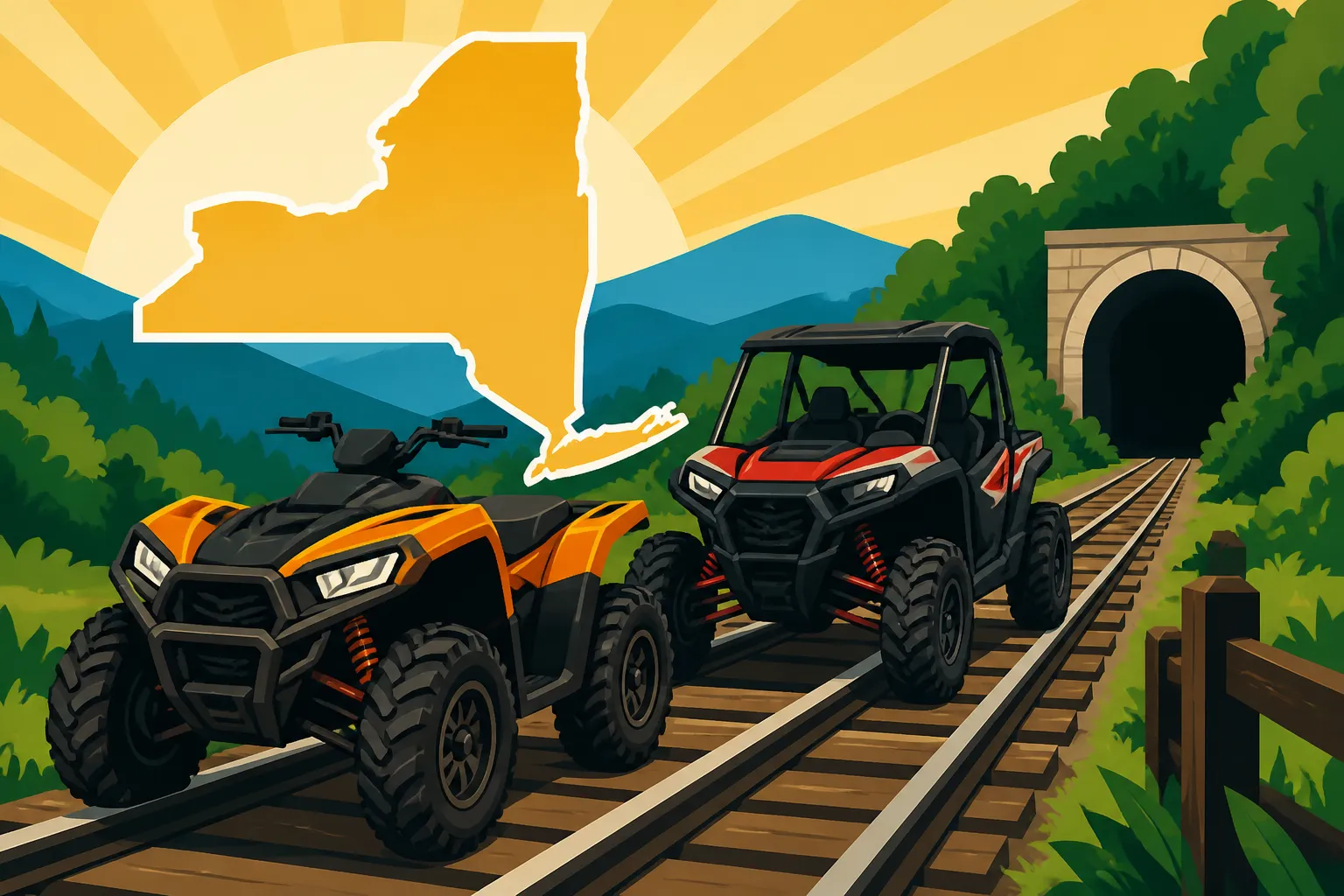
Rail Trails Open to New York Machines
A rail trail’s smooth surface and old railroad corridor can make it look like an easy ATV route, but the name does not tell you whether motorized riding is legal. In New York, access depends on who manages the trail, whether ATVs are specifically allowed, and what rules apply to your machine. Here’s how to check before you unload.
A rail trail is not automatically an ATV trail
“Rail trail” describes a route that follows or reuses a former railroad corridor. It does not mean the route is open to every kind of motor vehicle. Many rail trails are intended for walking, cycling, horseback riding, or other nonmotorized use. Some corridors may allow motorized access on particular sections, but that permission must come from the land manager or other authority responsible for the route.
That distinction matters in New York because a route can cross different kinds of land or be managed by different organizations along its length. A trail may appear continuous on a general map while its rules change at a town line, property boundary, or junction. Even when a rail corridor is open to some motor vehicles, the authorization might apply only to certain vehicles or users, not to ATVs as a category.
Do not rely on the trail’s name, surface, or the fact that you see tire tracks. Tracks are not proof of current permission. Nor is a nearby snowmobile trail, logging road, or road that ATVs may cross evidence that the rail trail itself is open. For the legal background, see New York Rules for Riding a Rail Trail and [New York Rules for Riding Public Land].
A useful starting rule is simple: unless the official trail information clearly allows your type of machine, treat the route as closed to ATV riding until you confirm otherwise. The same caution applies to UTVs and side-by-sides. A trail that allows a narrow ATV may still prohibit a wider or heavier machine, and a machine’s registration status does not grant access to a route.
How to verify whether a route allows your machine
Before planning a ride, identify the exact trail section and the body that manages it. A county, town, state agency, land trust, private landowner, or trail organization may control different parts of a corridor. Start with the official map or trail notice from the organization responsible for the section you want to ride. If the route crosses multiple jurisdictions, check each one rather than assuming the first section’s rules continue.
Look for an explicit statement that ATVs or the specific type of machine you own are allowed. General terms such as “multi-use,” “motorized,” or “recreational trail” can be too broad to settle the question. Find out whether access is limited by season, trail segment, machine dimensions, permit, membership, or another condition. If the posted information is unclear, contact the managing organization before riding.
| What to check | Why it matters |
|---|---|
| The exact trail section | Rules can change where management or ownership changes |
| Whether ATVs are expressly allowed | “Rail trail” or “multi-use” alone may not mean ATV access |
| Machine type and dimensions | Permission for one class of machine may not cover another |
| Permit or membership rules | Access may require more than vehicle registration |
| Seasonal dates and closures | A route may close temporarily or for part of the year |
| Road and land crossings | The trail’s rules do not automatically authorize adjoining roads or land |
| Current notices | Work, weather, landowner decisions, or other conditions can alter access |
A county or club map is useful, but check when it was issued and whether it identifies the route as open to the machine you plan to bring. A line on a map may show a trail corridor without showing every restriction. Trail markers on site also matter: follow closure signs, gates, and posted restrictions, even if an older map suggests the route is open.
If a trail requires a permit, confirm what that permit covers. A county trail pass may authorize use of specified trails in that county, not every rail trail in New York. A club membership may provide access to particular club-managed routes but not to public trails elsewhere. For the difference between local access rules and a statewide pass, see County Permits Instead of a State Sticker and New York Club Memberships and Trail Access.
Check for temporary closures shortly before leaving home. A route may be closed because of maintenance, wet conditions, a landowner’s decision, or another local restriction. If the trail manager posts updates online, check those notices on the day of the ride. New York Trail Closures to Check First can help you build that check into your trip planning.
Registration and reciprocity do not replace trail permission
New York ATV registration, trail permits, and permission to use a particular trail are separate things. Registration relates to the machine’s legal status under applicable rules. A local permit or membership may be required for access to a particular riding system. The land manager’s authorization determines whether you may ride that route. Having one does not automatically provide the others.
Before riding, confirm that your machine is eligible for the kind of registration and use you intend. New York’s rules distinguish ATVs from some larger or wider machines, so do not assume a vehicle commonly called a UTV can use ATV routes. Start with Why Most Side-by-Sides Cannot Be Registered in New York if you are bringing a side-by-side, and check the trail manager’s own machine restrictions as well.
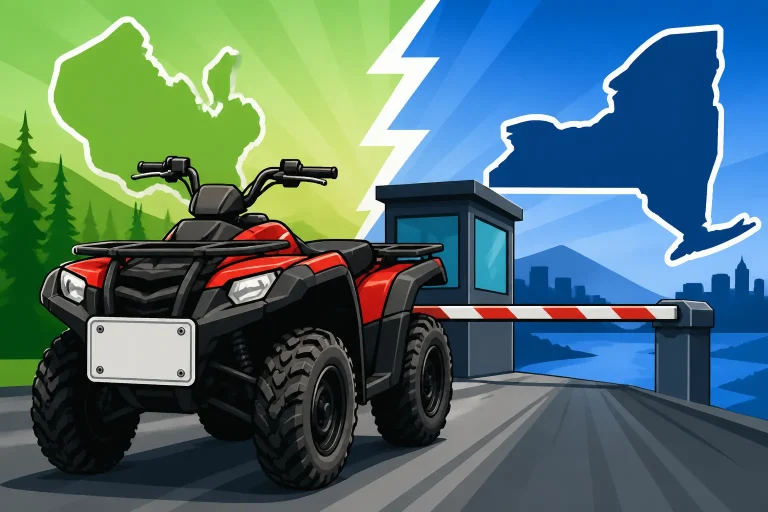
Out-of-state registration raises another question, but it does not change the route’s access rules. Reciprocity may affect whether New York recognizes a visitor’s registration for riding in the state. It does not turn a closed rail trail into an open one or waive a county permit. Visitors should carry their registration and confirm that their home-state documentation qualifies under New York’s rules. See New York Reciprocity for Out-of-State Registrations and [New York Rules for a Visiting Rider] for the visitor-specific details.
Treat each requirement as its own check:
- Confirm the machine’s status. Make sure it is properly registered for the riding you plan to do, and that its vehicle class is eligible.
- Confirm the trail is open to that machine. Verify the exact segment with its manager, not just a general trail map.
- Check permits or membership conditions. Find out whether a local pass, club membership, or other authorization is required.
- Check any additional operating rules. Look for seasonal limits, posted restrictions, equipment requirements, and rules for crossings.
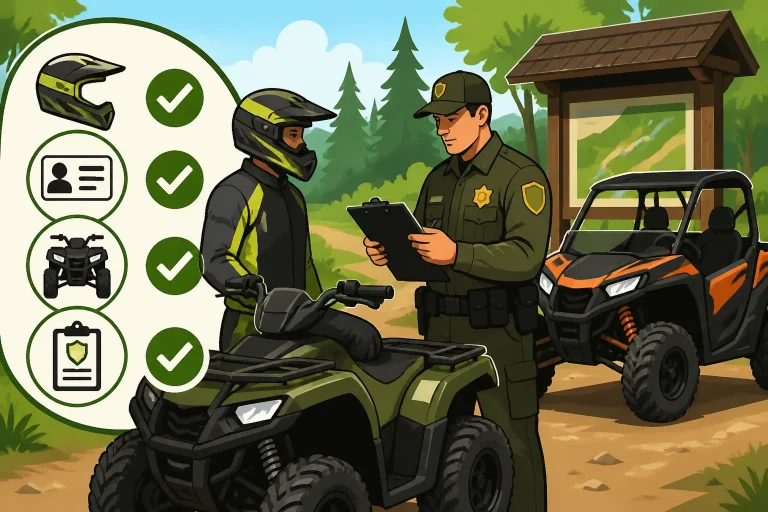
- Carry the required documents. Have your registration and any required permit or proof of membership available while riding.
A registration or permit should never be treated as blanket permission to ride on public land, private property, or a connecting road. If the rail trail ends at a road or another corridor, check that next section separately. The rules for crossing a road also differ from permission to travel along it. For snowmobile corridors and other neighboring routes, see New York Rules for Riding a Snowmobile Trail rather than assuming the rail-trail authorization applies.
Plan for uncertainty, crossings, and changes on the ground
When a trail’s status is unclear, the practical choice is to use a route that the responsible manager clearly identifies as open to your machine. Calling or emailing the manager can resolve questions that a map does not answer: whether a permit applies to visitors, whether a particular vehicle is excluded, or whether a segment is temporarily closed. Keep a note of the route and the conditions you verified, but follow newer posted instructions if they differ.
Pay attention to boundaries and access points during the ride. A rail corridor may pass close to private land, a village street, a parking area, or a nonmotorized section. Stay on the marked route and do not detour around a gate or closure. Permission to use one section does not grant permission to ride through adjoining private property or along an unapproved road.
It is also worth checking whether the trail permits travel in both directions and whether there are designated staging or parking areas. A route can be open to a class of vehicle but still have limits on where riders may enter, park, or turn around. If a trail notice identifies a particular access point, use it instead of creating a new route across nearby land.
For a visitor bringing a machine from another state, plan the paperwork and trail access separately. Confirm New York recognizes the registration, confirm that the policy and other required documents are in order, and then check any local permit and trail-specific conditions. Reciprocity addresses only one part of that process. The trail’s manager still decides whether the route is open to the machine.
The safest way to think about New York rail trails is to ask three questions in order: Is this machine properly registered for New York use? Is this exact trail segment open to this type of machine? Have I met the permit and local conditions for access? If you cannot confirm the second answer, do not ride the route until you have checked with the organization responsible for it. That extra call is simpler than discovering a closure or restriction after you arrive.
Disclaimer
This article is for general informational purposes only and does not constitute professional advice. Laws, prices and regulations vary by location and change over time. Consult a qualified professional for guidance on your specific situation.