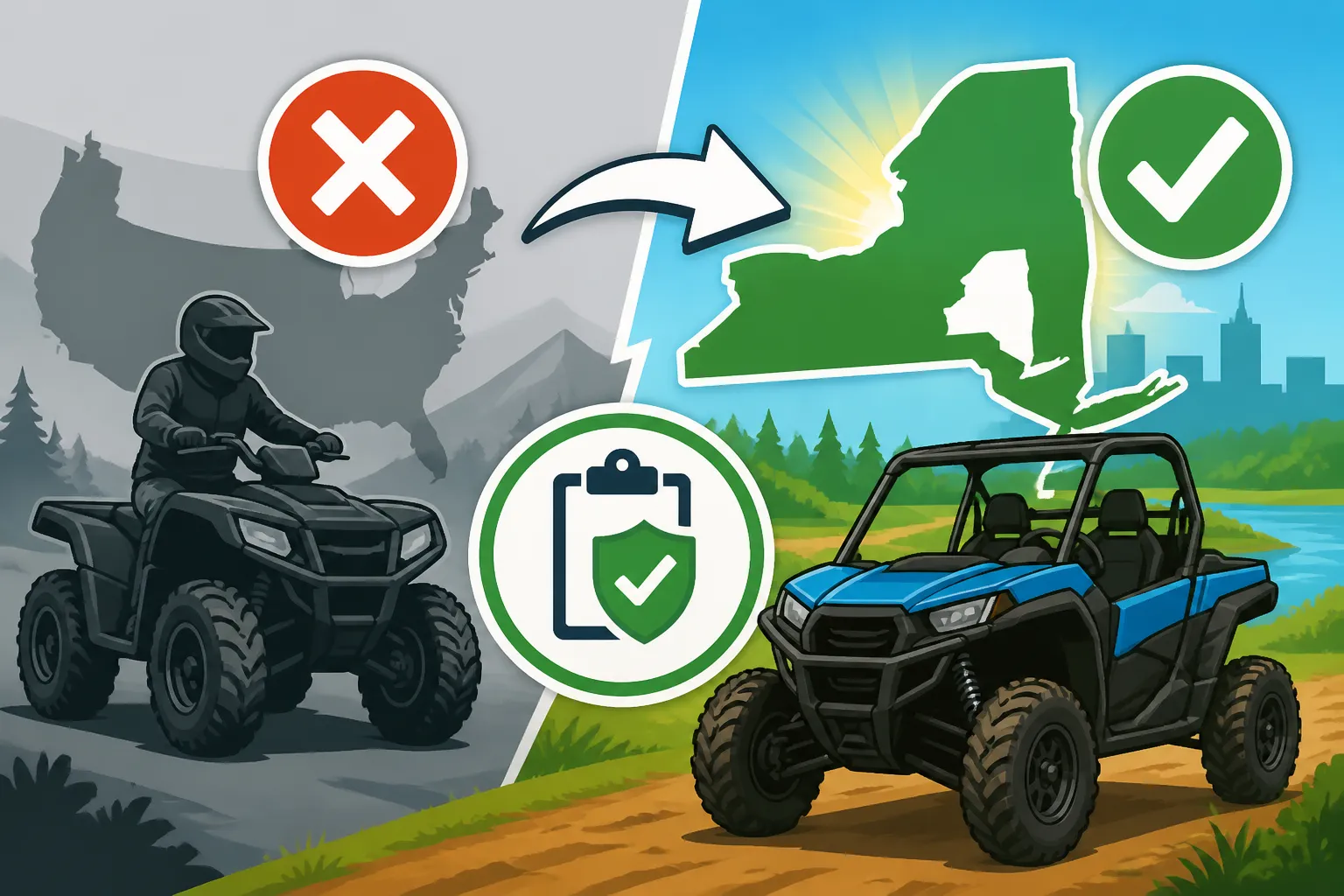
Why an Out-of-State Rider Must Register in New York
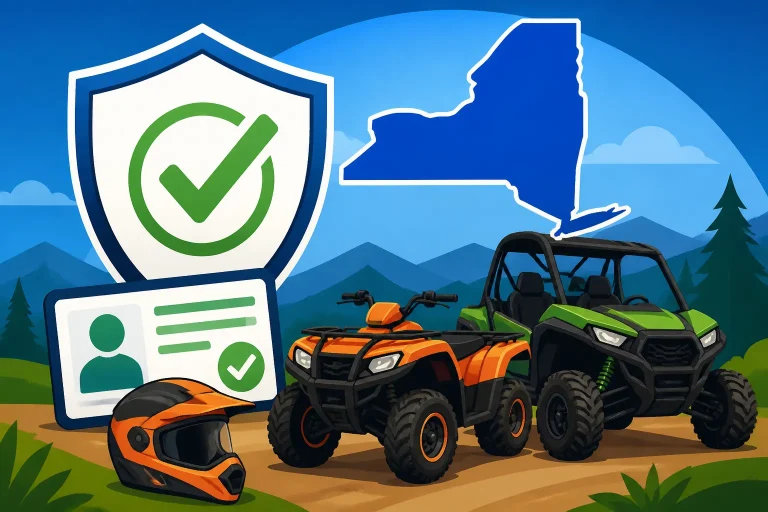
An out-of-state plate does not always let you ride an ATV in New York. The key question is whether your home jurisdiction registers the machine and whether your registration qualifies for New York reciprocity. Here’s how to tell when your existing registration may be enough, when you may need New York registration, and what else to check before riding.
Why New York May Require a Visitor to Register
New York generally requires an ATV operated in the state to be registered. For a visitor, however, the practical answer depends on the machine’s registration in its home jurisdiction. A valid out-of-state registration may be recognized under reciprocity; a rider whose machine lacks qualifying registration may need to register it in New York before operating it here.
That distinction matters because “I’m only visiting” is not, by itself, a substitute for registration. Nor does owning an ATV in a state with different rules automatically make the machine exempt once it crosses the New York border.
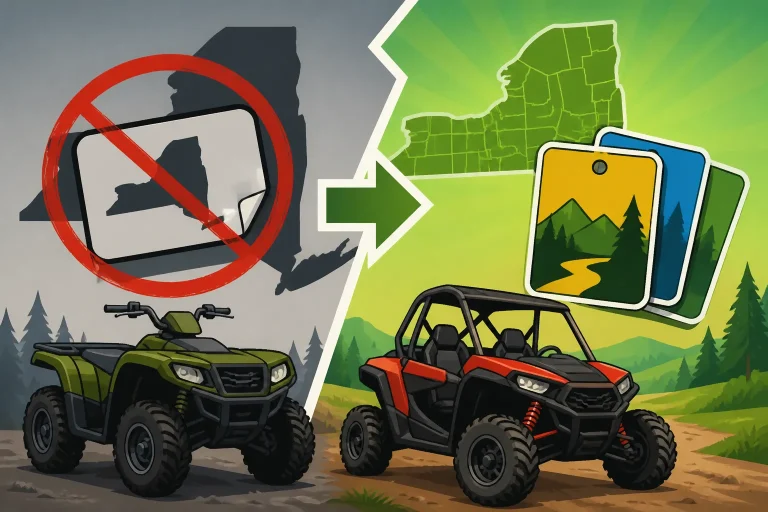
The usual starting point is whether your home jurisdiction requires ATV registration and whether your machine is currently registered there. If it does, carry the valid registration document and display the required plate or decal. If your jurisdiction does not require registration, or the machine is not registered when it should be, do not assume that the absence of a home-state requirement gives you a free pass in New York. You may need to obtain New York registration instead.
New York’s treatment of visitors is often summarized as reciprocity. In plain language, reciprocity can let a properly registered visitor use their home-state registration rather than obtain a second registration in New York. It is not a blanket exemption for every machine with an out-of-state address, old paperwork, or a plate that is no longer valid. The details of the home jurisdiction’s rules and the documents you carry matter. For more on the distinction, see New York Reciprocity for Out-of-State Registrations and Does New York Honor Another State’s ATV Registration?.
Keep in mind that the registration belongs to the machine, not to the rider. A New York resident and a visitor face different questions about which registration may qualify, but both need to make sure the machine is legally registered for the riding they plan to do. If you are lending or borrowing a quad, confirm that the registration is current and that the paperwork matches the machine.
The safest working rule is straightforward: if your ATV has a current registration from a jurisdiction that registers it, bring proof and check that it qualifies for use in New York. If it has no valid registration, resolve that before riding. New York registration requirements can apply even if the ride is short or the machine will be used only on a particular trail system.
When an Out-of-State Registration Is Enough
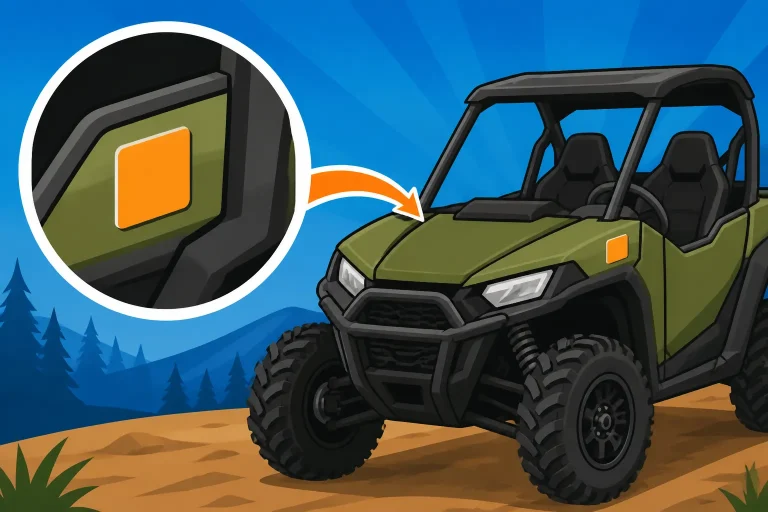
A visitor may be able to ride under a home-state registration when the machine is properly registered there and New York recognizes that registration through reciprocity. That does not mean you can leave the paperwork at home. Carry the registration document, keep the machine’s plate or other required display in place, and make sure the registration has not expired.
Check the details rather than relying on the appearance of the machine. A plate attached to the ATV does not prove that the registration is current. Likewise, a receipt, bill of sale, or insurance card is not necessarily a substitute for the registration document. Bring the actual document your home jurisdiction issued, or a valid official version if your jurisdiction provides one.
Before a trip, verify the following:
- The registration is current for the dates you plan to ride.
- The registration identifies the machine you are bringing.
- The required plate, decal, or other display is on the machine and readable.
- You have the registration document with you while riding.
- You have any insurance proof required for your trip.
If you are not sure whether your registration will be accepted, check with the New York DMV or another appropriate official source before you travel. Confirm the rule for your machine and home jurisdiction, rather than relying on another rider’s experience. Rules can differ between jurisdictions, and a friend’s registration status may not match yours.
An out-of-state registration also does not turn an ATV into a street-legal vehicle in New York. Registration is one requirement; it does not grant general permission to ride public roads, enter private land, or use a trail that is closed to ATVs. Check the specific access rules where you plan to ride.
Visitors sometimes confuse registration reciprocity with trail-permit reciprocity. They are separate questions. Your home-state registration may satisfy the machine-registration requirement, while a county or private trail system may still require its own permit, membership, or other access condition. New York does not offer one statewide trail pass that automatically covers every riding area. For a broader overview, see Do You Need a Trail Permit in New York? and New York Rules for a Visiting Rider.
When You Need New York Registration Before Riding
The clearest situation is a machine that does not have valid registration from its home jurisdiction. If the ATV is unregistered, the registration has expired, or the home jurisdiction does not issue ATV registrations that qualify for reciprocity, you should not assume you can ride it in New York without further steps.
A state or province that does not require ATV registration creates a common point of confusion. The owner may think, “My home state doesn’t require a plate, so I don’t need one anywhere.” That conclusion does not necessarily work in New York. If the home jurisdiction does not provide a qualifying registration, the visitor may need to register the ATV in New York to operate it here. For the specific no-plate scenario, see What a Visitor Does When Their State Issues No Plate.
You may also need to address New York registration if your home registration is no longer valid or does not match the ATV you brought. A registration document for a different machine, a previous owner’s paperwork, or a plate that was never transferred properly may not establish that the ATV is currently registered to you. If the seller never registered the machine, a bill of sale alone may not resolve every ownership or registration issue. See New York ATV Registration Paperwork for an overview of the documents involved.
If New York registration is needed, do not wait until you arrive at a trailhead to investigate. First gather the ownership records and identify the machine’s vehicle identification number. New York registration paperwork for a non-titled ATV can involve proof of ownership and other supporting documents; the exact documents depend on how you acquired the machine and its history. A missing title is not always the end of the process, but it can mean you need to establish ownership through acceptable records. Details are covered in Registering Here Before You Ride.
Before submitting an application, check current New York DMV instructions for your circumstances. Requirements can differ for a machine bought from a dealer, purchased privately, brought from another jurisdiction, inherited, or acquired without a complete paper trail. Do not assume that the process for a newly purchased ATV applies to a used machine with uncertain registration history. The DMV’s current requirements are the place to confirm forms, acceptable ownership evidence, and where to submit an application.
Plan enough time to resolve paperwork before riding. An application receipt or a pending registration may not give you the same rights as an issued, valid registration. If the paperwork is incomplete, ask what is missing and whether you may operate the ATV while the application is being processed. Do not treat silence, a seller’s assurance, or a temporary lack of enforcement as permission.
Registration Does Not Replace Insurance, Permits, or Access Permission
Registration answers one question: whether the ATV meets the applicable registration requirement. It does not settle every rule that applies to a ride. Visitors should treat registration, insurance, trail permits, rider requirements, and permission to use land as separate checks.
Insurance
New York has ATV insurance requirements that can apply to visitors as well as residents. Do not assume your out-of-state registration proves that you have the insurance New York requires. Check that your policy covers the machine and the planned use, and carry proof that you can show if asked. If you are uncertain whether your policy meets New York’s requirements, ask the insurer and verify the applicable rule before riding. See New York ATV Insurance Requirement.
Some riders carry proof of insurance in a phone app, while others keep a printed card with the registration. Either way, make sure you can access it in a place with limited cell coverage. A ride in a remote area is a poor time to discover that the document is missing or the app requires a connection.
Trail permits and local access rules
A valid registration does not necessarily buy access to a trail. New York riding areas may have county-specific permits, club membership conditions, seasonal rules, or limits on which routes a permit covers. A permit for one system should not be assumed to work in another. Verify requirements directly with the county, trail operator, or club that manages the route.
Ask practical questions before you load the ATV:
- Is this trail open to visitors with my type of machine?
- Does the system require a separate permit or membership?
- Does the permit cover the whole route, or only certain sections?
- Are there age, supervision, or equipment requirements for the rider?
- Is the route open on the date I plan to ride?
A trail can also close temporarily because of weather, landowner concerns, maintenance, or seasonal conditions. A permit does not override a closure. Check current local notices before setting out, and follow posted signs and instructions at the trailhead.
Permission to ride
Registration is not permission to ride on private property. You need the landowner’s permission where required, and you must stay on routes that are open to ATVs. A trail shown on an old map, a tire track through a field, or a route a friend rode last year is not proof that access is currently allowed.
Public land has its own rules as well. Do not assume that a road or trail is open to ATVs just because it is open to other motor vehicles or appears on a general recreation map. Check the managing agency’s current rules and any local signs.
The same principle applies to road use. Registering an ATV does not make ordinary public roads available for general riding. Where a road may be used or crossed, follow the rules that apply to that specific road and location. In short, a valid registration is necessary where required, but it is only one part of a lawful trip.
How to Check Before You Cross the State Line
A short pre-trip check can prevent a costly or frustrating surprise. Start with the machine’s paperwork, then confirm the rules for the place where you intend to ride. If an answer is uncertain, ask an official source rather than relying on an informal online discussion.
- Check the home registration. Confirm whether your home jurisdiction requires ATV registration and whether yours is current. Make sure the paperwork matches the ATV you are bringing.
- Ask whether New York recognizes it. Confirm that your specific registration qualifies for use in New York under the applicable reciprocity rules. If your home jurisdiction does not issue ATV registrations, ask whether New York registration is required.
- Confirm insurance. Check that the policy covers your ATV and the intended use in New York. Carry proof of coverage.
- Check the riding area. Contact the county, trail operator, or club to confirm permits, access, seasonal closures, and machine restrictions.
- Review rider requirements. Check age, supervision, helmet, passenger, and equipment rules for the trip. A visitor’s home rules do not necessarily replace New York requirements.
- Carry the documents. Bring registration and insurance proof, plus any permit or other document the trail system requires.
When you contact an agency or trail operator, describe the situation precisely. Give the machine’s home jurisdiction, whether it has a current registration, and the type of route you plan to ride. “Can I bring my ATV?” may not produce a useful answer if the real question is whether a machine with no home-state registration needs New York registration or whether a particular county trail requires a separate permit.
If you are buying an ATV shortly before a trip, check registration eligibility before paying. Ask the seller what paperwork will be provided and compare the machine’s identification number with the documents. A low price can become a poor deal if you cannot establish ownership or register the ATV for the riding you intend. Buying from another state does not, by itself, guarantee that the machine’s paperwork will meet New York requirements.
For a visitor, the practical bottom line is: bring a current qualifying registration if your home jurisdiction registers the ATV; if it does not, or the machine is not properly registered, confirm and complete any required New York registration before riding. Then check insurance and the rules for the specific trail or property. Those are separate steps, and completing only one does not satisfy the others.
Frequently Asked Questions
Does every out-of-state ATV need New York registration?
No. A visitor with a valid home-jurisdiction registration that New York recognizes through reciprocity may be able to ride using that registration. A machine without qualifying registration may need New York registration.
What if my home state does not require ATV registration?
Do not assume that this exempts the ATV in New York. Confirm whether you need to register it in New York before operating it here.
Does my out-of-state registration include a New York trail permit?
No. Registration and trail access are separate. A county or trail system may require its own permit or membership.
Should I carry the registration document while riding?
Yes. Carry proof of the machine’s current registration and the insurance proof required for your ride. A plate on the ATV may not be enough to answer questions about its status.
Disclaimer
This article is for general informational purposes only and does not constitute professional advice. Laws, prices and regulations vary by location and change over time. Consult a qualified professional for guidance on your specific situation.