Riding New York With an Out-of-State Plate
An out-of-state ATV plate can make a New York ride possible without getting a New York registration, but it does not replace every local requirement. Visitors need to understand what reciprocity covers, when insurance is required, and whether a trail system requires its own permit. The key is to treat registration, insurance and trail access as separate checks before unloading.
What an Out-of-State Plate Allows in New York
New York generally allows a nonresident to operate an ATV that is properly registered in another state. The out-of-state registration is the basis for reciprocity; it does not turn the machine into a New York-registered ATV or grant unrestricted access to trails, roads or public land.
Bring the current registration document, and make sure the machine displays its plate as required by its home jurisdiction. Keep the paperwork with the machine or with the rider who is operating it. A plate by itself may not be enough to show that the registration is valid, especially if the document is expired, belongs to another machine or is difficult to match to the vehicle identification number.
The general rule is intended for visitors whose home state registration is valid. It is not a reliable workaround for a New York resident who has left a machine registered elsewhere. If you live in New York, check whether the machine must be registered here before you ride. Residency, ownership and the machine’s registration status can affect the answer. See New York Reciprocity for Out-of-State Registrations for the distinction between a visitor’s registration and New York’s own registration requirements.
| What you have | What it may cover | What it does not automatically cover |
|---|---|---|
| Valid out-of-state registration | Registration reciprocity for a nonresident riding in New York | New York insurance requirements, trail permits or permission to ride a particular route |
| Out-of-state plate | Display of the machine’s home-state registration, according to that state’s rules | Permission to use a New York road or public trail |
| Proof of insurance | Evidence of financial responsibility, if the policy meets New York requirements | Trail access, registration or landowner permission |
| County or club trail permit | Access to the specific trail system covered by that permit | Other counties’ trails, closed routes or roads that are not designated for ATVs |
Reciprocity is easiest to apply when the machine is registered in the visitor’s own name and the registration is current. If you borrowed the ATV, are riding a machine registered to a relative, or are bringing a company-owned machine, carry clear proof that you are authorized to use it. Do not assume that a bill of sale, an old registration card or a photograph of a plate substitutes for current registration.
If your home state does not require ATV registration, do not assume that New York treats an unregistered machine as registered. Rules vary, and the exception for a nonresident with a valid out-of-state registration may not help if no registration exists. Confirm the correct procedure with the New York DMV before traveling; in some cases, getting a New York registration may be necessary. The overview in Does New York Honor an Out-of-State Registration? can help you identify the issue to verify.
What Reciprocity Does Not Replace
A valid out-of-state plate is only one part of the ride. It does not make every trail open to you, and it does not waive New York’s rules for insurance, equipment, helmets, passengers or riding locations.
Insurance is a separate check
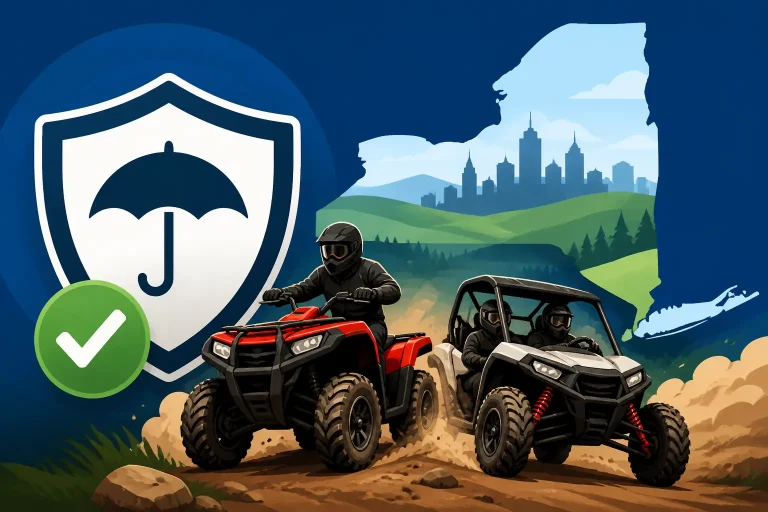
New York generally requires ATV liability insurance when a machine is operated away from its owner’s property, subject to the state’s rules and exceptions. Visitors should check that their policy covers the ATV while it is being operated in New York and that the coverage meets New York’s requirements. A policy issued in another state should not be assumed to qualify just because it covers the machine at home.
Carry proof of insurance while riding. Check the document for the insured machine, policy dates and named insured, and ask the insurer directly whether the policy meets New York’s requirements for ATV use. If the machine is borrowed, confirm that the policy covers the person riding it and the planned use. The details are covered in New York’s Mandatory ATV Insurance and Insurance a Visitor Must Still Carry.
Insurance rules may depend on where the ATV is being operated. Riding solely on the owner’s property can be treated differently from riding on a trail or other land. A visitor using a friend’s property should not assume that permission to ride there settles the insurance question; verify the applicable exception and the policy terms.
A county permit may still be required
New York does not issue one statewide trail pass that opens every ATV route. Counties, clubs and private trail systems may set their own access conditions. A trail permit may be required even when your ATV has a valid out-of-state registration, and one county’s permit may not work in another county.
Before you travel, identify the trail system you plan to ride and check its current permit rules, season dates, open routes and access conditions. Some routes are available only through a club or under a landowner agreement. A club membership may provide access to particular trails, but it is not automatically a permit for every system. County Permits Instead of a State Sticker explains why registration and trail access are separate, while New York Club Memberships and Trail Access can help you understand the role of clubs.
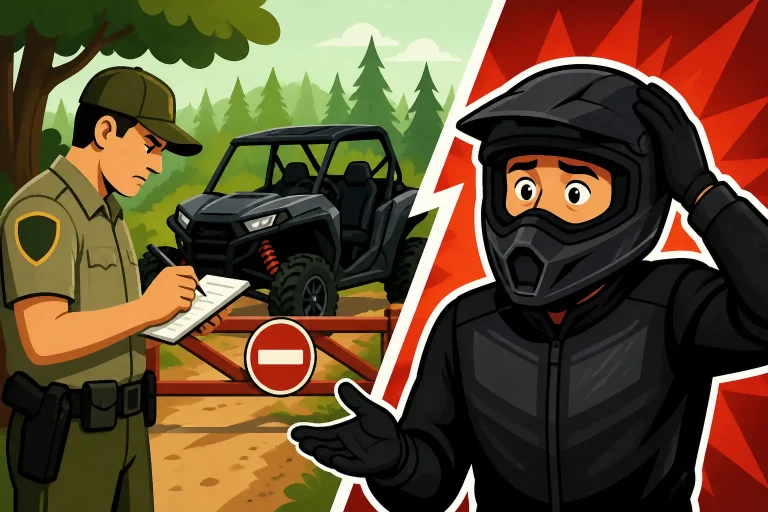
Do not treat a permit as permission to ride anywhere in the area. Stay on routes open to ATVs, follow posted signs and respect gates and closures. Trails can close because of weather, landowner decisions, maintenance or seasonal conditions. Check New York Trail Conditions Before You Ride shortly before departure rather than relying only on an old map or a previous visit.
Road access and public land have their own rules
An ATV plate does not make a machine street legal in New York. Riding on a public road is generally restricted unless the road or section is specifically designated and posted for ATV use, or a narrow exception applies. A road that looks quiet, unpaved or locally maintained is not necessarily open to ATVs. Do not use a road as a connector unless you have confirmed that it is authorized.
The same principle applies to public land. A trail, forest road or park area is not open simply because motor vehicles are present nearby. Check the land manager’s rules and follow posted access restrictions. Private land requires permission from the landowner; a trail map or county boundary does not grant permission to leave the authorized route.
Visitors should also review New York’s safety and operating rules before riding. Helmet, equipment and passenger requirements apply independently of where the ATV is registered. If a young rider is coming along, check the age, supervision and safety-certificate rules that apply in New York. An out-of-state registration does not create an exemption from those requirements. See New York Rules for a Visiting Rider and Does New York Accept an Out-of-State Safety Certificate?.
Prepare Before Bringing an Out-of-State ATV
A few checks before leaving home can prevent a long drive to a closed trail or a problem at a roadside stop.
- Confirm who counts as the visitor. If you live outside New York, check that your situation fits the nonresident reciprocity rule. If you live in New York or recently moved, ask whether New York registration is required instead.
- Check the registration. Make sure it is current, applies to the ATV you are bringing and can be matched to the machine. Carry the registration document, not only a photo of the plate.
- Confirm insurance for New York use. Ask the insurer whether the policy covers ATV operation in New York and meets the state’s requirements. Carry proof while riding.
- Choose a specific trail system. Verify its permit requirements, open dates, route restrictions and any membership conditions. Do not assume a permit from one county covers another.
- Check the machine and rider rules. Review helmet, equipment, passenger and youth requirements. Confirm the ATV is suitable for the permitted routes and comply with any trail-specific restrictions.
- Plan legal connections. If reaching the trail requires a road crossing or road travel, confirm exactly where ATV use is allowed. Do not improvise a route across a shoulder, road or adjoining property.
- Recheck conditions before you go. A route that was open last season may be closed now. Look for recent notices and obey signs at the trailhead.
At the trailhead, keep registration and insurance documents accessible, and have any required trail permit ready. Make sure the plate is visible and attached as required by the home state. If an officer or trail official asks to see documents, clear, current paperwork makes it easier to establish that the machine is registered and insured.
For a borrowed ATV, carry the owner’s contact details and written permission if practical. For a machine registered to a business or family member, make sure the documents connect the registration to that ATV and that the policy covers the actual rider. These extra steps do not replace legal requirements, but they can help resolve ordinary questions about authorization and coverage.
Common Visitor Situations
The machine is registered in a neighboring state
A current registration from another state may qualify a nonresident for reciprocity, but you still need to follow New York insurance and riding rules. Check the specific trail system for its permit requirements. A plate that is accepted for registration purposes does not make a county trail permit unnecessary.
The home state does not issue ATV registrations
This is a situation to resolve before travel, not at the trailhead. If your home state does not require registration or does not issue a document that New York recognizes, do not assume that a homemade plate, bill of sale or insurance card will substitute. Ask the New York DMV whether you need to register the machine in New York before operating it.
The rider lives in New York but the ATV has an out-of-state plate
Do not rely on visitor reciprocity without checking. The rule for a nonresident may not apply to a New York resident, even if the machine was bought or previously registered elsewhere. Confirm the registration obligation with the DMV before riding.
The ATV is borrowed or registered to someone else
Bring the registration and confirm that the owner’s insurance covers the rider and the planned New York use. If the owner is not traveling with you, written permission can help demonstrate that you have authority to use the machine. It does not, on its own, satisfy registration, insurance or trail-permit requirements.
You have a plate but no trail permit
You may have met the registration requirement and still be unable to ride the route you came for. Contact the county, club or trail operator for the system’s permit process and current access conditions. Do not ride onto a trail on the assumption that you can buy a permit later or that the registration plate acts as a pass.
The practical rule is simple: treat the out-of-state plate as proof of registration status, not as an all-access pass. Confirm your eligibility for reciprocity, carry appropriate insurance, obtain any required trail permit and ride only where ATVs are allowed. When any one of those points is unclear, check with the relevant New York agency or trail operator before the trip.
Disclaimer
This article is for general informational purposes only and does not constitute professional advice. Laws, prices and regulations vary by location and change over time. Consult a qualified professional for guidance on your specific situation.