New York Reciprocity With Ontario
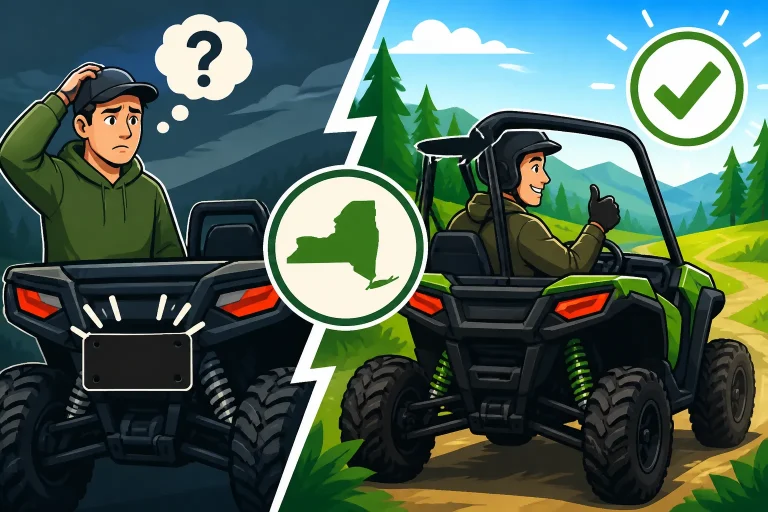
An Ontario ATV registration does not automatically answer every question about riding in New York. Reciprocity may let a properly registered Ontario machine operate there, but insurance, road rules and trail access are separate issues. Before crossing the border, check that your documents qualify, understand where you may ride, and confirm any local permit requirements.
Does New York recognize an Ontario ATV registration?
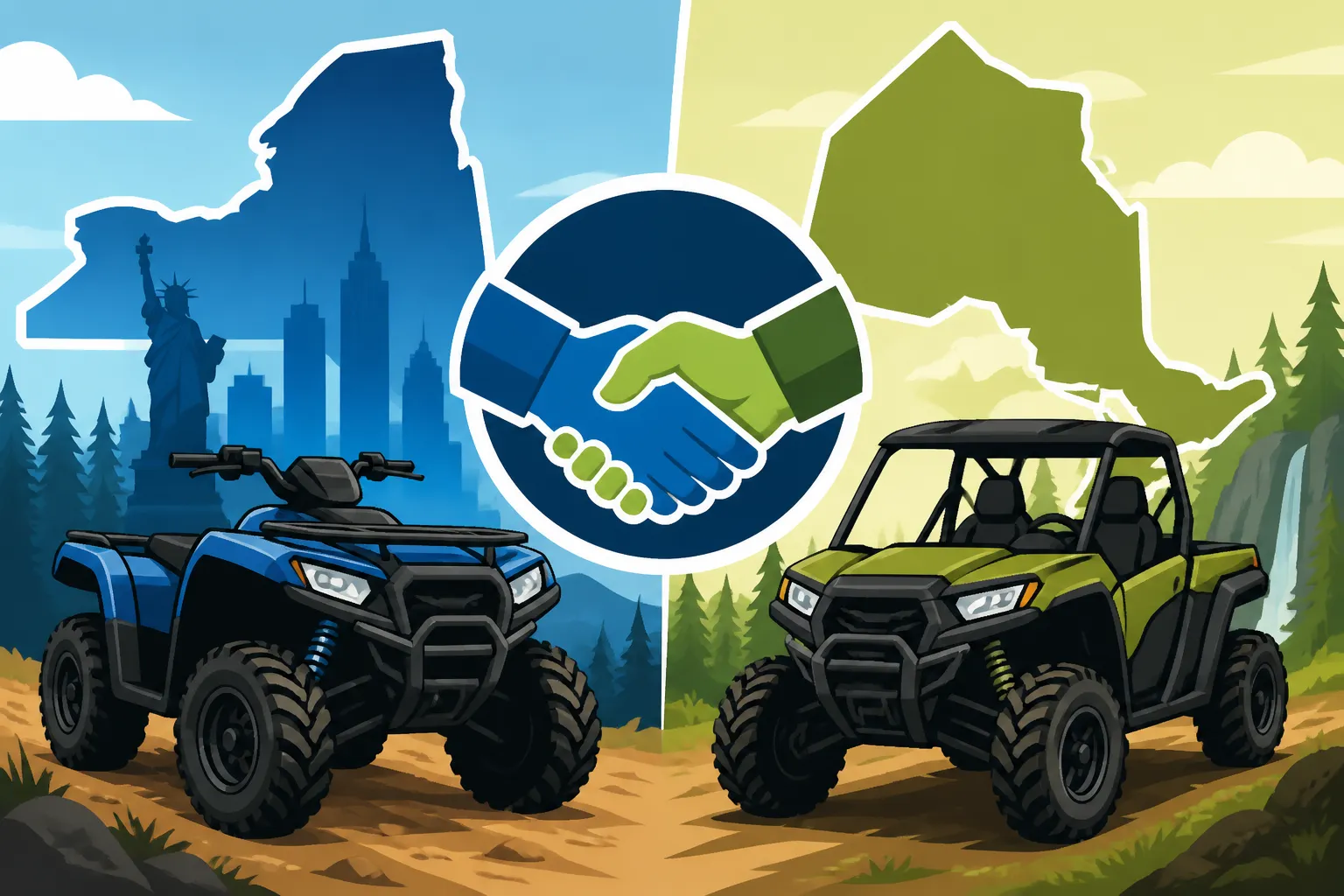
New York’s reciprocity rules can allow a nonresident to operate an ATV registered outside the state, provided the registration is valid and the other jurisdiction grants comparable privileges to New York residents. Ontario is a different jurisdiction from a U.S. state, so it is sensible to confirm that your particular Ontario registration qualifies before relying on reciprocity.
The practical answer is that an Ontario-registered ATV may be eligible to ride in New York without first obtaining a New York registration, but eligibility depends on valid registration and the applicable reciprocity rule. A plate by itself is not a guarantee: the registration must belong to the machine, remain current and satisfy the requirements that apply to your situation.
For more background on the general rule, see New York Reciprocity for Out-of-State Registrations and Does New York Honor Out-of-State Registration?. If you are bringing the machine from Ontario specifically, Bringing an Ontario-Plated Quad Across the Border covers the cross-border angle.
Before you travel, confirm the current requirements with the New York DMV and the Ontario authority responsible for your off-road vehicle registration. Ask a specific question: whether a machine registered in Ontario, with the documents you hold, may be operated in New York under reciprocity. If your paperwork is unusual, explain that too. A machine registered to a business, a recently purchased quad, or one with an expired permit may raise questions that a standard registration does not.
Keep the distinction clear:
- Registration identifies the machine for legal operation under the applicable registration rules.
- Reciprocity may let a nonresident use a valid registration issued elsewhere instead of registering the ATV in New York.
- Trail access is controlled separately. A valid Ontario registration does not, by itself, give you permission to ride every New York trail.
- Insurance is a separate requirement. An Ontario registration does not prove that you carry coverage New York requires.
- Border and transport requirements are separate from permission to operate on New York trails or roads.
That separation is the key to planning. A visitor can have a properly registered quad and still be unable to ride a particular trail because it is closed, requires a local permit, or is not open to ATVs.
What to carry and confirm before you cross
Bring documents that let you show both who you are and that the machine is lawfully registered. Requirements can differ depending on how the ATV is owned and registered, so check the documents issued for your machine rather than assuming a plate will answer every question.
A useful travel folder includes:
| Item | What it helps establish | What to check |
|---|---|---|
| Ontario registration document | The ATV is registered in Ontario | The machine details match and the registration is current |
| Ontario plate or identifying mark | The machine displays its registration identification | It is attached as required and can be read |
| Proof of ownership or purchase paperwork | You own the machine or have authority to use it | Names and identifying details are consistent |
| Insurance card or policy evidence | The machine has applicable insurance coverage | The policy covers the ATV and the planned use in New York |
| Photo identification | Your identity and, where relevant, residency | The name matches the registration or permission documents |
| Trail permit or membership evidence | You have access to a particular trail system | It covers the machine, rider and dates of travel |
Keep the registration document with you while riding, not buried in luggage at your lodging or in a vehicle parked far from the trail. Store a secure copy separately in case the original is lost, but do not assume a photograph will replace the official document if an officer or trail operator asks to see it.
If you borrowed the ATV, carry written permission from its owner and make sure the registration and insurance arrangements cover your use. If you recently bought it, take the bill of sale and any registration transfer documents. A plate attached to a machine does not establish that the seller completed a transfer or that the registration is still valid. The ownership issues are similar to those discussed in New York Rules for a Visiting Rider and New York ATV Proof of Ownership Requirements.
Insurance deserves a separate check. Ask your insurer whether the policy covers operation in New York, including the type of land and riding you intend to do. Do not infer coverage from a policy that insures the ATV in Ontario; territorial limits, exclusions and permitted uses may matter. New York’s insurance rules apply to visiting riders as well as residents in situations where coverage is required. See Insurance a Visitor Must Still Carry and New York ATV Insurance Requirement.
If you are unsure whether your policy meets New York requirements, ask the insurer for a clear answer in writing. A general statement that the ATV is “insured” may not answer whether the liability coverage satisfies New York’s requirements or applies to the intended ride. Carry proof in a form you can access while riding.
Also confirm that the machine itself fits the kind of riding you plan to do. New York’s ATV definition and registration rules do not necessarily treat every side-by-side or utility vehicle as an ATV. An Ontario registration does not change New York’s classification of the machine. If the vehicle is a UTV or a wide side-by-side, check the New York rules before planning a trail trip; New York UTV Registration Rules explains why the classification can matter.
Registration does not provide trail access
Reciprocity concerns whether an out-of-state or foreign registration can satisfy New York’s registration requirement. It does not grant access to public land, private trails or a county trail network.
New York does not have one universal trail permit that opens every riding area. Access rules depend on the landowner and the trail system. Some routes may require a county permit, club membership, or another authorization; some are open only during certain dates or when conditions allow. Others are closed to ATVs altogether. A permit for one system should not be assumed to work in another.
Before loading the ATV, identify the exact trail system and check its current rules directly. Confirm:
- Whether ATVs are allowed on the route.
- Whether Ontario-registered machines are accepted.
- Whether a local permit or club membership is required.
- Whether the permit applies to the machine, the rider or both.
- Whether the trails are open on your planned dates.
- Whether there are restrictions on machine width, passengers, hours or direction of travel.
- Where you may park and unload.
New York ATV Trail Permits Explained is a useful starting point for understanding why local trail access is separate from registration. For public land, consult [New York Rules for Riding Public Land]. Private club trails may have their own membership and permit conditions, so do not treat a county’s rules as universal.
Even when a route is open, follow posted signs and landowner restrictions. A mapped trail can change, close temporarily or be rerouted. Check for recent notices before you leave, especially after bad weather, during seasonal closures or where a trail crosses working land. New York Trail Closures to Check First and New York Trail Conditions Before You Ride can help you plan those checks.
Road use is another separate issue. An ATV registration, whether from Ontario or New York, does not make the vehicle generally street legal in New York. Rules for using or crossing a public road are limited and depend on the road and local designation. Do not ride on a road simply because it connects two trail sections or because the ATV may be used on roads in another jurisdiction. Review New York Rules for Crossing a Public Road and New York Roads Designated for ATVs before your trip.
New York’s operating rules apply to visitors while they are in the state. That includes applicable requirements for helmets, passengers, equipment, insurance and riding location. Ontario rules do not replace New York rules once you are riding in New York. A route that is permitted in Ontario may be restricted in New York, and a machine configuration allowed at home may not meet New York’s requirements.
A practical pre-trip checklist
Use this sequence before leaving Ontario. It helps separate border preparation from the different question of whether a New York trail is open to you.
- Confirm the ATV’s registration is current. Match the machine’s identifying details to the Ontario registration document. Resolve any mismatch, transfer or renewal issue before travel.
- Verify reciprocity. Contact the New York DMV and confirm that your Ontario registration and circumstances qualify. If you have a nonstandard ownership or registration situation, describe it clearly.
- Check insurance coverage. Ask your insurer whether the policy applies in New York and covers the planned use. Carry proof that you can show while riding.
- Identify the exact riding area. Check its official trail information, not just a general map or an old post. Verify the system accepts your machine and registration.
- Arrange any required trail authorization. Buy the correct permit or confirm membership eligibility before arrival. A state registration does not substitute for a trail permit.
- Review New York operating rules. Check rules for helmets, passengers, equipment, road crossings, age and riding location. Plan a route that stays within them.
- Prepare ownership and permission documents. If the ATV is borrowed, recently purchased or registered to someone else, carry documents showing you may use it.
- Recheck conditions before departure. Closures, weather, landowner decisions and trail conditions can change. Verify access close to the day you ride.
If you cannot confirm reciprocity, avoid riding on the assumption that the Ontario plate is enough. Ask the New York DMV whether you need New York registration for your circumstances and how to apply. Some machines may not qualify for ordinary New York registration, so do not assume that registering locally is an easy fallback. Registering an Out-of-State Machine in New York explains why the machine’s classification and paperwork can affect that option.
If you are stopped while riding, remain calm and provide the documents requested. A clear registration document, insurance proof and any trail authorization make it easier to explain why you and the ATV are there. If a trail operator says a permit is required, registration reciprocity is not a reason to bypass that rule. If an officer questions whether your Ontario registration qualifies, cooperate and resolve the issue through the appropriate official channel rather than continuing to ride on an uncertain assumption.
The simplest approach is to treat reciprocity as one part of trip planning, not as a blanket permission. Verify the registration, confirm insurance, secure access to the specific trail and follow New York’s operating rules. That avoids the common mistake of crossing with valid Ontario paperwork but no authorization for the ride itself.
Disclaimer
This article is for general informational purposes only and does not constitute professional advice. Laws, prices and regulations vary by location and change over time. Consult a qualified professional for guidance on your specific situation.