Riding a Club Trail on a Vermont Registration
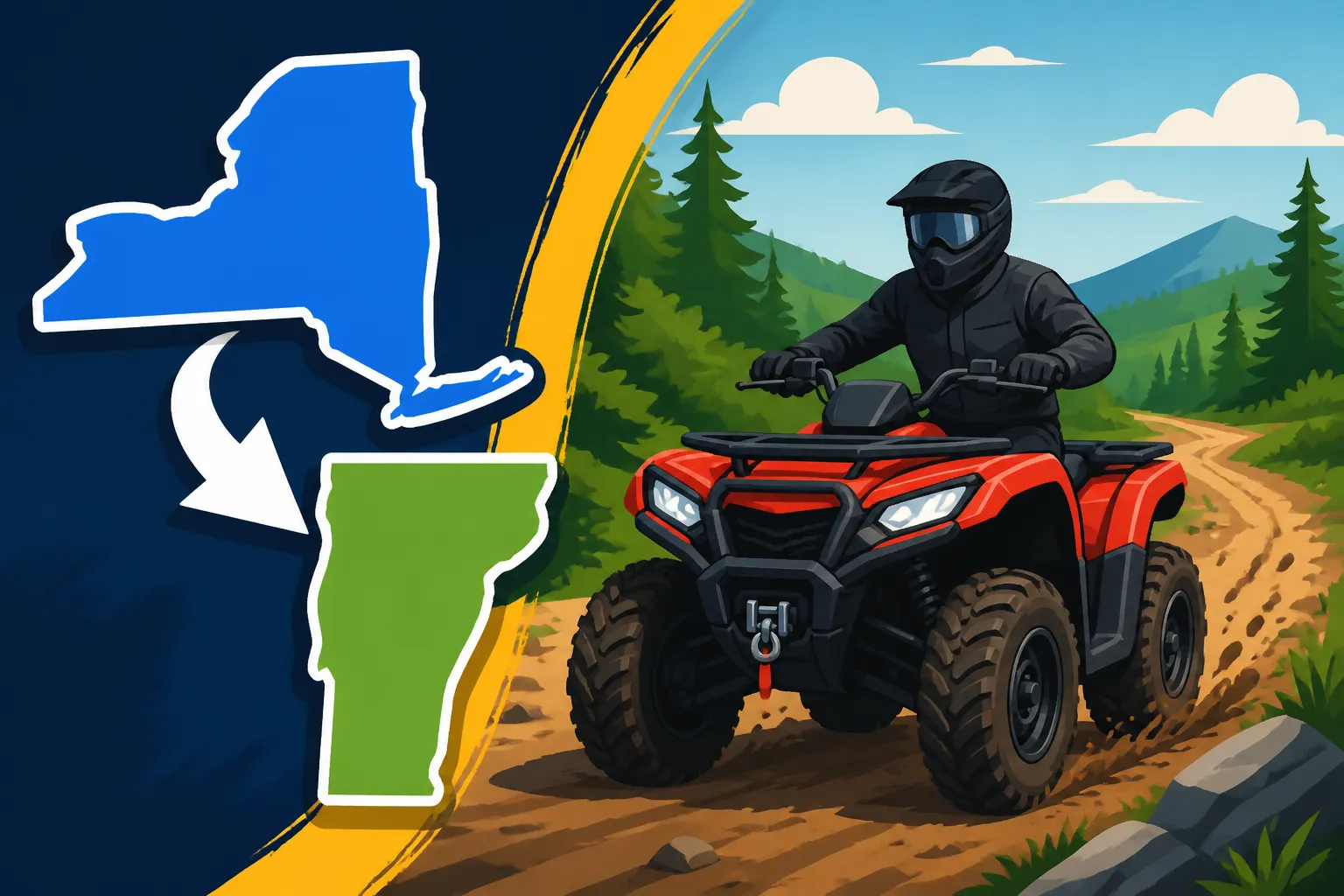
A Vermont registration can solve one important part of riding in New York: the state generally recognizes a valid ATV registration issued elsewhere. It does not, by itself, guarantee access to a particular club trail. Before hauling your machine across the border, confirm that its registration is valid, the trail allows your machine and visitors, and you have the required insurance and documents.
What a Vermont registration means in New York
According to the New York State Department of Motor Vehicles, New York honors valid out-of-state ATV registrations. That means a rider whose ATV is properly registered in Vermont generally does not need a separate New York registration just to operate it in the state.
The key word is valid. Carry the registration document while riding; the Department of Motor Vehicles requires ATV operators to have it with them. Check that the document matches the machine and that the registration has not expired. If Vermont does not require registration for your machine, New York’s exception works differently: the Department of Motor Vehicles says you must obtain a New York ATV registration before operating it in New York.
For a fuller explanation of how out-of-state plates are treated, see New York Reciprocity for Out-of-State Registrations and Does New York Honor Another State’s ATV Registration?. The practical distinction is that reciprocity concerns registration recognition. It does not decide whether a landowner, club, or trail operator allows you to ride a route.
A Vermont plate also does not change New York’s definition of an ATV. The New York State Department of Motor Vehicles defines an ATV as a self-propelled vehicle manufactured for off-highway use, no wider than 70 inches and weighing no more than 1,000 pounds. If your machine is wider or heavier, don’t assume a Vermont registration makes it eligible to ride New York trails. Check how New York classifies the machine and whether the trail allows it before you travel.
That point matters especially if you have a side-by-side or another wider utility machine. Registration in your home state and acceptance on a New York trail are separate questions. If you are uncertain whether your vehicle qualifies, Can You Register a Side-by-Side in New York? explains why it is worth checking the classification before making plans.
| Question | What a Vermont registration does | What you still need to check |
|---|---|---|
| Is the registration recognized? | The New York State Department of Motor Vehicles honors valid out-of-state ATV registrations. | Confirm that your Vermont registration is current and belongs to the machine you are bringing. |
| Does it guarantee club-trail access? | No. Registration recognition is separate from permission to use a trail. | Ask the club or trail operator about visitor access, membership, permits, and machine restrictions. |
| Does it replace insurance? | No. The Department of Motor Vehicles requires liability insurance for ATV operation in New York except on your own property. | Carry proof of coverage and confirm your policy covers the planned riding. |
| Does it make any machine acceptable? | No. New York’s ATV definition and trail restrictions still matter. | Confirm the machine fits New York’s definition and the trail’s own limits. |
The New York State Department of Motor Vehicles also says a driver license is not required to operate an ATV in New York. That does not remove other requirements, such as registration, insurance, age-related operating rules, or permission to use the land.
Club-trail access is a separate permission question
A club trail is not automatically open to every rider with a valid plate. The club or the trail operator may have access rules that are separate from New York’s registration rules. Before you set out, ask whether out-of-state riders can use the specific trail, whether you need a membership or permit, and whether there are limits on the type of ATV allowed.
Start with the organization responsible for the route, rather than relying on a general statement that a trail is a “club trail.” A club may maintain or coordinate access to particular segments, while the land underneath them may be private or public. The route’s current status and permission arrangements are what matter for your ride. New York Club Memberships and Trail Access and New York Rules on Club Trails can help you think through the difference between joining a club and having permission to ride a particular route.
New York’s rules make the distinction between registration and access especially important. The Department of Motor Vehicles says ATVs may operate on public lands where signs indicate ATV use is allowed, and on private property only with the property owner’s permission. It also says ATVs cannot be operated on public highways unless the highway has been designated and posted for ATV use. A map line, an old track, or a route used by another kind of vehicle is not, by itself, proof that ATV use is allowed.
For state forest land, the Department of Environmental Conservation says ATV operation is unlawful unless the route is specifically designated by posting or permit. Its policy does not permit general ATV use on State Forests, except where a connector trail is considered through Unit Management Planning or a similar public process. The Department also warns that connector trails can be closed if illegal off-trail use increases on adjacent State Forest land. These restrictions are a reason to confirm the exact route, not just the name of the nearby forest or trail system.
A club’s access instructions should answer practical questions such as:
- Is the route open to nonmembers or visitors?
- Does access require a club membership, trail permit, day pass, or advance permission?
- Are there machine-size or equipment limits beyond state requirements?
- Are any segments closed, seasonal, or restricted to a particular class of vehicle?
- Does the route cross private land or public land with separate restrictions?
- Is the route currently open, and where are riders expected to enter and park?
Ask about the specific trail you intend to ride. A club may have more than one route, and permission for one section should not be taken as permission for nearby roads, fields, or forest paths. If the information is unclear, wait for confirmation rather than treating another rider’s access as evidence that you are covered.
Documents, insurance, and machine checks
A valid Vermont registration does not replace New York’s operating requirements. The New York State Department of Motor Vehicles requires liability insurance for ATV operation anywhere in New York except on your own property. Carry proof of insurance, and confirm with your insurer that the policy applies to riding in New York and to the use you have planned. The Department says proof must be shown to a judge, police officer, or a person making a claim for injury or property damage. For more detail, see New York ATV Insurance Requirement.
Before departure, keep the registration document and insurance proof together where you can retrieve them without digging through cargo. A waterproof document holder can help protect paper copies; if you buy one through Amazon or another retailer, check that it closes securely and fits the documents you intend to carry. Keep any electronic copy as a backup rather than assuming it will substitute for the documents required while operating.
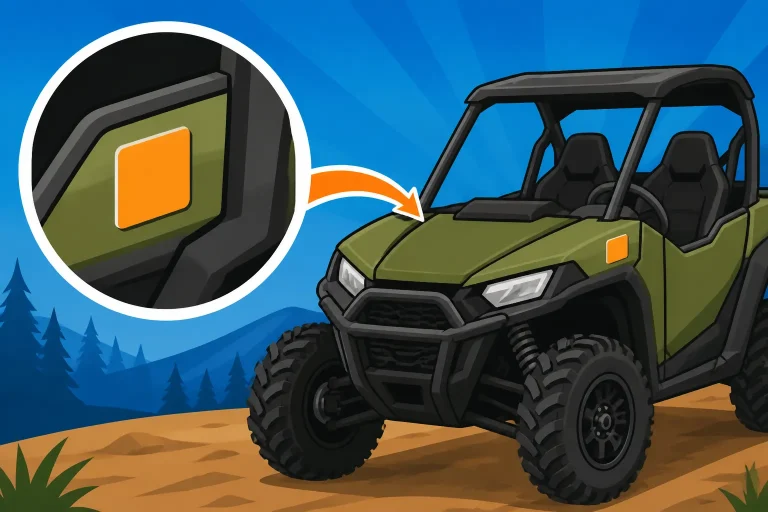
Check the machine and its visible identification as well. The Department of Motor Vehicles says the ATV license plate must be attached to the rear of the ATV, with the registration sticker placed on the right side of the plate. If you are riding with a Vermont-issued plate, confirm that it is securely mounted and readable, and follow the instructions that came with the registration. Showing a Plate and an Insurance Card covers the roadside-document issue in more detail.
A pre-ride check should include the following:
- Registration: Confirm that the Vermont registration is current and belongs to the machine. Carry the document while operating.
- Insurance: Carry proof of liability coverage and verify that the policy applies to the ride.
- Plate: Make sure the plate is securely attached at the rear and can be read.
- Machine dimensions: The New York State Department of Motor Vehicles sets the ATV definition at no more than 70 inches wide and no more than 1,000 pounds. Confirm your machine meets that definition and check any stricter trail limits.
- Tires: The Department of Motor Vehicles requires at least 2/32nds of an inch of tread, with no visible breaks, cuts, exposed cords, bumps, or bulges.
- Lights: The Department says headlights and taillights must be lit from 30 minutes after sunset to 30 minutes before sunrise.
- Helmets: The Department requires both operators and passengers to wear a USDOT-approved helmet.
- Trail permission: Save the club’s current instructions and be prepared to show any membership or permit required for access.
A driver license is not required under New York’s ATV rules, but a young rider still has to meet the state’s age and supervision rules. The Department of Motor Vehicles says riders under 16 are subject to restrictions. For example, operators under 14 may ride without adult supervision only on land owned or leased by their parent or guardian. Operators aged 14 to 15 may also ride without adult supervision on land owned or leased by a parent or guardian, subject to the applicable rules. These private-land provisions should not be treated as permission to ride a club trail independently. Review New York ATV Safety Certificate Requirements and check the rules that apply to the rider and route.
A practical plan before you cross the border
Use this sequence to avoid arriving at a trailhead with valid paperwork but no access:
- Confirm the machine is registered in Vermont. Check the registration’s validity and make sure its details match the ATV.
- Confirm New York recognizes your situation. The New York State Department of Motor Vehicles honors valid out-of-state registrations, but says a rider must obtain New York registration if the home state does not require ATV registration.
- Contact the club or trail operator. Ask whether the exact route is open to visitors and whether it requires membership, a permit, or other permission.
- Check the route’s land status. Confirm that ATV use is allowed on each segment, especially where the trail reaches public land, private property, or a road.
- Check the ATV against New York’s definition and trail limits. A valid Vermont plate does not override New York’s vehicle definition or the operator’s machine restrictions.
- Pack the required documents and equipment. Bring the registration document, insurance proof, helmet, and any trail-access materials the club requires.
- Recheck conditions before leaving. Trail closures, access arrangements, and operating conditions can change. Use current information from the club or land manager, rather than an old map or a prior visit.
If the club says its route is open but you cannot establish whether a segment is authorized for ATVs, ask which organization manages that segment and where the permission applies. Do not extend a route onto a nearby road or trail just because it appears connected. The Department of Motor Vehicles says public-highway riding is allowed only where the highway has been designated and posted for ATV use, and the Department of Environmental Conservation requires specific designation or a permit for ATV use on State Forest land.
If a club requests a permit or membership, treat that as an access condition, not a replacement for registration or insurance. Conversely, a Vermont registration that New York recognizes does not compel a club to admit the rider. Keeping these requirements separate makes it easier to identify what is missing and who can answer the question.
The bottom line is straightforward: a valid Vermont ATV registration is generally recognized in New York, but trail access depends on the route’s own permission and restrictions. Confirm both before traveling, carry your documents, and do not assume a club trail is open simply because your registration is valid.
Sources
- New York State Department of Motor Vehicles — Register an ATV | NY DMV (checked November 3, 2026)
- Department of Motor Vehicles — ATVs: Information for Owners and Operators | NY DMV (checked November 3, 2026)
Disclaimer
This article is for general informational purposes only and does not constitute professional advice. Laws, prices and regulations vary by location and change over time. Consult a qualified professional for guidance on your specific situation.