New York Rules on Club Trails
A New York ATV club membership does not automatically open every trail or replace legal requirements. Access may depend on the landowner agreement, county permit, machine registration, insurance and club rules for that route. This article explains how those pieces fit together, what to check before unloading, and how to avoid treating a club trail as permission to ride anywhere.
What “club trail” means in New York
The phrase “club trail” can describe more than one kind of riding area. A route may cross private land under an agreement with a club, form part of a county trail system maintained by volunteers, or be a private trail open only to members. The route’s day-to-day rules can depend on who owns the land, who manages access and whether the trail is open.
That matters because a club’s role does not necessarily make the trail public. A club may maintain a route, mark it, arrange landowner permission or manage a permit program without owning the property. Permission to ride may be limited to a particular season, a specific machine type, or people who have met the access conditions.
Before planning a ride, identify the trail system and the organization responsible for it. Start with the county or club’s current information, and look for details on:
- Whether the route is open to nonmembers
- Whether a county permit, club membership or day pass is required
- Which machines the route allows
- The current opening and closing dates
- Temporary closures, reroutes or landowner restrictions
- Parking and staging locations
- Any separate rules for youth riders or organized events
A club membership might support trail maintenance or qualify a rider for certain access, but it is not a statewide trail pass. Even within one county, separate clubs or land agreements may have different conditions. A permit for one system should not be assumed to cover another. The same goes for a day pass: check what routes it actually authorizes.
| Access item | What it generally does | What it does not automatically do |
|---|---|---|
| ATV registration | Shows that the machine is registered as required for its use | Grant permission to ride on a particular trail |
| County trail permit | May authorize access to a participating trail system | Replace registration, insurance or landowner permission |
| Club membership | May support maintenance and provide access under that club’s rules | Grant access to every club or private trail |
| Landowner permission | Allows use of the land within the permission given | Override state law or other trail-system conditions |
| Trail map or sign | Helps identify routes and restrictions | Guarantee that a route remains open after conditions change |
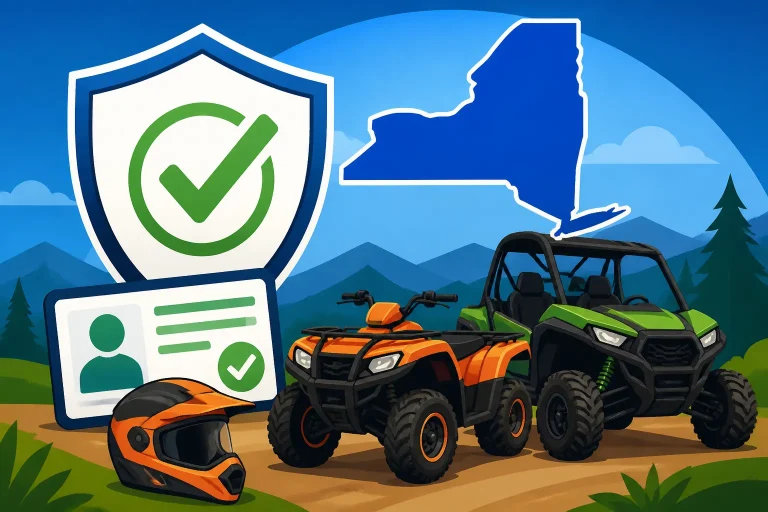
It helps to think of compliance as two separate questions: Is the rider and machine legally equipped to operate, and is this exact route open to that rider today? A “yes” to one does not answer the other. For more on how access arrangements work, see New York Club Memberships and Trail Access and Joining a New York ATV Club.
Registration, insurance and local permits are separate
The most common misunderstanding is that a trail permit or club sticker replaces the machine’s legal registration. It does not. A local permit is an access credential for a particular system; registration is a separate requirement under New York’s ATV rules. Confirm that the machine is properly registered for its use before heading out, including when it is registered in another state. Do You Need to Register an ATV in New York? explains the state registration question, while New York ATV Reciprocity With Other States covers the separate issue of an out-of-state registration.
Insurance is another separate requirement. New York imposes ATV insurance rules, and a trail permit does not satisfy them. A rider should check that the policy covers the machine and that the required proof is available during the ride. An out-of-state policy is not automatically acceptable just because the machine has a valid plate from home; confirm the policy meets New York requirements. See New York’s Mandatory ATV Insurance for the state-level requirement.
Local trail access can involve an additional county or club permit. In some systems, access may depend on buying a permit, holding a club membership, or meeting both conditions. Other trails may be restricted to members or organized events. Check the specific system’s instructions rather than relying on what was required at another trailhead.
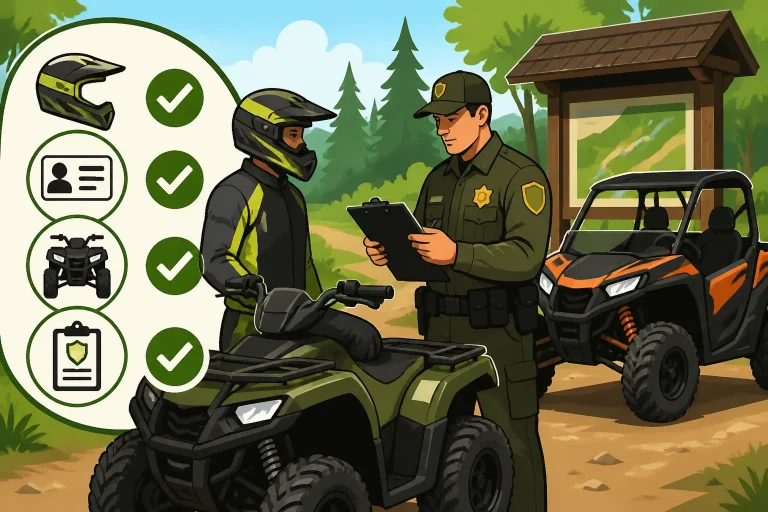
A practical way to sort out what you need is to ask four questions:
- Is the machine registered for operation in New York? Check the machine’s paperwork and any rules that apply to its type and use.
- Does the machine have the required insurance? Carry proof in the form accepted for the ride.
- What access credential does this trail system require? It could be a permit, club membership, pass or other authorization.
- Is the route open to your machine and riding group today? Check for restrictions, closures and temporary notices.
Do not infer that one document covers all four questions. A club sticker might show membership without proving registration. A registration card might show the machine is registered without proving insurance. Neither necessarily shows that a county trail permit has been obtained.
Local programs also change. Permit availability, eligible routes, access rules and the organizations administering them can vary. Confirm current requirements directly with the county or club responsible for the system before buying a permit or making a long trip. For broader context on the difference between county programs, see Why New York Has No Statewide Trail Pass and New York’s County Trail Systems Compared.
Follow the landowner, club and route rules
A club trail is usually available because somebody has agreed to allow riding there. That may be a private landowner, a group of landowners, a municipality or another manager. The permission can be conditional, and riders need to follow those conditions even when they have a valid membership or permit.
Rules may restrict riding to a marked route, prohibit travel through a field or yard, limit access to certain dates, or require riders to avoid a work area. A closed gate, posted sign or official closure notice is not an invitation to find another way around. If a route is blocked, do not go around the barrier or continue on unmarked land. Check with the club or system manager for an approved detour or updated route.
This is especially important where a trail crosses working property. A route may pass near a farm, logging operation, private driveway or seasonal land use. Keep to the marked corridor, ride at a controlled speed near people and equipment, and leave gates as instructed. Do not assume that a club’s agreement gives riders general access to the surrounding property. New York Trail Etiquette With Landowners and New York Trails That Cross Private Land offer more on keeping these arrangements workable.
Local rules can also apply to how the route is used. A system may set speed limits, require a particular direction of travel, restrict nighttime riding, or prohibit certain vehicle types. It may have rules about passengers, group size, noise, parking, dogs or riding during hunting seasons. A machine fitting the state definition of an ATV does not necessarily fit the club’s route limits or the trail’s physical width. Confirm the local rules and machine restrictions before riding.
When posted signs and current notices differ from an old map or a remembered route, follow the current official direction and ask the system manager if the situation is unclear. Maps can become outdated after land access changes, erosion, construction or a landowner request. A trail that was open on a previous visit may be closed today.
For road connections, remember that club approval does not make every adjoining road legal for ATV use. Public-road access has its own rules, and a town or other authority may have to designate and post a road for ATV travel. Do not ride along a road simply because a club trail reaches it. See New York’s Designated and Posted Roads for the distinction.
Rider and machine rules still apply
Being on a club trail does not exempt a rider from New York’s general ATV requirements. Riders should check the rules that apply to their age, supervision, helmet use, passengers, equipment and riding conditions. Those requirements are distinct from club rules; the strictest applicable condition is the one to follow.
Helmet requirements are particularly important for every member of a riding group. Do not assume an adult is exempt or that a club’s access policy changes the state rule. Review New York Helmet Rules for ATV Riders, and make sure any passenger is also equipped as required.
Young riders have additional restrictions, including rules that can depend on age, the machine and whether a safety certificate or adult supervision is involved. Parents and trip organizers should verify the requirements before the ride rather than relying on a youth rider’s previous experience or a club’s informal approval. See New York ATV Safety Certificate Requirements for the certificate rules and related age requirements.
The machine needs to be suitable for both the legal requirements and the route itself. Check that required lights and other equipment work, tires and brakes are in safe condition, and the machine meets any restrictions posted by the trail system. A route that is narrow, rough or soft after rain may not be appropriate for a wide or heavy machine, even if the machine is otherwise lawful to operate. Avoid modifying a machine or carrying a passenger in a way that conflicts with its design or applicable rules.
A brief pre-ride check can prevent common problems:
- Confirm the registration and insurance documents are current and accessible.
- Check that the required plate and any local permit display are in place as directed.
- Inspect tires, brakes, controls and lights.
- Make sure every rider has the required protective equipment.
- Confirm that the machine is allowed on the route.
- Agree on a plan for regrouping and handling a breakdown.
If renting a machine, do not assume the rental includes trail access, a county permit or insurance that meets the rider’s obligations. Ask what the rental provides and what the rider must arrange separately. [New York Rules for Riding a Rented ATV] covers that distinction.
Check access before you load and while you ride
Club-trail access can change with weather, landowner needs, maintenance work and seasonal conditions. A route map is useful for planning, but it is not a real-time guarantee that every marked section is open. Check the club or county’s current notice before loading the machine, and look again for signs or instructions at the staging area.
A useful pre-trip routine is:
- Identify the trail system. Use the official county or club information to confirm which organization manages the route.
- Verify access requirements. Check whether the trip requires membership, a county permit, a day pass or another authorization.
- Confirm the machine is eligible. Look for width, type or other restrictions, and verify the machine’s registration and insurance status.
- Check the route’s current status. Look for closures, seasonal opening dates, mud conditions, construction and landowner notices.
- Plan a legal route to and from the trail. A staging lot or trail connection does not grant permission to ride on an unposted public road or across private land.
- Carry what the system and law require. Keep required paperwork and protective gear with the group, not in a vehicle that will be left far away.
- Follow signs once riding. Stay on the marked route and turn back when a section is closed or conditions make it unsafe.
Be prepared to change plans. If a trail is closed, do not treat a permit as a right to use it anyway. Contact the club or county to ask about another open route, and avoid creating a new path around a closure. Riding past a barrier can jeopardize access for everyone who depends on the landowner agreement.
If an officer or trail representative asks to see your paperwork, respond calmly and provide the documents requested. A rider who has registration and insurance but lacks the system’s required permit may still be in violation of the trail’s access conditions. Conversely, holding the permit does not cure a registration or insurance problem. For information about enforcement, see [New York Fines for Riding Without a Permit].
After the ride, report a damaged sign, blocked passage, unsafe washout or possible conflict with land use to the organization responsible for the route. Do not move signs, remove barriers or repair property without authorization. Clubs rely on accurate reports and cooperation with landowners; a quick, responsible response can help prevent a small issue from becoming a reason to close a trail.
Frequently Asked Questions
Does a New York ATV club membership let me ride every club trail?
No. Membership applies according to the club’s own access rules and agreements. It may provide access to some routes but not other clubs’ trails, county systems or member-only properties. Check the rules for each trail system.
Does a county trail permit replace ATV registration?
No. A county or club permit is generally an access credential for a particular trail system. It does not replace New York registration, insurance or other legal requirements that apply to the machine and rider.
Can I ride a club trail when it is marked closed if I have a permit?
No. A permit does not override a closure, landowner restriction or posted route rule. Check with the club or county for the current status and any authorized detour.
Can an out-of-state ATV ride a New York club trail?
Possibly, but the rider must satisfy applicable New York requirements as well as the trail system’s access conditions. Confirm registration reciprocity, insurance and local permit rules before traveling.
Disclaimer
This article is for general informational purposes only and does not constitute professional advice. Laws, prices and regulations vary by location and change over time. Consult a qualified professional for guidance on your specific situation.