New York Rules for a Rented Machine
Renting an ATV or UTV in New York can make a trail day easy, but the rental agreement is not a pass to ride anywhere. Registration, insurance, rider-age rules, trail permits and machine type can all affect where you may go. This guide explains what to confirm before booking, what to carry, and how to avoid discovering a restriction at the trailhead.
Start by identifying the machine and the kind of ride
People often use “ATV,” “quad,” “side-by-side” and “UTV” interchangeably. New York’s rules do not always treat them as the same thing. Before you reserve, ask exactly what the rental business is providing and where that machine may legally be ridden.
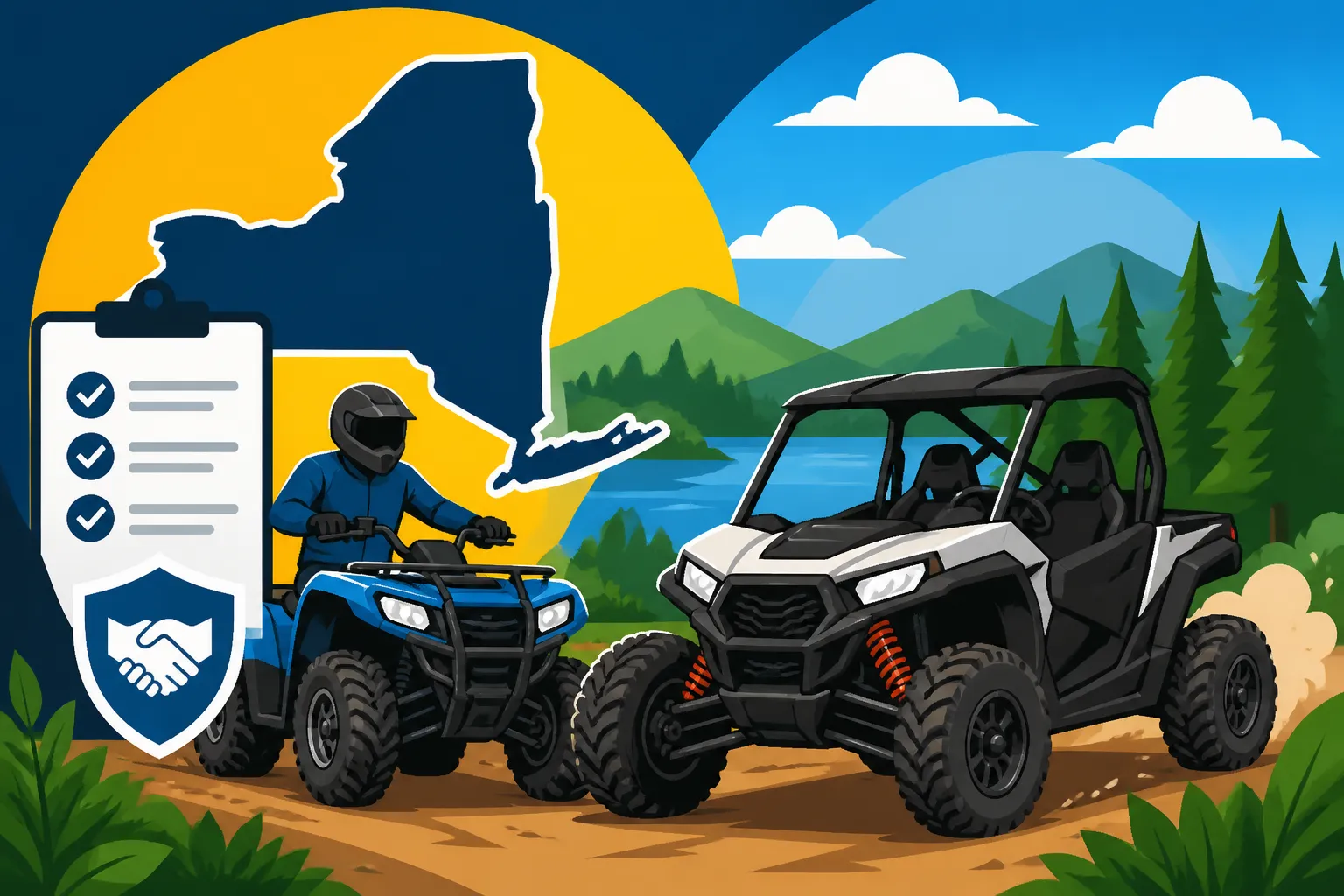
A conventional ATV is generally a straddle-seat machine steered with handlebars. Many UTVs and side-by-sides have seats beside one another, steering wheels and roll-over structures. New York’s ATV registration definition includes dimensional and weight limits. A side-by-side that exceeds the state’s definition may not qualify for ordinary ATV registration, even if a rental company calls it an ATV.
That difference matters because registration and access go together. A machine that cannot be registered as an ATV may not be eligible for a route or trail system that requires a properly registered ATV. A private riding park may have different rules on its own property, but permission to use the park does not make the machine legal on public roads or county ATV trails.
Before paying a deposit, ask the rental provider:
- Is the machine a straddle-seat ATV or a side-by-side?
- What is its width and weight, and is it registered for use in New York?
- Is the rental limited to a private property or park, or may it be taken onto public roads and trails?
- Which exact trails, roads or riding areas are included?
- Does the machine meet the rules of those places?
- Is the route open on the date of the rental?
If you are considering a side-by-side, read Why Most Side-by-Sides Cannot Be Registered in New York and Can You Register a Side-by-Side in New York before assuming that an ATV rental is eligible for ATV trails. “It has a plate” is not a complete answer: ask what the plate registers the vehicle for and whether that registration permits the intended use.
Ask whether the experience is guided or self-guided
A guided tour usually follows a prescribed route chosen by the operator. That can make it easier to stay within the rental company’s permitted area, but it does not remove the need to meet rider-age, helmet and other applicable requirements. Ask whether the guide stays with the group, what happens if someone falls behind, and whether the route changes with weather or trail closures.
A self-guided rental gives you more independence, but it also puts more responsibility on you to follow the route limits. Get the route in a form you can actually use, such as a printed map or a map saved for offline use. Do not rely on a verbal direction such as “head north until the trail opens up.” A marked trail, public road or adjoining parcel may have different access rules.
Some rentals are restricted to private property controlled by the business. That can be a sensible option for a first-time rider, but ask whether the route stays entirely on that property. If it crosses a town road, a public trail, or land owned by someone else, additional rules and permissions may apply.
Think about the ride, not just the reservation
A machine that fits the number of riders is not automatically a good fit for the trail. Consider the route’s width, surface, terrain and likely conditions. A wide side-by-side may be comfortable on a private course but unsuitable for a narrow club trail. A powerful machine can also be a poor choice for a new rider on steep, muddy or rocky ground.
Tell the provider about your group honestly. Mention first-time riders, children, mobility concerns and anyone who is not comfortable operating a heavy machine. Ask if the business offers a basic controls briefing and a practice area before the ride. A responsible operator should be able to explain the machine’s limits and decline a route that is unsuitable for the group.
Registration, insurance and reciprocity: what to verify
Registration belongs to the machine, not to the person holding the rental agreement. The rental business should be able to tell you how its machine is registered and show the relevant documents if required. A contract, payment receipt or reservation confirmation is not a substitute for vehicle registration.
Before you leave the pickup point, ask to see or confirm:
- The registration is current and applies to that machine.
- The plate and validation markings are present where required and are readable.
- The machine is approved for the type of riding the provider has authorized.
- You know where the registration papers are kept, or how to access them if stopped.
- The rental company’s insurance applies to the machine and your authorized use.
New York requires ATV insurance in many situations, including riding away from your own property. Rental operators may carry coverage for their fleet, but that does not automatically mean every injury, machine-damage claim or third-party loss is covered for every renter. Ask what the policy covers, whether the renter has a deductible or other financial responsibility under the contract, and whether coverage changes if you leave the approved route.
Do not treat a waiver as proof of insurance. A waiver may describe risks or allocate responsibility between you and the business; it is not the same as an insurance card or an explanation of the policy. Ask the provider what proof must be carried during the ride and how to contact the business if there is a crash or mechanical problem. See New York’s Mandatory ATV Insurance for the broader state insurance framework.
Rentals with out-of-state registration
A rental business may use a machine registered outside New York. Whether it can be operated in New York may depend on the machine, its registration, the rider’s circumstances and the rules of the location where you plan to ride. Do not assume that a plate issued by another state automatically gives access to every New York trail.
Reciprocity is especially easy to misunderstand. It concerns whether New York recognizes certain out-of-state registrations for qualifying use; it does not override trail closures, landowner restrictions, permit requirements, machine limits or the rental contract. A visitor may also have insurance obligations while riding in New York even when the machine is registered elsewhere. Review New York Reciprocity for Out-of-State Registrations and ask the rental company to confirm that the specific machine is permitted on the specific route.
If the provider cannot explain the registration status, does not want to show documentation, or says “everyone rides it there” instead of identifying the legal access, pause before signing. A short call to the trail operator or public agency responsible for the route can help clarify what is allowed. Confirm with the official authority for the current rule rather than relying only on an old brochure or a social-media post.
Registration does not grant trail access
Even when a machine is correctly registered, it may still need a separate trail permit or other authorization. A state registration and a trail-access permit solve different problems: one concerns the vehicle’s legal registration; the other concerns permission to use a particular trail system.
New York does not have one universal permit that opens every ATV trail. Some access is administered by counties, clubs, private operators or landowners. Requirements may differ by location, and a permit for one network should not be assumed to cover a neighboring system. Start with Do You Need a Trail Permit in New York and New York Club Memberships and Trail Access, then verify the particular route with the organization that manages it.
Trail permits and rental agreements
A useful rental question is not merely “Is a permit included?” Ask which permit, for which machine, for which dates, and for which trails. The answer should be specific enough that you can identify the system you are allowed to ride.
A business may include trail access in the rental package, provide access only to a private riding area, or expect you to obtain a permit separately. Some trails are open only during particular seasons or under current landowner agreements. A permit does not make a closed trail open, and permission for one route does not authorize riding beyond its marked boundary.
Before booking, ask the rental business to put the access details in writing or point you to the managing organization’s current rules. Find out:
- Whether the permit is attached to the machine, the rider, or the rental transaction.
- Whether each machine in a group needs its own permit.
- Whether the permit is valid for the full rental period.
- Which trail system or property it covers.
- Whether club membership, a day pass or advance purchase is required.
- How to display or carry the permit.
- What happens if the trail closes due to weather, maintenance or landowner restrictions.
These details matter when you are renting multiple machines. One person’s permit or club membership may not authorize a whole group, and a rental company’s access arrangement may apply only to its fleet or guided tours. Confirm the arrangement for every machine.
County and club systems are not interchangeable
A trail network may be managed by a county, a club, a private operator or through agreements among several parties. Those arrangements can change, and access may be limited to members, permit holders or specific machines. A map showing a trail does not necessarily mean the route is currently open to renters.
For example, if your itinerary involves a county trail network, contact the county or the organization listed as its manager. If it uses club trails, ask which club controls access and whether nonmembers can ride with a valid pass. For an overview of how local access works, see New York Club Memberships and Trail Access. For route-by-route coverage, see Which Trails a Lewis County Permit Covers if Lewis County is part of your plan.
The rental business may be familiar with the local system, but you should still know the rules that apply to your ride. Ask for the name of the access authority, a map of the approved route and a phone number or website for checking closures. If a business tells you to “just follow the other riders,” that is not a substitute for knowing where you are allowed to go.
Private property still requires permission
A trail that appears to cross an open field or forest does not necessarily allow public riding. Private land may be part of a formal trail agreement, or it may be closed to motorized use. Do not leave the marked route to explore, take a shortcut or follow a path that looks established unless the operator has confirmed that it is authorized.
Permission from a rental company does not automatically grant access to land the company does not control. Similarly, a rental contract cannot authorize you to ride on a neighbor’s property, a closed public trail or a road that is not open to ATVs. The same principle applies if you are riding with a local friend: their invitation is not necessarily permission from every landowner along a route.
Rules for public land vary by managing authority and property type. A trail on a map may be closed to ATVs even if hiking or other recreation is allowed. Review [New York Rules for Riding Public Land] before planning a route across public land, and never assume that a state forest, park or preserve is open to motorized riding.
Rider age, passengers and required equipment
The rental company can set a minimum age or other conditions that are stricter than the general state rules. It may require a parent or guardian to sign, limit who can drive, or refuse to rent to a younger rider. Meeting the legal minimum does not compel a business to rent to you.
New York has additional rules for riders under 16, including requirements that can depend on the rider’s age, machine and supervision. Do not rely on a birthday alone as proof that a young person may ride independently. Before booking for a child or teenager, confirm the current requirements with the rental operator and the official state guidance. New York Rules for Riders Under 16 explains the age-related framework.
Children and young riders
Give the rental provider the rider’s actual age and experience. Do not book an adult-sized machine for a child on the assumption that supervision will make any machine suitable. Young riders need a machine they can control, and the route should match their abilities. A child who can reach the controls while seated may still lack the strength, judgment or experience to manage the machine safely.
Ask whether the operator allows minors to drive, whether an adult must ride alongside or supervise, and what documents or safety-course credentials must be shown. If the rules or the rental business require a certificate, bring the original or another accepted form of proof; do not assume a photo on a phone will be accepted. Verify the exact requirement before arrival.
Do not put a child on a passenger seat unless the machine is designed and equipped for a passenger and the rental provider permits that use. A cargo rack, improvised cushion or second seat added after manufacture is not a safe substitute for a proper passenger position. Check the machine’s rider capacity and the operator’s passenger policy before paying.
Helmets, clothing and personal gear
New York helmet requirements apply to ATV riders and passengers. A rental helmet may be available, but ask whether it is included, fits correctly and is suitable for the ride. A helmet that shifts, pinches or does not fasten securely is not a good fit. If you prefer your own helmet, confirm that the operator accepts it and that it meets the applicable safety requirements. See New York Helmet Law for ATV Riders for more on the state rule.
Wear sturdy clothing that covers exposed skin, gloves and footwear that stays securely on your feet. Avoid loose drawstrings, dangling straps and anything that could catch on controls or moving parts. Eye protection matters on dusty or muddy trails, even when the machine has a windshield. Weather can change quickly, so bring layers and a way to keep essential items dry.
If you are buying personal gear before a trip, Amazon may be one place to compare items such as goggles, gloves or a waterproof pouch, but check fit and safety markings carefully. A product listing alone does not establish that a helmet meets the standards required for riding. For helmets in particular, choosing the correct fit and verifying the certification matters more than convenience.
A phone is useful for emergencies, but it should not become your only map or communication plan. Save the route for offline use if possible, carry the rental company’s contact information, and bring a paper map if the area has unreliable cell service. An inexpensive waterproof pouch bought from Amazon can help protect a phone from rain and mud, but it does not improve signal or replace a map.
Know where the rental machine may be ridden
The rental agreement may be more restrictive than state law. A provider can confine you to its property, a designated route or a specific riding area. You must follow those limits even if another road or trail looks accessible. Leaving the approved area can breach the contract and may also put you on a route where the machine is not registered or permitted.
Public roads and crossings
ATVs are not generally free to travel on public streets like ordinary passenger vehicles. New York has rules for roads that are specifically designated and posted for ATV use, and separate restrictions for crossing roads. A route map or rental briefing should identify any authorized road segments and crossings. Do not follow a vehicle onto a road simply because it is heading toward the same trail.
At a crossing, use only a lawful crossing point and follow required stopping and visibility procedures. Never ride along a road unless that road is open to ATVs under the applicable rules. Do not enter an interstate or use a public road as an improvised connector between trail segments. New York Rules for Crossing a Public Road can help you understand the difference between crossing a road and riding along it.
If the rental route involves a road, ask the operator to point it out on the map and explain why it is open to the machine. If you cannot identify the authorized segment, do not guess. A rental provider’s route plan should not require you to improvise your way through traffic.
Side-by-sides and places that allow them
A UTV or side-by-side may be allowed on a private course designed for that machine but not on ordinary ATV trails. The rental company should tell you whether it has a route specifically suited to the vehicle and whether all parts of that route are private or otherwise authorized.
Do not assume a vehicle’s registration plate makes it suitable for a trail. New York’s ATV definition has limits, and an oversized or overweight machine can fall outside the category used for ATV registration. A machine’s model name, dealer description or rental label does not settle the question. Ask about the specific vehicle and the specific access system.
If the provider advertises a side-by-side rental on public trails, ask for the route manager’s confirmation that the machine is allowed. If it cannot provide a clear answer, choose a route or rental that does not depend on an uncertain interpretation. A private park’s rules may permit use on its land, but that permission does not carry over onto roads or adjoining properties.
Night riding, weather and trail conditions
Rental hours may extend into evening, but the hours in your contract do not override equipment or operating rules. If your ride could continue after sunset, ask whether the machine has the required lighting and whether the route permits night use. Also consider whether you can confidently navigate and respond to a problem in the dark.
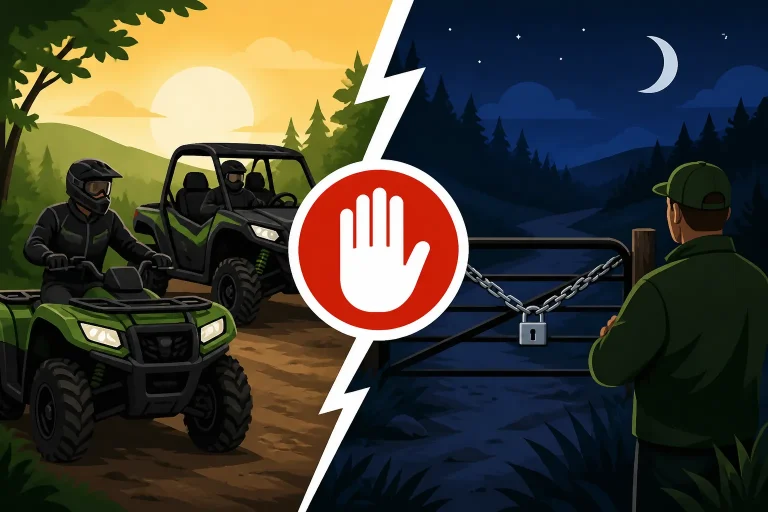
Rain, thawing ground, high water and trail maintenance can make a route unsafe or temporarily closed. A trail that was open when you booked may not be open on the day you arrive. Check for updates with the organization responsible for the trail, and follow a closure even if the rental agreement includes that route. Do not bypass a gate, closure sign or barrier.
Ask how the business handles a closure or a machine failure. Find out whether it will reschedule, provide an alternate route or send assistance. The exact remedy is a matter of the rental agreement, so read it before paying rather than assuming the business will refund or replace a ride in every circumstance.
A practical checklist before you ride
Use this sequence at booking, pickup and on the trail. It takes a few minutes and helps catch the problems that are hardest to solve once you are away from the rental office.
- Describe the group accurately. Give the provider each rider’s age and experience level, say whether anyone is a first-time rider, and identify any mobility or health issue that could affect operating the machine.
- Confirm the vehicle. Ask whether it is an ATV or UTV, whether it is registered for New York use, and whether the intended trail or private property allows that type of machine.
- Confirm the route. Get a map or clear route description. Ask which sections are private, which are public, and whether any road crossings or designated road segments are included.
- Confirm permits. Ask which trail permit or access authorization is needed, whether it is included, and whether each machine needs its own. Confirm the permit covers the exact route and date.
- Confirm insurance and responsibility. Ask what insurance applies, what proof is carried, how the policy applies to renters, and what the contract says about damage, injuries, towing and leaving the route.
- Check age and passenger rules. Make sure every rider is eligible under state rules and the rental company’s own policy. Confirm that any passenger seat is designed for a passenger and that the vehicle’s capacity is not exceeded.
- Inspect safety equipment. Check that helmets fit and fasten, lights work if needed, tires appear sound, and controls are explained. Ask for instruction before starting if you have not used that model.
- Save emergency details. Keep the provider’s phone number, the route map and any required documents accessible. Know where you are expected to stop if the machine has a problem.
- Check conditions again. Confirm that the trail is open and that weather or maintenance has not changed the plan. Follow the managing organization’s latest notice, not an old map or a prior visitor’s account.
- Stay on the authorized route. Do not follow an unmarked track, pass a closure or enter private land because another rider does. If you are uncertain, stop in a safe place and call the rental business.
At pickup, inspect the machine with the employee. Photograph existing damage if the contract or provider allows it, and make sure both parties agree on its condition. Ask how to report a breakdown, whether you should attempt a simple repair, and what to do if the machine becomes stuck. Do not try to winch or tow a rental machine unless the operator has explained the safe procedure and the contract permits it.
Keep the rental agreement, registration or proof of registration, insurance information and permit documentation available as instructed. A rider may not need to carry every original document in every situation, but you should know what the operator requires and where the relevant paperwork can be found. If the machine is stopped by an officer or trail official, remain calm and provide the requested information.
A simple waterproof pouch from Amazon can keep a route card and rental contact details from getting soaked. It is a convenience, not a legal document or substitute for required proof. If the rental business supplies a map or permit decal, follow its instructions for carrying or displaying it rather than putting stickers wherever they seem convenient.
Common rental situations and what to do
The rental business says the permit is included
Ask for the permit’s name and the system it covers. Then check whether it applies to the date, machine and trails in your plan. If the permit is attached to the vehicle, confirm it is displayed or carried as required. If it is issued to the rider, make sure each eligible rider has the right authorization.
“Included” could mean access to a private park, a day pass for a particular trail network, or an arrangement available only on a guided ride. Those are different things. Ask the operator to identify the boundary of the permitted area and explain what to do if the route is closed.
The machine has a plate from another state
Ask the business to confirm that the registration is recognized for the intended New York use and that the machine may access the route. Out-of-state registration does not eliminate New York’s operating rules, trail requirements or insurance obligations. Do not rely on the fact that a machine has been rented in the area before.
If the business cannot explain the registration or access basis, do not take the machine onto a public trail until the issue is resolved. A rental contract does not protect you from the consequences of riding a vehicle where it is not authorized.
You want to bring a rented machine to a different trail system
Get the rental company’s written approval first. Its insurance, registration arrangement, recovery plan or contract may limit the machine to a particular location. The new trail system may have different width limits, permit rules, seasonal closures or access restrictions.
Then check with the organization that manages the destination trail. Do not treat a permit for the rental company’s home system as a statewide pass. Verify each separate system and confirm that the rental machine is eligible there.
A child wants to ride or come along as a passenger
Confirm the child’s age-related requirements with the official state guidance and the rental business before booking. Ask whether the child may operate that particular machine and what supervision applies. If the child will ride as a passenger, confirm that the machine has a designed passenger seat, that the rental company permits a passenger, and that all helmet requirements are met. For a deeper look at passengers, see [New York Rules for a Passenger Under 16].
Never put a child on a rack, improvised seat or machine not designed for two riders. If the operator cannot provide an age-appropriate machine or clearly explain the rules, choose a different activity.
The trail is closed or the machine breaks down
Follow closure signs and instructions from trail officials. Do not bypass a gate or attempt to use an unmarked detour. For a mechanical problem, stop somewhere safe, keep the group together and call the rental provider using the contact information supplied at pickup. If anyone is injured or in immediate danger, seek emergency help.
Do not abandon the machine unless the operator instructs you to do so or there is a safety emergency. Avoid making repairs that could cause additional damage or violate the rental terms. Ask in advance whether the provider offers recovery support and how you should report an incident.
You are unsure whether a route is legal
Stop before entering the uncertain road or trail. Check the route map, contact the rental company and, when necessary, ask the trail manager or relevant public authority. A good rule is simple: if you cannot establish that a route is open to that machine and that you have the required access, do not ride it.
A rented machine can remove the need to own, store and transport an ATV, but it does not remove the rider’s responsibility to follow New York rules. Confirm the machine, documents, insurance, permits and route before leaving the pickup point. A few clear answers up front are better than a confusing conversation at a gate or roadside stop.
Disclaimer
This article is for general informational purposes only and does not constitute professional advice. Laws, prices and regulations vary by location and change over time. Consult a qualified professional for guidance on your specific situation.