Leaving Your Safety Certificate at Home on a Ride
Leaving your ATV safety certificate at home can create a real problem if you are a young rider relying on it to ride without adult supervision. The key is knowing when New York requires you to carry the certificate, what alternatives may let you ride legally, and what to do if you discover it is missing after you have set out.
When New York requires you to carry the certificate
The certificate is not a substitute for ATV registration, and it is not a document every rider must carry in every situation. The carry requirement is tied to a particular exception for young operators: according to the New York State Department of Motor Vehicles, operators aged 14 to 15 who ride independently on permitted property using a safety-training course certificate must carry that certificate.
That detail matters. A 14- or 15-year-old may have more than one lawful way to ride, depending on the rider’s supervision and where the ATV is being used. If the rider is relying on the certificate to operate without adult supervision on permitted property, leaving it at home means the rider cannot simply assume the certificate is enough because they completed the course. The DMV says the certificate must be carried for that form of independent riding.
For background on the document and how it fits into the rules, see The New York ATV Safety Certificate Explained and New York ATV Safety Certificate Requirements.
| Rider and situation | What the DMV rules allow | What to do if the certificate is at home |
|---|---|---|
| A 14- or 15-year-old riding independently on permitted property by relying on a safety-training certificate | The rider must carry the certificate, according to the New York State Department of Motor Vehicles. | Do not continue riding independently on that basis. Retrieve the certificate or switch to an allowed arrangement. |
| A 14- or 15-year-old riding under adult supervision | Adult supervision is an alternative to relying on the certificate for independent riding. | Confirm that the accompanying person meets the DMV definition of adult supervision. |
| A 14- or 15-year-old riding without supervision on land owned or leased by a parent or guardian | The New York State Department of Motor Vehicles allows this property-based exception. | Confirm the land qualifies; permission alone is not the same as being owned or leased by the parent or guardian. |
| An operator under 14 | The rider may operate under adult supervision, or without supervision only on land owned or leased by a parent or guardian, according to the DMV. | Do not treat a safety certificate as a general substitute for the age and supervision rules. |
| A rider not relying on the certificate-based exception | The specific carry rule described by the DMV applies to 14- and 15-year-olds riding independently on permitted property using the certificate. | Check which rule permits the ride, and carry other required documents such as the ATV registration. |
The alternatives are not interchangeable in every setting. According to the New York State Department of Motor Vehicles, a 14- or 15-year-old may operate under adult supervision, without supervision on land owned or leased by a parent or guardian, or independently on permitted property with a DMV-approved safety-training course certificate. For the independent permitted-property option, the rider must carry the certificate.
The DMV defines adult supervision as being accompanied by a person at least 18 years old, or by a person aged 16 or 17 who holds an ATV safety course completion certificate from the ATV Safety Institute. A group of young riders does not create adult supervision simply by having another teen along; the accompanying person must fit the stated definition.
Riders under 14 have a narrower unsupervised option. According to the New York State Department of Motor Vehicles, they may ride without adult supervision only on land owned or leased by their parent or guardian. A course certificate does not, by itself, remove that limit. For more detail about age-specific rules, see New York Rules for a Rider Aged 14, New York Supervision Rules for Minors, and What New York Requires of Riders Under 16.
What to do if you discover it is missing
If you are still at home or at the staging area, pause before riding. Work out which rule makes the ride lawful, rather than treating the certificate as a general permission slip. If a 14- or 15-year-old needs the certificate to ride independently on permitted property, the straightforward choice is to retrieve it or make another plan that fits the rules.
If the rider can be accompanied by someone who meets the DMV definition of adult supervision, that may be an alternative. Another possible option is riding without supervision on land owned or leased by the rider’s parent or guardian, if that is genuinely where the ride will take place. Do not assume a landowner’s general permission changes the parent-or-guardian ownership or lease condition.
If the rider is already on the trail or other permitted property when the certificate is noticed missing, stop the ride in a safe, lawful place and reassess. A practical response is to arrange for the certificate to be brought to the rider or return to retrieve it without continuing the ride independently. If neither is workable, end the ride. Do not rely on the fact that the rider completed a course, or that a photo of the certificate is saved on a phone, unless the DMV confirms that form is acceptable. The stated rule is to carry the certificate; do not assume an image or photocopy meets it.
The answer may be different if the rider is supervised or riding on qualifying parent- or guardian-owned or leased land. In that case, identify the specific exception that applies and make sure the facts match it. If there is uncertainty about whether the property qualifies, the safer choice is not to proceed unsupervised on the assumption that it does.
This is also a good point to check that the ride itself is allowed. A safety certificate does not grant access to a trail or property. According to the New York State Department of Motor Vehicles, ATVs may be used on public lands where signs indicate ATV use is allowed, and private property may be used only with the property owner’s permission. State Forest access has separate limits: the New York State Department of Environmental Conservation says an ATV may be operated on State Forest lands only where specifically designated by posting or permit. See New York Trail Access for Riders Under 16 for related access considerations.
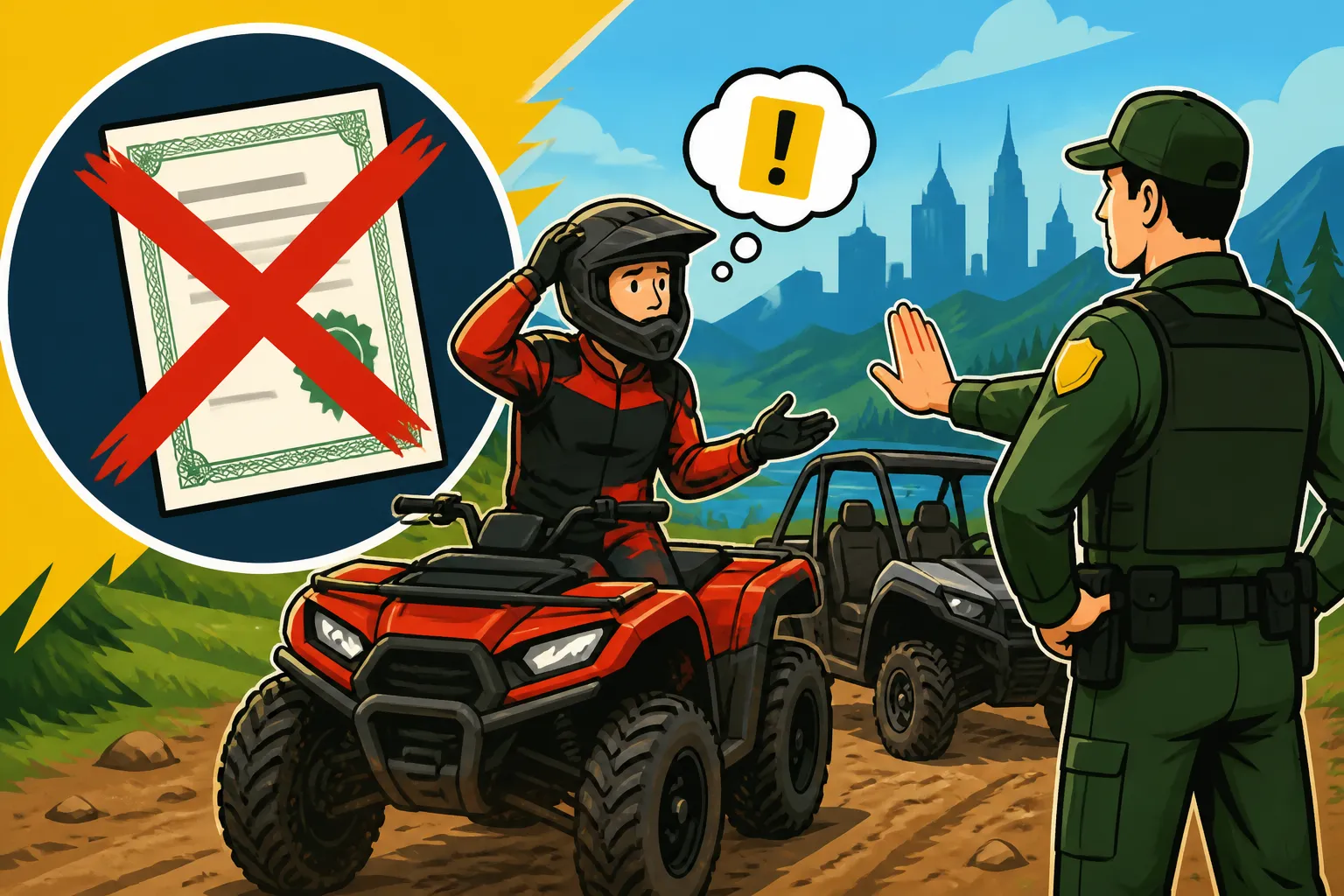
If an officer or other official asks about the missing certificate, be calm and explain the situation accurately. Do not claim that a digital copy is equivalent unless you have confirmed that it is accepted. The certificate question is separate from registration and insurance requirements, and an answer about one document does not resolve the others. The separate issue of what happens when a rider cannot show a certificate is covered in Why Failing to Show It Is Not an Offense.
Keep the certificate separate from other required documents
A common source of confusion is assuming that the safety certificate is the main paper an ATV operator needs. It is only relevant to a particular safety-training and age exception. The registration document has its own carry requirement: according to the New York State Department of Motor Vehicles, operators must carry the ATV registration document while operating.
The registration document and safety certificate prove different things. Registration relates to the machine’s legal registration; the safety certificate relates to the rider’s training and, in this situation, eligibility to ride independently. Keeping one does not replace the other. For help sorting out registration documents, see New York ATV Registration Paperwork.
Insurance is another separate requirement. The New York State Department of Motor Vehicles requires liability insurance to operate an ATV anywhere in New York State except on the owner’s property. The DMV also says proof of insurance must be shown to a judge, police officer, or a person making a claim of injury or property damage. A safety certificate does not satisfy this requirement.
A simple pre-ride document check can prevent a trip from ending at the trailhead:
- Confirm the rider’s age and whether the plan depends on adult supervision, a parent-or-guardian property exception, or the certificate-based option.
- If a 14- or 15-year-old will ride independently on permitted property using the safety-training certificate, make sure the rider has the certificate with them.
- Carry the ATV registration document.
- Confirm that the required liability insurance is in place for the planned location.
- Check that the destination is open to ATV use and that any private-property permission or applicable access requirement is settled.
For the certificate, choose a storage method that keeps it with the rider and protects it from water and dirt. A small waterproof document pouch, including one sourced through Amazon, can be useful if it stays secured to the rider’s gear rather than being left in a vehicle or at home. Keep the document readable and avoid storing it where it can fall out during a ride.
A phone photo can be a helpful backup for remembering certificate details or contacting a parent, but it should not be treated as a replacement for carrying the certificate unless the DMV confirms that a digital version is accepted. The safest routine is to check for the physical document before leaving and keep it in the same secure place each time.
Make the right decision before the ride starts
The practical question is not simply, “Did the rider pass the course?” It is, “What rule allows this rider to operate in this location today, and what must the rider have with them to use that rule?” That approach prevents a common mistake: assuming a completed course makes independent riding lawful anywhere, or that a parent’s permission automatically creates the property exception.
Use a short decision process:
- Check the rider’s age. The rules differ for riders under 14 and for riders aged 14 to 15.
- Identify the applicable option. Is the rider supervised, riding without supervision on land owned or leased by a parent or guardian, or relying on a safety-training certificate to ride independently on permitted property?
- If relying on the certificate, confirm it is with the rider. The DMV says 14- and 15-year-old operators using the certificate-based independent option must carry it.
- Check the route and property. A certificate does not authorize riding on a closed trail, a public road that is not designated and posted for ATV use, or private land without permission.
- Check the other paperwork. Carry the registration document and make sure the required insurance applies to the ride.
If the certificate is forgotten, changing the plan is usually simpler than arguing over whether a copy should count. Retrieve the document, ride with qualifying adult supervision if that option fits, or limit the ride to qualifying parent- or guardian-owned or leased land when that exception applies. If none of those options fits, postpone the ride.
Before the next outing, make the certificate part of the same routine as checking the helmet and registration. Keep it in a consistent, protected place that travels with the rider. This small habit helps avoid a preventable trip interruption while keeping the safety certificate in its proper role: proof used for a specific youth-riding option, not a replacement for registration, insurance, supervision, or trail access permission.
Sources
- Department of Motor Vehicles — ATVs: Information for Owners and Operators | NY DMV (checked November 3, 2026)
- Department of Motor Vehicles — Register an ATV | NY DMV (checked November 3, 2026)
Disclaimer
This article is for general informational purposes only and does not constitute professional advice. Laws, prices and regulations vary by location and change over time. Consult a qualified professional for guidance on your specific situation.