Why Failing to Show It Is Not an Offense
A request to show your ATV safety certificate can feel like a simple paperwork check, but New York treats not having the card on hand differently from not holding a valid certificate. The distinction matters most for young riders, who may need training or supervision to ride legally. Here’s what failure to show the certificate means—and what it does not excuse.
What “not a separate offense” means
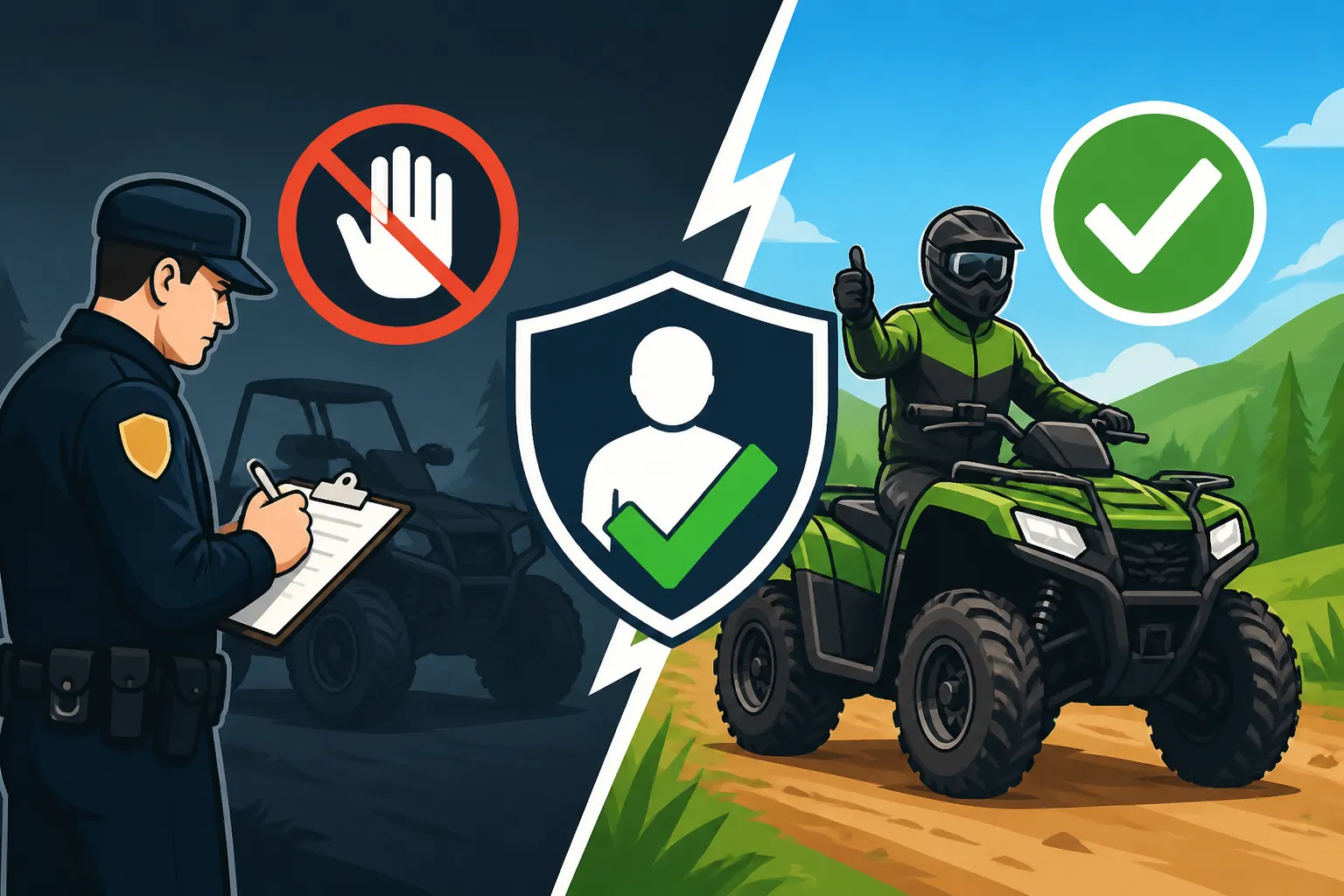
New York State Senate law says failing to exhibit an ATV safety certificate when an authorized officer demands it is not, by itself, a separate offense. But that does not mean the officer has to assume you hold a valid certificate. Under the same rule, failing to produce it is presumptive evidence that you do not have one.
In practical terms, the certificate and the act of showing it are different issues. The law does not treat the failure to show the certificate as its own standalone offense, but the missing certificate can still count as evidence about whether you meet the training requirement that applies to your ride.
That distinction is important if you are stopped. Saying that you completed a course is not the same as producing the certificate, and failing to produce it does not establish that you completed the course. If the training requirement applies to you, carry your certificate so you can show it when asked. For a broader explanation of who needs one, see New York ATV Safety Certificate Requirements.
The rule is also limited to the safety certificate. It does not erase separate requirements for registration, insurance, helmets, or lawful access to the land or trail. For example, according to the New York State Department of Motor Vehicles, ATV operators must carry the registration document while operating. A missing registration document is a different issue from not showing a safety certificate.
| Document or requirement | What it relates to | What the facts say about showing or carrying it |
|---|---|---|
| ATV safety certificate | Whether a rider meets an applicable training requirement | New York State Senate law says failing to exhibit it upon an authorized officer’s demand is not a separate offense by itself, but is presumptive evidence that the operator lacks a valid certificate. |
| Registration document | Whether the ATV is registered | The New York State Department of Motor Vehicles says operators must carry the registration document while riding. |
| Proof of insurance | Liability coverage | The New York State Department of Motor Vehicles says proof must be shown to a judge, police officer, or person making a claim of injury or property damage. |
The table is not a checklist that applies identically to every rider. Whether you need a safety certificate depends on your age and circumstances. Registration and insurance rules have their own requirements, and those rules can apply even when the rider does not need a safety certificate.
Who may need a safety certificate
New York does not require a driver license to operate an ATV, but age-related restrictions apply. The training certificate is especially relevant to riders aged 14 to 15 who ride without adult supervision on permitted property. According to the New York State Department of Motor Vehicles, those riders must have a DMV-approved safety-training course certificate and carry it when operating independently on that permitted property.
Other circumstances have different supervision rules. According to the New York State Department of Motor Vehicles, operators aged 14 to 15 may ride without adult supervision on lands owned or leased by their parent or guardian. Operators under age 14 may ride without adult supervision only on lands owned or leased by their parent or guardian. These exceptions do not mean that every young rider can ride independently anywhere; the location and supervision conditions matter.
For other riding situations, the New York State Department of Motor Vehicles defines adult supervision as being accompanied by a person at least 18 years old, or by a person aged 16 or 17 who holds an ATV safety course completion certificate from the ATV Safety Institute. Check the specific age and location rule that applies before riding rather than assuming a certificate alone replaces supervision. The details are covered in New York Supervision Rules for Young Riders.
A few common situations illustrate why the distinction matters:
- A young rider needs a certificate to ride independently on permitted property. If the rider cannot show the certificate when an authorized officer demands it, the failure to produce it is not a separate offense by itself under New York State Senate law. However, it is presumptive evidence that the rider does not hold a valid certificate.
- A young rider is riding under adult supervision. The applicable rule may be based on supervision rather than independent riding with a certificate. Make sure the supervision meets the state’s definition and that the riding location allows ATV use.
- A rider is on parent- or guardian-owned or leased land. The state provides specific exceptions to adult supervision for young riders on that land. That exception should not be confused with permission to ride on someone else’s property or on a public trail.
- An adult rider is asked for a certificate. Do not assume that every rider needs one, or that not having a certificate is the same as failing to show a required one. The relevant question is whether a training certificate is required for that rider’s age and circumstances.
For a rider who is required to hold a certificate, keeping it accessible avoids an unnecessary dispute about whether the requirement has been met. A clear photo or copy may be useful as a personal backup, but do not assume it will satisfy an officer if the official requirement calls for the certificate. Follow the instructions that came with the certificate and confirm what form of proof is accepted.
Keep the certificate separate from registration and insurance
A safety certificate does not register an ATV, and a registration document does not prove that a young rider completed a safety course. Treat each as a separate requirement.
According to the New York State Department of Motor Vehicles, a valid New York registration is generally required to ride an ATV in the state unless a specific exemption applies. New York honors valid out-of-state ATV registrations, but if a rider’s home state does not require registration, the rider must obtain a New York registration before operating here. More detail is available in New York Reciprocity for Out-of-State Registrations.
Registration papers also have a specific carry requirement. The New York State Department of Motor Vehicles says operators must carry the registration document while riding. A registration plate attached to the ATV is not a substitute for the document. If you are sorting out what documents belong with the machine, see New York ATV Registration Paperwork.
Insurance is separate again. According to the New York State Department of Motor Vehicles, liability insurance is required to operate an ATV anywhere in New York State except on your own property. Proof of insurance must be shown to a judge, police officer, or a person making a claim of injury or property damage. A safety certificate cannot stand in for proof of insurance, and insurance does not establish that a rider has completed required training. The related document requirements are explained in Showing a Plate and an Insurance Card.
A practical way to prepare is to organize paperwork by purpose:
- Keep the registration document with the rider or machine as required.
- Keep proof of insurance available for a request or claim.
- If the rider needs a safety certificate, carry it when the specific rule requires it, especially when riding independently on permitted property.
- Do not rely on a plate, insurance card, or another rider’s certificate as a substitute for the document that applies to you.
If you ride with family or a group, check each machine and rider separately. One person’s registration or certificate does not automatically cover another machine or another rider. For young riders, also verify that the property is open to ATV use and that any required supervision is present.
What to do if you cannot show the certificate
If an authorized officer asks for a safety certificate and you do not have it with you, stay calm and be accurate. Do not claim you can produce it if you cannot, and do not treat the “not a separate offense” rule as a reason to ignore the request. New York State Senate law makes failure to exhibit the certificate presumptive evidence that the operator does not hold a valid certificate.
If you have completed the course, explain that plainly and ask what information the officer needs to identify the certificate. The facts do not guarantee that an officer must accept a verbal explanation or a photo in place of the certificate. If you are unsure what the officer is asking for, clarify whether the request is for the safety certificate, registration document, or insurance proof; they are different documents with different rules.
If you receive a citation or other official notice, read it carefully and follow the instructions provided. The rule discussed here only concerns whether failing to exhibit the safety certificate is a separate offense in itself. It does not decide whether the rider actually meets a training requirement, whether another requirement was violated, or how a particular case should be handled.
Before the next ride, confirm the rider’s age-related rules, the route or property’s access rules, and the documents required for that specific situation. This is particularly useful when a group includes younger riders, when someone is riding on property they do not own, or when the group crosses from private land to a public route. New York’s land-access rules are separate from safety-certificate rules; public highways, for example, may be used only when designated and posted for ATV use, according to the New York State Department of Motor Vehicles.
The simplest takeaway is to distinguish possession from production. The rule does not create a separate offense solely for failing to exhibit a safety certificate upon demand, but the failure can count as evidence that the operator does not hold a valid one. If a certificate is required for the ride, carrying it is the clearest way to avoid that problem.
Sources
- Department of Motor Vehicles — ATVs: Information for Owners and Operators | NY DMV (checked November 3, 2026)
- Department of Motor Vehicles — Register an ATV | NY DMV (checked November 3, 2026)
Disclaimer
This article is for general informational purposes only and does not constitute professional advice. Laws, prices and regulations vary by location and change over time. Consult a qualified professional for guidance on your specific situation.