Riding County Forest Land in New York
Riding an ATV on county forest land in New York can look straightforward: the land is public, so surely the trails are open. That assumption can lead to a closed gate, a citation, or a damaged relationship with the land manager. The key is to confirm that motorized riding is allowed on the specific property and route, then check the separate rules for permits, registration, insurance, and trail conditions.
County forest land does not automatically mean ATV access
New York has no single statewide rule opening all county-owned forests to ATVs. A county may own land for forestry, watershed protection, wildlife habitat, or recreation, and allow different activities on different properties. Even where a county maintains ATV trails, those trails may cover only part of a property or operate under limited access conditions.
Treat each county forest, trail, and access road as its own situation. Look for information from the county department responsible for the property, such as its parks, forestry, recreation, or land-management office. A county trail map, official property notice, or posted sign is more useful than assuming that a road is open because it appears on a general map.
Pay attention to the difference between these terms:
- County forest land describes who owns or manages land. It does not, by itself, grant permission to ride an ATV.
- A county ATV trail system is a designated route network that may have its own operating rules, seasons, or permit requirements.
- A public road or forest road is not automatically open to ATVs. Road access depends on applicable state and local rules, as well as signs and local designations.
- A private trail across county-owned land may be managed by a club or another organization under an agreement. That arrangement can impose separate access rules.
Before loading your machine, find out whether the property permits ATVs at all, which routes are open, and whether access is limited to certain users or dates. If the county’s information is unclear, contact the land manager rather than treating silence as permission. The related overview, New York Rules on County Forest Land, can help distinguish general public-land questions from property-specific access.
A route may also be closed temporarily even if it is normally open. Maintenance, logging, erosion, seasonal conditions, wildlife management, or a change in landowner arrangements can affect access. A trail shown on an old map may no longer be available. Follow current notices and signs at the entrance, and turn around if a gate or closure notice blocks the route.
Check access, permits, registration, and insurance separately
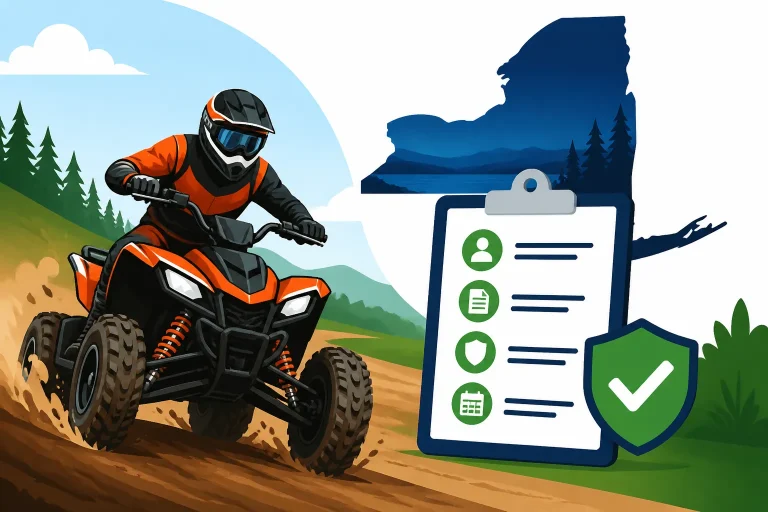
Riding permission is only one part of being ready to use county forest land. A county trail permit, state ATV registration, and insurance serve different purposes. Having one does not replace the others.
| Requirement | What it generally covers | What to confirm before riding |
|---|---|---|
| Permission to use the property | Whether ATVs may enter that specific county land | The property, route, dates, and any user restrictions |
| County or trail-system permit | Access to a particular trail network, when required | Which trails the permit covers, how to obtain it, and where it must be displayed |
| ATV registration | State registration requirements for the machine | Whether the machine is registered correctly or qualifies for an exception |
| Insurance | Financial protection required under applicable New York rules | That the policy applies to the machine and the planned use |
| Operating rules | Conditions such as posted routes, hours, or equipment requirements | Current county notices and relevant state rules |
A trail permit is not statewide permission
New York does not have one statewide ATV trail pass that automatically opens every county forest. Some trail networks use their own permit systems, while others may have no ATV access or may require a club membership, advance authorization, or another form of permission. The permit’s scope matters: a pass for one trail system does not necessarily authorize riding in a neighboring county or on unrelated county property.
Read the permit conditions before buying or using one. Check which machines and riders it covers, where it is valid, whether it must be displayed, and whether access is subject to seasonal closures. For a broader explanation of how local access passes differ, see Do You Need a Trail Permit in New York? and County Permits Instead of a State Sticker.
A permit also cannot override a closure. If a county has closed a trail because of damage or maintenance, do not assume that a valid pass grants an exception. Likewise, permission to ride a marked trail does not necessarily allow you to leave it, use adjacent roads, or cross land that belongs to a different owner.
Registration and out-of-state machines
Check the machine’s registration before heading out. A New York rider should confirm that the ATV is registered as required and carry the relevant documents. For paperwork questions, New York ATV Registration Paperwork outlines the kind of documentation riders may need to address.
Visitors should not assume that a registration from another state automatically grants access to every New York trail. New York’s reciprocity rules and the county’s own access requirements are separate questions. A machine may meet state registration conditions yet still need a local permit or permission to enter a particular trail system. See New York ATV Reciprocity With Other States for the state-level issue, then confirm access directly with the county or trail operator.
Insurance remains a separate check
Do not treat a county permit, registration card, or trail sign as proof that your insurance is adequate. New York has ATV insurance requirements, and a public or county-managed riding area is not the same as your own private property. Confirm that the policy applies to the machine and intended use, and carry proof as required. The details are covered in New York ATV Insurance Requirement.
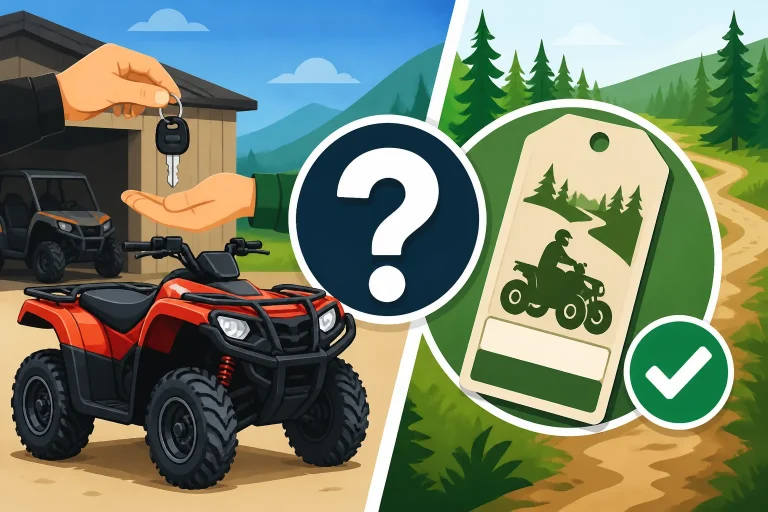
If you are borrowing a machine, ask the owner about registration and insurance before the trip. Do not rely on the owner’s verbal assurance alone if you cannot confirm that the paperwork and policy cover the ATV you will ride.
A practical check before you leave home
A few minutes of verification can prevent a wasted drive or a preventable violation. Use this process for each county property, even if you have ridden somewhere nearby before.
- Identify the exact property. Confirm its county name, entrance, and managing department. Nearby land may belong to a town, state agency, private owner, or club rather than the county.
- Find current ATV access information. Check an official county page, trail map, or notice. Look for language that specifically addresses ATVs, not just general recreation or motor vehicles.
- Confirm the allowed route. Note trail boundaries, connecting roads, staging areas, and any restrictions on leaving the marked route. Do not assume that every road inside the property is an ATV route.
- Ask about permits and eligibility. Check whether access requires a county permit, club membership, advance registration, or other permission. Confirm whether a permit applies to your particular machine and ride.
- Check dates and conditions. Look for seasonal openings, temporary closures, logging notices, maintenance work, and weather-related restrictions. A route can be closed even when a map still shows it.
- Review your machine documents. Make sure registration requirements are met and that you can show the paperwork if requested. Visitors should verify that their out-of-state registration is acceptable for the planned use.
- Confirm insurance and required equipment. Carry proof of insurance and check the rules that apply to the rider, passengers, and machine. Do not assume that a trail’s local rules replace New York requirements.
- Recheck before unloading. Read the signs at the entrance and look for notices posted at the trailhead. If local signs conflict with an old map or an online description, do not ride through the closure.
When a county office or trail operator gives an answer by phone, write down the property and route discussed, the date, and any conditions. That simple record can help avoid mixing up similar trails or relying later on a general answer that did not apply to your destination.
Ride only where permission applies
Once you reach the property, stay on the routes that are specifically open to ATVs. A trailhead sign is not an invitation to explore every track, field, woods road, or adjoining parcel. Riding off route can damage soil and vegetation, disturb wildlife, create conflicts with hikers or other users, and put future access at risk.
This is especially important where county land borders private property. A trail may cross a private parcel under a limited agreement, or a county route may end at a boundary. A gate, marker, or worn track does not establish permission to continue. Confirm where the authorized route ends and respect signs and barriers. For questions about access beyond county land, review New York Landowner Permission Rules.
Follow local directions about speed, hours, parking, noise, and group riding. Do not block a gate, forestry road, or emergency access point when parking a trailer or staging a machine. Yield when appropriate to people on foot, maintenance crews, and other trail users, and avoid spinning tires or creating ruts. A route that becomes muddy or soft may need to be left alone even if it has not yet been formally closed.
If you encounter a new closure, do not move a barrier or ride around it. Turn back and use only a route confirmed as open. Report hazards or damaged signs to the manager when practical. Before another trip, check New York Trail Conditions Before You Ride for useful ways to think about current conditions and closure information.
County forest access can change, and no general summary can establish that a specific trail is open today. The reliable approach is to confirm the land manager’s current instructions, obtain any required local permit, and meet state requirements for the machine and rider. When those pieces are unclear, delay the ride until they are verified. That is safer than treating public ownership as permission to ride wherever a trail happens to lead.
Disclaimer
This article is for general informational purposes only and does not constitute professional advice. Laws, prices and regulations vary by location and change over time. Consult a qualified professional for guidance on your specific situation.