Showing a Permit and a Certificate
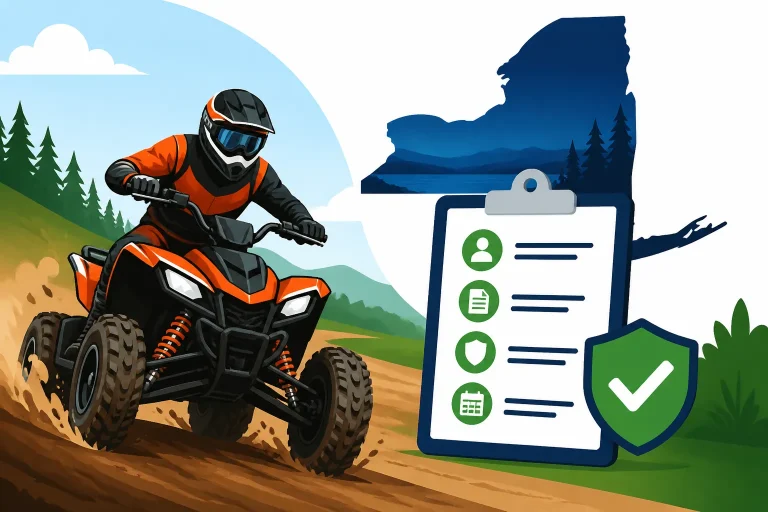
A trail check can be confusing when someone asks for a “permit” and a safety certificate as if they were the same thing. In New York, registration, route access authorization, insurance proof, and a rider’s training certificate serve different purposes. Knowing which document applies to your ride helps you carry the right paperwork and avoid mistaking permission to ride for proof that the machine is registered.
Know Which Document You Are Being Asked to Show
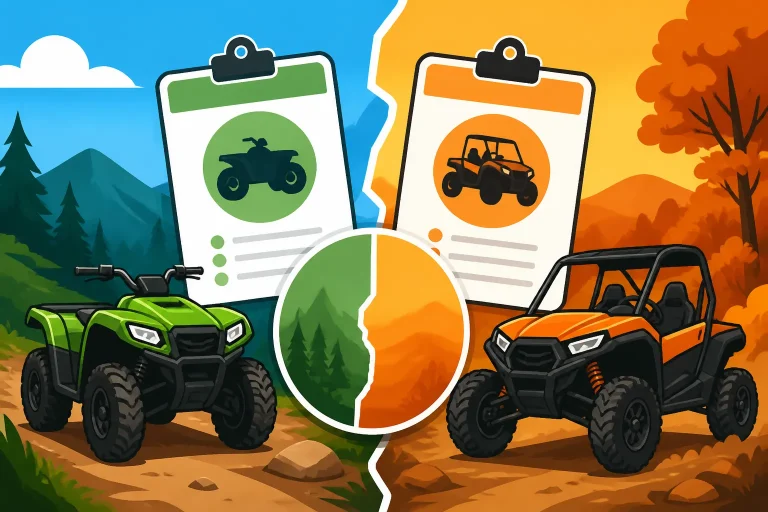
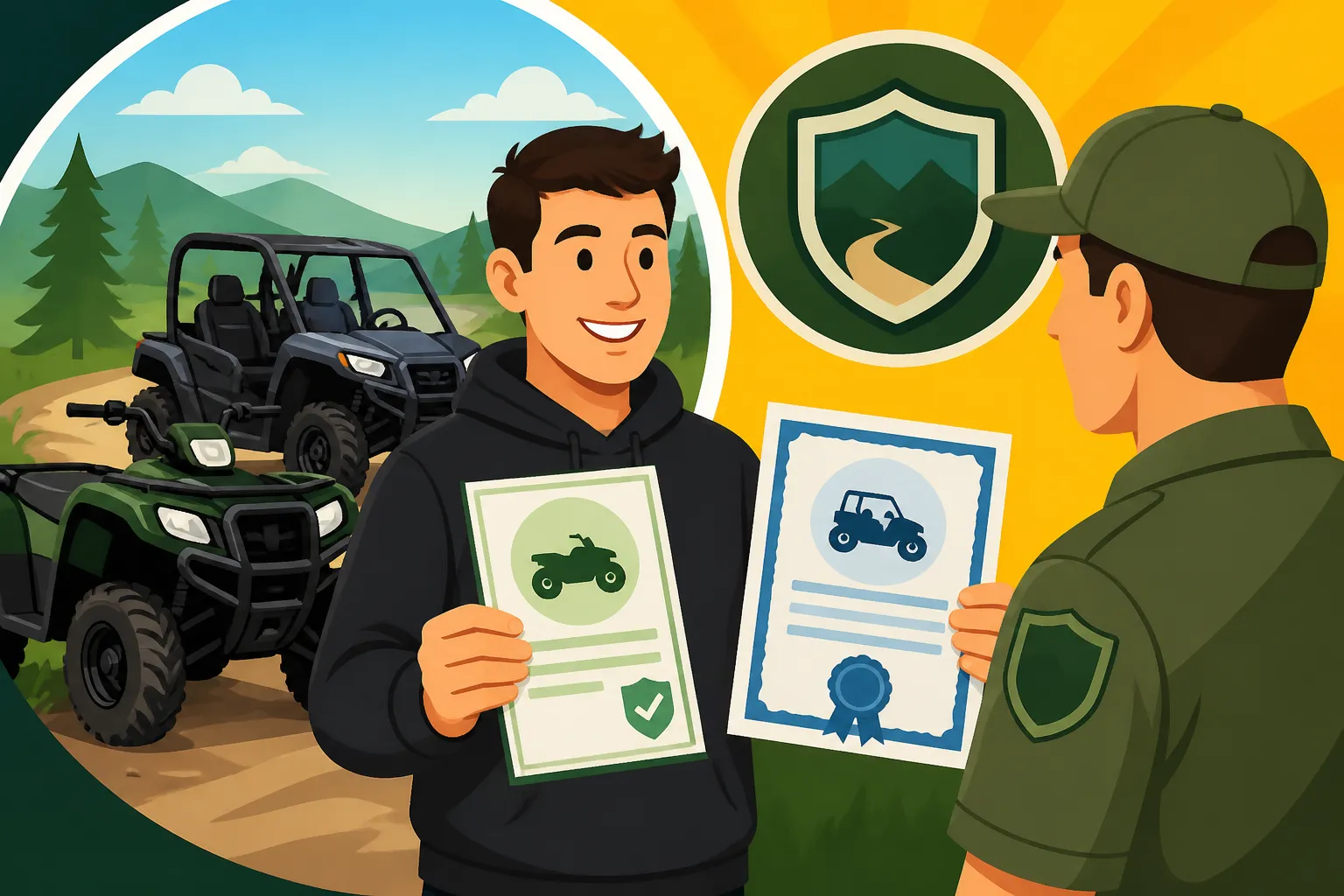
The word “permit” can mean different things in an ATV conversation. It may refer to the ATV’s registration, authorization to use a particular route, or a separate access document issued for a specific program. A safety course completion certificate is different again: it documents a rider’s training, not the machine’s registration or permission to use a trail.
According to the New York State Department of Motor Vehicles, operators must carry the ATV’s registration document while operating the machine. The registration is the basic document connecting the ATV to its New York registration. If an officer asks to see it, the registration document—not just the plate or a phone photograph of paperwork—is what the DMV says operators must carry.
The DMV also says that operators must produce the registration certificate upon demand by a police officer, peace officer, or magistrate. If you are unsure what paperwork is involved in registering a machine, New York ATV Registration Paperwork explains the documents to prepare.
A safety course completion certificate has a narrower role. According to the New York State Department of Motor Vehicles, operators who are required to complete an approved safety training course must carry and present that certificate. The relevant example in the DMV rules is a rider aged 14 to 15 who operates independently on permitted property. The certificate proves course completion; it does not replace the ATV registration.
A route permit or other access authorization is a separate question. Some locations require particular permission to use a route, and a document issued for that access does not automatically serve as proof of registration or training. For example, the New York State Department of Environmental Conservation allows ATV use on specific routes designated for its Motorized Access Permit for People with Disabilities. On State Forest lands, the DEC says ATV operation is unlawful unless the route is specifically designated by posting or by permit.
| Document | What it relates to | When it matters |
|---|---|---|
| ATV registration document | The machine’s registration | Carry it while operating; produce it when an authorized officer requests it |
| Safety course completion certificate | The rider’s training | Carry and present it when the rider is required to complete an approved course |
| Route permit or access authorization | Permission to use a particular route or program | Check the rules for the specific trail, land, or access program |
| Proof of insurance | Liability coverage for the ATV | Show it to a judge, police officer, or person making an injury or property-damage claim |
The easiest way to avoid a document mix-up is to ask what the request relates to: the ATV, the rider, the route, or insurance. A plate can show that a machine has a plate attached, but it is not a substitute for carrying the registration document. A training certificate cannot authorize trail access, and a route permit cannot stand in for the machine’s registration.
When Riders Need a Safety Certificate
New York does not require an ATV driver license, but age-related operating rules still apply. According to the New York State Department of Motor Vehicles, restrictions apply to operators under 16. The certificate requirement is tied to the rider’s age and circumstances—not simply to the fact that someone is riding an ATV.
For an operator aged 14 to 15, the DMV describes different ways the rider may operate: under adult supervision, without adult supervision on land owned or leased by a parent or guardian, or independently on permitted property with a DMV-approved safety-training course certificate. A rider in that age group who operates independently on permitted property must carry the course certificate.
The DMV defines adult supervision as being accompanied by a person at least 18 years of age, or by a person aged 16 or 17 who holds an ATV safety course completion certificate from the ATV Safety Institute. A young rider should not assume that a parent’s permission or a trail pass alone satisfies a supervision or training requirement.
For an operator under 14, the DMV says riding without adult supervision is allowed only on land owned or leased by the rider’s parent or guardian. The DMV also permits operation under adult supervision. These rules make it important to distinguish permission to be on a property from eligibility to ride without supervision.
If you are checking what training applies to a young rider, see New York ATV Safety Certificate Requirements and New York Trail Access for Riders Under 16. For a quick pre-ride check, confirm the rider’s age, whether supervision is required, whether the property or route is permitted for ATV use, and whether the rider must carry a course certificate.
A certificate should be kept somewhere it can be produced if requested, rather than buried in a bag or left at home. A clear paper copy can be useful as a backup, but keep the original document available when the applicable rules require it. If you store paperwork in a pouch, make sure it remains legible and does not get soaked, torn, or separated from the rider who needs it. Amazon is one place to compare waterproof document pouches, though any secure, practical storage option can work.
Check the Route Permit Separately
A machine’s registration does not mean it can be ridden on every trail or public land. Registration identifies the machine for state requirements; access depends on where you plan to ride and the rules of the land or route.
The New York State Department of Motor Vehicles says ATVs may be operated on public lands where signs indicate that ATV use is allowed. On private property, the DMV says an operator needs the property owner’s permission. The DMV also says ATVs cannot be operated on public highways unless the highway has been designated and posted for ATV use.
State Forest rules are more specific. According to the New York State Department of Environmental Conservation, operating an ATV on State Forest lands is unlawful unless the use is specifically designated by posting or by permit. The DEC also identifies specific routes for people with qualifying disabilities through its Motorized Access Permit program. A permit for such a route should not be treated as a general pass for other state land or trails.
Before setting out, check what the access document covers. Confirm the issuing organization, the land or trail named on it, any limits on route use, and whether the authorization is valid for the intended ride. If the route crosses different land types, verify the rules for each portion. A document issued for one trail system may not grant access elsewhere.
New York honors valid out-of-state ATV registrations, according to the New York State Department of Motor Vehicles. However, the DMV says that if an operator’s home state does not require ATV registration, the operator must obtain a New York State ATV registration before operating in New York. Reciprocity addresses registration; it does not by itself establish that every route is open to the machine. New York ATV Reciprocity With Other States covers that distinction, and [New York Rules for Riding Public Land] can help with the separate access question.
It is also worth checking that the machine itself meets the state’s ATV definition before relying on a registration or route document. According to the New York State Department of Motor Vehicles, an ATV cannot exceed 70 inches in width or weigh more than 1,000 pounds. A permit or registration document should not be assumed to make a machine eligible where it otherwise does not meet the applicable definition.
Prepare for a Document Check
A calm, organized response is easier when your paperwork is together and you know what each item proves. Before riding, match the documents to the trip instead of carrying a stack of unrelated papers and hoping one will satisfy every request.
Use this practical check before loading the machine:
- Confirm registration. Make sure the registration is current and carry the registration document. According to the New York State Department of Motor Vehicles, new and used ATV registrations first issued in New York expire each year on August 31; ATVs originally registered before April 1, 2005, continue to expire each year on April 30.
- Check reciprocity if the ATV is registered elsewhere. The DMV honors valid out-of-state ATV registrations, but a visitor whose home state does not require registration must obtain New York registration before operating in the state.
- Check the rider’s age and training status. If the rider is required to complete an approved safety course, carry the completion certificate and be ready to present it. Make sure any applicable supervision rules are also met.
- Verify access. Check that ATV riding is allowed on the particular property or route and carry any access permit that applies to that place or program. Do not treat registration as trail permission.
- Carry insurance proof. The DMV requires liability insurance to operate an ATV anywhere in New York State except on the owner’s property. The DMV says proof of insurance must be shown to a judge, police officer, or a person making a claim of injury or property damage. See New York ATV Registration and Insurance Proof for the distinction between registration and insurance documents.
If someone asks to see paperwork, listen for the document they mean. An officer asking for registration is asking about the machine’s registration document. A request for a safety certificate concerns the rider’s training when the rider is subject to that requirement. A trail steward or land manager may be checking access permission for the route. If you have multiple documents, offer the one that answers the request and ask politely if the person needs another specific record.
Keep papers protected but accessible. A registration document folded into a wallet or placed in a sealed pouch is generally easier to produce than papers stored loose under tools or gear. Keep a young rider’s required certificate with that rider or in a location the rider can readily access. A photo on a phone can be a useful backup for your own records, but do not assume that a digital image replaces a document the DMV says must be carried and presented.
For groups, each rider should know where their own required papers are. One person holding every document may not help if another operator is asked to produce a certificate. Before the ride, make sure everyone understands which papers belong to the ATV, which belong to the rider, and which authorize access to the route. If a trail system has its own access process, confirm that with the organization responsible for the trail rather than assuming the state registration covers it.
Frequently Asked Questions
Is an ATV registration the same as a trail permit?
No. Registration concerns the machine; a trail permit or access authorization applies to a particular route, land area, or program. Check the requirements for the place where you intend to ride.
Does every ATV rider need to carry a safety certificate?
No. According to the New York State Department of Motor Vehicles, riders who are required to complete an approved safety training course must carry and present the completion certificate. The requirement depends on the rider’s circumstances.
Does an out-of-state registration let me ride any New York trail?
No. The DMV honors valid out-of-state ATV registrations, but route access is separate. Check whether ATV use is allowed on the specific trail or property and whether additional authorization is required.
Is a driver license required to operate an ATV in New York?
No. The New York State Department of Motor Vehicles says a driver license is not required, although restrictions apply to operators under 16.
Sources
- New York State Department of Motor Vehicles — Register an ATV | NY DMV (checked November 3, 2026)
- Department of Motor Vehicles — ATVs: Information for Owners and Operators | NY DMV (checked November 3, 2026)
- New York State Department of Environmental Conservation — chatatvpl.pdf (checked November 3, 2026)
Disclaimer
This article is for general informational purposes only and does not constitute professional advice. Laws, prices and regulations vary by location and change over time. Consult a qualified professional for guidance on your specific situation.