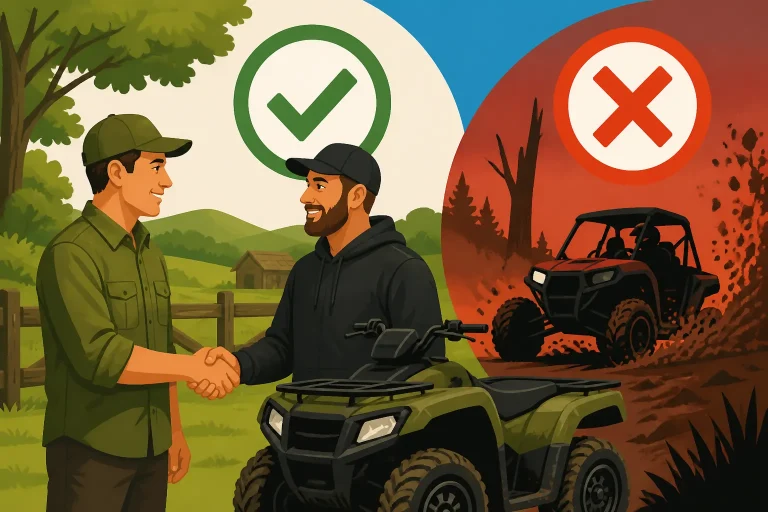
Renting a Machine to a Fifteen-Year-Old
Renting an ATV to a 15-year-old in New York is not just a question of whether a rental shop will hand over the keys. The rider’s age, safety training, supervision, machine type, insurance and intended riding area can all matter. Check those pieces before paying or signing a waiver, because permission from a rental business does not override New York’s operating rules.
Can a 15-year-old legally ride a rented ATV in New York?
A 15-year-old may be able to operate an ATV in New York, but age alone does not settle whether a particular ride is allowed. The rules for riders under 16 depend on factors such as where the machine will be used, whether the minor has an approved safety certificate and whether the required adult supervision is in place. Review New York Rules for a Rider Aged 15 and New York Supervision Rules for Minors for the specific age-related conditions.
The important practical point is that a rental shop’s minimum age and the state’s operating rules are separate checks. A business might set its own age requirement, refuse to rent to minors, require a parent or guardian to sign, or impose supervision conditions. Meeting the business’s policy does not automatically establish that the teen can operate legally at the planned location.
The reverse is also true: even if a 15-year-old appears to meet a state rule for a particular kind of riding, the rental company may still decline the rental or require an adult to be present. Ask the shop to explain its requirements before you book, and give the business the rider’s actual age rather than assuming an adult can sign paperwork on the teen’s behalf.
Confirm the safety-training and supervision conditions
Ask whether the 15-year-old needs an ATV safety certificate for the planned ride, and what supervision is required if the rider has one—or does not. A certificate can affect what a minor is permitted to do, but it should not be treated as a universal pass to ride alone anywhere. Location rules and other restrictions still apply. New York ATV Safety Certificate Requirements explains the certificate question in more detail.
If supervision is required, clarify what “supervision” means for that rental and route. Ask whether the adult must ride alongside the teen, whether the adult must be on the same machine or simply accompany the group, and whether the requirement changes on public or club trails. Do not rely on a vague assurance that an adult will be “nearby.” Confirm that the arrangement meets the applicable rule and the rental company’s policy.
An adult’s presence also does not make an unsuitable ride safe. The adult should be able to monitor the teen, understand the route and respond if the machine stalls, tips or becomes separated from the group. A fast group ride on unfamiliar terrain may be a poor match for a first-time 15-year-old, even if the paperwork is in order.
Make sure the machine is an ATV, not just a vehicle the shop calls one
Rental listings sometimes use broad terms such as ATV, UTV, side-by-side or off-road vehicle. Those labels are not interchangeable for New York rules. A UTV or side-by-side can be subject to different registration and access issues than a qualifying ATV. Before booking, ask for the machine’s make, model and type, and confirm that the exact vehicle is permitted on the route you plan to ride. See New York Rules for Riding a Rented ATV and Why Most Side-by-Sides Cannot Be Registered in New York.
Do not assume that a machine is eligible for a trail because it is offered for rent nearby. A rental business may operate on private land, on a route with its own restrictions, or in an area where a particular machine type is allowed but not permitted elsewhere. The machine’s dimensions and registration status can matter too. If you are considering a side-by-side, ask directly whether that specific unit may legally use the intended route in New York.
What to verify with the rental company before paying
Call or message the company before putting down a deposit. Describe the trip honestly: the rider is 15, whether they have a safety certificate, who will supervise, and where you hope to ride. Ask the business to confirm its current rules for that exact situation. Get important answers in writing when possible, especially if the booking information is brief or unclear.
| What to check | Questions to ask | Why it matters |
|---|---|---|
| Minimum age | Does the company rent to a 15-year-old operator? | The company may have a stricter policy than the state rules. |
| Adult involvement | Must a parent or guardian sign, attend, ride, or supervise? | A signature alone may not meet operating or business requirements. |
| Safety certificate | Is a certificate required for this rider and route? | A minor’s training status can affect the conditions for operating. |
| Machine type | Is the rental an ATV, UTV or side-by-side? | Different machine types may have different registration and route eligibility. |
| Training and fit | Is instruction provided, and is the machine suitable for the teen? | A machine should match the rider’s ability and physical size. |
| Registration and insurance | Is this specific machine properly registered and insured for the planned use? | A rental contract does not by itself prove either requirement is satisfied. |
| Trail access | Does the rental include access to the intended trail or park? | Local permits, club rules and land access may be separate from the rental. |
| Waiver and coverage | Who signs, what risks are excluded, and what happens after damage? | Waivers and insurance terms can allocate costs without changing state law. |
Ask what the rental includes, but do not treat “all paperwork handled” as a complete answer. Request confirmation that the machine may be used on the route you intend to ride, and ask what documents the teen and accompanying adult should carry. If the business cannot answer a basic question about age, supervision, registration or route access, pause the booking until it can.
Read the waiver and damage terms carefully
A waiver is not a substitute for checking the law, and signing one does not make an otherwise prohibited ride lawful. Read the full agreement before the rental begins. Look for terms covering damage, recovery after a breakdown, late returns, passenger use, prohibited areas, required protective equipment and who is responsible if a rule is broken.
For a minor, ask who must sign and whether the adult has to remain at the rental location or accompany the ride. Do not assume a parent’s signature transfers every responsibility away from the rider or guarantees insurance coverage. If a term is unclear, get an explanation before signing rather than relying on what another renter says.
Check whether the rental includes protective gear and whether the teen must bring anything. Ask about helmets, eye protection and clothing suited to the route and weather. If the company supplies a helmet, confirm it fits securely; an ill-fitting helmet is not a useful safety measure. A rental may include equipment, but riders should verify rather than assume.
Match the vehicle to the teenager
The vehicle should be manageable for the rider, not simply the largest model available. Ask the business whether the machine is intended for a rider of the teen’s age, height and experience. A teen who has never operated an ATV should say so. Request a basic orientation and a chance to understand the controls before entering a trail or riding area.
A larger or more powerful machine is not automatically a better rental. Weight, throttle response, braking, ground clearance and the rider’s ability to reach the controls all affect how manageable it is. If the teen cannot comfortably operate the controls or follow instructions in a flat, open area, do not proceed to rough terrain. A rental employee’s approval does not replace an honest assessment of the rider’s ability.
Passenger rules matter too. Do not put another person on a machine unless it is designed and equipped to carry a passenger and the applicable rules allow it. A rider under 16 may face additional restrictions, and a passenger cannot make an unsafe machine safer. Check New York Rules for a Passenger Under 16 before planning to ride two-up.
Registration, insurance and trail access are different checks
A rental contract may say that a machine is registered or insured, but that does not automatically answer every question about the planned ride. Ask the company to confirm the status of the exact machine and the route. For background on the state requirements, see New York ATV Registration and New York’s Mandatory ATV Insurance.
Registration is not the same as a trail permit. New York does not have one statewide trail pass that automatically opens every route. Counties, clubs, parks and private operators may set separate access requirements. A rental company might include a permit or arrange access for a particular route, but do not assume that a permit provided for one system covers another. Confirm the location, dates, machine type and rider conditions with the entity responsible for the trail.
This matters especially when a rental business advertises “trail access.” Ask what that means in practical terms: Is the machine allowed on the named trail? Is a county or club permit required? Does the rental fee include it, or must you obtain it separately? Are there restrictions on age, machine width, passengers or operating hours? The answer should apply to the actual trail, not just to the general area.
Check insurance and responsibility for a minor
Ask what insurance applies to the rental, what it covers and what the renter may still have to pay. Do not assume that the rental company’s policy covers every injury or every kind of property damage. Ask whether the policy covers the 15-year-old as an operator, whether there are exclusions for minors or unapproved routes, and what happens if the machine is damaged or recovered after getting stuck.
New York’s insurance requirements and a rental contract’s coverage are related but not identical questions. A business may require the renter to show proof of coverage, offer a separate option or set terms for the person signing the agreement. Confirm the details directly, and ask for the relevant terms in writing. More context is available in New York ATV Insurance Requirement.
Parents and guardians should also understand that renting the machine does not remove their responsibility to make a sensible decision about the teen’s readiness. A safety certificate, adult supervision and insurance do not eliminate the possibility of injury or damage. If the rider is inexperienced, choose a beginner-friendly setting and a route that allows close oversight, or postpone the ride.
A practical plan for a safer, compliant rental
Use this sequence before the rental day:
- Identify the exact machine and riding area. Find out whether the rental is an ATV or a UTV, and name the specific trail, park or private riding area.
- Confirm the teen’s eligibility. Check the requirements that apply to a 15-year-old, including any safety-certificate and supervision conditions for that location.
- Ask the rental company about its policies. Confirm its minimum age, adult-signature rules, supervision requirements and whether the teen may operate the specific machine.
- Verify registration, insurance and access. Ask whether the machine is covered for the intended use and whether a separate trail permit or permission is needed.
- Review the contract before signing. Check the waiver, damage responsibility, equipment rules and restrictions on passengers or routes.
- Choose a suitable ride. Match the machine and terrain to the teen’s experience, and make sure the accompanying adult can supervise effectively.
- Stop if a requirement is uncertain. Do not treat a verbal “it should be fine” as confirmation of age eligibility or legal trail access.
If a rental business says a 15-year-old can ride without explaining the relevant conditions, ask for clarification before accepting the keys. If the route crosses public roads, private land or more than one trail system, check each portion separately. Permission to ride one section does not necessarily authorize riding the next one.
A good rental plan should leave no guesswork about who operates the machine, where it may go, what supervision is required and what happens if something goes wrong. When a shop cannot confirm those points—or when the teen is not comfortable controlling the vehicle—the safer choice is to select another activity or wait until the conditions are clear.
Disclaimer
This article is for general informational purposes only and does not constitute professional advice. Laws, prices and regulations vary by location and change over time. Consult a qualified professional for guidance on your specific situation.