Permission Before You Ride Someone’s Land
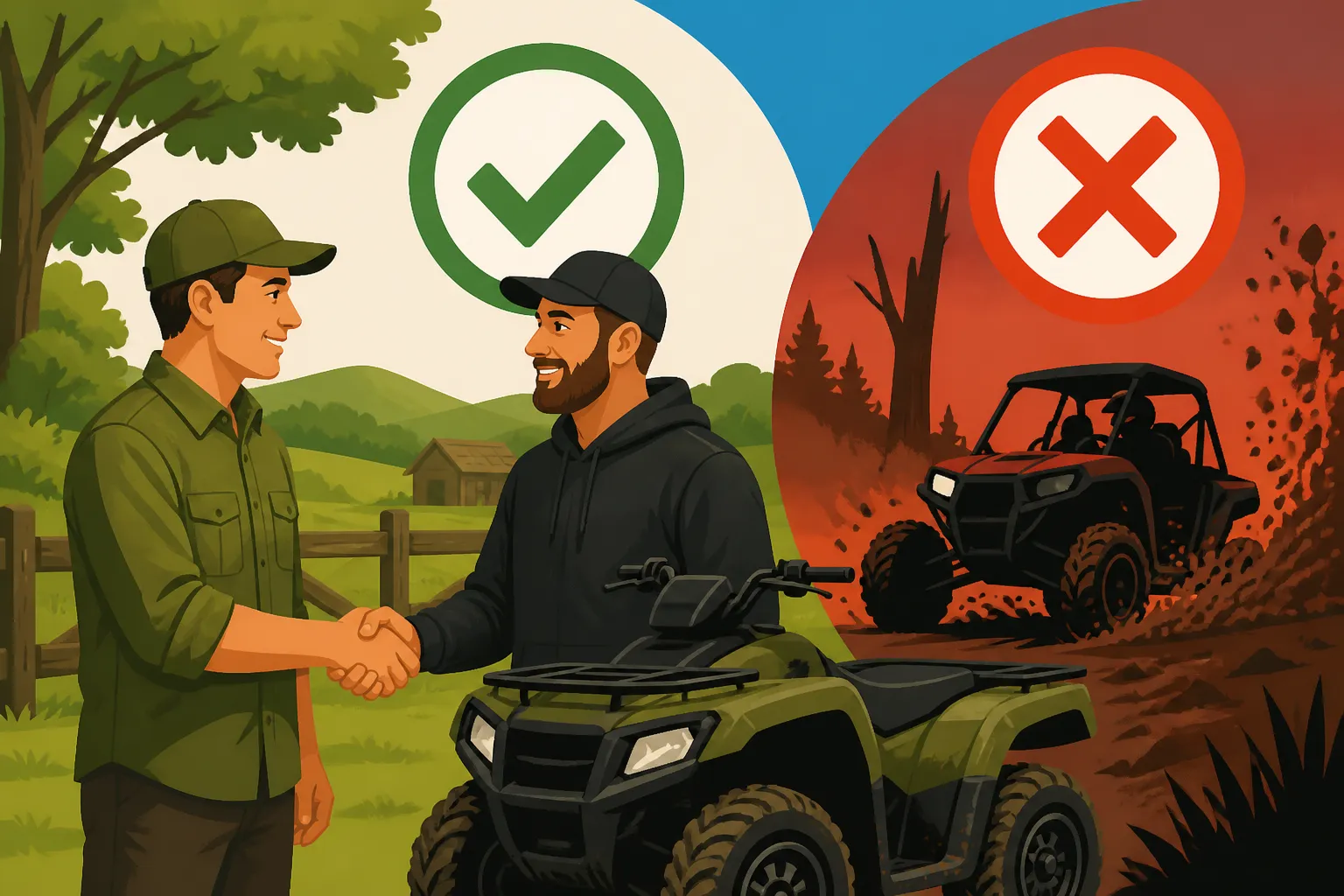
Riding an ATV or UTV across private land in New York is not allowed just because a gate is open or a trail looks familiar. Get permission from someone with authority over the property, agree on where and when you may ride, and keep a record. These steps help prevent trespass disputes and clarify what your permission actually covers.
Get Permission From Someone Authorized to Give It
Before unloading a machine or entering a trail, ask the landowner or another person who has clear authority to allow ATV or UTV access. That could be a tenant, property manager, farm operator, or club representative, but do not assume every person working on the property can approve recreational riding.
A neighbor’s casual assurance may not be enough if they do not own or control the land. Likewise, permission to park, hunt, hike, or retrieve an animal does not automatically include permission to ride. If the person granting access is not the owner, ask what authority they have and whether the owner’s approval is needed.
New York’s private-land rules depend on having permission, but the practical question is often how to show that permission was given and what it covered. A clear conversation is a useful start. A text message, email, or signed note gives both sides a more dependable record. For more on the distinction, see New York Landowner Permission Rules and Written Permission From a New York Landowner.
Do not treat these as permission:
- No “No Trespassing” sign
- An unlocked gate or open driveway
- Tire tracks from other riders
- A route shown on an old map or app
- Past access that the owner has not renewed
- A neighbor’s assumption that the land is open
The absence of a sign is not an invitation. Nor does one rider’s access establish a general right for other riders. If you are uncertain, stop and ask before entering.
What permission should cover
Permission is most useful when it answers specific questions rather than simply saying “you can ride here.” Confirm:
- Which parcel or route is included
- Where you may enter and park
- Which trails, fields, or roads are open
- Whether the permission applies to ATVs, UTVs, or both
- Which dates, hours, or seasons are allowed
- Whether guests may come with you
- Whether passengers, dogs, or trailers are allowed
- Whether riding is limited by weather, farm work, hunting, or other activity
- Whether you must stay on marked routes
- Who to contact if a gate is locked or conditions change
A text message can work well if it clearly identifies the property and boundaries. For a recurring arrangement, a signed note or written agreement may be easier to understand later. Keep the record available while riding, either as a saved message or a paper copy. A waterproof sleeve can help protect a paper note from rain and mud.
Permission is not necessarily a permanent right. The owner may set conditions, limit access to certain dates, or withdraw permission. If the owner closes a route or tells you to leave, do so promptly. If your riding group is large, make sure the person giving permission knows how many machines and riders are expected.
Check the Boundaries, Route, and Conditions
A property can look like one continuous area while including multiple owners, tenants, easements, or public rights-of-way. Permission for one section does not necessarily authorize crossing the next parcel. Before riding, establish where the permitted area ends and identify any gates, crossings, or connecting roads that need separate approval.
A route may also pass through land where a different person controls access. For example, a landowner might allow riding on a field but not on a logging road, or a club may have permission to maintain one marked trail but not to open every trail on the property. Follow the route the owner identifies instead of choosing a shortcut.
| Situation | What to confirm before riding |
|---|---|
| Private field or woods | The owner or authorized occupant has allowed ATV or UTV use on that specific area |
| Farm lane or working farm | The route is open that day and does not interfere with vehicles, livestock, crops, or work |
| Club trail on private land | The trail agreement is active and your membership or access pass meets the club’s rules |
| Hunting lease or recreational lease | The lease allows motorized riding, not only the activity named in the lease |
| Road crossing or connecting route | The road is legally open to your machine and you have permission for each private section |
| Public land | The managing agency has opened that specific route to ATVs or UTVs |
The table is a planning aid, not a substitute for local rules. Permission from a private owner does not make a public road or public-land trail open to motor vehicles. Conversely, a public route’s existence does not grant permission to cross a private parcel to reach it. Public-land access is a separate issue; see [New York Rules for Riding Public Land].
Ask about gates, signs, and changes
Follow the owner’s instructions for gates. If told to close a gate behind you, close it every time. Do not cut a lock, move a barrier, or treat a gate that is open on arrival as ongoing permission. A gate may be open for farm traffic, maintenance, or another authorized user.
Check for temporary restrictions before each ride. A property may be closed during planting, harvest, logging, trail repair, wet conditions, or hunting activity. The owner’s permission can be conditional, and yesterday’s approval may not mean the route is available today. If conditions have changed or you cannot tell whether the route is open, contact the owner rather than guessing.
Stay on the agreed route. Riding off it can damage crops, fences, drainage, sensitive ground, or property that the owner did not intend to open. Avoid spinning tires, making new trails, and entering buildings or work areas. Do not assume that a machine may cross a lawn, driveway, yard, or pasture just because it is on the same parcel.
Understand What Permission Does Not Cover
Landowner permission answers one question: whether you may enter and ride on that land under the conditions the owner set. It does not replace registration, insurance, equipment, age, passenger, or road-use requirements. Nor does it authorize conduct that violates another law or a local restriction.
Before you ride, confirm that your machine can be legally operated in New York and that you have the required documents and equipment. The rules may differ depending on the machine and where it is operated. Start with New York Rules for Riding Private Land and New York ATV Insurance Requirement. If the machine is registered outside New York, check whether that registration is recognized for the riding you plan to do; private-land permission alone does not settle reciprocity.
Permission also does not grant access to a neighboring parcel, a public road, or a trail beyond the property. If the route requires crossing a road, verify that the road is open to ATV or UTV use and follow the applicable crossing rules. Do not ride along a public road merely because the landowner’s driveway connects to it.
Trespass concerns can arise when a rider enters land without consent, goes beyond the agreed route, ignores a clear request to leave, or returns after permission has been withdrawn. Posted signs and other barriers matter, but do not rely on the absence of a sign as a defense for riding without consent. For a closer look at the issue, see New York Trespass Rules for Riders.
A hunting lease deserves particular care. The lease may give a hunter permission to access land for hunting without granting a right to operate an ATV or UTV. Ask the landowner or lease administrator directly, and confirm whether the permission applies during the season and on the route you intend to use. See Does a Hunting Lease Let You Ride the Land? before assuming that one kind of access includes another.
Permission and liability are separate questions
Some riders assume that a landowner’s approval means the owner accepts responsibility for every injury or machine damage. That is not a safe assumption. Rules affecting landowner liability can depend on the circumstances, and permission does not erase a rider’s own responsibilities. A landowner may also have conditions for access or ask riders to avoid particular hazards.
Ride within your ability, use suitable protective gear, and make sure your insurance is appropriate for the activity and location. Do not rely on a verbal statement that “the owner said it was fine” as a replacement for required coverage or safe riding practices.
A Simple Process Before Each Ride
Use this routine when arranging access, especially if you have not ridden the property before or the arrangement has changed.
- Identify who controls the land. Ask the owner, tenant, farm operator, club, or property manager who is authorized to approve riding.
- Request permission for motorized riding. Be direct about whether you plan to bring an ATV, UTV, or both. Do not assume permission for another activity includes riding.
- Confirm the exact area. Ask for a map, marked route, landmarks, or clear entry and exit points. Clarify any crossings and neighboring parcels.
- Agree on timing and conditions. Check dates, hours, weather limits, seasonal closures, farm operations, and hunting activity.
- Ask about other riders and machines. Confirm whether guests, passengers, or a group ride are included.
- Save the agreement. Keep a text, email, signed note, or other record that describes the permission and its limits.
- Check legal requirements separately. Verify registration, insurance, equipment, age, passenger, and road rules for your situation.
- Reconfirm if anything changes. Ask again if the route, landowner, season, group size, or property conditions have changed.
A short, specific request often prevents misunderstandings. For example, ask whether you and a named group may ride a particular marked route on a particular day, where to park, and whether any sections are off limits. That gives the landowner a real chance to set boundaries and makes it easier for everyone to follow them.
If permission is denied, do not argue or ride in anyway. Find a designated riding area or another property where access has been clearly approved. If permission is withdrawn while you are on the land, leave by the route the owner identifies, without damaging property or creating a confrontation. When access is handled clearly and respectfully, it is easier for landowners to decide whether they are comfortable allowing riders back.
Disclaimer
This article is for general informational purposes only and does not constitute professional advice. Laws, prices and regulations vary by location and change over time. Consult a qualified professional for guidance on your specific situation.