Where a Fourteen-Year-Old Takes the ATV Safety Course
A fourteen-year-old can start by looking for an ATV safety course recognized by New York State, rather than booking the first course that appears in a search. Course locations and dates vary, and a completed course is only useful if it meets New York’s requirements. Here’s how to find a suitable class, check the details before registering, and understand what the certificate does—and does not—allow.
Find a New York-recognized course
Start with the ATV safety training information provided by the New York State Office of Parks, Recreation and Historic Preservation, commonly called New York State Parks. Look for its current course listings or instructions for finding an approved instructor. If a location or date is not listed, contact the state program or the instructor named in an official listing to ask about upcoming sessions.
Courses may be offered at different locations, including community venues or through local riding organizations. The key is not simply where the class takes place; it is whether the course is recognized for New York’s ATV safety certificate. A club’s social media post, a retailer’s announcement, or a search result may point you toward a class, but confirm its New York status before enrolling.
Fourteen is the important age to check when searching for a New York certificate course. Before paying, ask the provider to confirm that a fourteen-year-old is eligible to take that particular class and that successful completion leads to the certificate required in New York. A course can be useful for safe riding even if it is not the course that produces the state credential, so be clear about your goal.
| Where you find a class | What to verify before registering |
|---|---|
| New York State Parks course listing | The class is current, the listed age range includes the rider, and the course leads to the New York certificate |
| Local club or community organization | The instructor and course are recognized for New York, not just advertised as general ATV training |
| An online search or course marketplace | The course is accepted in New York and provides the credential the rider needs |
| A course in another state | New York accepts that specific course or certificate for the intended use |
If you are comparing a local class with an online option, do not assume the formats are interchangeable. Ask the provider whether the course includes in-person instruction or a practical component, whether equipment is provided, and what proof of completion the student receives. Then confirm that the result satisfies New York’s requirements. For more background on the credential itself, see The New York ATV Safety Certificate Explained and New York ATV Safety Certificate Requirements.
Availability can change during the riding season. Some classes may have limited seats, require advance registration, or be offered only on selected dates. If a listed session is full, ask whether there is a cancellation list or another nearby class. Check the listing again before traveling, especially if the course involves an outdoor or hands-on portion that could be affected by conditions.
Check age, registration, and class details before you book
Before signing up, confirm three things: the fourteen-year-old meets the class’s age rules, the course is accepted by New York, and the certificate issued after completion is the one the rider needs. These checks are worth making directly with the course contact. A listing that says “youth ATV course” may not explain all three.
Ask the provider specific questions. Is a parent or guardian required to register the student or attend? Does the student need identification? Is there a written test, a riding exercise, or both? Must the family bring an ATV, helmet, or other equipment? What happens if the student misses part of the class or does not pass an assessment? The course listing may answer some of these questions, but it is better to resolve the rest before the class date.
A fourteen-year-old should also be prepared to follow the provider’s safety directions even if they already ride at home. Familiarity with a family machine is not a substitute for training. The class may cover safe starting and stopping, protective equipment, hazard awareness, riding within the machine’s limits, and how to respond to changing trail conditions. The actual curriculum and format depend on the course, so rely on the instructor’s current instructions.
Use a simple checklist when comparing sessions:
- Confirm the age requirement. Ask whether the student can enroll at fourteen and whether any adult must complete registration.
- Confirm New York acceptance. Ask whether the course results in a New York ATV safety certificate, rather than only a provider’s completion card.
- Check what the student must bring. Follow the listing’s directions about clothing, helmets, machines, paperwork, and arrival time.
- Ask about attendance and testing. Find out whether the student must attend the full session and how successful completion is determined.
- Save the confirmation. Keep the course date, location, instructor contact, and any registration receipt or email where an adult can find them.
If the family is considering a course outside New York, verify recognition before enrolling. A certificate from another state may not automatically meet New York’s requirements. The same caution applies to an online course: check acceptance with the New York program, not only with the website selling the course. The separate issue of out-of-state credentials is covered in Does New York Accept an Out-of-State Safety Certificate?.
Parents should also consider the rider’s actual experience and comfort. A fourteen-year-old who has never operated an ATV may need more practice and closer support than a teenager who has ridden on private property for years. Conversely, an experienced young rider can still benefit from learning the rules and building safer habits. Choose a class for the instruction it provides, not just for the quickest path to a card.
Understand what the certificate allows
A safety certificate is not a general permission slip to ride any ATV, on any land, or without an adult. New York has separate rules about a young rider’s age, supervision, the machine, and where it is operated. The certificate may matter for a fourteen-year-old, but it does not cancel those other requirements.
Before a newly certified rider goes out, check the rules for the specific situation: the rider’s age, the ATV’s size and type, the landowner’s permission, and whether the trail or route is open to ATVs. Requirements can differ between private property and public or organized riding areas. A trail operator may also have access conditions of its own. See What a Fourteen-Year-Old May Ride With a Safety Certificate and General Supervision by Someone Eighteen or Over for related details.
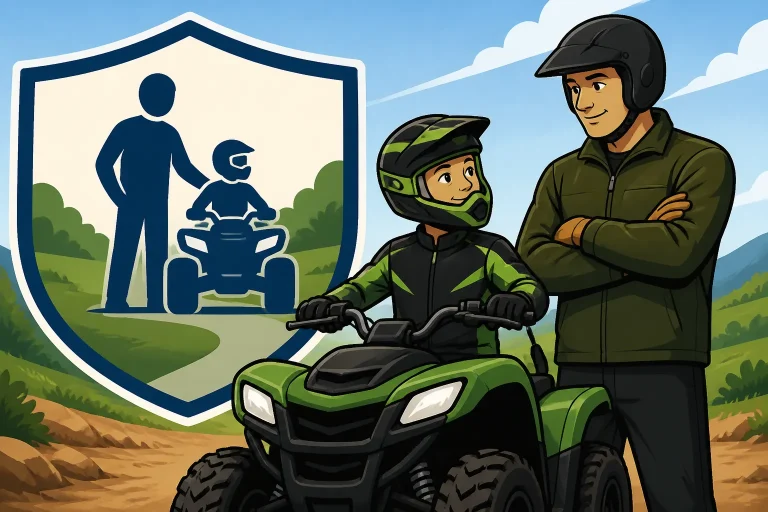
Do not infer that a certificate means the rider can travel alone. A young person may still need to ride with an adult or be supervised under the applicable rules. Check the current requirements for the rider’s age and intended riding location before setting out. The rules for a fourteen-year-old are not necessarily identical to those for a fifteen-year-old, so avoid relying on a friend’s or sibling’s experience. New York Rules for a Rider Aged 14 explains the age-specific issue, while Can a Fifteen-Year-Old Ride Alone With a Certificate? addresses the next age group.
The certificate also does not make an unsuitable machine appropriate. A young rider needs an ATV that fits their size, strength, and experience and that complies with the rules for that rider. Follow the manufacturer’s guidance and the course instructor’s advice. A machine that is too large or powerful can be difficult to control, particularly on hills, loose ground, or uneven trails.
Finally, plan for the rest of the ride. Check that the route is open and that the machine is properly registered where required. Review helmet, insurance, and equipment requirements, and make sure the rider knows who to contact if the group becomes separated. A course is one part of preparation, not a replacement for checking the rules that apply on the day. Related information is available in New York Supervision Rules for Young Riders and New York Trail Access for Riders Under 16.
Make the course useful beyond the certificate
A good course should leave the teenager and supervising adult with practical habits they can use every time they ride. After class, ask the student to explain the main safety points in their own words: how they will check the machine, where they will ride, what protective gear they need, and what they will do if conditions change. This is a helpful way to identify questions that did not come up during the session.
Treat the certificate as a reason to plan a supervised first ride, not as a reason to increase speed or take on more difficult terrain. Choose a legal route that matches the rider’s skill level. Keep the group together, agree on a stopping point, and make sure the adult knows how the young rider will signal a problem. On unfamiliar trails, narrow or technical sections can be more challenging than they appear on a map.
Keep the certificate or proof of completion in a safe, accessible place. Ask the course provider whether the student receives a physical card, a digital record, or another form of documentation, and what to do if it is delayed or lost. Carrying proof may be useful when a riding location requires it, but it does not replace any other paperwork or safety equipment the rider must have.
If the course provider cannot clearly say whether a fourteen-year-old is eligible or whether the certificate is recognized in New York, pause before registering. Contact the state program for clarification. That small check can prevent a family from spending time and money on a course that does not meet its intended purpose. Then verify the rider’s supervision and machine rules separately before the first trip.
Disclaimer
This article is for general informational purposes only and does not constitute professional advice. Laws, prices and regulations vary by location and change over time. Consult a qualified professional for guidance on your specific situation.