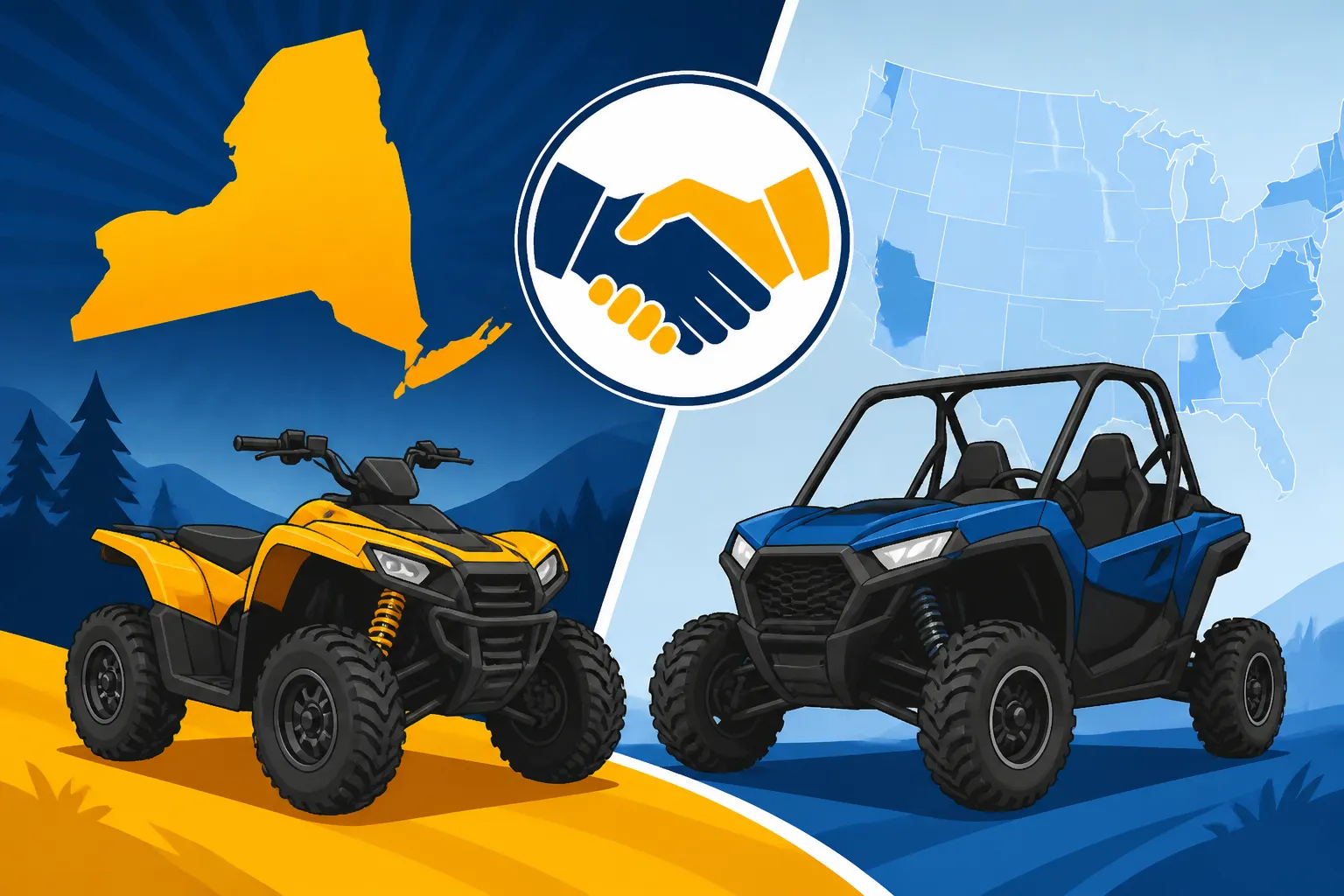
New York Reciprocity for Out-of-State Registrations
A current ATV registration from another state can often let a visitor ride in New York without getting a second registration. But that recognition is not a statewide trail pass, and it does not replace New York’s insurance, safety or access rules. The key is to confirm that the machine and its paperwork qualify before you travel, then check the rules for the specific riding area.
What reciprocity does and does not cover
New York generally recognizes a valid ATV registration issued by another state for a nonresident’s machine. That recognition can spare a visitor from obtaining a New York registration solely to ride while visiting. It is about the machine’s registration status—not blanket permission to ride wherever an ATV can physically go.
A valid out-of-state registration does not automatically provide:
- A permit for a county trail system or private club trail.
- Permission to use a road, trail, farm lane or private property.
- An exemption from New York insurance, helmet or equipment rules.
- Proof that a particular side-by-side or other wide machine is allowed on New York trails.
- Permission to ride if the home-state registration is expired, suspended or otherwise invalid.
The distinction matters because New York has both statewide operating rules and access rules set by local governments, landowners and trail operators. A visitor can have valid registration and still be turned away at a trailhead for lacking a local permit or riding a machine that does not meet that system’s requirements.
| Question | What out-of-state registration may do | What it does not do |
|---|---|---|
| Does the machine need a New York registration? | A valid registration from the visitor’s home state is generally recognized for a nonresident’s machine. | It does not make an expired or invalid home-state registration acceptable. |
| Can the machine use a county trail? | It may satisfy a registration requirement, depending on the trail system. | It does not replace any required county permit, club membership or landowner permission. |
| Does it cover insurance? | It may help establish the machine’s registration status. | It does not prove the policy meets New York’s requirements or covers the planned riding. |
| Does it make every machine eligible? | It provides evidence that the home state recognizes the machine. | It does not guarantee that New York or a local trail system will treat every UTV as an eligible ATV. |
| Can the rider use public roads? | It may satisfy a registration-related part of the rules. | It does not make a road open to ATVs or turn an ATV into a street-legal vehicle. |
If you want to confirm the basic registration question first, see Does New York Honor an Out-of-State ATV Registration?. The practical answer depends on the rider’s residency, the machine’s status and the paperwork carried on the ride.
Reciprocity also depends on the registration being real and current. A bill of sale, an application that has not been approved, or a plate with an expired registration should not be treated as equivalent to valid registration. When in doubt, contact the agency that issued the home-state registration and the New York authority or trail operator responsible for the place you plan to ride.
Confirm the machine and registration before you travel
Start with the registration document, not just the plate. Check that it identifies the correct machine, is current for your travel dates and belongs to the person or household bringing the ATV. Compare the vehicle identification number on the paperwork with the number stamped on the machine. A mismatch can create a problem at a roadside stop or when a trail operator checks documents.
A visitor should also confirm that the vehicle is recognized as an ATV under the relevant rules. New York’s ATV definition has limits, and a machine’s marketing name does not settle its legal classification. A vehicle sold as a UTV, side-by-side or recreational vehicle may not be treated like a conventional quad for every New York registration or trail-access purpose. If the machine is wider or heavier than New York’s ATV limits, do not assume that an out-of-state plate resolves the issue. Review New York’s 70-Inch Width Limit, New York’s 1,000-Pound Weight Limit and Why Most Side-by-Sides Cannot Be Registered in New York.
This does not mean every out-of-state side-by-side is automatically barred from every location. It means the visitor should get a clear answer for the specific vehicle and destination before loading it. A private riding park, a club trail and a public trail system can have different eligibility rules. Ask the operator whether the machine’s make, model, width, weight and registration type are accepted—not simply whether “out-of-state plates” are allowed.
Check the registration carefully
Before departure, verify the following:
- The registration is current. Check the expiration date and any conditions attached to the registration.
- The machine details match. Compare the identification number and vehicle description with the machine.
- The registration is issued by the proper authority. A receipt or dealer document may show that an application was submitted without showing that registration was granted.
- The display requirements are clear. Follow the home state’s plate or decal rules, and check whether the destination has additional display requirements.
- The rider can produce the document. Keep the registration accessible during the ride, not buried in a trailer or left at home.
The registration rules may differ depending on where the visitor lives. For examples of nearby-state questions, see New York Reciprocity With Pennsylvania and New York Reciprocity With Vermont. A visitor arriving from Ontario should check New York Reciprocity With Ontario as well. Do not assume that one state’s process or document format applies to another.
If the home jurisdiction does not issue ATV registration, or does not require registration for the machine, the visitor should not assume that the machine is automatically exempt in New York. The obligation may depend on how New York treats that machine and where it will be used. Ask the relevant state agency or destination operator whether New York registration is required before riding. The article Why an Out-of-State Rider Must Register in New York explains why a visitor’s home-state rules can affect the answer.
Keep documents together
Carry the registration and insurance proof in a secure place. A sealed document pouch can help protect paper from rain and mud; some riders use a pouch sold by a powersports retailer or Amazon. Make sure the documents remain readable and are not attached where heat, water or vibration could damage them.
Do not rely on a photo alone unless the relevant authority or trail operator confirms that a digital copy is accepted. A clear phone image can be a useful backup, but it is safer to carry the original registration or an accepted copy.
Insurance and rider rules still apply
Registration reciprocity is not insurance reciprocity. A policy issued in another state may cover the machine, but the rider should confirm that it meets New York’s requirements and covers the type of use planned. A policy designed for storage, farm use or riding only on the owner’s land may not cover a trip on a New York trail.
Before travel, ask the insurer to confirm:
- The ATV or UTV is listed on the policy.
- Liability coverage applies while riding in New York.
- The policy covers the intended type of riding, including trail use if applicable.
- The policy is active for the travel dates.
- The rider can obtain proof of coverage to carry.
New York’s insurance rules apply to visitors as well as residents. Review New York ATV Insurance Requirement and New York ATV Insurance Minimum Coverage for more detail. If you are unsure whether a particular policy qualifies, ask the insurer directly rather than relying on the fact that the machine is registered in another state.
The same principle applies to helmets, passengers and equipment. An out-of-state registration does not excuse a rider from New York rules. Before setting out, check the applicable requirements for the machine and the people riding it. The New York Helmet Law for ATV Riders and New York Equipment Requirements for ATVs are useful starting points.
For young riders, do not assume a home-state age rule or safety credential settles what is permitted in New York. Check the age, supervision and training requirements that apply to the ride and destination. A visiting family should confirm that each child may operate the specific machine under New York rules, and that any required adult supervision is available.
A registration document is also not a driver’s license or a road-use permit. ATVs are not generally made street legal simply because they carry an out-of-state registration. New York allows riding on certain roads only under specific conditions, such as where a road has been designated and posted for ATV use. See New York’s Designated and Posted Roads before planning a route that includes road access or crossings.
Trail permits and local access are separate questions
New York does not have one statewide ATV trail permit that grants access to every trail. Counties, clubs, parks and private landowners manage different areas, and each may set its own access conditions. A registration recognized under reciprocity may satisfy a vehicle-registration requirement while leaving the trail permit requirement untouched.
Start by identifying the exact trail system, not just the county or general region. Then check the official trail operator’s current rules for:
- Whether a permit is required.
- Whether permits are available to nonresidents.
- Whether a separate permit is needed for each machine.
- Whether club membership is required or affects access.
- Whether the system accepts the machine’s registration type.
- Whether the vehicle’s width, weight or configuration is allowed.
- Which trails are open during your planned dates.
The rules may differ even between nearby systems. A county-managed network might use a permit process, while private club trails may be limited to members, guests or riders with permission. A trail that crosses private property can close if the landowner withdraws permission, even when the trail appeared on a map earlier.
For a broader explanation, see New York ATV Trail Permits Explained and Why New York Has No Statewide Trail Pass. If your route uses a county forest or club trail, check the specific access rules in New York Rules on County Forest Land and New York Rules on Club Trails.
Do not assume a permit from one county covers another county. If a planned ride crosses a boundary, ask whether the permit is valid on each segment and whether the route connects legally. A map may show a continuous line without guaranteeing that every portion is open to ATVs or covered by the same access agreement.
A trail operator’s response should be specific. “Out-of-state machines are welcome” may answer only the registration question. Follow up to ask whether a separate permit is needed, whether the vehicle class is accepted and what documents must be shown at the trailhead. Keep a record of the current permit confirmation and follow any posted instructions for displaying the permit.
Check the status close to the ride
Trail openings and access conditions can change because of weather, maintenance, landowner decisions or seasonal closures. Check the operator’s current notices shortly before travel, even if you already bought a permit or downloaded a map. A permit does not authorize riding on a closed trail.
Use official county, club or park information where possible. A trail map posted by another rider may be out of date or may show a route that is not open to the public. If the operator cannot confirm access for the machine you are bringing, choose a destination that can.
A practical checklist for visiting riders
A little preparation can prevent a long drive ending at a closed gate or a registration problem. Work through this checklist before leaving:
- Confirm the machine’s classification. Identify whether the vehicle is treated as an ATV under the rules that apply, and check any relevant width or weight limits.
- Verify the home-state registration. Make sure it is current, issued for the correct machine and valid for the travel period.
- Check the registration display. Confirm that the plate or decal is attached as required and remains visible.
- Confirm insurance coverage. Ask the insurer whether the policy meets New York requirements and covers trail riding in New York.
- Choose a specific destination. Identify the actual county system, club trail, park or private property rather than relying on a general location.
- Ask about permits and eligibility. Confirm the permit process, machine restrictions and accepted forms of registration with the operator.
- Review rider requirements. Check the rules for helmets, passengers, children, equipment and any required supervision or training.
- Plan the route legally. Confirm that roads, crossings and connecting trails are open to ATVs. Do not use a public road as a link unless the rules allow it.
- Carry the documents. Bring registration and insurance proof, plus the trail permit or confirmation if required.
- Recheck conditions before departure. Look for updated closures, weather-related changes and temporary restrictions.
If a trail operator gives an answer that seems different from a state-level rule, ask what the answer covers. A local operator can set access conditions for its land or trail system, but it cannot change statewide registration or insurance law. Conversely, state recognition of registration does not compel a private landowner to open a trail.
When the rules remain unclear, avoid treating silence as permission. Contact the relevant agency or trail manager and describe the exact machine, home-state registration and planned route. Getting a direct answer before travel is much easier than resolving a dispute at the trailhead.
Frequently Asked Questions
Can I ride in New York with my home-state ATV plate?
Generally, a nonresident may use a valid out-of-state ATV registration while visiting New York. The registration must be current and apply to the machine. Insurance, local permits and New York operating rules still apply.
Does out-of-state registration let me ride any New York trail?
No. Registration does not grant access to every trail. A county, club, park or landowner may require a separate permit, membership or permission, and may restrict certain machine types.
Do I need New York insurance if my ATV is insured at home?
You need to confirm that your policy satisfies New York’s requirements and covers the planned use. A policy from another state is not automatically sufficient just because the ATV has a valid registration.
Can I bring a side-by-side with an out-of-state registration?
Do not assume that the registration alone makes it eligible. New York’s ATV definition and local trail rules may restrict a machine based on its classification, width or weight. Confirm acceptance with the relevant authority and trail operator before traveling.
What if my state does not register ATVs?
Do not assume that having no home-state registration requirement exempts the machine in New York. Ask whether New York registration is needed for your machine and intended use before riding.
Disclaimer
This article is for general informational purposes only and does not constitute professional advice. Laws, prices and regulations vary by location and change over time. Consult a qualified professional for guidance on your specific situation.