Why the Insurance Rule Catches Visitors Too
Visitors often assume an ATV registration from home settles every New York requirement. It does not. New York honors valid out-of-state registrations, but its liability-insurance rule applies to visitors riding here, too. The key is to check that your policy covers ATV use in New York, carry proof, and understand the narrow property exception before you unload.
Why New York’s insurance rule applies to visitors
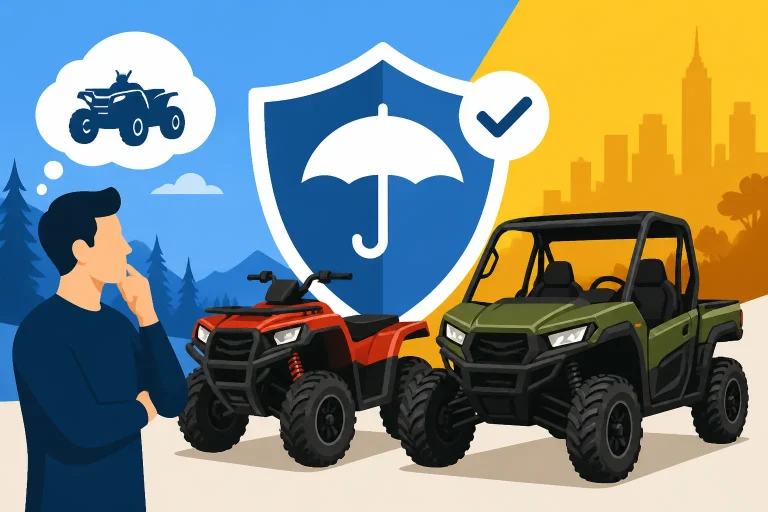
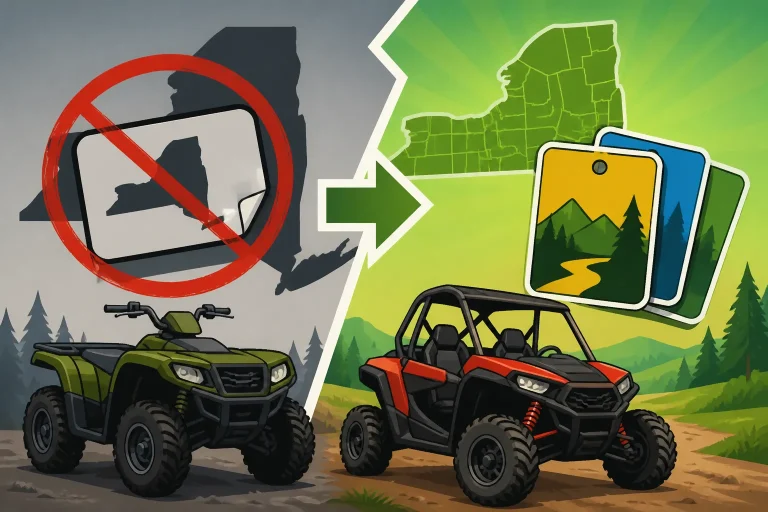
New York’s registration reciprocity and insurance requirements are separate. The New York State Department of Motor Vehicles honors valid out-of-state ATV registrations, but it also requires liability insurance for ATV operation anywhere in New York State except on the owner’s property. That insurance rule applies even when the ATV is registered in another state.
In practical terms, an out-of-state registration does not act as an insurance waiver. It can satisfy New York’s registration requirement when it is valid, but it does not establish that you have liability coverage for a ride here. Before traveling, check both questions independently: Is the registration valid for New York use, and does the policy cover liability while operating the ATV in New York?
| Your situation | What to check |
|---|---|
| Your home state registers your ATV | Carry a valid registration, and separately confirm that liability insurance applies to New York use. |
| Your home state does not require ATV registration | The New York State Department of Motor Vehicles says you must obtain a New York State ATV registration before operating in New York. Liability insurance is still a separate requirement. |
| You are riding on your own property | The New York State Department of Motor Vehicles identifies the owner’s property as the exception to its ATV liability-insurance requirement. |
| You are riding on someone else’s property or an approved route | Do not treat the property exception as applying. The New York State Department of Motor Vehicles requires liability insurance to operate an ATV anywhere else in the state. |
This can surprise a visitor whose home state has different registration or insurance rules. New York does not make its insurance requirement depend on where the ATV is registered or where the rider lives. If your policy’s wording is unclear, ask the insurer directly whether its liability coverage applies while you operate the ATV in New York. A general statement that the machine is insured may not answer the question that matters for your trip.
For a broader explanation of the visitor registration question, see New York Reciprocity for Out-of-State Registrations and Riding New York With an Out-of-State Plate. Those topics do not replace the insurance check: registration and liability coverage serve different purposes.
Registration reciprocity is not insurance reciprocity
Registration is the document showing that the machine is registered. Liability insurance addresses responsibility for covered injury or property damage. One does not prove the other, and a valid plate does not by itself show that a policy covers your New York ride.
The New York State Department of Motor Vehicles says operators must carry the ATV registration document while operating. It also says proof of insurance must be shown to a judge, police officer, or a person making a claim of injury or property damage. For a visitor, that means having both documents available, rather than assuming the registration paperwork or a photo of the plate is enough.
If your home state issues ATV registrations, confirm that yours remains valid for the trip. New York honors valid out-of-state ATV registrations, according to the New York State Department of Motor Vehicles. If your home state does not require registration, the New York State Department of Motor Vehicles says you must obtain a New York registration before riding here. Neither situation removes the separate insurance obligation.
Keep the policy details accessible, not just the name of the insurer. Before departure, check that you can identify the insured machine and that the liability coverage applies to the type of ATV use planned in New York. If the policy excludes certain uses, locations, or riders, those restrictions may matter. Ask the insurer to clarify any uncertainty, and keep its response and proof of coverage available with your registration document.
For more detail on the rule itself, see New York ATV Insurance Requirement and New York’s Mandatory ATV Insurance. If you already have an out-of-state policy, Does an Out-of-State Policy Satisfy New York’s ATV Rule? is also relevant. The practical point is not to guess from the policy’s home-state status: confirm its New York application with the insurer.
Questions to ask your insurer
Before you travel, ask direct questions rather than relying on a general declaration that your ATV is insured:
- Does the policy provide liability coverage while the ATV is being operated in New York?
- Does the coverage apply to the riders who will use the machine?
- Are there restrictions on where or how the ATV may be operated?
- What proof of insurance should the operator carry?
- What should the operator do if there is a crash or a claim?
These are policy-specific questions, so the insurer is the right place to confirm the answers. New York’s rule establishes that liability insurance is required outside the owner’s property; it does not mean every policy offers identical coverage or terms.
How to prepare before riding in New York
A few checks before loading the ATV can prevent a registration problem from being mistaken for an insurance problem, or vice versa. Treat documents, coverage, and access permission as separate parts of the plan.
- Check the registration. Confirm that the ATV’s out-of-state registration is valid. The New York State Department of Motor Vehicles honors valid out-of-state ATV registrations. If your home state does not require ATV registration, the New York State Department of Motor Vehicles says you need a New York registration before operating here.
- Confirm liability coverage for New York. Ask your insurer whether the policy covers ATV operation in New York. Do not infer coverage from a valid registration, a policy card, or the fact that the insurer covers the machine at home.
- Carry the documents. The New York State Department of Motor Vehicles requires operators to carry the registration document and says proof of insurance must be shown to a judge, police officer, or a person making a claim of injury or property damage. Keep the documents easy to access while riding.
- Check who and where the policy covers. Make sure the planned operators are covered under the policy and ask about any restrictions that could affect the trip. If a family member or friend will ride, do not assume the policy applies to every person in the same way.
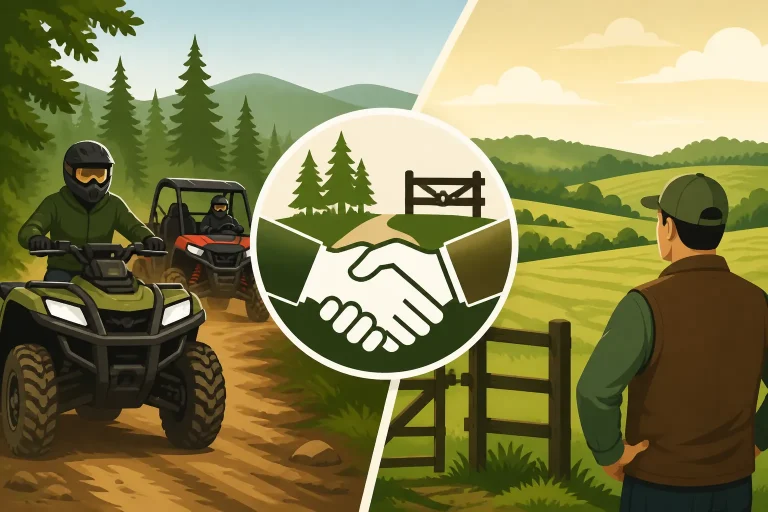
- Verify that the route is open to ATVs. Insurance does not grant permission to ride on a particular road, trail, or parcel. The New York State Department of Motor Vehicles says ATVs may operate on public lands where signs indicate ATV use is allowed, and private property may be used only with the owner’s permission.
- Keep registration, insurance, and access information distinct. A registration document does not prove insurance, and insurance does not authorize access to land. Bring what you need for each requirement.
New York does not require a driver license to operate an ATV, according to the New York State Department of Motor Vehicles. That fact does not change the insurance rule, and it does not mean every place is open to riding. The same agency says ATVs may not be operated on public highways unless the highway has been designated and posted for ATV use. Check the route and local access rules rather than treating a public road or trail as automatically available.
If you are planning to use county or club trails, check their separate access requirements as well. A county permit or club membership, where required, is not a substitute for the state’s insurance requirement. Likewise, a permit to ride a particular route does not establish that your insurer will cover a claim arising there. For a visitor-focused overview, see Insurance a Visitor Must Still Carry.
The property exception and what it does not mean
The New York State Department of Motor Vehicles describes an exception for operating an ATV on the owner’s property. The wording matters: it is the owner’s property, not simply any land that is private, familiar, or available by invitation. If you are visiting a friend’s property, staying at a camp, using a private trail, or riding on land where you have permission, do not assume that the exception applies to you. Confirm the insurance requirement with the New York State Department of Motor Vehicles and your insurer for your particular situation.
The property exception also should not be confused with land access permission. The New York State Department of Motor Vehicles says an ATV may be operated on private property only with the property owner’s permission. Permission to ride does not itself settle the insurance question. A landowner can allow access, but the visitor still needs to consider New York’s liability-insurance rule.
The safest planning approach is straightforward: if the ride is anywhere other than the ATV owner’s property, arrange liability coverage that applies in New York and carry proof. If you believe the owner-property exception applies, make sure the facts really fit that description instead of relying on a broad idea that “private land” is exempt. When ownership, a lease, or the riders’ relationship to the property makes the answer uncertain, ask the insurer and check the state requirement before riding.
Also remember that insurance is only one part of a lawful ride. The New York State Department of Motor Vehicles says ATV use on public highways is prohibited unless the highway is designated and posted for ATV use, and public-land riding is limited to places where signs allow it. On private land, the operator needs the property owner’s permission. A visitor should therefore confirm insurance, registration, and route access separately; meeting one requirement does not satisfy the others.
New York’s visitor rule is easy to overlook because an out-of-state plate can make a machine look fully cleared for use. It is better to treat the plate as evidence of registration only. Confirm liability coverage for New York, carry proof alongside the registration document, and verify that the planned route is open to ATVs. That simple separation helps avoid relying on a home-state rule that does not answer what New York requires.
Disclaimer
This article is for general informational purposes only and does not constitute professional advice. Laws, prices and regulations vary by location and change over time. Consult a qualified professional for guidance on your specific situation.