Why You Cannot Even Cross a New York Interstate
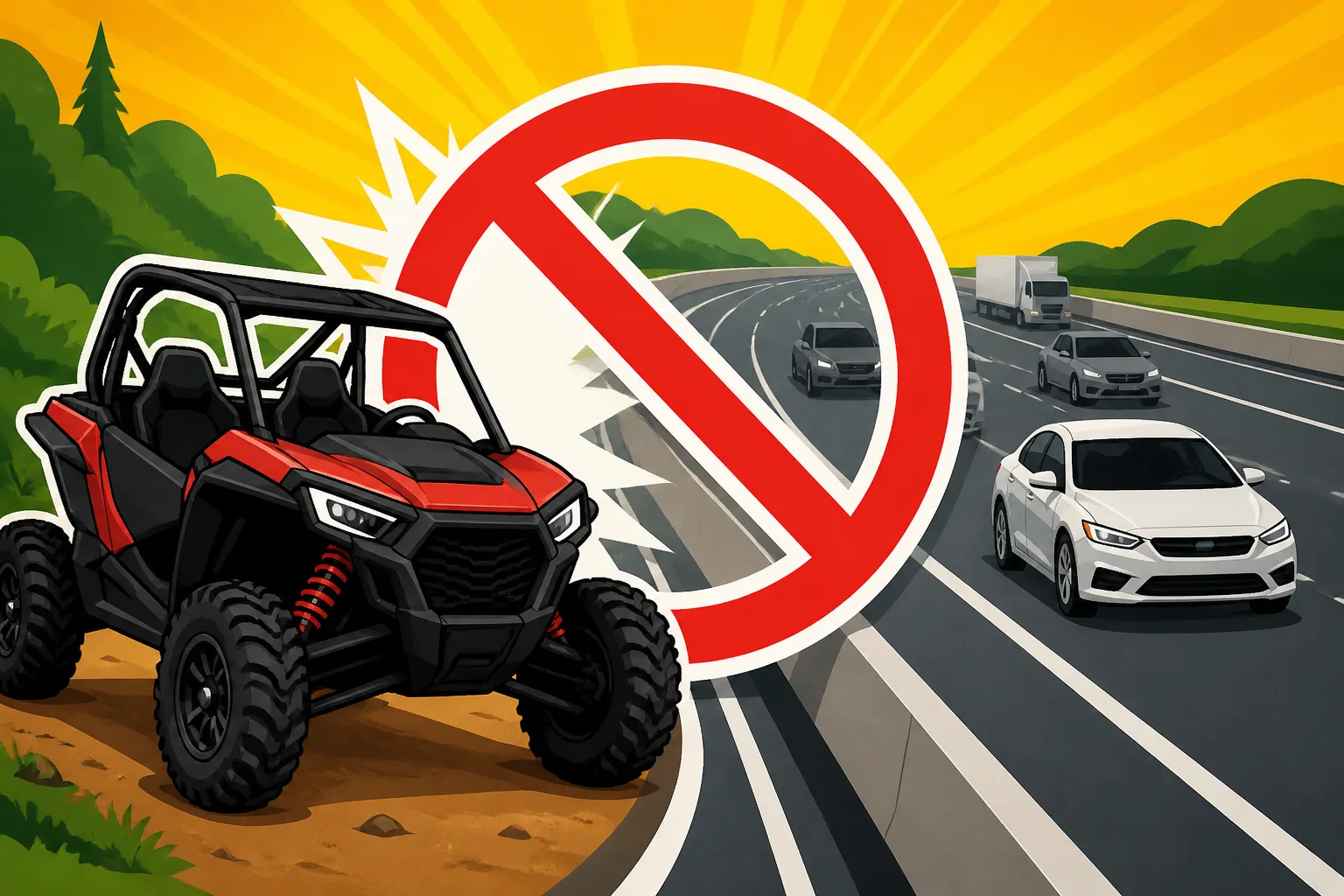
It's a common thought for many ATV and UTV riders across New York State, especially when planning a long trip or navigating around familiar terrain: "Can I just hop across that interstate to get to the other side?" The answer, clear and unwavering, is a resounding no. This guide is here to unravel the complex web of federal and state laws, safety concerns, and the stark realities that make riding or even crossing a New York Interstate on an ATV or UTV not just illegal, but incredibly dangerous.
The Core Legal Barrier: Federal and State Highway Laws
Understanding why you can't ride your ATV or UTV on an interstate boils down to how these roads are classified and regulated at both the federal and state levels. They aren't just any old road; they are a distinct category with specific rules designed for a particular kind of vehicle and travel.
Federal Regulations: Interstates Are Not for ATVs
Interstate highways were created with a very specific purpose: to facilitate rapid, long-distance travel for passenger vehicles and commercial trucks. They are designed for high speeds, feature controlled access points (on-ramps and off-ramps), and are built to keep traffic flowing efficiently and, ideally, safely. This entire infrastructure is predicated on vehicles maintaining a minimum speed and being capable of merging and exiting at high velocities.
An ATV or UTV simply does not fit this profile. These machines, while incredibly capable off-road, are inherently slow-moving compared to interstate traffic. Their maximum speeds often fall far below the minimum posted speed limits on interstates. Imagine trying to merge onto a highway where cars are traveling at 65-70 miles per hour while your machine struggles to hit 40 or 50. It’s a recipe for disaster. Furthermore, the design of these vehicles—open-air, often with knobby tires, and lacking the robust safety cages or crumple zones of cars—makes them completely unsuitable for the impact forces involved in a high-speed collision. The federal government, through various highway administration guidelines, establishes the standards for vehicles allowed on these national arteries, and ATVs and UTVs are simply not among them.
New York's Specific Prohibition on Interstate Use
Beyond federal guidelines, New York State law explicitly restricts the operation of ATVs and UTVs on interstates. The Vehicle and Traffic Law (VTL) in New York, which governs all motor vehicle operation within the state, clearly defines what an ATV is and where it can and cannot be ridden. Interstates, by their very nature as high-speed, limited-access highways, are off-limits. This isn't a grey area or a local interpretation; it's a fundamental aspect of the law.
While some towns or counties might have local ordinances that permit [Crossing a Highway on an ATV in New York] at specific, designated points, these exceptions never apply to interstates. Interstates are a different beast entirely. You might be able to cross a local road at a ninety-degree angle after coming to a complete stop, but this legal allowance vanishes the moment you even contemplate approaching an interstate. The state's position is unequivocal: interstates are for cars, trucks, and motorcycles that meet stringent highway safety standards, not for off-highway vehicles. Attempting to traverse or ride along an interstate is a direct violation of these state laws, carrying significant consequences that we'll explore shortly.
Safety Concerns and the Design of Interstates
Legal prohibitions are almost always rooted in practical safety concerns, and nowhere is this more apparent than with ATVs and UTVs on interstates. The inherent design of these machines, combined with the dynamics of interstate traffic, creates an incredibly hazardous environment.
Speed Differentials and Accident Risk
The most immediate and glaring safety concern is the colossal speed differential. Interstate vehicles are traveling at speeds designed to minimize travel time and facilitate smooth traffic flow. When an ATV, capable of far lower top speeds and slower acceleration, attempts to enter this environment, it becomes an instant, massive hazard. Drivers on an interstate simply do not expect a slow-moving, open-air vehicle in their lane or attempting to merge.
Consider a typical scenario: you're trying to cross an interstate where the speed limit is 65 MPH. Your ATV might max out at 50-55 MPH under ideal conditions, but its acceleration from a dead stop (which you'd need to do to cross) is significantly slower than a car or truck. By the time you get up to speed, traffic that was a quarter-mile away could be on top of you. Furthermore, ATVs and UTVs have limited visibility, both for the rider and for other drivers. They're smaller, lower to the ground, and don't have the same reflective surfaces or standardized lighting as highway vehicles. This lack of visibility, coupled with the speed disparity, makes the risk of a catastrophic collision astronomically high. It's not just about your safety; it's about the safety of every other person on that interstate whose lives would be put at risk by such a dangerous maneuver.
ATV Design Limitations for Highway Travel
ATVs and UTVs are marvels of engineering for off-road use, but those very design features make them utterly unsuitable for highway travel. Let's talk tires, for instance. Your knobby, aggressive off-road tires are fantastic for gripping mud, rocks, and loose dirt. However, on smooth, high-speed asphalt, they offer significantly less grip than street tires, wear down rapidly, and can even cause unpredictable handling at higher speeds. This can lead to dangerous wobbles or a loss of control, especially when braking or turning.
Then there's the suspension. Off-road suspension is built to absorb massive bumps and uneven terrain. On pavement, this often translates to a softer, more "bouncy" ride that doesn't offer the precise, stable handling required for quick maneuvers in heavy traffic. Braking systems on ATVs are also designed for off-road speeds and conditions; they may not provide the stopping power necessary to react quickly to highway speeds or sudden stops. Finally, the [New York Equipment Rules for ATVs] focus on features for trail riding, not highway safety. ATVs lack turn signals, federally mandated headlights and taillights for highway use, and the structural integrity (like a full roll cage or impact-absorbing chassis) to withstand a high-speed collision. Relying on such a machine to navigate an interstate is akin to bringing a dirt bike to a NASCAR race—it's simply not built for that environment.
Penalties and Enforcement for Interstate Violations
The legal system takes infractions on interstates very seriously, and for good reason. Violating these laws isn't just a slap on the wrist; it can lead to severe penalties that impact your wallet, your driving record, and even your ability to operate vehicles in the future.
The Legal Consequences of Riding or Crossing an Interstate
If you are caught operating an ATV or UTV on a New York Interstate, you're looking at a multitude of potential charges. The most immediate could be operating an unregistered vehicle and operating a vehicle on a prohibited highway. Since ATVs and UTVs are generally not street legal in New York, you'd likely also face charges for not having proper registration for highway use, not having required insurance, and potentially reckless endangerment depending on the circumstances. [New York Fines for an Unregistered ATV] can be substantial, and these amounts can quickly stack up when multiple violations are issued.
Beyond fines, you could accumulate points on your driver's license, which can lead to increased insurance premiums or even a license suspension. Your ATV or UTV would almost certainly be impounded, leading to towing fees, storage fees, and the headache of recovering your machine, which can be an expensive and time-consuming process. In some severe cases, especially if your actions create an immediate danger to others, you could face misdemeanor charges. It's a stark reminder that the state views these acts not just as minor violations, but as serious threats to public safety. You'd likely be subject to [What a New York Officer Checks Roadside], and the lack of appropriate highway registration and equipment would become glaringly obvious, leading to immediate action.
Why Enforcement is Strict on Interstates
Law enforcement agencies, particularly the New York State Police and local highway patrols, have a heightened focus on maintaining safety on interstates. These roads are vital transportation corridors, and any disruption or unauthorized vehicle poses a significant threat to the massive volume of traffic they carry. Troopers are specifically trained to identify and address vehicles that do not belong on these highways, and they operate with a zero-tolerance policy when it comes to unauthorized vehicles like ATVs and UTVs.
The visibility of an ATV on an interstate is also a factor. It stands out immediately, making it easy for officers to spot. Unlike a minor traffic infraction on a quiet back road, an ATV on an interstate is an obvious and pressing safety hazard that demands immediate intervention. The goal isn't just to issue a ticket; it's to remove a dangerous situation from a high-speed environment as quickly as possible. This strict enforcement is a deterrent, aiming to prevent potentially fatal accidents before they occur. The [New York Fines for an ATV Violation] are designed to reflect the seriousness of endangering yourself and countless others on such a critical piece of infrastructure.
Understanding Legal ATV Road Use in New York
While interstates are a definitive no-go, it's important to understand that there are legal ways to interact with public roads in New York State using your ATV or UTV. The key lies in understanding the distinctions between different road classifications and adhering to very specific rules.
Where ATVs Can Legally Cross Roads in New York
It's a common misconception that ATVs can never touch a paved road in New York. That's not entirely true, but the allowances are extremely narrow and strict. On certain designated public roads, you might be permitted to cross at a right angle (90 degrees) after coming to a complete stop, yielding to all traffic, and only when it's safe to do so. This is often done to connect two sections of a legal trail system. Think about those moments when a trail suddenly ends, and you see another section just across a rural route or county road.
However, these crossings are highly regulated and only apply to specific types of roads that are clearly marked or designated for such use. You won't find this allowance on busy state highways or, as we've discussed, interstates. It's crucial to consult local ordinances and trail maps, or signage posted by the local municipality, to know which roads, if any, permit such crossings. Always remember the rules for [Crossing at Ninety Degrees in New York] and [New York's Designated and Posted Roads]. Ignorance of these rules is not an excuse, and riding where you shouldn't can lead to significant penalties.
The Critical Distinction: Interstate vs. Other Public Roads
To truly grasp New York's ATV road rules, it's vital to differentiate between an interstate and other public roads. They are not interchangeable in the eyes of the law or in terms of safety.
Here’s a simplified breakdown:
| Feature | Interstate Highway | Other Public Roads (Town/County/State Routes) |
|---|---|---|
| Purpose | High-speed, controlled-access, long-distance travel | Local access, connecting communities, varying speeds |
| Minimum Speed | Generally enforced (e.g., 40 MPH) | Not typically enforced; speed limits vary by context |
| ATV/UTV Operation | Strictly Prohibited (no riding, no crossing) | Prohibited for general riding; limited crossing may be allowed |
| ATV/UTV Crossing | Never Permitted | May be permitted at 90 degrees in designated areas (very specific) |
| Vehicle Design Standard | Federally mandated highway vehicles only | Varies; generally allows registered, insured vehicles of appropriate design |
| Enforcement Severity | Extremely High (State Police, zero tolerance) | High, but context-dependent |
The table above really highlights the chasm between interstates and other roads. An interstate is a completely different operating environment. For riders who want to stay safe and legal, understanding this distinction is paramount. It emphasizes why you absolutely must keep your ATV or UTV off interstates, and instead, focus on legal trails and designated crossing points. If you're ever in doubt about what's legal, err on the side of caution. Taking a [New York ATV Safety Certificate Requirements] course can also help clarify these rules, ensuring you have the knowledge to make safe and legal decisions out on the trails. Remember, while you might feel like your ATV is tough enough, [Are ATVs Street Legal in New York?] is typically answered with a firm 'no' for highway use, and the [New York ATV Insurance Requirement] underlines the need to be covered even on legal trails.
Disclaimer
This article is for general informational purposes only and does not constitute professional advice. Laws, prices and regulations vary by location and change over time. Consult a qualified professional for guidance on your specific situation.