New York Rules for Towing With an ATV
It's incredibly frustrating when you have a capable machine like an ATV, perfect for hauling gear or clearing debris, but you're unsure if you're actually allowed to use it for towing in the Empire State. Many riders simply want to use their quads for practical tasks around their property or on designated trails, only to be met with a confusing maze of rules. This guide will help you understand the specific New York regulations governing towing with an ATV, distinguishing between what's permitted and what could land you in trouble, so you can ride and work with confidence.
Understanding New York's Core ATV Towing Regulations
New York State has a very specific framework for ATVs, and unlike many other states, it doesn't just broadly permit their use on public roads or for general utility purposes. This distinct approach heavily influences what you can and cannot do when it comes to towing with your quad. It’s not about the raw power of your machine, but rather the legal definitions and designated areas.
Why Towing Isn't Always a Simple 'Yes' or 'No'
The biggest misconception riders often have is assuming that if their ATV has a hitch, they can tow anything, anywhere. In New York, that couldn't be further from the truth. The state’s laws are primarily focused on the safe operation of ATVs for recreational purposes on approved trails and private land, not as utility vehicles on public thoroughfares. This means that even if your ATV is a workhorse, legally, its towing capabilities are severely restricted in most public settings. You might be able to easily pull a heavy trailer around your own property, but taking that same setup onto a county trail or, heaven forbid, a town road, could quickly lead to a violation. The "yes" or "no" hinges entirely on where you are and the purpose of the tow.
Furthermore, New York's definition of an All-Terrain Vehicle is quite narrow compared to how manufacturers build many modern machines. Your vehicle's inherent design, particularly its width and weight, can already limit where it's legally permitted to ride, which then cascades into its towing capabilities. For instance, if your machine is already pushing the [New York ATV Width Limit for Registration] or the [New York ATV Weight Limit for Registration], adding a heavy, wide trailer only exacerbates these issues, making it even less likely to be considered compliant on any public land where ATVs are allowed.
The Importance of Designated Areas and Private Property
When it comes to towing, the location is paramount in New York. On your own private land, or land where you have explicit permission from the landowner, the rules are much more relaxed. Here, you're generally free to use your ATV to tow trailers, haul firewood, move brush, or assist with farm tasks without worrying about state ATV towing statutes. This is where your machine truly shines as a utility vehicle. Many New Yorkers rely on their quads to manage large properties, pull log splitters, or carry hunting stands deep into the woods. As long as you have [New York Rules for Riding Private Land] secured, you have a lot of freedom.
However, once you leave private property and venture onto public land, such as state-managed trails or county-designated routes, the regulations tighten considerably. Most of New York's limited public ATV trail systems, like those in Lewis County or Oswego County, are designed for recreational riding, not for towing large loads. The infrastructure—the bridges, culverts, and trail surfaces—may not be built to handle the stresses of a heavy ATV pulling a loaded trailer. While you might be able to pull a small, lightweight game cart on some trails during hunting season, anything substantial is usually prohibited. Always check with the specific trail system's rules or the managing authority before attempting to tow anything on public trails.
New York's Definition of an "ATV" and Its Impact on Towing
New York Vehicle and Traffic Law defines an ATV as a self-propelled vehicle weighing less than 1,000 pounds, 70 inches or less in width, and intended for off-highway use. This definition is crucial because it dictates what kind of machine is even allowed to operate as an ATV in the first place, and thus, what kind of machine falls under the state's ATV regulations for towing. If your machine, or your machine with an attached trailer, exceeds these dimensions or weight, it might not even be classified as an ATV anymore for the purposes of public land use, which can lead to entirely different legal challenges and violations.
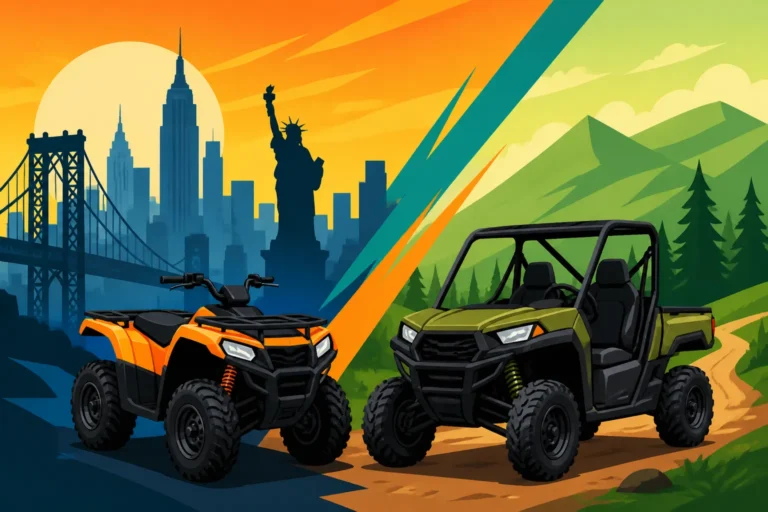
Many modern side-by-sides, for example, often exceed the 70-inch width and 1,000-pound weight limits. This is why [Why Most Side-by-Sides Cannot Be Registered in New York] as ATVs. If your vehicle doesn't meet the ATV definition, its use on public land is even more restricted, and towing anything with it becomes exponentially more complicated from a legal standpoint. The state doesn't have a separate registration or robust trail system for these larger "utility vehicles" or "UTVs" in the same way it does for ATVs, further limiting their public utility and towing capabilities. Essentially, if your machine doesn't fit the state's narrow ATV definition, any public land towing is likely out of the question.
Safety Considerations and Practical Towing Tips
Even on private property where you have the freedom to tow, safety should always be your top priority. An ATV can be a powerful tool for hauling, but improper towing techniques or inadequate equipment can quickly turn a helpful task into a dangerous situation, potentially leading to injuries, property damage, or costly repairs to your machine.
Matching Your ATV to the Load: Weight and Capacity
One of the most critical aspects of safe ATV towing is understanding your machine's limitations. Every ATV has a specified towing capacity, which is the maximum weight it can safely pull. This figure is usually found in your owner's manual. Exceeding this capacity can strain your engine, transmission, and braking system, leading to premature wear and tear, or worse, a complete mechanical failure. It also severely compromises your control over the vehicle, making it difficult to steer or stop, especially on uneven terrain or inclines.
Beyond the gross towing weight, consider the tongue weight—the downward force exerted by the trailer coupler onto the hitch ball. Too much tongue weight can lift the front wheels of your ATV, reducing steering control and traction. Too little can cause the trailer to sway dangerously. Aim for a tongue weight that is typically 10-15% of the total loaded trailer weight. If you're planning on towing heavier loads consistently, especially across rugged terrain, investing in aftermarket heavy-duty springs or suspension upgrades can help your ATV handle the extra weight more safely and preserve its lifespan. Remember, just because your ATV can move a load doesn't mean it can safely stop or steer with it.
Essential Equipment for Safe Towing
Having the right gear makes all the difference when towing. A sturdy hitch receiver and ball are non-negotiable. Ensure they are properly rated for the weight you intend to tow. Many ATVs come with a simple hitch, but if you're frequently towing or working with heavier loads, an aftermarket hitch designed for greater strength and durability might be a wise investment. Companies like SuperATV offer a range of heavy-duty hitches and accessories that can significantly improve your ATV's towing capabilities while enhancing safety. Their robust designs can provide peace of mind when you're pulling a utility trailer full of lumber or a downed deer out of the back forty.
A good trailer is equally important. Look for one with appropriate tires, working lights (if you're near any public access or roads, even briefly, though mostly irrelevant for ATVs), and a solid frame. Always ensure your trailer is securely connected to your ATV with safety chains as a backup in case the primary hitch fails. Additionally, consider a winch. While primarily used for self-recovery, a powerful winch like those offered by SuperATV can also be incredibly useful for pulling heavy items onto a trailer, or for maneuvering a loaded trailer through difficult spots where direct ATV pulling might be too risky or challenging. Don't forget proper tie-downs to secure your load and prevent shifting during transport, which can throw off your ATV's balance and lead to accidents.
Best Practices for Navigating Terrain While Towing
Towing changes the dynamics of your ATV dramatically. Your machine will accelerate slower, brake less efficiently, and be more prone to tipping, especially on side slopes. Always approach hills, rough patches, and turns with extreme caution. Shift to a lower gear before starting up an incline to maintain power and control, and descend hills slowly, using engine braking where possible to avoid overheating your brakes. On turns, widen your arc to account for the trailer's tracking, ensuring it doesn't clip trees or obstacles.
Maintain a slower speed than you normally would without a trailer. This gives you more time to react to unexpected obstacles or changes in terrain. Avoid sudden starts, stops, or turns. The added weight of the trailer can easily cause your ATV to lose traction, skid, or even flip, especially on loose gravel, mud, or icy surfaces. If crossing water, be mindful of the added drag and resistance the trailer creates. It's often safer to scout challenging sections on foot first, or even unhitch and maneuver the trailer by hand if the terrain is particularly tricky. Remember, patience and a cautious approach are your best allies when navigating any terrain with a towed load.
Legal Ramifications of Improper Towing in New York
While the focus might often be on the practicalities of getting a job done, ignoring New York's ATV towing laws can lead to serious legal and financial consequences. It's not just about a simple slap on the wrist; improper towing can escalate into significant fines, insurance headaches, and even criminal charges in severe cases.
Fines and Penalties You Could Face
Attempting to tow a trailer on a public road, or even on a public ATV trail where it's explicitly prohibited, can result in a summons. The exact fines can vary depending on the specific violation and the local municipality, but they are rarely negligible. For instance, operating an unregistered ATV, or operating it in a manner inconsistent with its registration (like towing where not allowed), can lead to considerable penalties. These fines are often similar to those you might face for other ATV violations, such as riding on unapproved roads or without proper safety gear. Ignoring these rules means you could be looking at a hefty bill.
Moreover, if your towing operation on public land leads to an accident, the penalties can increase exponentially. You could be cited for reckless operation, property damage, or even personal injury, compounding the initial towing violation. An officer encountering an ATV pulling an oversized or unregistered trailer on a town road might issue multiple tickets, not just one. It’s crucial to remember that New York's law is quite clear: ATVs are primarily for off-highway recreational use. Any deviation from this, especially involving utility tasks like towing on public land, is likely to be met with enforcement. Staying within the bounds of [New York Fines for an ATV Violation] requires understanding these nuanced towing rules.
Insurance Implications When Towing Goes Wrong
This is where things can get truly expensive. New York State mandates that every ATV operated anywhere other than on the owner's property must carry liability insurance. This isn't just a suggestion; it's the law. If you're towing a trailer on public land—even if it's a designated ATV trail where towing is technically prohibited—and an accident occurs, your insurance company might deny coverage. Why? Because you were operating the vehicle outside the legal parameters for which the policy was intended. An insurance policy is designed to cover legal operation. If you're doing something illegal, like towing a trailer on a prohibited trail or a public road, you could be deemed to be operating outside the terms of your policy.
Imagine you're pulling a small trailer on a county trail, and you lose control, causing damage to someone else's property or, worse, injuring another rider. If your insurance company determines you were in violation of towing rules, you could be personally liable for all damages, medical bills, and legal fees. This can quickly amount to tens or even hundreds of thousands of dollars, completely bankrupting you. This is why understanding [New York ATV Insurance Requirement] is so vital, and why operating within the legal limits, especially when towing, is not just about avoiding a ticket, but about protecting your financial future.
When a "Helper" Becomes a Hazard
It’s tempting to use your ATV to help out a friend or neighbor, whether it’s pulling their broken-down quad back to their camp or helping them move a heavy object. However, doing so on public land can quickly turn your good intentions into a legal nightmare. For example, if you're trying to tow a disabled ATV on a public trail that doesn't permit towing, both you and the owner of the disabled machine could face citations. The "helping hand" suddenly becomes an accomplice to a violation.
Furthermore, towing another person on an ATV, especially if they are not properly seated on a factory-fitted passenger seat, is highly dangerous and almost universally illegal on public land. Most ATVs are designed for a single rider, and carrying passengers (let alone towing a person) in any other fashion is prohibited and incredibly risky. If you're using your winch to pull a vehicle out of a ditch, ensure you're on private property and following all safety protocols. The moment you cross onto public land, even in a "rescue" scenario, you open yourself up to potential fines and liability if not done strictly according to very specific, often non-existent, regulations for ATVs. Always consider the legal implications before using your ATV as a recovery vehicle on public access areas.
Common Scenarios: What You Can and Cannot Tow
Understanding the nuances of New York's ATV towing rules can feel overwhelming. Let's break down some common real-world scenarios to illustrate where you generally have the green light, and where you absolutely should reconsider. The key differentiator, as we’ve discussed, almost always comes back to the type of land you're on.
Hauling Firewood or Hunting Gear on Private Land
This is arguably the most common and accepted form of ATV towing in New York, and it's almost exclusively done on private property. If you own a piece of land, or have express permission from the landowner, you can absolutely use your ATV to haul firewood, carry hunting equipment, transport feed for livestock, or move tools around a job site. This is where your ATV truly acts as a versatile utility vehicle. Whether you're pulling a small log trailer, a heavy-duty game cart, or even a modest utility trailer, as long as you're on private land, you're usually good to go.
Many hunters rely heavily on their ATVs during hunting season to retrieve game, carry tree stands, or haul gear to remote blinds. Similarly, landowners use them for property maintenance, clearing brush, or moving materials for small construction projects. The beauty of private land is the flexibility it offers. You don't have to worry about the specific weight or width limits of the ATV itself, beyond its practical capability to safely tow the load. This is where a sturdy trailer and a powerful winch, perhaps from SuperATV, can really come in handy, making light work of otherwise grueling tasks. Just remember, even on private land, safety precautions and matching the load to your ATV's capacity are still paramount to prevent accidents. You might even find yourself carrying a [New York Rules for Carrying a Firearm on an ATV] while doing so.
Towing a Disabled ATV or Snowmobile
This is a common occurrence on the trails. Picture this: you're out riding with a buddy on a designated trail system, and their machine breaks down miles from the nearest road. Your first instinct is to simply hook up a tow strap and pull them back. However, this is where things get tricky in New York. While it might seem like a common-sense solution, towing another ATV, or a snowmobile for that matter, on a public ATV trail or snowmobile trail may not be explicitly permitted. Trail systems often have rules against towing because of the potential for accidents, trail damage, or creating obstructions for other riders.
Always check the specific regulations of the trail system you're on. Some organized club trails might have specific allowances or designated rescue procedures, but it's rarely a blanket "yes." On undesignated public land or private land with permission, towing a disabled machine is generally acceptable, provided it's done safely. If you must tow on a public trail, do so with extreme caution, at very slow speeds, and with both machines visible. It’s always best to have the disabled machine’s rider on their own vehicle, steering, rather than attempting to tow an empty, unsteered quad. If possible, contacting a professional recovery service or arranging for a trailer pickup is often the safest and legally soundest option, especially for longer distances or more challenging terrain.
Why You Can't Tow a Trailer on Most Public Roads
Let's get straight to it: you generally cannot tow a trailer with your ATV on public roads in New York. This is a hard stop for most scenarios. New York law considers ATVs off-highway vehicles. They are not designed, manufactured, or intended for use on public streets, highways, or roads. While there are very limited exceptions for crossing roads or riding on specific [New York's Designated and Posted Roads], these exceptions almost never extend to towing. If your ATV is not "street legal" (and almost none are in New York, beyond specific agricultural exemptions for short distances), then neither is any trailer you attach to it for public road use.
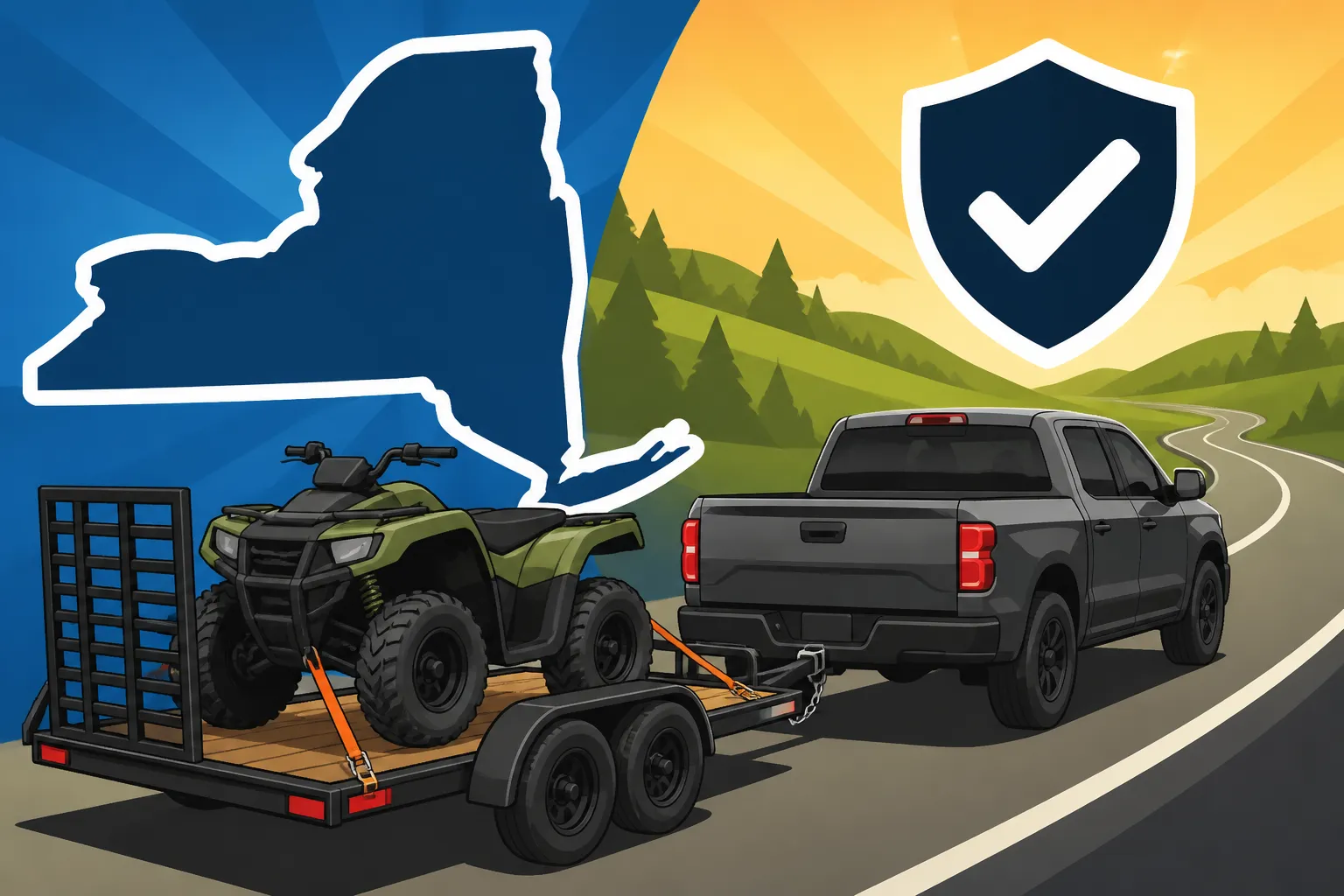
Trying to tow a small utility trailer or even a boat trailer with your ATV down a town road, even for a short distance, will likely result in a ticket for operating an unregistered vehicle on a public highway, or other similar violations. This applies even if the road is quiet and you feel you're not bothering anyone. The law is clear: ATVs and public roads don't mix, and adding a trailer only compounds the issue. If you need to transport a trailer, you'll need a proper tow vehicle like a truck or SUV, and an appropriately registered road-legal trailer. Don't risk the fines, potential accidents, and insurance nightmares that come with trying to use your ATV as a road-going tow vehicle in New York.
New York ATV Towing Scenarios at a Glance
To help clarify the common towing situations, here's a quick reference guide. Always remember to verify local rules and prioritize safety in every scenario.
| Scenario | Location | General Legality/Considerations |
|---|---|---|
| Hauling Firewood | Private Property | Generally Allowed. Use appropriate equipment. |
| Hauling Hunting Gear | Private Property | Generally Allowed. Use game carts/trailers safely. |
| Hauling Firewood/Gear | Designated Public Trails | Rarely Allowed. Most public trails are for recreation only. Check specific trail rules (e.g., Lewis County trails may have restrictions on anything other than very small game carts). |
| Towing a Disabled ATV | Private Property | Generally Allowed. Proceed with extreme caution. |
| Towing a Disabled ATV | Designated Public Trails | Often Prohibited/Discouraged. Check trail rules. Use only for short-distance recovery if absolutely necessary, with high visibility and extreme caution. Professional recovery usually recommended. |
| Towing a Boat/Utility Trailer | Private Property | Generally Allowed. Ensure ATV capacity and hitch rating are sufficient. |
| Towing a Boat/Utility Trailer | Public Road/Highway | Strictly Prohibited. ATVs are not street-legal tow vehicles. |
| Towing a Snowmobile | Public Snowmobile Trails | Often Prohibited. Snowmobile trails are for snowmobiles. Towing can cause damage or hazards. Check local club rules. |
| Plowing/Grading | Private Property | Generally Allowed. Use specific plow/grader attachments. Not considered "towing" in the traditional sense, but still a utility function. |
Disclaimer
This article is for general informational purposes only and does not constitute professional advice. Laws, prices and regulations vary by location and change over time. Consult a qualified professional for guidance on your specific situation.