Riding a Marked Trail and Nothing Else
A trail marker can make a route look straightforward, but it does not automatically give you permission to ride every road, spur, or piece of land nearby. In New York, the practical rule is to stay on the route you are authorized to use, confirm what permit and registration apply, and stop when signs, gates, or closures say the route is off-limits.
What a Marked Trail Does and Does Not Authorize
A marked ATV trail is a route to follow, not a general invitation to ride wherever the trail system appears to continue. Markers may identify a route through land that has specific access arrangements, such as a county trail network or a private club system. Those arrangements can limit where riders may go, when they may ride, and which machines may use the route.
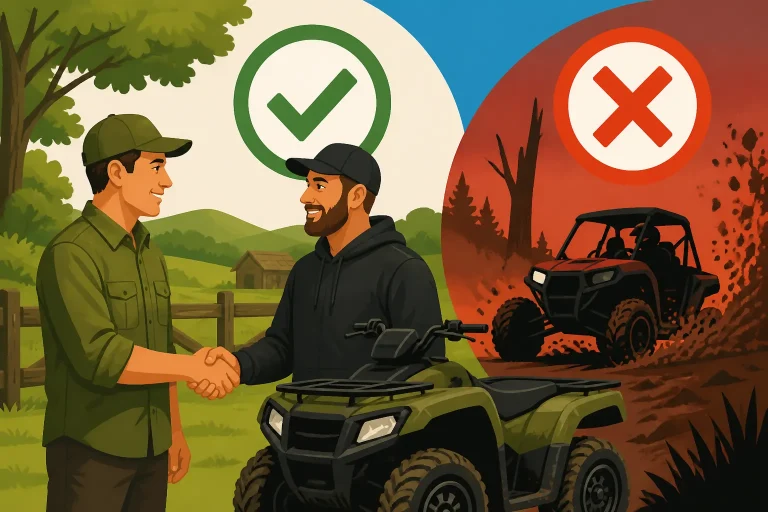
A marker does not, by itself, make a nearby field, logging road, driveway, road shoulder, or unmarked spur part of the trail. Nor does seeing tracks from other machines establish that a route is open. Permission can depend on landowner agreements and may change if a route is closed, rerouted, or temporarily unavailable.
Treat the marked route as the boundary of your permission. If the trail turns, follow the marked turn rather than continuing along a more obvious-looking road. If markers end and you cannot tell where the authorized route goes, stop and check a current map or contact the organization responsible for the trail. Do not assume that a route continues just because it appears rideable.
It also helps to separate three questions that riders sometimes treat as one:
- May the machine be operated there? Registration, insurance, and other operating requirements may apply.
- May the rider use that trail system? A county permit, club membership, or another form of access authorization may be required.
- Is the specific route open now? Seasonal schedules, weather, maintenance, landowner requests, and temporary closures can affect access.
A valid registration or permit does not automatically answer all three questions. A trail can be closed even when your paperwork is in order, and an open trail can still have access requirements you have not met.
New York does not have one statewide ATV trail pass that grants access to every trail. Requirements depend on the particular system. Before planning a ride, check Do You Need a Trail Permit in New York? and the rules for the county or club trail you intend to use. For background on public land, see [New York Rules for Riding Public Land]; access rules can differ from one type of land to another.
How to Stay on the Authorized Route
The safest way to avoid an accidental detour is to plan from current trail information rather than relying only on what you see from the seat. Markers are useful, but they can be easy to miss at junctions, may be obscured, or may not show the full conditions and access restrictions for the route.
Check the trail map and access rules before unloading
Use the map and notices provided by the trail operator, county, or club responsible for the system. Check that the map is current and that it covers the route you plan to ride. A screenshot or downloaded map can help if your phone loses service, but an older copy may not reflect a closure or reroute.
Look for details such as:
- Which trails are open to ATVs, and whether any sections have machine-size or other restrictions.
- Where the trail begins and ends, including whether it connects to another trail system.
- Whether a permit, membership, or other access credential is required.
- The operating season and any daily or temporary restrictions.
- Whether a route crosses private property, a road, a farm, or an area with special rules.
- The location of staging areas and the approved places to park or unload.
A county or club map is a guide to the route, not permission to use land beyond the trail or to ignore signs posted on site. If a map and an on-the-ground closure notice appear to conflict, do not ride past the closure while trying to resolve it. Contact the trail operator or relevant local office for clarification.
Before heading out, review New York Trail Conditions Before You Ride and New York Trail Closures to Check First. Those checks matter especially after heavy rain, a thaw, trail work, logging activity, or a landowner change.
Read junctions, gates, and signs carefully
At an intersection, slow down enough to identify the route markers before choosing a direction. A trail may cross a road or share a corridor with other users without authorizing you to ride the road itself. Follow signs for the ATV route, and do not take a road connector unless it is specifically open to ATVs.
A gate does not always explain why access is restricted. It may mark a temporary closure, a private driveway, a seasonal boundary, or a location where the trail does not continue. Do not go around or over a closed gate. If the route appears to pass through it but the gate is shut or a closure sign is posted, treat the route as closed until the trail operator confirms otherwise.
Here is a practical way to interpret common situations:
| What you encounter | A prudent response |
|---|---|
| A marked trail with no closure notice | Follow the route and any posted conditions; confirm that your permit or other access credential covers it. |
| A marked route with a closure sign or closed gate | Stop and turn back. Do not bypass the closure. |
| A road that seems to continue the trail | Use it only if the road itself is authorized for ATV travel and the route information confirms it. |
| An unmarked spur or path with tire tracks | Do not assume it is open. Stay on the marked route and check with the trail operator. |
| A marker that is missing or unclear | Stop, consult the current map, and contact the responsible organization if the route remains uncertain. |
| A trail crossing private land | Stay within the authorized corridor and follow any posted conditions. Do not enter adjoining property. |
Do not treat a crossing as an extension
A trail may cross a public road, private road, farm lane, utility corridor, or another trail. Crossing a route and riding along it are different things. A crossing point does not necessarily give you permission to travel along the road or corridor in either direction.
Stop and look for signs or other instructions before crossing. If the route requires you to use a road for a short connector, make sure that the road has been designated or otherwise authorized for ATV use. Do not decide that a road is open just because it is quiet, unpaved, or used by other riders.
If you are uncertain whether a connector is legal, plan a route that avoids it until you can confirm the rules. New York Rules for Riding a Town Road and New York Roads Designated for ATVs explain why road access should be checked separately from trail access.
Permits, Registration, and Out-of-State Riders
A marked trail does not replace the paperwork or access conditions that apply to the machine and rider. Before a trip, identify the requirements for the machine’s registration, the trail system, and the person operating it. These are related, but they are not interchangeable.
Trail permits and local access requirements
Permit requirements are system-specific. A trail pass or permit for one county or network does not necessarily cover a different county, a private club trail, or another route you reach later in the ride. Some systems may also limit access to members or require riders to carry proof of authorization.
Check the trail operator’s instructions for where to buy or display a permit, which machines it covers, whether a second machine needs separate authorization, and whether visitors can use the route. A permit is not permission to ride outside the trails it covers. If your route crosses into another system, check that system’s rules too. In some cases, you may need separate authorization; in others, the connector may not be open at all.
For club routes, verify whether access is open to nonmembers and whether any day-use option is available. New York Rules on Club Trails and Joining a New York ATV Club can help you understand how access and membership may work. Do not assume that a trail is public simply because it is marked or appears on a map.
Registration and insurance still matter
Trail access does not make an unregistered machine lawful to operate. Confirm that the machine meets New York’s registration requirements or qualifies under an applicable exception. New York also has insurance requirements for ATV use in circumstances covered by state law. Check that your policy is valid for the planned use and that you can show proof when required.
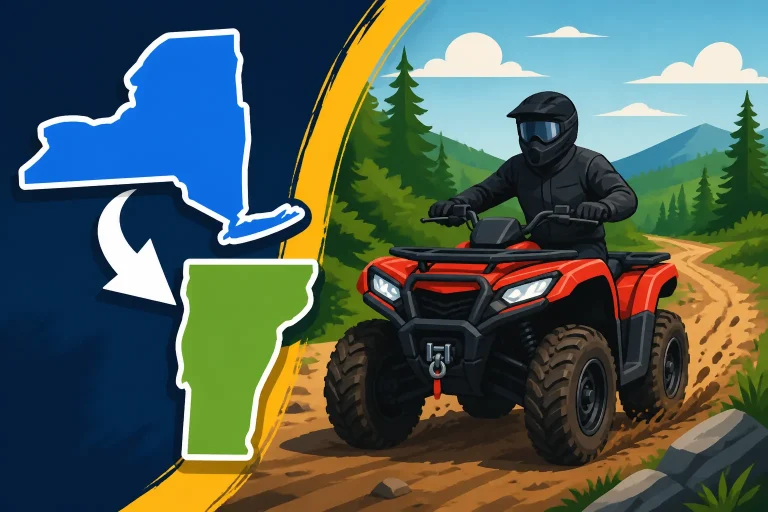
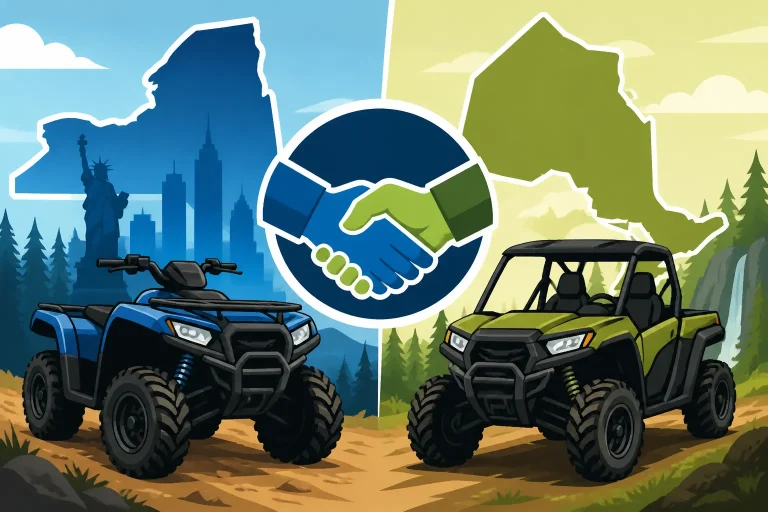
A machine registered for a different purpose or in another state may not automatically meet every New York requirement. Visitors should check the rules before riding rather than relying on the assumption that an out-of-state plate settles the question. See New York Reciprocity for Out-of-State Registrations and New York ATV Insurance Requirement for more detail.
Keep required documents accessible, but protected from water and damage. If you are riding in a group, each operator should know what paperwork and access credentials apply to their own machine. One rider’s permit or registration does not necessarily cover another machine.
Young riders need separate checks
If a child or teenager will ride, check age-related operating and supervision rules before the trip. A trail permit does not replace any safety certificate or supervision requirement that applies to the rider. Confirm whether the particular route has additional restrictions and make sure the machine is suitable for the rider.
See New York ATV Safety Certificate Requirements for the certificate rules. Also check whether a trail system allows the machine and rider combination you plan to bring; trail access is not a substitute for compliance with rider-safety requirements.
Handling Closures, Detours, and Unclear Trail Markers
The route that was open on a previous visit may not be open today. Trail systems can change because of weather, maintenance, landowner decisions, or seasonal schedules. A printed map may still show a route even when a current notice closes it. Make checking for changes part of the ride plan, not an afterthought.
If you encounter a closed section, turn around and use only a detour that the trail operator has identified as open. Do not create your own bypass through woods, fields, a neighboring property, or a road that is not designated for ATV use. A short detour can cross land where the trail agreement does not apply and can jeopardize future access for everyone.
When markers are confusing, stop somewhere safe and compare your location with the current map. If you cannot confidently identify the authorized route, do not keep exploring until you find it. Contact the county, club, or organization responsible for the system. If you cannot reach anyone, turn back to the last point where the route was clear.
Make your ride plan easy to follow by saving the map offline, noting the trailhead and return route, and agreeing on a regrouping point if the group separates. Let someone outside the group know where you expect to ride and when you expect to return. Cell coverage may be limited on some rural trail systems, so do not depend on a phone call as your only navigation or safety plan.
If an officer or trail representative asks about your route, be prepared to explain where you entered and which marked trail you followed. Keep your registration, proof of insurance, and required trail credentials available. Riders using a county system can review What an Officer Checks at a Lewis County Trailhead for an example of the kinds of items that may be checked at a trail access point.
The basic approach is simple: use the current map, follow the authorized markers, and treat uncertainty as a reason to stop. Staying on the marked route protects your ride from an avoidable trespass or access problem and helps preserve trail agreements that depend on riders respecting their boundaries.
Disclaimer
This article is for general informational purposes only and does not constitute professional advice. Laws, prices and regulations vary by location and change over time. Consult a qualified professional for guidance on your specific situation.