Electric Machines on a New York Club Trail
An electric ATV can be quiet, capable and appealing for a New York trail ride, but battery power does not guarantee access to a club trail. The machine still has to meet applicable registration rules, and the trail’s landowner, club and permit conditions matter too. Here’s what to check before hauling an electric machine to a New York riding area.
Check whether the machine can be registered
Start with the machine’s legal category, not its electric motor or the label in a sales listing. New York registration depends on whether the vehicle meets the state’s ATV definition and registration requirements. A machine sold as an electric ATV is not automatically eligible; an electric side-by-side is not automatically eligible either. Design and specifications matter.
Before buying or planning a ride, gather the make, model, vehicle identification number, manufacturer specifications and ownership paperwork. Check the machine’s dimensions and weight against New York’s ATV requirements. The state’s limits include a maximum width and weight, so a machine that exceeds either may not qualify even if it is marketed for off-road use. See New York’s 70-Inch Width Limit and New York’s 1,000-Pound Weight Limit for more on those measurements.
Then confirm how the New York DMV classifies the exact machine. If it is eligible, follow the applicable registration process and carry the required registration documents. If its classification is unclear, do not assume that a dealer’s description, an out-of-state plate or the word “electric” settles the question. Registering an Electric Machine in New York covers the registration question in more detail.
An electric machine’s appearance can also be misleading. Some vehicles have a seated riding position and controls resembling an ATV, while others resemble a utility vehicle or golf cart. New York’s registration categories are based on legal and physical characteristics, not simply on the vehicle’s intended trail use. For example, the rules that prevent many larger side-by-sides from qualifying are not bypassed by an electric motor. If the vehicle is a side-by-side, check Why Most Side-by-Sides Cannot Be Registered in New York before relying on a seller’s assurances.
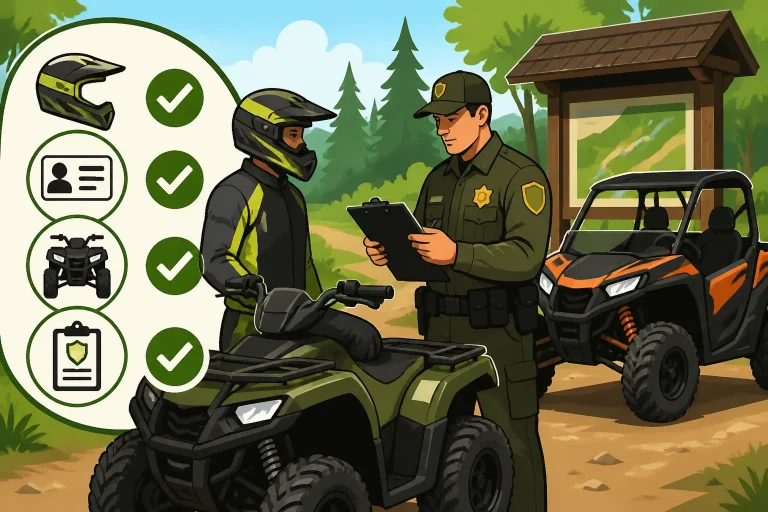
A useful first-pass checklist is:
- Identification: Can you read and document the VIN or frame number?
- Ownership: Do you have acceptable proof of ownership for registration?
- Classification: Has the DMV confirmed the machine’s category?
- Specifications: Do its width and weight meet the applicable limits?
- Registration: Is the machine registered for use in New York?
- Insurance: Have you confirmed what coverage and proof are required for your use?
- Trail access: Has the club or trail operator confirmed that this particular electric machine may use the trail?
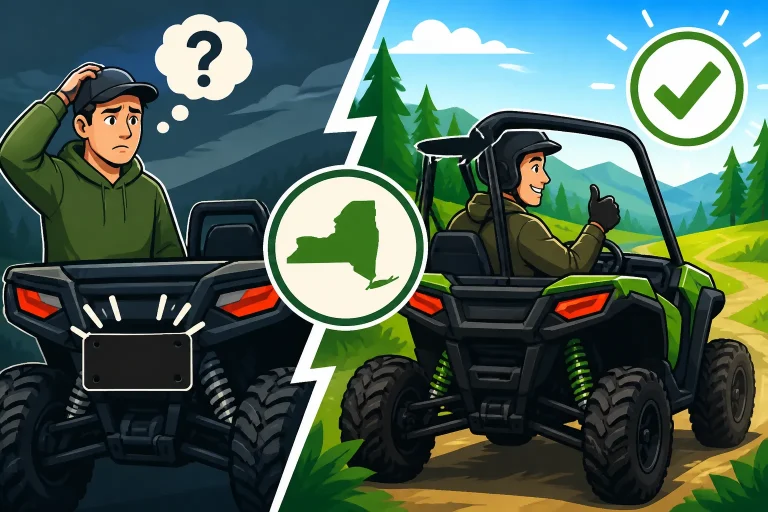
Registration and trail permission are separate questions. A machine may be properly registered and still be barred from a particular club trail. Conversely, a trail operator’s willingness to admit an electric machine does not make an ineligible vehicle registrable. Treat each approval as its own checkpoint.
An electric dirt bike or motorcycle may also fall into a different category from an ATV. If a vehicle has foot pegs, a motorcycle-style seat, or other features unlike an ATV, ask the DMV how it is classified rather than assuming an ATV registration applies. A trail club cannot change the state’s vehicle classification.
Confirm the trail’s rules and permit requirements
New York does not have one statewide trail pass that automatically grants access to every club trail. Access can depend on the county system, the individual club, the landowner agreements behind the route and the conditions attached to a permit or membership. Start with the trail operator responsible for the route you plan to ride.
Ask directly whether the specific electric make and model is accepted. “Electric ATV allowed” can mean different things to different operators: one may admit registered electric ATVs that meet its size rules, while another may restrict machines based on vehicle type, width, noise, speed, battery system or other site-specific concerns. Get a clear answer before traveling, especially if the machine is unfamiliar to the club.
Also ask whether the route is open to the public, members only, or available only with a county permit or other authorization. A club membership may help with access on certain systems, but it should not be treated as blanket permission for every trail. Review New York Club Memberships and Trail Access and Which Trails a Lewis County Permit Covers when planning around a specific access system. Conditions can differ between counties and between routes within an area.
| Check | What to confirm | Why it matters |
|---|---|---|
| Vehicle registration | The machine is eligible and properly registered for New York use | Trail approval does not replace state registration |
| Electric-machine policy | The club accepts your vehicle type and model | A general rule may not cover a particular design |
| Permit or membership | What authorization is required for that route | Requirements can vary by county and trail system |
| Route status | The trail is open on the day you plan to ride | Weather, landowner issues or maintenance can change access |
| Charging plan | Whether charging is available and permitted | A trailhead outlet should never be assumed |
| Out-of-state documents | Whether your registration is recognized and what else is required | Registration reciprocity does not necessarily cover trail access |
If you are visiting from another state, ask about registration reciprocity separately from trail permits. A recognized out-of-state registration does not automatically provide access to a club system, waive a local permit requirement or settle insurance obligations. See New York ATV Reciprocity With Other States and [New York Rules for a Visiting Rider] for related visitor requirements.
Permit stickers and other proof of access may have placement or display rules. Follow the instructions for the specific permit you purchase, and keep any required paperwork available while riding. Do not substitute a club decal, permit sticker or seller-provided document for state registration.
It is worth asking about limits beyond the machine itself. A club may have rules for trail width, passenger use, hours, speed, equipment or riding in a group. Some routes cross private property, and access depends on continuing landowner permission. Staying on marked routes and obeying closures helps protect that permission. The trail can close even when a permit remains valid.
For a practical call or email, give the operator the machine’s make and model, vehicle type, width, weight and registration status. Ask:
- Is this exact electric vehicle allowed on the trail?
- Does it need New York registration, or will its existing registration be accepted?
- Is a county permit, club membership or day pass required?
- Are there restrictions on width, passenger use or specific routes?
- Is the trail open, and are there any current closures?
- Is there an approved place to charge, or should riders arrive with a full battery?
A specific answer is more useful than relying on a general social media post or an old trail map. If the operator cannot confirm the vehicle’s eligibility, wait for clarification rather than interpreting silence as permission.
Plan for range, charging and trail conditions
Even when the machine is legal and the route operator approves it, electric range can determine whether the ride is practical. Manufacturer range figures are not a guarantee of distance on a real trail. Soft ground, hills, mud, cold temperatures, passenger or cargo weight, stop-and-go riding and repeated acceleration can all affect how much energy the machine uses.
Plan around the ride, not the most favorable range estimate. Find out the route distance, whether there are return options and whether the trail connects to other systems. Leave a reserve for an unplanned detour, slow progress or a closure that forces you to turn around. If the route is unfamiliar, choose a shorter loop until you understand how the machine performs on that terrain.
Do not count on charging at a trailhead, clubhouse, campground or business unless the operator has explicitly confirmed that charging is permitted and available. A powered outlet may be intended for staff or maintenance equipment, may not be compatible with your charger, or may not be accessible when you arrive. Ask about the charging arrangement, including whether you need to bring a charger and whether there is a safe, approved place to use it.
Cold weather deserves special attention. A battery can deliver less usable energy in cold conditions, and a machine that performs well on a mild day may not have the same practical range during a winter ride. Store and charge the battery according to the manufacturer’s instructions. Do not improvise charging from an unapproved source or leave charging equipment unattended where it could be exposed to moisture, damage or interference.
Before setting off:
- Charge the machine fully using the approved equipment.
- Check the display and battery condition rather than assuming a previous charge is complete.
- Carry the machine’s required charging equipment if the operator has approved a charging location.
- Tell your group how far the machine can reasonably travel and agree on a turnaround point.
- Keep enough reserve to return to the staging area without relying on an unconfirmed outlet.
- Check weather and trail notices for conditions that could increase energy use or delay the ride.
Quiet operation does not mean unrestricted operation. An electric machine still has to follow posted trail rules, stay on authorized routes and yield appropriately to other users. Other riders, landowners and trail workers may hear a machine less readily than they would hear a conventional ATV, so ride predictably and give people time and space. Use lights and other required equipment where applicable, and do not treat the lack of engine noise as permission to ride outside permitted hours or areas.
The same caution applies to environmental claims. An electric motor may produce no exhaust at the point of use, but the machine’s tires and weight can still affect a trail. Avoid wet or closed routes, do not bypass gates, and follow any restrictions the club has set to protect the trail surface and adjoining land.
If a battery, display or drivetrain warning appears, stop somewhere safe and follow the manufacturer’s instructions. Do not block the trail while troubleshooting. Carry a charged phone if service is available, but do not depend on cell coverage in a remote area. For group rides, agree beforehand on what the group will do if an electric machine cannot continue under its own power. Towing or recovering a disabled machine may require suitable equipment and an approved route back.
A sensible order for getting permission
The easiest way to avoid a wasted trip is to handle the checks in sequence:
- Identify the vehicle. Confirm whether it is an ATV, side-by-side, dirt bike or another type of machine. Record its specifications and VIN.
- Check New York eligibility. Confirm the vehicle’s classification and whether it can be registered. Resolve any uncertainty with the DMV before buying a permit or heading out.
- Arrange registration and insurance. Complete the requirements that apply to your machine and keep the required proof with you.
- Choose a specific trail system. Do not assume that approval on one club’s route applies to another club’s land.
- Ask the operator about the exact electric model. Confirm vehicle acceptance, route restrictions, permit requirements and current openings.
- Plan the battery range. Choose a route that leaves a practical reserve and confirm any charging arrangement in advance.
- Check again before departure. Trail conditions and access can change after the initial plan.
If an operator says the machine is not allowed, ask whether the restriction applies to all electric vehicles or only to a certain category or specification. Do not ride first and seek approval later. If the issue is vehicle classification, take it back to the DMV; if the issue is trail access, only the responsible trail operator or land manager can resolve it.
The key distinction is simple: electric power does not by itself guarantee registration or club-trail access, and registration does not guarantee permission to ride every trail. Confirm the machine’s New York status, the local access rules and a realistic charging plan before loading up.
Disclaimer
This article is for general informational purposes only and does not constitute professional advice. Laws, prices and regulations vary by location and change over time. Consult a qualified professional for guidance on your specific situation.