Registering an Electric Machine in New York
Bringing home a shiny new (or new-to-you) electric all-terrain vehicle in New York can be incredibly exciting. You're probably already dreaming of quiet rides through the woods or tackling chores around the property without the roar of a gas engine. But before you hit the trails or even your own backyard, a common question pops up: how exactly do you register an electric machine in New York? Many riders get a bit stumped because the rules often feel geared towards traditional gasoline-powered ATVs, leaving electric quad owners wondering if their eco-friendly ride even fits the state's definition. This guide will walk you through the specifics of registering your electric ATV, clarifying the process and addressing those unique concerns so you can get out and ride legally and with peace of mind.
Understanding New York's ATV Definition for Electric Machines
One of the biggest hurdles, and frankly, a source of frustration for many electric ATV owners, is making sure their machine actually fits New York State's legal definition of an "all-terrain vehicle." It might seem like a no-brainer—it's an ATV, right? But the state has very specific criteria, and unfortunately, these criteria were written long before electric powersports became commonplace. The good news is that for registration purposes, the primary focus isn't on the type of motor (gas, electric, or otherwise), but rather on the physical characteristics of the machine itself.
Key Physical Requirements for Registration
New York's vehicle and traffic law defines an ATV based on several physical attributes. If your electric quad meets these, then the power source isn't an issue. The law specifies that an ATV is a motor vehicle that is designed for off-highway travel, weighing less than 1,000 pounds, and no more than 70 inches in width. It also needs to have three or more wheels, a seat designed to be straddled by the operator, and handlebars for steering. So, when you're looking at your electric machine, you need to grab a tape measure and maybe even a scale.
Imagine you’ve just unboxed your new electric ATV. It’s sleek, silent, and you can’t wait to ride. First things first, before you even think about the DMV, physically check its dimensions. Is it under 70 inches wide? Most traditional single-rider electric ATVs will easily meet this. Now, the weight can be a trickier one. While many smaller or youth electric quads will be well under the 1,000-pound limit, some of the more powerful, utility-focused electric ATVs or those with large battery packs might push closer to or even exceed this threshold. This is a common point of contention, and it's essential to be accurate because if your machine is over 1,000 pounds, it simply won't qualify as an ATV in New York, regardless of its power source. For more on this, you might want to read about [New York ATV Weight Limit for Registration] and [New York ATV Width Limit for Registration].
The Three-Wheel, Straddle Seat, Handlebar Rule
Beyond weight and width, the "three or more wheels," "straddle seat," and "handlebars for steering" are defining characteristics. This means that a lot of electric side-by-sides (UTVs) won't qualify as ATVs because they often have steering wheels, bucket seats, and are usually much wider and heavier. If your electric machine looks and feels like a traditional quad, with a seat you straddle like a horse and handlebars to steer, you're likely in the clear on these points. However, if it's a small electric vehicle with four wheels but looks more like a golf cart or has a steering wheel, it's not an ATV for registration purposes in New York. This distinction is crucial and often catches new owners off guard, especially if they’re coming from states with different classification rules.
Let’s consider a scenario: You’ve found a fantastic electric four-wheeler that’s perfect for your property. You measure it, and it's 65 inches wide and weighs 900 pounds. It has a straddle seat and handlebars. Great! It meets those physical criteria. Now, if you instead bought an electric utility vehicle that's 72 inches wide and weighs 1,200 pounds, with a steering wheel and side-by-side seating, it wouldn't be considered an ATV in New York, and therefore, the standard ATV registration process simply wouldn't apply. This can be a real disappointment for those hoping to register their larger electric machines for trail use, as [Why Most Side-by-Sides Cannot Be Registered in New York] elaborates.
Required Documentation for Your Electric ATV
Once you've confirmed that your electric machine fits New York's ATV definition, the documentation process is largely the same as it would be for a gasoline-powered quad. There are no special forms or separate departments just for electric ATVs, which can be a relief. However, proving ownership and ensuring all the necessary paperwork is in order is where many people encounter delays.
Proving Ownership and Your Bill of Sale
Since New York doesn't issue titles for ATVs, proving ownership relies heavily on your original bill of sale. This document is paramount, whether you're buying a brand new electric ATV from a dealer or picking one up used from a private seller. The bill of sale needs to be clear, comprehensive, and include specific information. It should list the buyer's and seller's full names and addresses, a detailed description of the electric ATV (make, model, year, VIN/serial number), the purchase price, and the date of sale. Both parties should sign and date it.
For those buying a used electric ATV, this is where you need to be particularly diligent. If the previous owner never properly registered the machine, or if they've lost their original proof of ownership, you could run into a serious snag at the DMV. A simple handwritten note might not cut it. It’s always best to have a formalized bill of sale. Sometimes, using a template from a reputable source like LawDepot can help ensure you don't miss any critical details, making your document legally sound. This helps protect both buyer and seller. Without proper documentation of the chain of ownership, you might find yourself unable to register your electric machine, as proving prior ownership is key. You can find more detail on this in [New York ATV Bill of Sale Requirements] and [Proving Ownership Without a Title in New York].
The Importance of the Manufacturer's Statement of Origin (MSO)
If you're buying a brand new electric ATV from a dealer, you'll receive a Manufacturer's Statement of Origin (MSO), sometimes called a Manufacturer's Certificate of Origin (MCO). This is essentially the birth certificate of your vehicle and is crucial for its first registration. The MSO verifies that the machine is new and that you are its first retail owner. Ensure the dealer completes this document accurately, including your full name, address, and the electric ATV's VIN. Dealers are usually well-versed in this process, as they deal with it daily, but it never hurts to double-check everything before you leave the dealership.
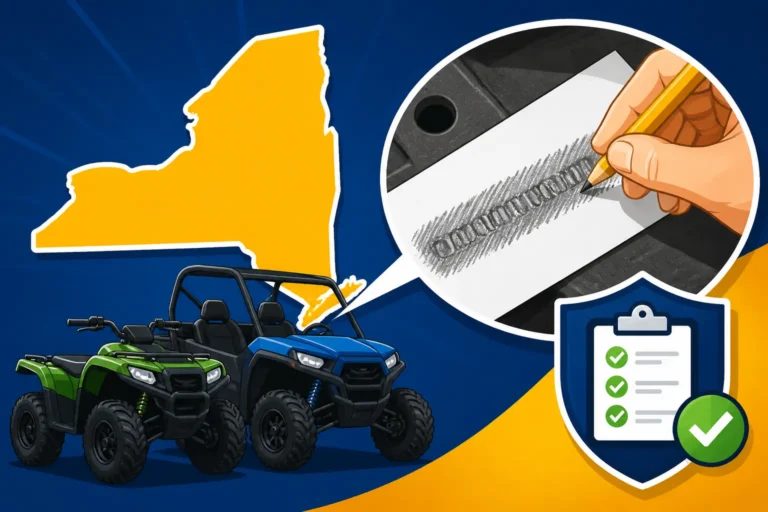
When you present your MSO to the DMV, they'll keep the original and issue you a registration. Make sure the VIN on the MSO matches the VIN on your electric ATV exactly. Any discrepancy, even a single digit, will lead to delays and require you to go back to the dealer to correct it. Sometimes, you'll also need a pencil tracing of the VIN, especially if you're registering by mail or at certain DMV offices, so be prepared for [New York ATV VIN Tracing Requirement].
Necessary Forms and Proof of Insurance
To register your electric ATV, you'll need to fill out a Vehicle Registration/Title Application (Form MV-82). Even though New York doesn't title ATVs, this is the standard form used for all vehicle registrations, including non-titled machines. You'll also need proof of New York ATV liability insurance. This isn't optional; it's a legal requirement to operate any ATV in New York, even on private land unless it's exclusively your own property. You'll need to present an insurance card or other acceptable proof that your electric ATV is covered by a policy meeting New York's minimum liability requirements.
Here's a quick rundown of what you'll typically need to bring to the DMV:
| Document Type | New Electric ATV (from dealer) | Used Electric ATV (private sale) |
|---|---|---|
| Proof of Ownership | Manufacturer's Statement of Origin (MSO) | Bill of Sale (from previous owner) |
| Proof of Prior Reg. | Not applicable | Previous registration (if available) |
| Identification | Valid NY Driver's License/ID | Valid NY Driver's License/ID |
| Insurance Proof | NY Liability Insurance Card | NY Liability Insurance Card |
| Application Form | MV-82 (completed) | MV-82 (completed) |
| Payment for Fees | Registration Fee, Plate Fee | Registration Fee, Plate Fee, Sales Tax |
| VIN Tracing (optional) | May be requested | May be requested |
Remember, if you're buying a used electric ATV, you'll also likely pay sales tax on the purchase price. The DMV handles the collection of sales tax at the time of registration, so be prepared for that expense. This is generally calculated based on the purchase price listed on your bill of sale. For more on the paperwork side, check out [New York ATV Registration Paperwork].
The Registration Process and What to Expect
Once you have all your documents in order, the actual registration process for your electric ATV is quite straightforward. You can usually complete it at most New York Department of Motor Vehicles (DMV) offices.
Where to Go and What to Do
The best place to register your electric ATV is at a New York State Department of Motor Vehicles office. While some smaller county clerk offices might handle registrations, the DMV is generally the most reliable option for ATV registrations. When you arrive, be sure to have all your paperwork organized. This includes your completed MV-82 form, your MSO or bill of sale, your New York driver's license or other valid identification, and your proof of insurance. It's often helpful to have extra copies of your documents, just in case.
During your visit, a DMV clerk will review your documents to ensure everything is correct and that your electric ATV meets the state's definition. They'll verify the VIN, process your payment for the registration fees, and then issue you a registration certificate and an ATV license plate. Don't be surprised if they also give you a validation decal to place on the plate. Make sure you understand where this decal needs to go, as incorrect placement can sometimes lead to issues down the road. For specifics on where to go, you can look at [Where to Register an ATV in New York].
Fees and Expiration Dates
Registering an electric ATV in New York involves a few fees. There's an annual registration fee and a one-time plate fee. The plate fee is just that—a one-time charge for the physical license plate itself. Once you've paid it, you won't pay it again for that machine unless you need a replacement plate. The registration, however, needs to be renewed annually. This is a common source of confusion for many riders, as New York ATV registrations expire on August 31st each year, regardless of when you initially registered your machine.
So, if you register your electric ATV in, say, July, your registration will still expire the following August 31st. You won't get a full year from your registration if you register close to the expiration date. This non-prorated system can be a bit frustrating, but it's consistent across all ATV registrations in New York. You'll receive a renewal notice in the mail well before the August 31st deadline. It’s important to renew on time to avoid any lapse in legal operation. To understand the costs involved, you might want to look at [New York ATV Registration Cost] and [New York ATV Plate Fee]. Also, knowing [New York's August 31 Expiration] is key to staying compliant.
What to Do After Registration
Once you have your registration certificate and plate, you're almost ready to ride! You need to securely attach the license plate to the rear of your electric ATV. There are specific rules about where the plate should be mounted and how it should be displayed to be clearly visible. Generally, it goes on the rear, and some machines have a designated spot. Your validation decal will stick directly onto the plate in the area specified by the DMV.
Keep your registration certificate and proof of insurance with you whenever you ride. While you won't need to carry them on your person if you're on your own private property, if you're riding on designated trails or crossing public roads where legal, an officer might ask to see them. Being able to produce these documents quickly can save you a lot of hassle. And don't forget your [New York's Mandatory ATV Insurance]! It's not just a registration requirement; it's vital protection.
Special Considerations for Electric ATVs
While the general registration process is the same, some unique aspects of electric ATVs might lead to additional questions or require a bit more attention.
Youth Electric ATVs and Age Restrictions
Electric ATVs are often popular choices for younger riders due to their quieter operation and sometimes simpler controls. However, the same age restrictions and safety course requirements that apply to gas-powered ATVs also apply to electric ones in New York. A rider must be at least 10 years old to operate an ATV, and those between 10 and 15 years old must have an ATV Safety Certificate and be under direct supervision by an adult over 18. This means that even if your child's electric quad is small and seems harmless, the state's rules are still firm. You can't just hand over the keys without understanding the legal responsibilities involved. For more on this, look into [New York Registration for a Youth Machine] and [New York Minimum Age to Ride an ATV].
Evolving Regulations and Future Changes
The world of electric vehicles, including ATVs, is constantly evolving. New York, like many states, is beginning to grapple with how to best integrate these machines into existing laws. While currently, the electric nature of your ATV doesn't fundamentally change its registration requirements if it meets the ATV definition, there could be future legislation. For instance, there have been discussions and proposed bills concerning electric ATVs and UTVs to update definitions or create specific categories.
It's a good practice for electric ATV owners to stay informed about potential legislative changes. What might not be an issue today (like a slightly heavier electric ATV) could become one if new laws are passed. These changes often take time, passing through committees and public comment, but it's worth keeping an ear to the ground. For now, the existing ATV definition is your guide, but future changes could impact everything from [A New York Bill to Widen the ATV Definition] to [What New York's Electric ATV Bill Would Change].
Disclaimer
This article is for general informational purposes only and does not constitute professional advice. Laws, prices and regulations vary by location and change over time. Consult a qualified professional for guidance on your specific situation.