Registering a Quad You Trailer in New York
It's a common thought process, isn't it? You've got your quad, you've got your trailer, and you only plan on riding it at designated trail systems or on private land. The idea of going to the DMV for something that never even touches a public road under its own power can feel like an unnecessary hurdle. But the truth is, if you're bringing your ATV to New York trails, even if it's securely strapped down on a trailer for the entire journey on asphalt, understanding the state's registration requirements is absolutely crucial to avoid fines, legal headaches, and a ruined day of riding. This guide will help clear up the confusion and explain exactly why and how you need to register your quad, even if its wheels rarely touch anything but dirt once it leaves your trailer.
Do You Need to Register a Quad if You Only Trailer it to the Trails?
This is perhaps the most frequently asked question among ATV enthusiasts who primarily use their machines for recreational trail riding. The short, unequivocal answer in New York is: yes, you almost certainly do. The act of trailering your quad doesn't exempt it from the state's registration requirements if you intend to operate it anywhere off your own private property.
The Myth of the "Trailer-Only" Exemption
Many riders operate under the misconception that if their ATV isn't driven on public roads, or only travels on them via a trailer, it doesn't need to be registered. This belief, while understandable, is a persistent myth that can lead to significant trouble in New York. The state's Vehicle and Traffic Law is quite clear: an ATV must be registered if it's going to be operated anywhere other than solely on private land owned by the ATV's owner, where it never leaves that property.
Consider this common scenario: you load up your ATV, drive two hours from your home in Syracuse to the vast trail network in Lewis County, and then unload your machine, ready for a day of adventure. Even though your quad spent the entire highway journey on your trailer, the moment it's offloaded and ridden on those public or club trails, it falls squarely under New York's registration mandate. The trailer is simply a conveyance; it doesn't transfer the registration requirement from the ATV to the tow vehicle, nor does it make the ATV invisible to the law.
New York's Core Registration Requirement
New York State law defines an all-terrain vehicle (ATV) and then establishes a clear requirement for its registration. The law doesn't differentiate based on how the ATV gets to its riding location. The fundamental principle is about where and how the machine will be operated. If you plan to ride your quad on any trail that is not exclusively and entirely your own private land—be it a state-maintained trail, a county trail system, or a private club's network—it needs to be registered.
This means that whether you're heading to the Tug Hill Plateau for some mudding, or exploring a local club trail near Oswego, your ATV needs a valid New York registration and plate. The registration fee helps fund the very trails you enjoy, making it a crucial part of maintaining the riding experience in the state. For a deeper dive into the basic requirements, check out [Do You Need to Register an ATV in New York?]. It outlines the parameters that trigger the need for registration.
Why the Trailer Doesn't Matter
Think about it this way: you trailer a boat to a lake. The boat still needs to be registered with the appropriate state agency, right? The trailer is merely the means of getting the vessel from point A to point B. The same logic applies to ATVs in New York. The physical act of transporting the ATV on a trailer does not change its classification or the legal requirements for its operation once it's offloaded.
The state's interest lies in identifying machines that will be used off-highway, ensuring they meet certain standards, and collecting fees that often contribute to trail maintenance and safety programs. So, while your trailer is doing its job of safely moving your quad, it's not absolving the quad itself of its legal obligations within New York State.
What Happens if You Don't Register Your Trailered Quad?
Ignoring the registration requirement, even if you only trailer your quad, can lead to a host of unpleasant consequences. Many riders assume that as long as they aren't riding on a public road, they're in the clear, but enforcement isn't limited to just catching someone in the act of riding on forbidden pavement.
Roadside Stops and Enforcement
You might think that as long as you're not riding on a road, law enforcement won't bother you. However, officials regularly monitor popular trailheads, staging areas, and even gas stations near riding spots. If your quad is on a trailer and appears ready for off-road use, an officer can certainly inquire about its registration status. They might notice missing plates or expired decals, which are easy indicators of non-compliance.
Imagine pulling into a rest stop on I-81 with your shiny, unregistered quad prominently displayed on your trailer. While the primary focus might be your tow vehicle's registration, a keen-eyed trooper could easily spot the lack of an ATV plate. This isn't just a theoretical concern; it happens. Enforcement efforts are often concentrated in areas where ATVs are frequently transported or used, such as the Tug Hill region or other popular riding destinations.
Fines and Penalties
Operating an unregistered ATV in New York, or possessing one for use off your private property without proper registration, carries significant fines. These aren't just minor slaps on the wrist; they can quickly add up and turn your planned fun day into a costly headache. Penalties can include monetary fines, and in some more serious or repeat offense situations, your machine could even be impounded. The cost of retrieving an impounded vehicle, along with any storage fees, can far outweigh the initial registration fee you tried to avoid.
It's a far better investment of your time and money to go through the proper registration channels than to risk the financial hit of fines and potential impoundment. For more specific details on what you might face, consult [New York Fines for an Unregistered ATV]. Knowing the potential costs upfront can be a powerful motivator for compliance.
What About Insurance?
Beyond registration, New York has a mandatory insurance requirement for ATVs. Just like with registration, this isn't optional for machines used off your own private land. If your quad is unregistered, it's highly likely it's also uninsured, or at least not insured to the state's minimum requirements for trail riding. This creates a double whammy of legal issues.
If you're involved in an accident while riding an unregistered and uninsured ATV, even if it's on a designated trail, you open yourself up to immense personal liability. You could be responsible for all damages, medical bills, and property destruction out of pocket, in addition to fines for both lack of registration and lack of insurance. New York takes ATV insurance seriously, and for good reason: accidents can be severe. Understanding [New York's Mandatory ATV Insurance] is just as important as knowing the registration rules, as the two often go hand-in-hand in terms of legal consequences.
The Registration Process for Your Trailered Quad
So, you've decided to do things by the book—smart move! Registering your ATV in New York is a relatively straightforward process, though it does require careful attention to detail and the right paperwork. Since New York does not issue titles for ATVs, proof of ownership is absolutely critical.
Gathering Your Paperwork
Before you head to the Department of Motor Vehicles (DMV), make sure you have all your ducks in a row. The key documents you'll need typically include:
- Proof of Ownership: This is usually a detailed bill of sale.
- Proof of Identity: Your New York driver's license or non-driver ID.
- Proof of Residency: Documents showing your New York address.
- Form MV-51B: This is the specific form used for non-titled vehicles like ATVs. You'll fill out sections related to the vehicle and the buyer/seller. This form is essential for [New York's Form MV-51B Explained].
- VIN Tracing: New York often requires a pencil tracing of the ATV's Vehicle Identification Number (VIN) directly from the frame. This might sound old-fashioned, but it’s a crucial step to verify the machine's identity and ensure it hasn't been tampered with. Make sure you know [New York ATV VIN Tracing Requirement] before you go.
Having everything organized will save you multiple trips and ensure a smooth registration experience.
Understanding the Ownership Proof
Since New York doesn't title ATVs, your bill of sale isn't just a casual receipt—it's your primary legal proof of ownership. This document needs to be clear, comprehensive, and legally sound. A good bill of sale should include:
- Full names and addresses of both buyer and seller.
- The date of sale.
- The ATV's Vehicle Identification Number (VIN).
- Make, model, and year of the ATV.
- Sale price.
- Signatures of both buyer and seller.
- If possible, notarization adds an extra layer of authenticity, though it's not always strictly required for ATV registration.
When you're dealing with a private sale, especially for a used machine, it's easy to overlook these details. However, a poorly documented sale can severely complicate your registration efforts. If you're buying a used quad from an individual, consider using a standardized template. Services like LawDepot offer customizable bill of sale templates that ensure all the necessary legal information is included, giving you peace of mind and making the DMV process much smoother. This is particularly important for [New York ATV Bill of Sale Requirements]. For more on this, see [Proving Ownership Without a Title in New York].
Where to Go for Registration
Once you have all your documents prepared, you'll need to visit your local New York Department of Motor Vehicles (DMV) office. While many transactions can be done online or by mail, initial ATV registrations typically require an in-person visit so the DMV clerk can verify your documents and collect the necessary fees.
It's always a good idea to check your specific DMV office's requirements or make an appointment if possible, especially in busier areas. Be prepared for a wait, but rest assured that with all your paperwork in order, the process will be efficient. The fees involved include the registration fee and a one-time plate fee. While we can't give specific figures, know that these costs are relatively modest, especially when compared to the fines for non-compliance. You can learn more about this at [Where to Register an ATV in New York] and [New York ATV Registration Cost].
Essential Considerations for Trailering in New York
Registering your quad is a significant step, but it's just one part of being a responsible ATV owner in New York. There are other considerations, especially when you're trailering your machine across the state or from out of state.
Planning Your Route and Destination
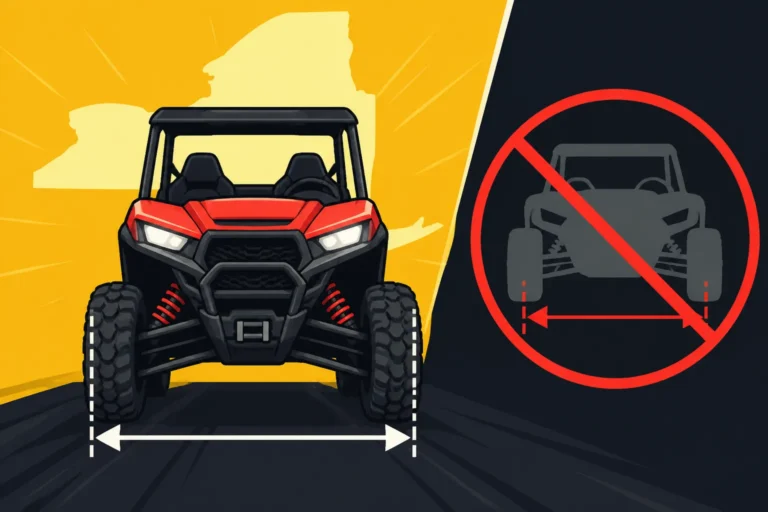
Even with a fully registered and insured ATV, you can't just ride anywhere. New York has specific rules about where ATVs can and cannot be operated. Designated trail systems, like those in Lewis County, are your primary legal riding areas. However, these trails often have their own rules regarding machine size, width, and weight. For instance, New York has a [New York ATV Width Limit for Registration] of 70 inches for machines to be considered ATVs under the law and registered as such. Many modern side-by-sides exceed this.
It's crucial to research your intended riding destination before you load up the trailer. Check with county parks departments, local ATV clubs, or state land managers for current trail maps, open seasons, and any specific machine restrictions. Showing up to a trailhead only to find your machine is too wide or that the trails are closed for mud season can be incredibly frustrating after a long haul with your trailer.
Out-of-State Machines
If you're a visitor to New York and plan to trailer your quad here, you might be wondering about registration reciprocity. Generally, if your home state has an ATV registration program that issues a plate or decal, New York may honor it for a limited period, but this isn't always a guarantee and depends on the specifics of your home state's program. However, if your home state does not have a formal ATV registration program, or if New York does not have reciprocity with it, you will likely need to register your machine in New York before riding.
Don't assume your out-of-state plate is sufficient. Always verify with the New York DMV or the specific trail system you plan to visit. It's better to be safe than sorry, especially when traveling long distances. More information can be found at [Registering a Visitor's Machine in New York]. Riders from neighboring states like Pennsylvania or Vermont should specifically look into reciprocity rules.
The Importance of a Bill of Sale
We've touched on this before, but it bears repeating: the bill of sale is your golden ticket for ATV ownership in New York. This document proves you legally acquired the machine, which is fundamental to registration, insurance, and even selling it down the line. If you purchased your quad from a private seller, and they didn't provide a comprehensive bill of sale, you need to rectify that immediately.
Without a robust bill of sale, proving ownership for an unregistered ATV can become a bureaucratic nightmare. The DMV needs to be absolutely sure the machine isn't stolen or subject to other legal disputes. If you're struggling to track down the original seller or get proper documentation, it can severely delay your ability to get on the trails. When in doubt, a formal template from a reputable source like LawDepot can provide the necessary structure for a clear and undisputed transfer of ownership. This ensures you're protected and simplifies the registration process for [New York ATV Registration Without a Title].
Required Documents for New York ATV Registration
| Document Category | Specific Items | Importance |
|---|---|---|
| Proof of Ownership | Detailed Bill of Sale | Essential for non-titled ATVs; must include VIN, buyer/seller info, date, price, signatures. |
| DMV Form | Form MV-51B (Application for Registration) | Specific form for non-titled vehicles. |
| Machine Verification | Pencil Tracing of VIN (from frame) | Verifies the ATV's identity and condition. |
| Personal ID | New York State Driver's License or Non-Driver ID | Establishes identity of the registrant. |
| Residency Proof | Utility Bill, Bank Statement, Lease Agreement | Confirms New York State residency. |
| Insurance Proof | New York ATV Insurance ID Card or Policy Details | Mandatory for operation anywhere off your own private property; ensures financial responsibility in case of accident. |
Disclaimer
This article is for general informational purposes only and does not constitute professional advice. Laws, prices and regulations vary by location and change over time. Consult a qualified professional for guidance on your specific situation.