Registering a Hunting Quad in New York
For many hunters across New York, their ATV isn't just a recreational vehicle; it's a vital piece of gear, helping them access remote hunting spots, haul stands, and retrieve game. But navigating the state's registration requirements for these machines can feel like trying to track a wily buck through thick brush – confusing and full of hidden obstacles. This guide aims to clear the path, walking you through everything you need to know to properly register your hunting quad in New York so you can focus on the hunt, not on legal worries.
Understanding New York's ATV Registration Requirements for Hunters
It’s a common misconception that if you’re only using your ATV for hunting on private land, you don't need to register it. While there are some narrow exemptions, the reality for most hunting quads in New York is that registration is absolutely mandatory if you plan to ride anywhere off your own property, and even then, there are nuances. This isn't just about trail riding; it's about lawful operation, period. Ignoring this can lead to fines, headaches, and even having your machine impounded, which is the last thing you want during hunting season.
Why Your Hunting Quad Needs to Be Registered
The core reason your hunting quad likely needs registration in New York boils down to state law. The Department of Motor Vehicles (DMV) defines an ATV quite broadly, and if your machine fits that definition, it typically needs to be registered. This requirement isn't just for organized trail systems; it extends to roads designated for ATV use, lands leased for hunting, or even just crossing a short section of public road to get from one private parcel to another. The state's primary interest is in accountability, safety, and funding. Registration fees help maintain public trails and support enforcement, which ultimately benefits all riders, including hunters.
Many hunters operate under the assumption that since their property is private, or they have permission to ride on a friend's private land, they're exempt. However, the law generally states that if the ATV is operated anywhere other than your own property without crossing a public highway, it needs to be registered. The moment you touch a public road, even briefly, or venture onto designated state land or a club trail, registration becomes non-negotiable. Even on private land, having your machine registered and insured is a good idea for liability reasons, protecting both you and any landowners who grant you access.
Think of it this way: your hunting rifle needs a license, your fishing boat needs registration, and your truck needs plates. Your ATV is no different in the eyes of the law, especially when it's being used beyond the confines of your own backyard. It’s a matter of ensuring proper identification and compliance, which helps prevent theft and aids in recovery if something goes wrong.
Key Registration Criteria for ATVs in New York
New York has specific criteria that a machine must meet to be registered as an ATV. These aren't just arbitrary rules; they're designed to ensure public safety and manage the types of vehicles operating on trails and certain roads. The most critical factors often revolve around the physical dimensions of the machine, which can be particularly tricky for larger, modern side-by-sides. If your machine doesn't meet these definitions, you might find yourself unable to get that coveted registration sticker.
One of the biggest hurdles for many modern hunting rigs, especially side-by-sides (UTVs), is the width and weight limitations. New York defines an ATV as a machine not more than 70 inches wide and weighing no more than 1,000 pounds. This immediately rules out many popular utility side-by-sides like the Polaris Ranger or Can-Am Defender, which are often wider and heavier right off the showroom floor. It's a frustrating reality for hunters who rely on these machines for their capacity and versatility. You can learn more about this by reading [New York ATV Width Limit for Registration] and [New York ATV Weight Limit for Registration].
Additionally, the ATV must be designed for off-road use, have handlebars for steering, and a seat designed to be straddled by the operator. While this covers most traditional ATVs, it's another point of distinction from vehicles like golf carts or certain specialized utility vehicles that might not fit this description. Before you even head to the DMV, it's crucial to measure and weigh your machine to ensure it falls within these parameters. Don't assume; verify.
Proving Ownership Without a Title
One of the most common stumbling blocks for New York ATV owners, particularly those who've purchased a used machine for hunting, is the lack of a traditional title. Unlike cars and trucks, New York does not issue titles for ATVs. This can lead to confusion and frustration when you're trying to prove ownership for registration purposes. However, the DMV has established clear guidelines for what constitutes acceptable proof, even in the absence of a title.
When you go to register, the DMV will ask for specific documentation to confirm that you are the rightful owner. If you bought your quad from a dealership, they will typically provide you with a Manufacturer's Statement of Origin (MSO) or a similar document, along with a bill of sale. This MSO serves as the initial ownership document for a new machine. For used ATVs, the primary proof of ownership typically comes down to a well-executed bill of sale from the previous owner. This document is paramount, so make sure it's thorough.
A good bill of sale should include the seller's and buyer's full names and addresses, the date of sale, the purchase price, and a detailed description of the ATV, including its make, model, year, and crucially, the Vehicle Identification Number (VIN). Both parties should sign and date it, and it's always a good idea to have it notarized if possible, though not strictly required by the DMV. You can find reliable templates for a bill of sale through services like LawDepot, which help ensure all the necessary information is included. Without a robust bill of sale, proving ownership can become a significant hurdle, potentially delaying or even preventing your registration. Knowing [New York ATV Bill of Sale Requirements] is incredibly helpful here.
The Registration Process: Step-by-Step for Hunters
Getting your hunting quad registered in New York is a straightforward process once you understand the steps involved and have all your ducks in a row. It primarily involves gathering the right documents, knowing where to submit them, and understanding what to expect when you're there. Don't let the thought of bureaucracy deter you; being prepared makes all the difference.
Gathering Your Documentation
Before you even think about stepping foot in a DMV office, the most crucial step is to collect all the necessary paperwork. Showing up unprepared will only lead to delays and multiple trips, eating into your valuable time that could be spent scouting. Having a complete packet of documents will make the process smooth and efficient, ensuring you get that registration sticker without a hitch.
Here's a breakdown of what you'll typically need:
- Proof of Ownership: As discussed, this will likely be your original MSO if the machine is new, or a comprehensive bill of sale if it's used. Ensure the VIN on the document matches the ATV exactly. For an inherited machine, you'll need the will or letters of administration.
- Proof of Identity: A valid New York driver's license or non-driver ID card is usually sufficient. If you're new to the state or don't have a New York ID, you'll need to check the DMV's specific requirements for alternative proofs.
- Proof of Residence: A utility bill or other official mail showing your New York address might be requested to confirm residency.
- Form MV-51B (Application for Registration/Title): This is the main application form you'll fill out. Even though New York doesn't title ATVs, this form is used for registration. Be sure to fill it out completely and accurately, especially the sections pertaining to vehicle description and ownership. Understanding [MV-51B and New York's Non-Titled Vehicles] can help clarify this form's purpose.
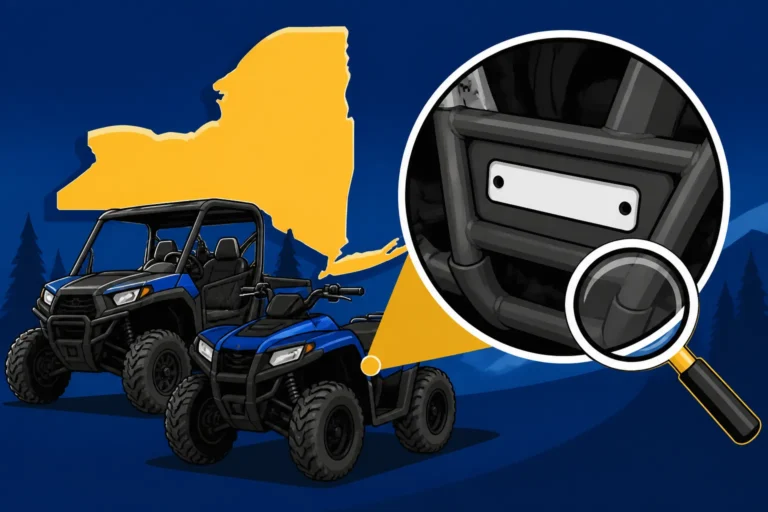
- VIN Tracing or Photo: The DMV often requires a pencil tracing or a clear photograph of your ATV's VIN. This is a measure to prevent fraud and ensure the VIN you provide matches the machine. Prepare this before you go. The detail on [Why New York Wants a Pencil Tracing of the VIN] is worth reviewing.
- Proof of Insurance: You must have valid ATV insurance that meets New York's minimum liability requirements. Bring your insurance card or declaration page as proof. More on this later, but know it's a non-negotiable requirement.
- Payment for Fees: Be prepared to pay the registration fee and any other associated costs. The DMV accepts various forms of payment, but cash, check, or credit/debit card are generally accepted.
Here’s a handy checklist table for your convenience:
| Document Category | Specific Documents Required (Typical) | Notes for Hunters |
|---|---|---|
| Proof of Ownership | Manufacturer's Statement of Origin (MSO) OR Bill of Sale | Crucial for used quads; consider a LawDepot template for a robust Bill of Sale. |
| Identification | Valid NY Driver's License or Non-Driver ID | Ensure address on ID matches proof of residence. |
| Residency Proof | Utility Bill, Bank Statement, or Lease Agreement | Must show your current New York address. |
| Application Form | NY DMV Form MV-51B | Fill out completely, including VIN and vehicle details. |
| VIN Verification | Pencil Tracing of VIN OR Clear Photo of VIN Plate | Do this at home before your visit. |
| Insurance Proof | ATV Insurance Card or Declaration Page | Must meet NY's minimum liability requirements. |
| Payment for Fees | Cash, Check, or Credit/Debit Card | Check current fees on the DMV website before you go. |
Where to Go to Register Your ATV
Once you have all your documents organized, the next step is to visit your local New York Department of Motor Vehicles (DMV) office. While some vehicle registrations can be handled online or by mail, for an initial ATV registration, an in-person visit is usually necessary to ensure all documentation, especially the proof of ownership and VIN verification, can be properly reviewed. This ensures accuracy and helps prevent fraud.
You can find the nearest DMV office by visiting the official New York DMV website. It's often a good idea to check their hours of operation and if they require appointments for certain services, especially if you're going during peak times like lunch hours or right before hunting season. Some smaller county clerk offices may also handle ATV registrations, so check if your local county offers this service, as they can sometimes be less crowded than larger regional DMV offices. Planning ahead can save you a lot of waiting time and frustration.
When you arrive, make sure to ask for the correct counter or department that handles ATV registrations. Sometimes, there are separate lines for different services, and knowing where to go initially can make your visit more efficient. Be patient, as the DMV can sometimes be a busy place, but being prepared with all your paperwork will undoubtedly speed up your personal transaction. [Where to Register an ATV in New York] might give more specific guidance on locations.
What to Expect at the DMV
Your visit to the DMV for ATV registration should be fairly straightforward if you're well-prepared. Once you're called to the counter, a DMV representative will review all the documents you've brought. They will cross-reference your identification, verify your proof of ownership, and ensure your insurance coverage meets the state's minimums. This is also where they will scrutinize your VIN tracing or photo to match it against the paperwork.
They will process your MV-51B form and calculate the applicable fees. These fees typically include an initial registration fee and a one-time plate fee. Remember, do not expect to haggle or discuss the fees; they are set by law. Once the payment is processed, you will typically receive your ATV registration certificate, a set of new ATV plates, and validation stickers on the spot. Make sure to affix your plate to the rear of your machine and the validation sticker as instructed, usually near the plate, to ensure compliance. You might be interested in [New York ATV Registration Cost] and [The One-Time Plate Fee in New York] for more details on pricing.
After your visit, it’s a good practice to keep your registration certificate and insurance card with you whenever you're riding your ATV. While you won't carry the actual plate in your wallet, having the documents accessible is crucial if you are stopped by law enforcement or need to prove registration for trail access. Consider taking a photo of these documents on your phone as a backup, in addition to carrying the physical copies.
Beyond Registration: Important Rules for Hunters
Registration is just one piece of the puzzle. For hunters, understanding the broader rules governing ATV use in New York is essential for a safe, legal, and enjoyable experience. This includes everything from mandatory insurance to where you can actually take your machine, especially when carrying firearms or retrieving game.
Insurance and Safety Certificate Requirements
New York takes ATV safety and responsibility seriously, which is why both insurance and, for younger riders, a safety certificate, are mandatory. These requirements aren't just bureaucratic hurdles; they're designed to protect riders, other trail users, and landowners from the financial fallout of accidents. For a hunter venturing into remote areas, having proper insurance is particularly critical.
Every ATV operated in New York, with very few exceptions for strictly private land use, must be covered by liability insurance that meets the state's minimum requirements. This typically includes coverage for bodily injury and property damage. Without it, you risk significant fines and potential legal issues if you're involved in an accident, even if you're not at fault. Many auto insurance providers offer ATV policies, so it's worth checking with your current carrier. Always carry proof of insurance with you when you ride. [New York ATV Insurance Requirement] explains the specifics of what's needed.
For riders under the age of 16, a New York ATV safety certificate is also mandatory. While most adult hunters won't need this, it's important to remember if you have a younger family member joining you on the hunt or operating their own youth quad. The safety course covers proper riding techniques, rules of the trail, and emergency procedures, giving young riders the foundational knowledge they need to stay safe. You can find more details at [New York ATV Safety Certificate Requirements]. Even for adults, taking a voluntary safety course is always a wise investment in your own safety and skills.
Where You Can Legally Ride Your Hunting Quad
This is perhaps the most critical section for hunters: knowing where you can actually ride your ATV. New York has strict rules about ATV operation, and violating them, even unknowingly, can lead to trespass charges, fines, and damage to landowner relationships. Your hunting quad is designed for off-road terrain, but that doesn't mean all off-road terrain is fair game.
Generally, ATVs in New York are restricted to designated trails, private land with explicit permission, or roads that have been specifically designated and posted for ATV use by local municipalities. You cannot simply ride on any public land, state forest, or unposted road. Many state parks and the vast majority of the Adirondack and Catskill Forest Preserves are strictly off-limits to ATVs. Always assume an area is closed to ATVs unless it is clearly marked as open. [Where New York Bars ATV Riding] offers a comprehensive overview of restricted areas.
For hunters, this means you need to verify the legality of ATV use on your specific hunting grounds. If you're on private land, you must have the landowner's explicit permission to ride an ATV. A general hunting lease may not automatically grant ATV riding privileges, so it's always best to get clarification in writing. For public hunting lands, check with the managing agency (e.g., DEC, county parks department) for specific ATV regulations. Some properties may allow ATVs only for game retrieval on specific access roads, while others may ban them entirely.
Specific Rules for Carrying Firearms and Game
For hunters, the ATV is often a tool to assist with carrying gear and retrieving game. However, there are specific regulations in New York regarding carrying firearms on an ATV and transporting harvested animals. Ignorance of these rules is not a defense, so make sure you understand them before you head out.
When it comes to firearms, New York law generally prohibits the possession of a loaded firearm on an ATV, except for specific circumstances (e.g., actively engaged in hunting from a stationary position where permitted, or by law enforcement). This means your rifle or shotgun should be unloaded and properly cased or otherwise secured while the ATV is in motion. This rule is designed to prevent accidents and ensure responsible firearm handling. Always double-check current hunting regulations for any specific exceptions or updates related to ATV use during hunting season. [New York Rules for Carrying a Firearm on an ATV] can provide more detail on this often-misunderstood topic.
Retrieving game with an ATV is often a primary reason hunters use these machines. While ATVs can be invaluable for hauling out a heavy deer or bear, you must still adhere to all the rules regarding ATV operation and land access. You cannot simply drive off-trail or onto restricted land to retrieve game, even if it means an easier haul. All game retrieval must be done on designated trails or on private land with permission. Always ensure your harvested game is properly tagged and cared for according to DEC regulations, regardless of how you transport it.
Common Pitfalls and How to Avoid Them
Even with the best intentions, hunters can sometimes fall into common traps regarding ATV registration and use in New York. Being aware of these pitfalls can save you significant trouble and help you stay on the right side of the law.
Misconceptions About Farm Use and Private Land
One of the most persistent myths among hunters is that if their ATV is used for "farm" purposes or solely on private land, it doesn't need to be registered. While there are agricultural exemptions for certain vehicles, they are often narrowly defined and do not apply to the average hunting quad, especially if it's also used for recreation or is operated off the farm property. For instance, a quad used for fencing on an active farm might be exempt, but the moment that same quad is used to access a hunting blind on a different property, or to trail ride, the exemption likely vanishes.
Similarly, the "private land" exemption is often misinterpreted. As previously mentioned, New York law generally requires registration if an ATV is operated anywhere other than solely on your own property. If you have permission to hunt on a friend's 100 acres, that's private land, but it's not your private land unless you own it. Therefore, riding your ATV on that friend's property requires registration. The intent behind these laws is to ensure that any machine that could potentially be operated on public access points or other lands is identifiable and accountable. When in doubt, it’s always safer and wiser to register your machine. You can explore [Does a Farm-Only Quad Need New York Registration?] for more specific details.
Addressing Machine Width and Weight Limits
This is a major pitfall for many hunters looking to purchase new ATVs or side-by-sides. Modern utility side-by-sides, favored by many for their cargo capacity and passenger room, often exceed New York’s strict 70-inch width and 1,000-pound weight limits for ATV registration. It’s incredibly disappointing to buy a brand-new machine, only to discover you can’t legally register it for use on New York’s trails or public access roads.
Before you make a purchase, especially of a side-by-side, carefully check the manufacturer's specifications for width and dry weight. Do not rely on casual measurements or dealer assurances without double-checking the exact specifications against New York's law. If the machine exceeds these limits, it simply cannot be registered as an ATV in New York. This doesn't mean you can't own it, but its use will be severely restricted to your own private property, effectively making it useless for most hunting trips that require access to designated trails or crossing public roads. [Why a Modern Side-by-Side Fails the Test] provides a good explanation of this issue.
There have been discussions and proposals in the New York legislature to amend these width and weight limits to accommodate larger machines, but as of now, these proposals are not law. Always operate under the current regulations. Ignoring these limits can lead to you having an expensive, unregistered machine that you can only ride on your own acreage, which is hardly ideal for pursuing that trophy buck deep in the woods.
What Happens if You Don't Register
Riding an unregistered ATV in New York, especially one used for hunting, comes with a range of undesirable consequences. The risks far outweigh any perceived benefit of saving a few dollars on registration fees. Law enforcement officers, including DEC Environmental Conservation Officers, are well-versed in ATV regulations and actively patrol areas known for ATV use, especially during hunting seasons.
If you're caught operating an unregistered ATV, you could face significant fines. These aren't just minor tickets; they can quickly add up. Beyond monetary penalties, an officer has the authority to impound your machine. Imagine being deep in the woods, having harvested a deer, and then your ATV is towed away because it's unregistered. Not only do you have to deal with the fines, but also impound fees, and the headache of recovering your machine, which could be miles away from your hunting camp.
Furthermore, riding an unregistered ATV can complicate matters significantly if you're involved in an accident. Your insurance coverage might be jeopardized, leaving you personally liable for damages or injuries. It also erodes the trust between landowners and riders, potentially leading to fewer areas being open for ATV use for all hunters. The simple act of registering your hunting quad ensures you're a responsible operator and helps preserve access for everyone. [New York Fines for an Unregistered ATV] will give you a stark idea of the penalties involved.
Disclaimer
This article is for general informational purposes only and does not constitute professional advice. Laws, prices and regulations vary by location and change over time. Consult a qualified professional for guidance on your specific situation.