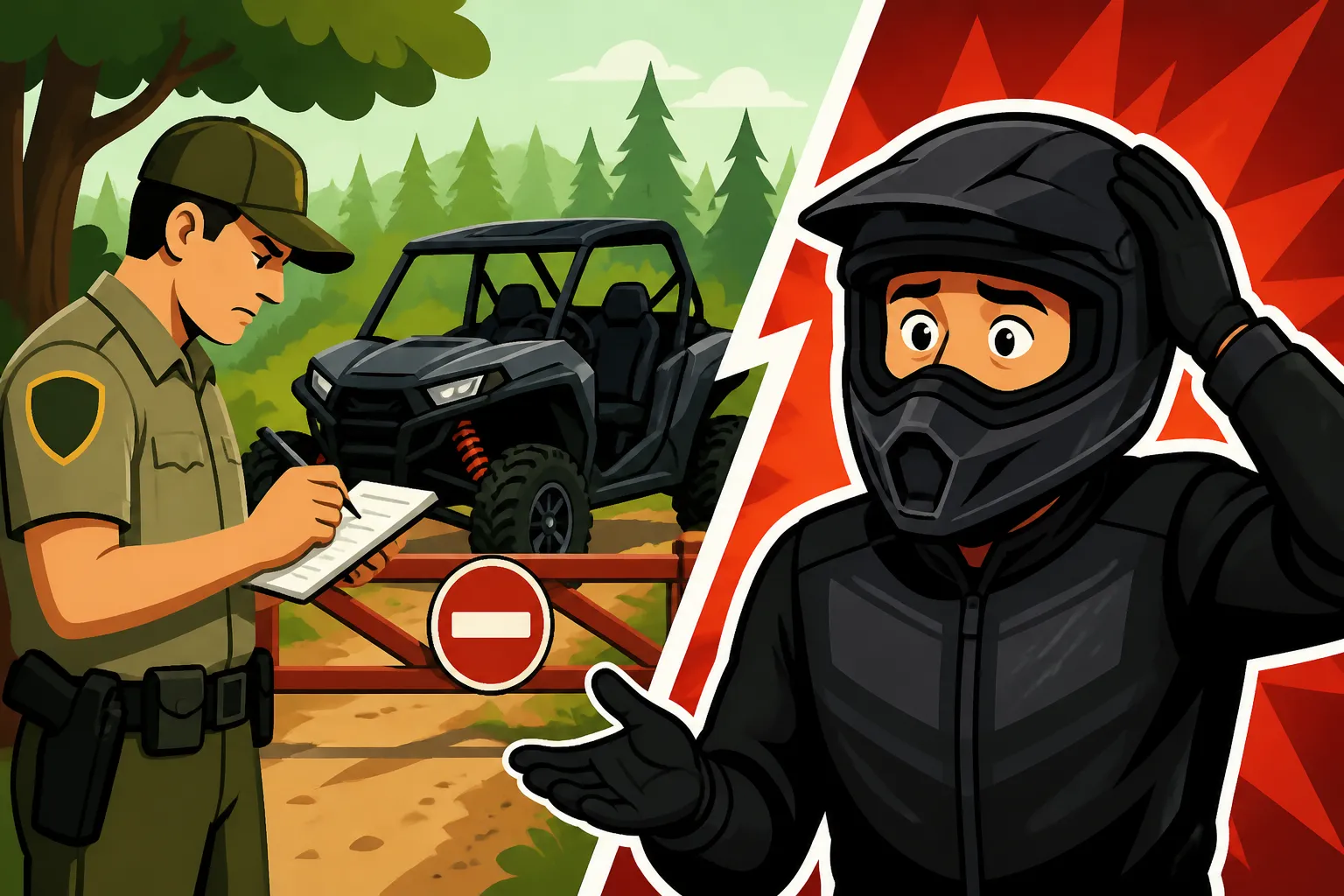
Getting Ticketed on a Private Club Trail
A ticket on a private club trail can be confusing: the trail is on private land, but that does not automatically put it beyond New York’s laws. The key is to identify who issued the notice, what rule it alleges you broke, and whether it is a court summons or only a club action. Those details determine what to do next.
First, find out what kind of ticket you received
“Ticketed” can mean two different things on a club trail. A law enforcement officer may issue a summons or other formal notice for an alleged legal violation. A club or trail operator may instead give you a warning, revoke access, or report a violation under its own rules. Those are not the same process, even if both are described as tickets.
Read the document carefully. Look for the issuing person or agency, the alleged violation, any court or response information, and any deadline. Keep the original and take clear photos of every page. If you received a paper notice from a club, check whether it identifies a court or government agency. If it does not, it may be an access or membership matter rather than a court case.
| What you received | What it may mean | What to check |
|---|---|---|
| A summons or formal notice from an officer | An alleged violation of state or local law | The cited law, response instructions, and any court information |
| A club warning or violation notice | An alleged breach of club or trail rules | The club’s rules, appeal process, and possible access consequences |
| A request to leave or a notice that access is revoked | The landowner or club may be ending your permission to ride | Whether you have written permission or a valid access authorization |
| A notice about missing paperwork or equipment | The issue may concern registration, insurance, a permit, or required equipment | What the notice says you lacked and what documents you had with you |
Do not assume a club can issue a government fine, and do not assume that a notice from a club is meaningless. A club may control access to a trail it operates, and a landowner may withdraw permission to use private property. Separately, a law enforcement officer may enforce applicable laws on private land. A trail being private does not, by itself, make every activity on it exempt from regulation.
If the notice names a law, record that exact reference. If it uses broad language such as “no permit” or “unauthorized access,” ask the issuer what specific permit or access rule it means. A county trail permit, club membership, event authorization, and state ATV registration are different things. One does not automatically substitute for another.
Why a private trail can still lead to a legal citation
Private ownership addresses who controls access to the land; it does not erase New York’s operating requirements. On a club trail, a rider may have permission to be on the property and still be accused of a separate violation, such as operating without required registration or insurance, failing to meet an equipment rule, or ignoring a posted restriction.
The first question is whether you were authorized to ride there. Club trails may be open only to members, permit holders, invited guests, or riders using a particular access arrangement. Rules vary by trail system. Some trails cross private parcels under agreements with landowners, and permission may depend on following marked routes and respecting closures. Review the access conditions for the specific trail, not just the general rules of a club or county. New York Rules on Club Trails
A rider may also misunderstand which kind of authorization is needed. A club membership can provide access to a particular trail system, but it is not the same as state registration. A county permit may be needed for a county system, while another privately operated trail may have separate access terms. New York does not have a single statewide ATV trail pass that automatically grants access to every private trail. Check the specific system’s current requirements before riding.
Out-of-state registration does not necessarily settle every access question either. Reciprocity concerns whether an out-of-state registration is recognized for riding in New York; it does not grant permission to enter private land or replace a trail system’s access rules. See New York ATV Reciprocity With Other States and confirm the rules that apply to the machine and trail you are using.
Other common issues include:
- Registration: Whether your machine is properly registered for the way and place it is being operated. Keep the registration document available and make sure the plate is displayed as required.
- Insurance: New York has ATV insurance requirements, and riding on another person’s land is not the same as riding solely on your own property. Check that the policy meets the applicable requirement and covers the machine being ridden. New York’s ATV Insurance Mandate Explained
- Trail authorization: Whether you have the membership, permit, pass, or written permission required for that particular route.
- Trail closures and boundaries: Whether you left a marked route, crossed onto land without permission, or continued after a closure.
- Equipment and rider rules: Whether the machine and rider complied with applicable requirements, including rules that may apply to helmets, passengers, age, and equipment.
A valid club pass does not cure a registration or insurance problem. Likewise, having registration and insurance does not give you permission to ride a trail that is closed or restricted. Treat each requirement as a separate check.
What to do after you are stopped or given a notice
Keep the interaction calm and factual. Do not argue on the trail or assume that explaining your intentions will resolve the issue. Ask what the alleged violation is and, if you are unsure who is addressing you, whether the person is issuing a formal citation or a club notice. Provide the documents you are legally required to show, but do not guess about facts or make statements you cannot support.
As soon as practical, make a record while the details are fresh:
- Save the notice. Photograph every page, including the back, and keep any envelope or accompanying paperwork.
- Write down the circumstances. Note the date, approximate time, trail or access point, direction of travel, weather, and what happened before the stop.
- Identify the issuer. Record the officer’s name or agency if shown, or the club representative’s name and role. Keep contact details only if they were provided through an appropriate channel.
- Gather your documents. Save copies of your registration, insurance proof, club membership or trail permit, and any permission or reservation information.
- Preserve relevant communications. Keep emails, text messages, trail notices, maps, closure alerts, and receipts that relate to access.
- Follow the notice’s response instructions. If it names a court or gives a deadline, do not ignore it while waiting for a club response.
- Ask the relevant organization for clarification. For a club notice, request the rule involved and the process for challenging it. For a government citation, contact the court or agency identified on the document for procedural information.
If an officer said a registration, plate, or insurance card was missing, check whether the document was actually unavailable or whether it was present but not accepted for another reason. A trail-side misunderstanding can sometimes be clarified with records, but submitting paperwork does not automatically dismiss a citation. Showing a Plate and an Insurance Card
Do not alter, discard, or write on the original notice. Do not post another rider’s personal information online. If the matter could affect your driving or riding privileges, involves an injury or property damage, or has significant consequences, consider getting advice from a qualified attorney familiar with New York ATV matters.
Preventing another ticket on a club trail
The most reliable approach is to check both legal requirements and the trail operator’s access rules before unloading. A trail map alone may not show every temporary closure, landowner restriction, or membership condition. Confirm that the route is open and that your authorization applies to the specific trail and date.
Use this pre-ride checklist:
- Verify the machine’s registration and display the plate as required.
- Carry current proof of insurance and make sure the policy covers the machine.
- Confirm whether the trail requires a club membership, permit, day pass, or other authorization.
- Check current trail notices, closures, boundaries, and any route-specific restrictions.
- Carry any required paperwork for the rider, passenger, or machine.
- Stay on the marked route and obey signs and directions from trail staff or law enforcement.
- Make sure passengers, age, helmet use, and machine equipment comply with applicable rules.
- If riding with a group, confirm that every rider has the required documents and access authorization.
An officer may ask for documents during a stop, and the club may check access at a trailhead. Be ready to show what applies rather than relying on a verbal explanation that you belong to a club or were told the trail was open. For more on the kinds of documents that can be checked, see What an Officer Checks at a Lewis County Trailhead and New York Registration and Insurance Proof.
If the notice concerns trespass, take it seriously even if you bought a pass or believed the route was open. Access permission can be limited to particular trails, dates, or users, and an agreement with one landowner does not grant permission across every adjoining parcel. Review New York Fines for Trespass on a Trail and contact the trail operator to understand whether the route was closed, incorrectly marked, or outside the area covered by your authorization.
For a permit-related allegation, first identify whether the notice refers to a county or trail-system permit, a club access rule, or state registration. These are separate obligations and can have different issuers and consequences. New York Fines for Riding Without a Permit explains why it matters to distinguish a missing access permit from other required documents.
A practical rule is to keep three things straight before every ride: permission to use the land, authorization for the particular trail system, and compliance with New York’s operating requirements. Having one does not automatically provide the other two.
Disclaimer
This article is for general informational purposes only and does not constitute professional advice. Laws, prices and regulations vary by location and change over time. Consult a qualified professional for guidance on your specific situation.