Does New York Honor Another State’s ATV Registration?
A valid ATV registration from another state is generally recognized in New York, but that does not give you permission to ride every road or trail. The practical questions are whether your registration is current, whether you need New York insurance, and whether your machine and chosen route meet state rules. Here’s how to sort those out before you ride.
New York recognizes valid out-of-state ATV registrations
According to the New York State Department of Motor Vehicles, New York honors valid out-of-state ATV registrations. A visitor with a current registration from their home state generally does not need to register the same ATV in New York just because they are riding here.
The key word is valid. Bring the registration document with you and make sure it is current and clearly identifies the machine. The Department of Motor Vehicles says ATV operators must carry the registration document while operating. If you are visiting from a nearby state, see the details for Riding New York on a Pennsylvania Registration or Riding New York on a Vermont Registration.
This recognition is not a blanket exemption from New York requirements. It applies to registration; it does not make an ATV legal to ride on a closed trail, an undesignated public road, or private land without permission. It also does not replace insurance requirements.
| Your situation | What to do before riding in New York |
|---|---|
| Your home state issued a current ATV registration | Carry the registration document and confirm the machine is covered by liability insurance. |
| Your home state does not require ATV registration | Obtain a New York ATV registration before operating in the state. |
| Your registration is expired, missing, or does not match the machine | Resolve the issue with your home-state registration authority before the trip, or check whether you need New York registration. |
| Your machine is called a UTV or side-by-side | Check whether it fits New York’s ATV definition; the name used by the seller or manufacturer does not settle the question. |
| You have a valid registration but no route permission | Do not ride until you confirm the road, trail, or property is open to ATVs. |
If your home state does not require ATV registration, the Department of Motor Vehicles says you must obtain New York ATV registration before operating here. In that situation, a state-issued registration from somewhere else cannot serve as a substitute if your home state does not issue one.
For a visitor whose machine is already registered, it is still worth checking that the paperwork is the kind of registration New York recognizes, rather than a receipt, bill of sale, or proof of ownership. Keep the document accessible during the ride. A registration sticker or plate alone may not be the only document an officer or other person asks to see.
If you are uncertain about the document or the machine’s registration history, Registering a Visitor’s Machine in New York and New York Reciprocity for Out-of-State Registrations cover related situations. The practical point is to settle the paperwork question before loading the machine, not after arriving at a trailhead.
Registration does not replace insurance or route permission
A valid out-of-state registration does not exempt a visitor from New York’s insurance rule. According to the Department of Motor Vehicles, an ATV operated anywhere in New York State must be covered by liability insurance except when it is operated on the owner’s property. The department also says proof of insurance must be shown to a judge, police officer, or a person making a claim of injury or property damage.
Do not assume that a policy automatically meets New York’s requirement just because it covers your machine at home. Check with your insurer that the policy covers the ATV while it is operated in New York and that you can produce proof of coverage during the trip. For more detail, see Does an Out-of-State Policy Satisfy New York’s ATV Rule? and New York ATV Insurance Requirement.
Registration and insurance also do not authorize you to ride wherever you see a trail or open space. According to the New York State Department of Motor Vehicles, ATVs cannot be operated on public highways unless the highway has been designated and posted for ATV use. The department also says ATVs may be operated on public lands where signs indicate ATV use is allowed, and on private property only with the property owner’s permission.
That distinction matters for a trip that involves roads between trail sections. A road may look quiet, connect two riding areas, or appear on a navigation app without being open to ATVs. Check local signs and current route information before using it. The rules for New York Roads Designated for ATVs explain the difference between a road that is available to ordinary traffic and one designated for ATV use.
A route can also have restrictions that are separate from registration. State Forest land, for example, is not generally open to ATV riding just because a visitor has an out-of-state plate. The New York State Department of Environmental Conservation says ATV use on State Forest lands is unlawful unless it is specifically designated by posting or permit. If a map shows an access route, verify that the route is designated for the kind of use you plan to make. New York Rules for Riding State Land offers more context.
Private land requires its own check. Ask the owner for permission rather than treating a visible track, open gate, or route shown on a map as consent. A trail may cross land under a specific agreement or be open only to certain users. Registration proves that the machine is registered; it does not grant access to someone else’s property.
Check that the machine qualifies as an ATV in New York
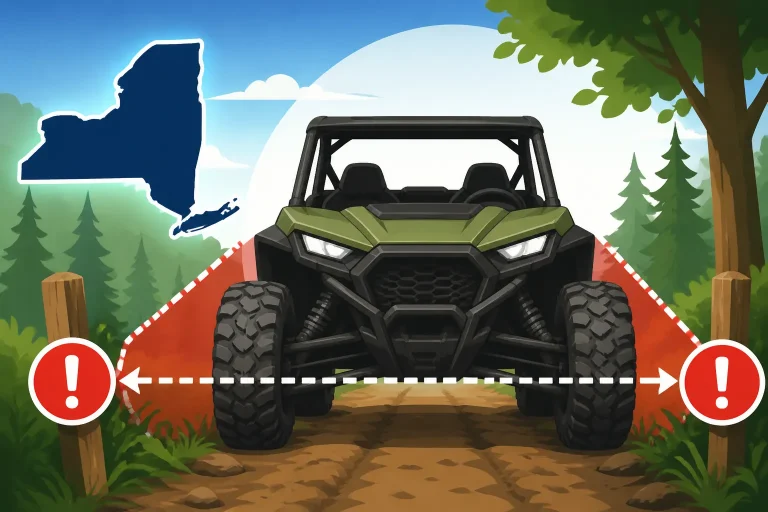
An out-of-state registration does not necessarily settle whether a machine fits New York’s ATV definition. According to the New York State Department of Motor Vehicles, an ATV is a self-propelled vehicle manufactured for off-highway use, no wider than 70 inches and weighing no more than 1,000 pounds. The department’s definition also describes an ATV as having two or more wheels.
That matters for larger UTVs and side-by-sides. A machine may be marketed as an ATV in another state or carry an out-of-state registration, but New York’s rules still depend on whether it meets the state’s definition. The registration-recognition rule should not be treated as a way to bypass the width or weight limits. If you ride a larger machine, check the details in Why Most Side-by-Sides Cannot Be Registered in New York and New York’s 70-Inch Width Limit before planning a trip.
If the machine’s width or weight is close to the state limit, use reliable specifications for the exact model and configuration. Accessories, modifications, and measuring methods can make it unwise to rely on a general model name or a seller’s casual description. Ask the manufacturer or dealer for the machine’s specifications, and confirm how New York applies its definition if there is any doubt.
A visitor should also remember that New York’s operating rules apply even when the machine is registered elsewhere. According to the Department of Motor Vehicles, operators and passengers must wear a USDOT-approved helmet. The department says headlights and taillights must be lit when riding from 30 minutes after sunset to 30 minutes before sunrise. It also requires ATV tires to have at least 2/32nds of an inch of tread without visible breaks, cuts, exposed cords, bumps, or bulges.
These requirements are not a substitute for checking the trail’s own conditions or rules. A club or land manager may impose additional access conditions, and a route may be temporarily closed. Confirm the current status with the organization responsible for the trail before setting out.
A driver license is not required to operate an ATV in New York, according to the Department of Motor Vehicles, but restrictions apply to younger operators. If a young rider is joining the trip, review [New York Rules for a Visiting Rider] and the state’s age and supervision requirements rather than assuming that a home-state rule carries over unchanged.
A practical pre-ride check for visitors
Before leaving home, make sure the paperwork, machine, and route all line up. A quick check can prevent a wasted trip or a ride that begins with a registration or access problem.
- Confirm that the registration is current. Check the expiration date and make sure the document identifies the ATV you are bringing. If it is expired or does not match, contact the issuing authority before you ride.
- Carry the registration document. The Department of Motor Vehicles requires ATV operators to carry it while operating. Keep it somewhere protected but easy to reach.
- Confirm liability coverage in New York. Ask your insurer whether the policy covers ATV operation in the state and keep proof of insurance with the machine. The owner-property exception is limited to operation on the owner’s own property.
- Check the machine against New York’s definition. Confirm the width and weight from information for your exact machine. The New York State Department of Motor Vehicles sets the limits at 70 inches wide and 1,000 pounds.
- Verify each road and trail. Look for current signs and route notices. Do not use a public highway unless it has been designated and posted for ATV use, and do not enter private property without permission.
- Review the operating rules. Check helmets, lights, tires, passenger arrangements, and any age-related requirements that apply to your group.
- Recheck conditions shortly before departure. A route that was open when you planned the trip may have a closure or access change. Confirm with the relevant land manager, county, or trail organization.
If you discover that your home state does not require ATV registration, stop and resolve that before riding in New York. According to the Department of Motor Vehicles, an operator in that situation must obtain a New York ATV registration. The registration process and documents are explained in Registering a Visitor’s Machine in New York.
A visitor’s valid registration is useful, but it answers only the paperwork question. Before starting the engine, confirm that the registration is current, the insurance applies, the machine qualifies, and the route is open to ATVs. Those checks are what turn registration recognition into a lawful, usable trip.
Sources
- New York State Department of Motor Vehicles — Register an ATV | NY DMV (checked November 3, 2026)
- Department of Motor Vehicles — ATVs: Information for Owners and Operators | NY DMV (checked November 3, 2026)
Disclaimer
This article is for general informational purposes only and does not constitute professional advice. Laws, prices and regulations vary by location and change over time. Consult a qualified professional for guidance on your specific situation.