New York Rules for a Machine Wider Than the Trail
A machine can fit New York’s ATV width definition and still be too wide for a particular trail. That difference matters: registration eligibility does not guarantee access to every route, and trying to force a wide machine through a tight corridor can damage the trail or put riders at risk. Here’s how to check the rules and judge whether your machine fits the route.
Legal width and trail width are different questions
New York’s ATV width limit is a vehicle-classification rule. It helps determine whether a machine qualifies as an ATV under state law; it does not promise that the machine can use every trail open to ATVs. For a closer look at the registration threshold, see New York’s 70-Inch Width Limit. A machine over that limit raises a different registration question, covered in New York Rules for a Machine Over 70 Inches.
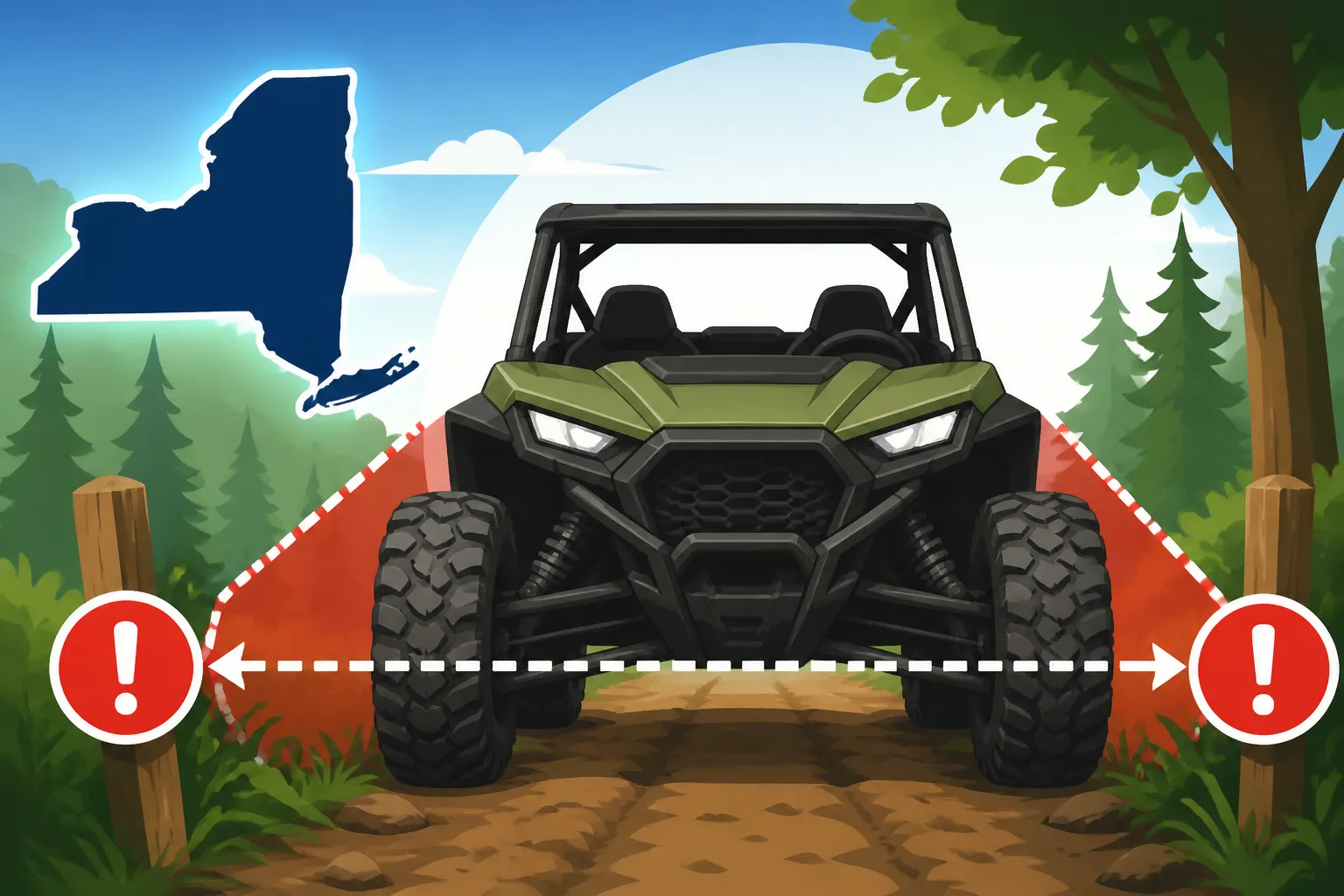
Trail width is a practical and access question. A route may have narrow sections, gates, bridges, tight turns, trees close to the trail edge, or soft shoulders that leave less room than the machine’s stated width suggests. A machine can be within the legal ATV limit yet still be a poor fit for a particular route. Likewise, a wide side-by-side might physically fit on a broad road but still not be eligible to register or permitted on that route.
| Question | What it tells you | What it does not tell you |
|---|---|---|
| Is the machine within New York’s ATV width definition? | Whether it may qualify as an ATV for state registration, subject to other requirements | Whether a particular trail allows it or has enough clearance |
| Does the machine fit through the trail’s narrowest sections? | Whether it is physically suitable for the route | Whether it has legal access |
| Does the route allow this type of machine? | Whether the route’s rules permit that class or size of vehicle | Whether current conditions make it safe to ride |
| Does the rider have required registration and trail access? | Whether the rider has the necessary paperwork or permit for the trip | Whether every connected trail is open to that rider and machine |
Think of these as separate checks. A valid registration does not make a trail open, and a wide trail does not make an otherwise ineligible machine registerable.
That distinction is especially important when choosing a machine for club or county routes. Trails may be established through local arrangements and landowner agreements, and their rules can reflect the specific properties and infrastructure they cross. The width limit of your machine is only one part of the decision. Check New York Rules on Club Trails and the access details for the route you intend to ride.
If you are shopping for a machine, do not rely on a general statement that it is “trail ready” or “legal in New York.” Ask what those descriptions mean. Registration eligibility, trail access, physical clearance, and suitability for a particular county system are different things. A route that works for a narrow quad may not work for a wide machine, even if both machines are legally registered.
Check both access rules and the route’s usable clearance
Before riding, confirm that the route allows your machine and that the route is wide enough for it. These checks are related, but neither replaces the other.
Start with the rules for the specific trail system. New York does not have one statewide trail pass that automatically grants access to every ATV route. Counties, clubs, and individual trail systems can have their own permit or membership arrangements. A permit for one system does not necessarily cover another, and access may depend on which trails are included. New York ATV Trail Permits Explained describes why access needs to be checked by area. For a specific example, see Which Trails a Lewis County Permit Covers.
Next, look for vehicle restrictions in the system’s current information. Check for stated width limits, restrictions on side-by-sides or other machine types, and any route-specific rules. If the published rules do not clearly say whether your machine is allowed, contact the county office, club, or trail operator that manages access. Give them the machine’s actual width and model, rather than asking only whether “ATVs” are allowed.
Then assess physical clearance. A map can show where a trail goes, but it may not show how narrow a gate is, how close trees grow to the track, or whether a bridge has enough usable width for a wide machine. Ask the trail operator about known pinch points and restrictions. Recent trail information is important because construction, erosion, a landowner’s request, or seasonal conditions can affect access.
Before you load, check current notices and closures. New York Trail Conditions Before You Ride and New York Trail Closures to Check First are useful reminders that access can change after you have planned a trip. A route shown on an older map may have a temporary or seasonal restriction, and a trail that is open to ATVs may still have a section that is unsuitable for a wide vehicle.
A practical pre-ride check looks like this:
- Confirm the machine’s legal classification and registration status.
- Identify the exact trail system and confirm which routes your permit or membership covers.
- Check whether the system restricts machine width or vehicle type.
- Ask about narrow gates, bridges, tight turns, and other known clearance limits.
- Check current trail conditions and closures before leaving.
- Choose another route if the information is unclear or the machine may not fit safely.
Do not treat a trail map, a permit sticker, or another rider’s account as proof that your machine is allowed everywhere on the system. Maps can be simplified, permits can cover only certain routes, and another machine may be narrower or configured differently from yours. Confirm the details that matter for your trip.
What to do when a machine is wider than a trail
If the route is too narrow, do not try to squeeze through, widen it yourself, or ride along the edge to get around an obstacle. Those choices can damage vegetation and trail surfaces, create hazards for other users, or violate access rules. A narrow trail is a real limit even when there is no posted sign at the specific pinch point.
The safest response is to stop before the obstruction and turn around if there is room to do so. If turning around is unsafe, avoid forcing the machine past the obstacle; contact the trail operator or follow the operator’s directions. Do not assume that a route will become passable just because a group is able to move an obstacle or push a machine through.
Pay special attention to features that reduce usable width:
- Gates and barriers: The opening may be narrower than the trail itself. Do not remove, bend, or bypass a barrier.
- Bridges and culverts: The deck or approach may be narrower than the machine. Do not ride onto a structure unless you can confirm it is suitable and permitted.
- Trees and brush: A machine’s body, racks, mirrors, tires, or accessories can extend beyond its advertised dimensions.
- Turns and banks: A machine may fit along a straight section but need more room to turn, especially where the trail edge drops away.
- Mud and erosion: Soft shoulders may not support the machine. Trying to use them as extra clearance can cause damage or a loss of control.
- Other trail users: A narrow corridor may not offer room to pass. Follow posted rules and use a safe, authorized place to yield.
For groups, set expectations before the ride. A route chosen for the narrowest machine in the group may be unsuitable for a wider one. If members bring machines of different widths, make sure every rider can legally access the route and that the route has enough clearance for the widest machine. Splitting the group or choosing a different trail can be safer than asking a wider machine to follow a route it cannot navigate comfortably.
Do not assume that a machine with a valid out-of-state registration has broader access in New York. Reciprocity addresses recognition of certain out-of-state registrations; it does not automatically grant access to every local trail or override route restrictions. Check New York Reciprocity for Out-of-State Registrations and confirm local trail rules separately.
Choosing a route and machine that fit
If you regularly ride narrow trails, machine width should be part of your buying decision. Compare the machine’s actual outside width with the type of routes you plan to use. The published specification may not include added accessories, so check the full setup: tires, racks, mirrors, fenders, plows, and other equipment can affect the space needed to pass through a tight opening.
A useful way to compare options is to consider both the machine and the riding area:
| Riding plan | What to prioritize |
|---|---|
| Mostly narrow club trails | A compact machine, current trail rules, and reliable information about pinch points |
| A mix of county routes and wider roads | A machine that meets state requirements and fits the restrictions of each system |
| Private property only | Landowner permission, safe clearance, and any registration or operating rules that apply |
| A machine near or over the state width threshold | Confirm classification and registration eligibility before purchase |
| Riding with a mixed-width group | Choose routes suitable for the widest machine and confirm every rider has access |
For a general comparison of route options, New York Trails for a Narrow Machine may help you think about fit, but always confirm current rules and conditions with the operator. A trail described as suitable for narrow machines is not automatically open to every machine within the state’s width limit; the operator’s specific rules still matter.
When buying, ask the seller or dealer for the machine’s width and verify it against the manufacturer’s specifications. Then check New York’s registration requirements independently. If the machine is near the state limit, small measurement differences or added equipment can matter. Do not rely on a sales description alone, and do not buy on the assumption that a machine can be registered or used on a particular trail without confirming both points.
For a machine you already own, make a route plan around its real dimensions. Keep a record of the machine’s width in its riding configuration, including anything that sticks out beyond the body. Contact the trail manager if you cannot confirm a route’s narrowest point. If the manager cannot verify that your machine is suitable, choose a route with clearer access information rather than testing the trail in the field.
When registration or local access remains uncertain, pause before riding. A quick confirmation from the appropriate agency or trail operator is more useful than assuming that a broad trail entrance means the entire route will fit. If the machine is outside New York’s ATV definition, review New York Rules for a Machine Over 70 Inches before treating it as an ATV for registration or access purposes.
Disclaimer
This article is for general informational purposes only and does not constitute professional advice. Laws, prices and regulations vary by location and change over time. Consult a qualified professional for guidance on your specific situation.