How Clubs Keep Landowners Willing to Host Trails
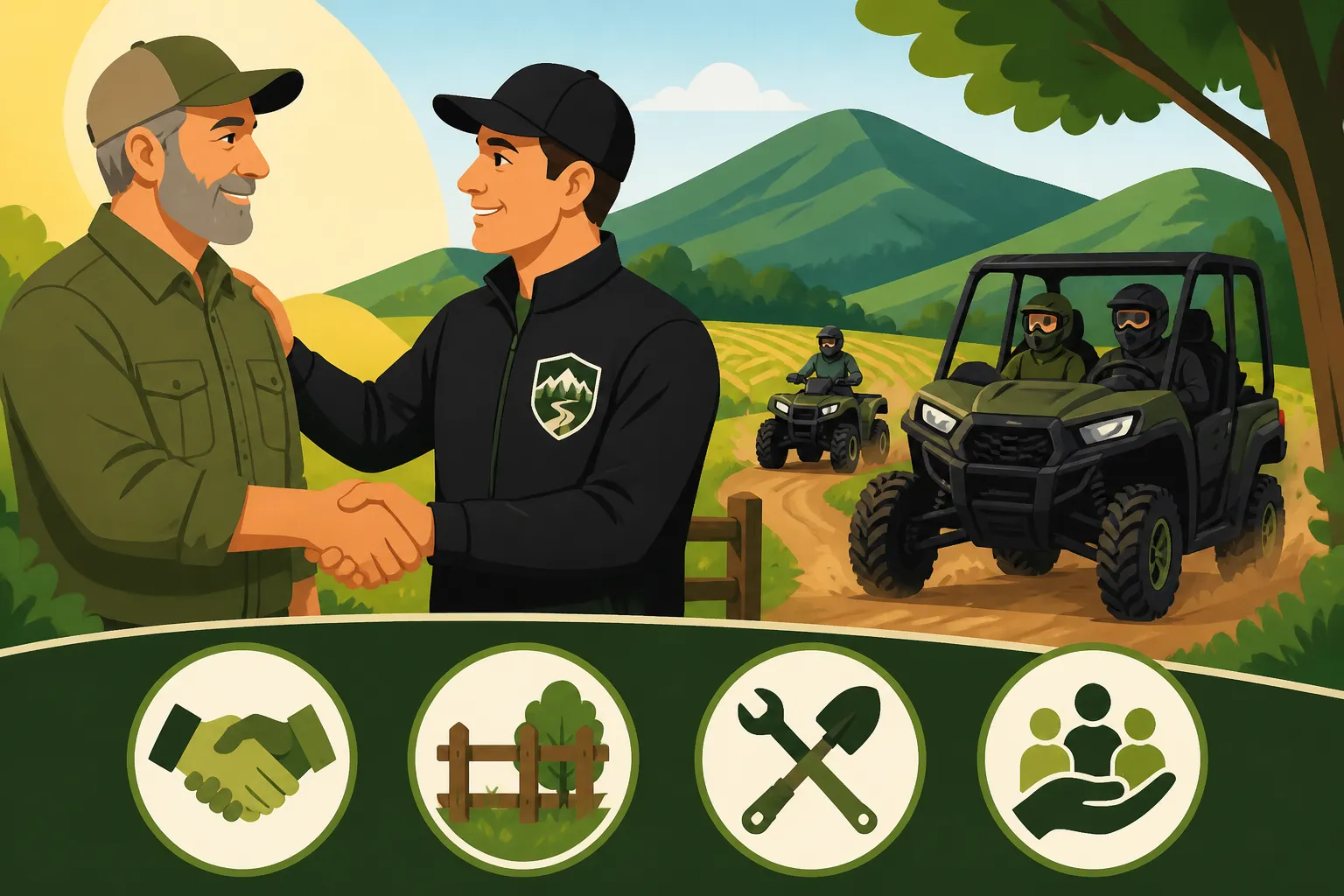
New York ATV riders often find that a trail’s continued availability depends on more than its route or condition. Private landowners may allow a club to cross their property, but that permission can change. Clubs help preserve access by setting clear expectations, caring for the trail, and responding quickly when problems arise.
Why Landowner Permission Is an Ongoing Relationship
A trail crossing private land is a privilege, not a permanent public right. A landowner may agree to let a club route riders across a property, then reconsider if the arrangement causes disruption, damage, or safety concerns. Permission may be limited to a particular route, season, or type of use. Riders should not assume that a trail shown on a map is open indefinitely.
Clubs make access more dependable by treating each landowner relationship as an agreement that needs attention. That often starts with explaining where the trail will go, when riders may use it, and who to contact if something goes wrong. Written terms can help both sides understand the arrangement, but the details vary. A club should not promise that a landowner’s permission covers every rider or every use unless the agreement actually says so.
A club’s relationship with a property owner is different from a rider’s individual permission to use private land. Joining a club or buying a trail permit does not automatically authorize riding on any private property. Check the rules for the trail system you plan to use, and follow signs and closures. For a broader look at rider responsibilities, see New York Rules for Riding Private Land and Permission Before You Ride Someone’s Land.
Landowners may value access for different reasons. Some support local recreation; others may be willing to host a route only if it stays in a defined corridor and creates little extra work. A club that understands what matters to each owner is better placed to prevent small issues from becoming reasons to close a trail.
| Landowner concern | Club practice that can help |
|---|---|
| Riders leaving the approved route | Mark the route clearly and remind members to stay on it |
| Litter or property damage | Organize cleanup and address reported damage promptly |
| Unwanted traffic at the property entrance | Explain approved access points and parking expectations |
| Noise or riding at inappropriate times | Share route rules and communicate about complaints |
| A changed land use or owner preference | Confirm permission and adjust or close the route when needed |
No single practice guarantees that a landowner will keep a trail open. The point is to make the arrangement clear, limit avoidable impacts, and show that the club takes concerns seriously. Landowner Agreements That Keep Trails Open explains why the terms and boundaries of an arrangement matter.
What Clubs Do to Reduce Impacts
The most effective trail stewardship is practical. It makes it easier for riders to do the right thing and easier for a landowner to see that the club is managing access responsibly.
Define the route and make it easy to follow
If riders cannot tell where a trail goes, some may stray onto fields, driveways, yards, or other parts of a property. Clubs can reduce that risk by using clear markers and maps, maintaining visible route boundaries, and telling riders what to do when a marker is missing or confusing.
Markers should not suggest that a rider has broader permission than the club received. A trail corridor is not an invitation to explore nearby land, use a private road for another purpose, or stop wherever convenient. When a route changes, the club should update its directions and remove or correct misleading signs where possible.
Riders also have a role. Follow the route, avoid cutting corners, and do not ride around a closed gate or barrier. If you see a missing marker, a blocked section, or signs that a route is being used outside its limits, report it to the club rather than improvising a detour.
Keep the trail and its surroundings in order
Regular attention can help keep a small maintenance issue from growing into a bigger problem. Depending on the route and agreement, club work may include clearing brush, addressing drainage concerns, removing litter, or checking signs and gates. Any work should stay within the permission the club has received; trail volunteers should not change a route or carry out work on private property without authorization.
A responsible club also sets expectations about damage. If a rider causes a problem, the club should have a way to receive the report and follow up. That does not mean the club can control every rider, but ignoring complaints can undermine landowner confidence. Volunteering on a Trail Work Day offers a related look at how hands-on participation supports trail upkeep.
Make rules understandable before riders arrive
A rule is most useful when riders can find it before they reach the trail. Clubs can share route restrictions, access hours, parking instructions, and closures through the channels riders use to plan a trip. Where a trail is subject to a county permit or club-specific access requirement, the club should explain what the permit covers and what it does not.
New York does not have one statewide trail pass that automatically opens every riding area. Access rules can vary by trail system, county, and club. A permit for one system should not be treated as permission to use another. Before setting out, check Why New York Has No Statewide Trail Pass and New York Club Trail Rules for the distinction between access systems and trail conduct.
Clubs can also help avoid misunderstandings by being direct about restrictions. If a route is members-only, seasonal, closed after weather damage, or unavailable to certain machines, riders need to know that before they travel. Clear information may prevent a rider from arriving at a landowner’s property and trying to negotiate access on the spot.
How Clubs Respond When Something Goes Wrong
Even well-managed routes can have problems. A gate may be left open, a rider may leave the trail, or a landowner may report damage or noise. A club’s response can affect whether the owner views the issue as an isolated incident or a reason to end the arrangement.
Take complaints seriously and respond promptly
A useful first response is to listen, gather the details, and avoid arguing about whether the concern is justified before understanding it. The club can ask where and when the issue occurred, whether the route or signage was involved, and what outcome the landowner wants. If a rider or section of trail can be identified, the club can follow up using its own procedures.
The response should be proportionate to the problem. A missing sign might call for a repair and a rider notice. A route that is being used outside the agreed corridor might need stronger marking, an immediate closure, or a revised route. Where the club cannot resolve an issue, it should not keep directing riders onto land without clear permission.
A club should also be honest about the limits of its control. It can set conditions for members and share expectations with visitors, but it cannot guarantee that every person will follow them. What it can do is make rules visible, provide a contact route for reports, and show that it follows up rather than leaving the landowner to manage the issue alone.
Close or reroute access when permission changes
A landowner may withdraw permission, change the approved route, or ask for a temporary closure. Clubs need a way to communicate that change quickly. Outdated online maps, old signs, and word-of-mouth directions can continue sending riders into an area after access has ended.
When a route closes, the club should tell riders what has changed and avoid implying that a nearby path is an acceptable substitute. Riders should not bypass a closure because the trail used to be open or because a map has not been updated. For more on the consequences of changed access, see What Happens When a Landowner Pulls Trail Permission.
Closures can be frustrating, especially when they disrupt a familiar loop. But continuing to ride after permission has ended can make it harder for the club to maintain trust with that owner and may affect neighboring access. A clear closure is better than leaving riders to guess.
Keep communication going between riding seasons
A relationship should not depend only on contacting a landowner when the club needs something. Periodic check-ins can help identify concerns before the next busy period and give the owner a chance to mention changes in property use. The right timing and frequency depend on the agreement and the landowner’s preferences; frequent contact is not automatically better if it becomes intrusive.
Clubs can also share information about planned trail work, expected traffic periods, or temporary changes when those details are relevant. The aim is not to overwhelm property owners with updates. It is to make sure they know how to reach someone who can act on a concern and are not surprised by avoidable changes.
For riders, good trail etiquette supports those relationships too. Close gates as directed, avoid littering, respect private signs, and do not treat a trail crossing as permission to stop or roam on the property. New York Trail Etiquette With Landowners covers ways riders can avoid creating unnecessary friction.
What Riders Can Do to Help Keep Trails Open
Clubs can manage routes and communicate with landowners, but riders’ conduct is part of the arrangement. One person’s shortcut or careless behavior can affect access for everyone who follows.
Before a ride, confirm that the trail is open and that your permit or membership applies to that system. Check whether access is limited by season, weather, machine type, or club rules. If you ride with visitors, make sure they understand the route and restrictions too. Joining a New York ATV Club and What Club Dues Pay For can help explain how club participation and trail support fit into access.
On the trail:
- Stay on the marked route, even if a nearby path looks easier.
- Follow gates, signs, and temporary closures as posted.
- Use only the parking and staging areas identified for riders.
- Keep noise and speed appropriate to the conditions and surroundings.
- Do not leave garbage, damage property, or confront a landowner about access.
- Report a hazard, conflict, or suspected route problem through the club’s stated contact method.
If you are unsure whether a route is open, pause and check rather than assuming. An old map, a past visit, or another rider’s directions may not reflect the current agreement. If you cannot confirm permission, choose a route whose access is clear.
A club can build goodwill through maintenance, communication, and prompt problem-solving, but access remains dependent on the landowner’s permission. Riders who respect that limit help protect the relationships that make private-land trail networks possible. For more on the role clubs play in sustaining access, see How Clubs Keep Landowners Willing to Host Trails is not applicable; consult What a New York Club Membership Buys for practical details about participating in a club.
Disclaimer
This article is for general informational purposes only and does not constitute professional advice. Laws, prices and regulations vary by location and change over time. Consult a qualified professional for guidance on your specific situation.