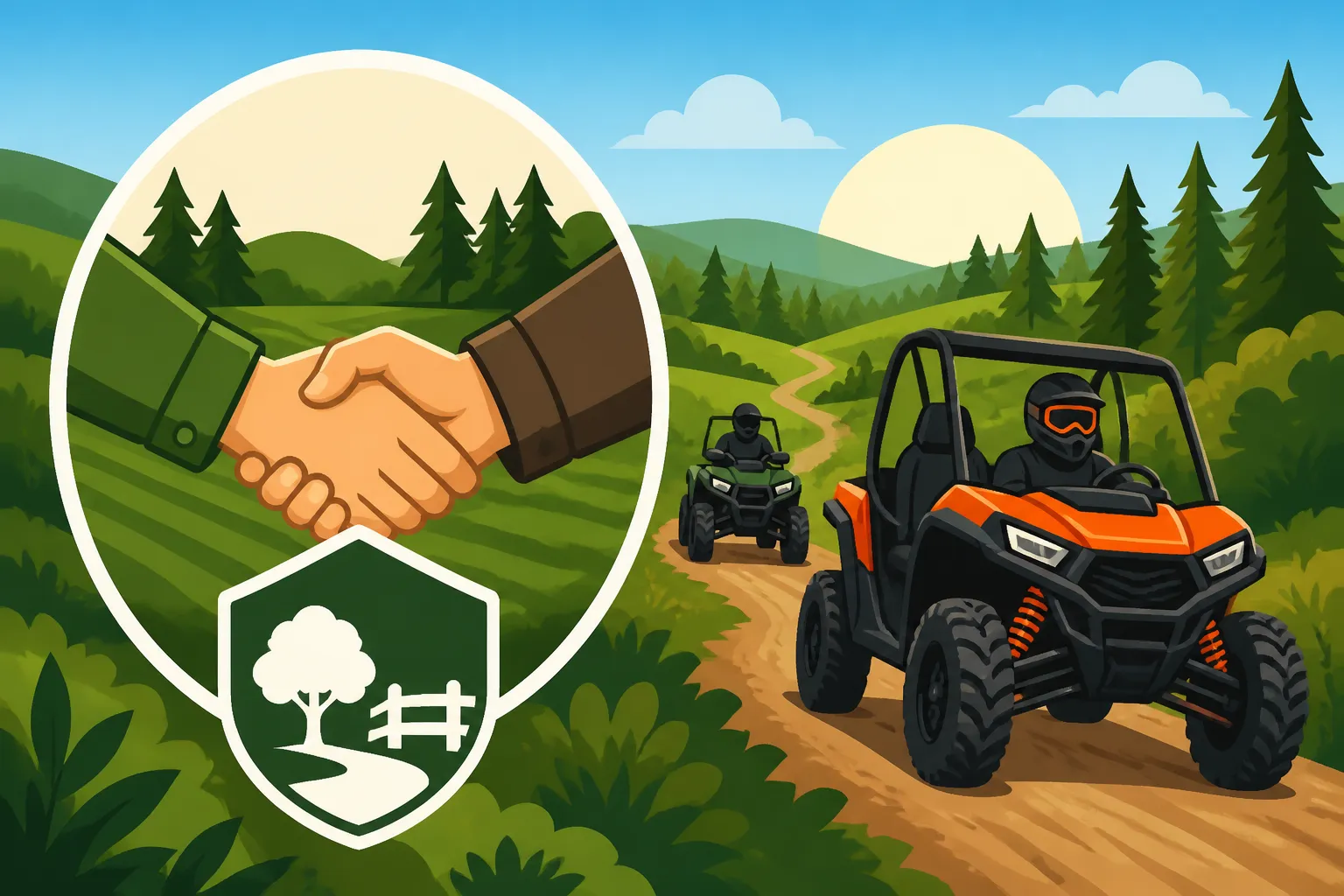
Landowner Agreements That Keep Trails Open
A trail that crosses a farm lane or private woodlot can disappear when permission ends, sometimes with little warning to riders. In New York, clear agreements between landowners and trail organizations help prevent misunderstandings, protect property, and keep routes usable. This guide explains what those agreements should cover, how riders can respect them, and what to do when access changes.
Why landowner agreements matter on New York trails
A marked trail may cross private property
Many riding routes depend on access across land that does not belong to the club, county, or town maintaining the trail. A route may use a stretch of private woods, pass along a field edge, or cross a working farm before connecting with another section. Permission to ride there is a privilege, not a permanent public right.
That distinction can be easy to overlook when a trail has signs, a map, and a well-used staging area. Riders may assume that a route is guaranteed to remain open because it has been open for years. But a landowner can change their mind, sell the property, begin a new operation, or decide that trail use is causing too much disturbance. A signed agreement cannot prevent every change, but it can make expectations clearer while permission is in place.
This is especially important in areas where trail networks rely on many separate property owners. A club route in Lewis or Oswego County, for example, may feel like one continuous ride to visitors even though different portions depend on different access arrangements. The practical lesson is simple: a trail being shown on a map does not, by itself, prove that access is currently allowed. See New York Trails That Cross Private Land and Landowner Consent on New York Private Land for more on the difference between a mapped route and permission to ride.
Agreements give both sides a shared set of expectations
A useful agreement answers basic questions before they become trail-side arguments: Where may riders travel? When is the route open? Who maintains it? Who handles complaints? What happens if a landowner needs to close a section temporarily? If the club and owner have discussed these points in advance, each side has a clearer basis for responding when conditions change.
Written permission is often easier to manage than a chain of verbal understandings passed from one volunteer to another. A document or written record can identify the landowner or authorized contact, describe the permitted route, and record any special conditions. It also gives new club officers a way to understand what was agreed to rather than relying on someone’s memory from several seasons ago. For more on documenting consent, see Written Permission From a New York Landowner.
An agreement is not a promise that the land will always be available. It is a practical tool for setting boundaries and maintaining communication. Landowners may still need to close a route for logging, livestock movement, repairs, hunting activity, weather damage, or other property needs. The goal is not to take control away from the owner; it is to help riders and trail organizations use access responsibly for as long as the owner is willing to allow it.
What a trail access agreement should address
Route, timing, and permitted use
The agreement should make it reasonably clear where riders may go. That can mean describing a route in writing, attaching a map, identifying entry and exit points, or specifying boundaries such as a farm lane or marked corridor. If the permission covers only a particular trail, riders should not treat it as permission to explore nearby fields, cut across a yard, or follow an unmarked path.
Timing matters, too. A route might be open only during a defined riding season, on certain days, or when the land is firm enough to avoid damage. Landowners may also need flexibility to close a section temporarily. Whatever the arrangement, it helps if the club has a clear process for communicating a closure and riders know where to check before loading their machines.
The agreement should also spell out what kinds of activity are allowed. ATV access does not automatically mean permission for side-by-sides, motorcycles, passenger use, overnight parking, events, or trail work. A landowner and club can discuss the actual machines and activities covered rather than assuming that one broad “trail use” description covers every situation. Riders should follow the route and conditions that are actually authorized, not the version they heard from another rider.
Maintenance, signs, gates, and reporting problems
A trail agreement can identify who is responsible for clearing brush, managing drainage, repairing trail damage, and placing or maintaining signs. Without this clarity, a landowner may be left dealing with ruts or litter while the club assumes someone else is handling it. A named club contact and a straightforward way to report concerns make it easier to act before a small problem turns into a reason to withdraw access.
Gates need special attention. Some are there to control vehicle access, protect livestock, or keep farm equipment secure. Riders should never assume that an open gate means they can leave it open, or that a closed gate is an invitation to move it. The agreement and signs should make the expected behavior clear. If riders are expected to close a gate behind them, that rule should be easy to understand and consistently followed. See Gates on a Club Trail for more on why gates are part of trail access, not just an obstacle along the way.
Signs can prevent accidental trespass by showing where the approved route goes and where it does not. But a sign does not replace permission, and an old sign should not be treated as proof that a route is still open. Clubs can help by checking trail markers and closure notices regularly, especially after property changes, storm damage, or seasonal work. Riders should respect signs even when they are inconvenient or differ from what they remember from an earlier visit. Signage on a County Trail offers more context on how trail markers help guide riders.
| Agreement topic | What to clarify | Why it helps |
|---|---|---|
| Route | Approved corridor, entry points, and boundaries | Keeps riders from wandering onto other parts of the property |
| Schedule | Season, permitted days, and temporary closures | Helps avoid conflicts with property work and changing conditions |
| Machines and activities | Which vehicle types, events, and uses are allowed | Prevents riders from assuming broader permission than was granted |
| Maintenance | Who handles clearing, drainage, signs, and repairs | Gives both sides a clear contact and responsibility |
| Gates and access points | Whether gates must be opened, closed, or left untouched | Protects livestock, equipment, and property security |
| Communication | How to report damage, complaints, or a closure | Makes it easier to address problems before access is withdrawn |
How clubs and riders can help keep permission in place
Communication needs to continue after the agreement is signed
A signed agreement is only the starting point. Clubs can keep the relationship healthy by checking in with landowners, sharing a direct contact for concerns, and responding promptly when something goes wrong. If the owner reports noise, litter, damaged fencing, or riders leaving the marked route, the club should take the complaint seriously rather than dismissing it as a one-time misunderstanding.
A practical communication plan is especially helpful when volunteers change. The club should know who is responsible for each property contact and keep a record of current access conditions. That prevents a familiar problem: a new volunteer assumes an old route is open because it appears on last season’s map, while the landowner believes permission ended or changed. Clubs can also make it easier for riders by publishing clear closure notices and removing outdated route information when permission is no longer active.
Riders have a role, too. Stay on the marked route, slow down near homes and farm activity, pack out trash, and avoid revving or riding in a way that needlessly disturbs people or animals. If you see a damaged sign, blocked trail, or unsafe crossing, report it to the club rather than improvising a detour. Good New York Trail Etiquette With Landowners is not just about being polite; it helps preserve the trust that makes private access possible.
Mapping tools can help riders plan and understand where they intend to go, but they cannot establish permission. A rider might use onX Offroad to review a planned route or keep track of a trip, then confirm that the trail is currently open through the relevant club or local trail manager. Treat mapping information as a planning aid, not as a substitute for current access notices or direct confirmation from the organization responsible for the route.
Use maps carefully and avoid creating your own detour
A map can make a trail network easier to understand, particularly when routes cross several properties or connect with public roads. A tool such as onX Offroad can help a rider prepare for a trip and notice where a planned route may pass near property boundaries. Still, mapped lines can be incomplete, outdated, or difficult to interpret in the field. They do not tell you whether an owner has granted access today.
If a gate is closed or a trail is posted, do not go around it because a digital map still shows a line through the property. Stop, turn back, and check an official club or county notice. Do not assume that a neighboring lane, field edge, or utility corridor is an acceptable workaround. Taking an unauthorized detour can damage property and put an entire trail relationship at risk.
It can also help to save the club’s contact information before a ride, since cell service can be limited in some rural and wooded areas. onX Offroad may be useful as one planning reference, but the club’s current notices and the landowner’s conditions remain central. For practical habits that support access, see How Lewis County Trail Agreements Keep Private Land Open and Finding a Club Whose Trail Agreement Is Still Active.
When access changes or a landowner withdraws permission
Treat closures as real, even if they are sudden
Landowners may withdraw or change access for reasons riders cannot see from the trail. A property could be sold, a farm operation could expand, logging could begin, or repeated problems could make continued access unworkable. Sometimes a closure is temporary; sometimes the route is gone for good. Riders should not try to decide for themselves that a closure is unfair or only applies to someone else.
If you arrive to find a closed gate, new sign, or blocked route, do not force your way through or move the obstruction. Turn around and check with the trail organization for an approved alternative. If the organization has not posted an update, contact it directly rather than relying on a social media comment, an old map, or what another rider remembers. The consequences of ignoring a closure can extend beyond one rider: the owner may close the route to everyone.
Clubs can reduce confusion by updating maps, posts, and signs promptly when permission changes. They should avoid presenting an uncertain route as open while a dispute or renewal is being discussed. For riders, the safest habit is to check current local notices before setting out, especially after seasonal closures or reports of property changes. What Happens When a Landowner Pulls Trail Permission explains why access can change and what that can mean for a route.
A dispute is a reason to pause, not to argue on the property
If a landowner or representative asks you to leave, stay calm and leave the property. Do not argue about who signed an agreement, whether a trail appears on a map, or what another club member told you. Those issues are for the club and landowner to address through the appropriate channels, away from an active confrontation.
If you believe there has been a misunderstanding, write down what happened and contact the trail organization afterward. Share the location, date, and any relevant details, but do not post private information about the landowner or encourage other riders to confront them. A club may need to review the agreement, update its records, or seek qualified legal guidance about the situation. Rules and legal protections can depend on the facts, so no general article can determine how a particular agreement or liability question applies.
The broader lesson is that access depends on relationships as much as route maps. When riders respect posted limits, clubs respond to concerns, and landowners can communicate conditions clearly, a trail has a better chance of remaining available. When permission ends, accepting the closure promptly can help preserve other routes and avoid turning one difficult situation into a larger loss of access.
Disclaimer
This article is for general informational purposes only and does not constitute professional advice. Laws, prices and regulations vary by location and change over time. Consult a qualified professional for guidance on your specific situation.