Insurance a Visitor Must Still Carry
Visitors often assume that a valid ATV registration from home is enough to ride in New York. It may satisfy the registration requirement, but it does not remove the state’s insurance rule. Here’s what visiting riders need to know about liability coverage, proof of insurance, registration, and the checks worth making before unloading.
Out-of-state registration does not waive New York’s insurance rule
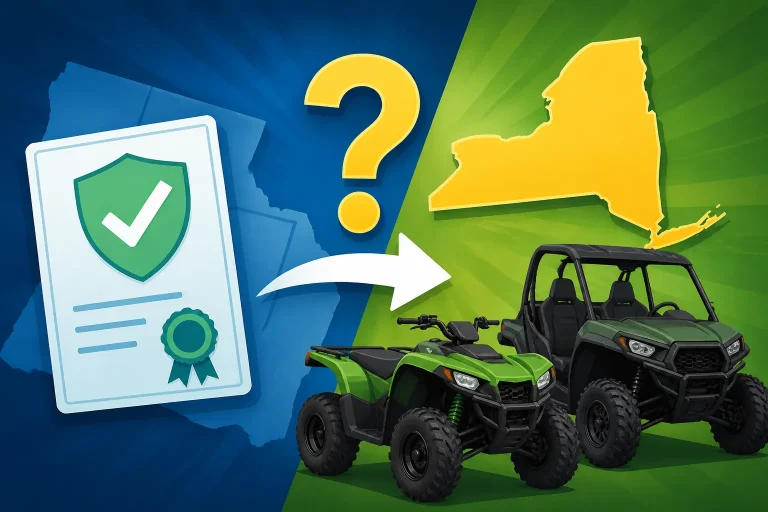
New York honors a valid ATV registration issued by another state, according to the New York State Department of Motor Vehicles. That recognition can let a visitor ride without obtaining a New York registration, but it does not exempt the visitor from New York’s separate liability-insurance requirement. New York Reciprocity for Out-of-State Registrations
The New York State Department of Motor Vehicles requires liability insurance for an ATV operated anywhere in New York State except on the owner’s property. In practical terms, a visitor riding on a trail, public land where ATV use is allowed, or private property with the owner’s permission should not assume that an out-of-state plate alone is enough. The insurance requirement is about where and how the ATV is operated, not just where it is registered.
This distinction matters because registration and insurance serve different purposes. Registration identifies a machine as registered for operation under applicable rules. Liability insurance provides coverage for certain claims if the rider’s operation causes injury or property damage. A valid registration from home does not prove that the ATV has insurance, and an insurance policy does not replace a registration that New York requires.
| Visitor’s situation | What to check before riding |
|---|---|
| The ATV has a valid home-state registration | Carry the registration document, and confirm the ATV has liability insurance that applies to riding in New York. |
| The home state does not require ATV registration | The New York State Department of Motor Vehicles says the operator must obtain a New York ATV registration before operating in the state. |
| The ATV will be used on the owner’s property | The New York State Department of Motor Vehicles states that the liability-insurance requirement has an owner-property exception. Other operating rules may still apply. |
| The machine is described as a UTV or side-by-side | Confirm how the machine is classified and what requirements apply; do not assume ATV rules automatically cover it. |
If you are unsure whether your home registration qualifies, review Does New York Honor Out-of-State Registration? and [New York Rules for a Visiting Rider]. If your home state does not register ATVs, read Registering Here Before You Ride before planning to ride.
Confirm that your policy actually covers the trip
The New York requirement is for liability insurance. Do not rely on a general assumption that a policy covers every vehicle you own or every place you ride. Contact your insurer and ask specifically whether the policy covers the ATV while it is operated in New York, including on the type of property or trail you plan to use. Ask how you can show proof of coverage if requested.
This is especially important if the ATV is insured under a policy with limits on where it may be operated, who may ride it, or what type of machine is covered. The policy documents and the insurer can clarify those details. The New York State Department of Motor Vehicles states that proof of insurance must be shown to a judge, police officer, or any person making a claim of injury or property damage.
A policy card that identifies a different machine, a policy that has lapsed, or paperwork that is difficult to access can create avoidable problems. Before departure, check that the insurance information matches the ATV you are bringing and that the policy is active for the trip. For a closer look at the state rule, see New York ATV Insurance Requirement and Does an Out-of-State Policy Satisfy New York’s ATV Rule?.
Know the owner-property exception’s limits
The exception is narrow: the New York State Department of Motor Vehicles says liability insurance is required except when an ATV is operated on the owner’s property. Do not read that as a general exemption for any private land. A visitor riding on someone else’s property should not assume the exception applies simply because the land is private. Confirm coverage with the insurer and get the property owner’s permission before riding.
Likewise, a route that begins at a private home may include land or roads beyond that property. If the ATV leaves the owner’s property, the insurance requirement may apply. Before setting out, identify where the ride will take place rather than judging the insurance question only by where the machine is parked or stored.
What visiting riders should carry and check
A smooth roadside check or injury claim depends on being able to show the right information. The New York State Department of Motor Vehicles requires ATV operators to carry the registration document while operating the machine, and says proof of insurance must be shown to a judge, police officer, or a person making an injury or property-damage claim.
Keep the registration and insurance information accessible and protected from weather. A waterproof document pouch can help keep paperwork together; if you are shopping for one, Amazon is one possible retailer, but the important point is that the documents remain readable and available. Keep a copy of the insurer’s contact information separately in case the original card is lost or damaged.
Before you ride, check the following:
- Registration: Confirm that the registration is valid and belongs to the machine you are bringing. A visitor should carry the registration document while operating.
- Insurance: Ask the insurer to confirm that liability coverage applies to the ATV while riding in New York. Keep proof where you can produce it promptly.
- Machine classification: Confirm whether the machine is legally treated as an ATV. The New York State Department of Motor Vehicles defines an ATV as a self-propelled vehicle with two or more wheels, no wider than 70 inches and weighing no more than 1,000 pounds.
- Where you can ride: Do not assume registration or insurance gives permission to use a route. The New York State Department of Motor Vehicles says ATVs may not be operated on public highways unless the highway has been designated and posted for ATV use. On private property, the operator needs the property owner’s permission.
- The route’s current status: Check the responsible land manager or trail operator before riding. A route’s appearance on a map does not by itself establish that ATV use is permitted.
Having paperwork does not make an otherwise prohibited route legal. The registration answers whether the machine is registered; it does not grant access to every road, trail, or parcel. For public-land rules, see [New York Rules for Riding Public Land]. For roads, New York Roads Designated for ATVs explains why visitors need to confirm that a road is designated and posted.
What to do if someone asks for proof
If a police officer or judge requests insurance proof, show the documentation you have and answer clearly. If a person says your operation caused injury or property damage, the New York State Department of Motor Vehicles says proof of insurance must be shown to that person as well. Do not assume that showing a registration document satisfies an insurance request; they are separate records.
If you cannot locate the proof, contact your insurer as soon as practical and ask how to confirm coverage. Avoid continuing a ride on the assumption that the policy exists but can be produced later. A missing card and an absent policy are not the same thing, but the rider should be able to verify coverage rather than guess.
For more on what may happen when proof is unavailable during a stop, see Getting Pulled Over With No ATV Insurance Card. If a claim arises, Showing Proof to an Injured Party covers the separate question of providing proof to someone asserting an injury or property-damage claim.
Plan for registration and machine eligibility too
Insurance is not the only visitor requirement to check. The New York State Department of Motor Vehicles honors valid out-of-state ATV registrations, but says an operator must obtain a New York State ATV registration before operating in New York if the operator’s home state does not require ATV registration. If you are in that situation, resolve registration before riding rather than treating insurance as a substitute.
The machine must also fall within New York’s ATV definition to rely on ATV registration rules. The New York State Department of Motor Vehicles defines an ATV as a self-propelled vehicle with two or more wheels, no wider than 70 inches and weighing no more than 1,000 pounds. A machine that is marketed as a UTV, side-by-side, or off-road vehicle may not necessarily qualify as an ATV under this definition. Check its classification with the New York State Department of Motor Vehicles before assuming that an out-of-state ATV registration will be recognized for it.
That distinction can affect a visitor’s planning. If the vehicle does not qualify as an ATV under New York’s definition, an ATV registration from another state may not answer what rules apply to the machine. Do not assume that the ATV insurance discussion resolves vehicle classification or permission to ride. Ask the insurer what the policy covers, and confirm the machine’s legal status with the appropriate official source. New York UTV Registration Rules and Can You Register a Side-by-Side in New York? address the related classification issue.
Separate registration from trail access
A valid plate does not grant access to all public land. The New York State Department of Motor Vehicles says ATVs may be operated on public lands where signs indicate ATV use is allowed, and the Department of Environmental Conservation states that operating an ATV on State Forest Lands is unlawful unless the use is specifically designated by posting or permit. Check signs and current land-manager information for the precise route you intend to use.
That is important for visitors because a route can cross areas with different access rules. An ATV may be properly registered and insured but still be prohibited from a particular trail, road, or public-land area. Get permission for private property and verify that public routes are designated for ATV use. For the broader access picture, see [New York Rules for a Visiting Rider] and New York Rules for Riding a Club Trail.
A practical pre-ride checklist for visitors
Use this checklist before loading the ATV:
- Confirm the machine’s status. Make sure it is an ATV under New York’s definition and that its home-state registration is valid. If your home state does not require ATV registration, the New York State Department of Motor Vehicles says you must obtain a New York registration before operating there.
- Call the insurer. Confirm that liability coverage applies to this machine while it is operated in New York. Ask what proof to carry and whether any policy conditions affect the planned ride.
- Pack both documents. Carry the ATV registration document and accessible proof of insurance. The New York State Department of Motor Vehicles requires operators to carry the registration while operating and to show proof of insurance when requested by the specified people.
- Verify the route. Check that the public road or land is open and designated for ATV use, and get permission before riding on private property. Registration and insurance do not replace access permission.
- Make a plan for a claim or stop. Know how to contact the insurer and where the documents are stored. If someone requests proof, do not confuse the registration with the insurance record.
The key takeaway is straightforward: a valid out-of-state ATV registration may be recognized in New York, but it does not erase the state’s liability-insurance requirement. If you ride anywhere beyond the owner’s property, confirm that your policy covers the trip and carry proof you can show. Check registration, vehicle classification, and trail access separately so that one document is not mistaken for permission to do everything.
Sources
- New York State Department of Motor Vehicles — Register an ATV | NY DMV (checked November 3, 2026)
- Department of Motor Vehicles — ATVs: Information for Owners and Operators | NY DMV (checked November 3, 2026)
Disclaimer
This article is for general informational purposes only and does not constitute professional advice. Laws, prices and regulations vary by location and change over time. Consult a qualified professional for guidance on your specific situation.