Are You Liable If You Lend Out Your Quad?
Lending your quad may feel like a simple favor, but in New York the rider’s age, supervision, insurance and permission to use the land all matter. An owner or person in possession can face legal consequences for knowingly allowing a rider under 16 to operate unlawfully. Here’s what to check before handing over the keys—and what to do if a ride goes wrong.
When lending a quad can make you liable
According to the New York State Department of Motor Vehicles, an ATV owner or person in possession must not knowingly permit or authorize someone under 16 to operate the vehicle in violation of state or local laws. The key issue is not simply whether you lent out the ATV. It is whether you knowingly allowed a young rider to use it unlawfully.
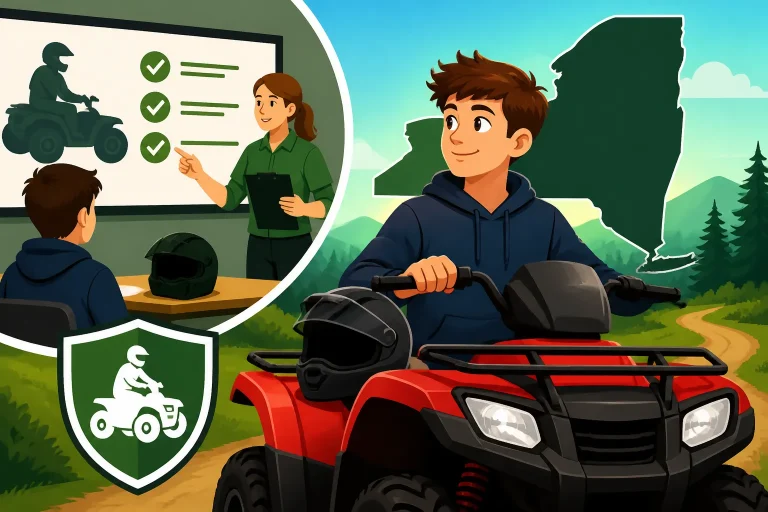
That makes a quick age check important, but age alone is not enough. A rider may need adult supervision, a safety-training certificate, or both, depending on age and where the ATV will be ridden. The rules for a child riding on a parent’s property are not a general permission to ride unsupervised anywhere. For the full age breakdown, see New York Supervision Rules for Minors and New York Minimum Age to Ride an ATV.
The rule about knowingly allowing an unlawful ride is specific to operators under 16. It does not mean that lending to an adult guarantees you will never have a legal or financial problem. If someone is injured or property is damaged, questions about what happened, who had control, permission, insurance and the applicable law may still matter. Don’t treat a written note or casual agreement as a way to cancel legal responsibilities.
There is also a difference between a violation by the rider and a possible issue for the person who provided the ATV. A rider might break a rule without your knowledge; the DMV rule focuses on knowingly permitting or authorizing unlawful operation by someone under 16. But if you know the rider is too young to ride independently in that location, lacks required supervision or training, or plans to take the ATV somewhere it cannot legally go, handing over the keys could put you in a difficult position.
When in doubt, delay the ride until the situation is clear. A short conversation before the ATV leaves can establish who will ride, where they plan to go, whether an adult will accompany a young rider, and whether the machine is covered and ready to use.
Check the rider, location and supervision
Before lending the ATV, confirm the rider’s age and the planned route. New York does not require a driver license to operate an ATV, according to the Department of Motor Vehicles, but that does not remove the rules that apply to younger operators.
The age rules are not identical for all riders under 16. The Department of Motor Vehicles says operators under 14 may ride without adult supervision only on lands owned or leased by their parent or guardian; otherwise, adult supervision is required. Operators aged 14 to 15 may ride without adult supervision on lands owned or leased by their parent or guardian. For those aged 14 to 15 riding independently on other permitted property, a DMV-approved safety-training course certificate is required, and the rider must carry it.
| Rider and situation | What to confirm before lending |
|---|---|
| Operator under 14 | According to the Department of Motor Vehicles, the rider needs adult supervision unless riding without supervision on land owned or leased by their parent or guardian. |
| Operator aged 14 to 15 | According to the Department of Motor Vehicles, the rider may ride without supervision on land owned or leased by their parent or guardian; independent riding on other permitted property requires the applicable safety-training certificate. |
| Young rider with supervision | According to the Department of Motor Vehicles, adult supervision means being accompanied by someone at least 18 years old, or someone aged 16 or 17 who holds an ATV Safety Institute course completion certificate. |
| Any rider on private property | According to the Department of Motor Vehicles, the operator needs the property owner’s permission. |
| Any rider on public land or a highway | According to the Department of Motor Vehicles, use is limited to public lands or highways where ATV use is allowed and properly indicated or designated. |
For a more detailed look at the age and certificate rules, see New York ATV Safety Certificate Requirements. If the rider is young, ask to see the certificate when one is required rather than relying on a verbal assurance that the course was completed.
Permission to use a property is another separate check. A person who has access to a farm, camp or hunting property does not necessarily have permission to ride an ATV there. The Department of Motor Vehicles says ATVs may be operated on private property only with the property owner’s permission. If the route reaches a public highway, the ATV cannot be operated there unless that highway has been designated and posted for ATV use, according to the DMV. New York Rules for Riding Private Land and New York Roads Designated for ATVs explain those access issues in more detail.
Do not assume that a trail, forest road or snowmobile corridor is open to ATVs just because it looks rideable. Public access can be restricted to posted routes, and land managers may impose additional limits. A rider who is not sure whether a route is open should stay off it until permission and access are confirmed.
Make sure the machine and insurance are ready
Lending the quad does not transfer away the practical need to check its registration and insurance. The Department of Motor Vehicles requires a valid New York ATV registration to ride in the state unless a specific exemption applies. New York honors valid out-of-state ATV registrations, but a rider whose home state does not require registration must obtain a New York registration before operating here, according to the DMV.
Ask the borrower to carry the registration document. The DMV says operators must carry it while operating an ATV. Check that the registration has not expired: according to the DMV, new and used ATV registrations first registered in New York expire on August 31 each year, while registrations for ATVs originally registered before April 1, 2005, continue to expire on April 30 each year. If you are lending the ATV to a visitor, New York ATV Reciprocity With Other States can help clarify how out-of-state registration is treated.
Insurance deserves its own conversation. According to the Department of Motor Vehicles, an ATV operated anywhere in New York State must be covered by liability insurance except when it is operated on the owner’s property. The exception is narrow: riding on someone else’s private land is not the same as riding on the owner’s property. The DMV also says proof of insurance must be shown to a judge, police officer, or a person making a claim of injury or property damage. Review New York ATV Insurance Requirement and confirm directly with the insurer that the coverage applies to the planned use and the person borrowing the machine.
A borrower’s promise to pay for damage is not a substitute for checking insurance. If the ATV will leave your property, ask the insurer whether the policy covers another operator and the locations involved. Policy language varies, so do not assume that a policy covers every rider, trail or type of use. If coverage is unclear, hold off on the loan until you have an answer.
Do a practical safety check, too. The DMV says both ATV operators and passengers must wear USDOT-approved helmets. If you’re buying or replacing a helmet through Amazon or another retailer, check the helmet’s approval markings rather than relying on a product title or a general claim that it is protective. For a broader equipment checklist, see New York Equipment Requirements for ATVs.
The same DMV rules require ATV tires to have at least 2/32nds of an inch of tread and no visible breaks, cuts, exposed cords, bumps or bulges. Headlights and taillights must be lit from 30 minutes after sunset to 30 minutes before sunrise, according to the DMV. A worn tire, broken light or missing helmet is a reason to postpone the ride, not a detail for the borrower to sort out on the trail.
Agree on the passenger rule before the ATV leaves, especially if the borrower plans to carry someone. The passenger must also wear a USDOT-approved helmet, according to the Department of Motor Vehicles. Do not lend a one-seat machine on the assumption that a passenger can simply ride along; check the machine and applicable rules first. A clear limit—such as no passengers unless the ATV is designed and equipped for them—can prevent confusion.
Set clear limits and respond properly after a crash
A useful lending conversation covers more than who gets the keys. Agree on the permitted riding area, whether the borrower may carry a passenger, who may operate the ATV, and when it must be returned. If the borrower is under 16, be especially clear about required supervision, training and where the ATV may be used. A short written message can help both sides remember the limits, although it does not override the law or replace insurance.
Before the ride, walk around the ATV together. Point out the registration document, plate, lights, controls and any existing damage. Make sure the borrower knows how to stop the machine and understands that public-road access is restricted. The DMV says ATVs cannot be operated on public highways unless the highway has been designated and posted for ATV use. The rule is not permission to take an ATV on any road simply because a short stretch seems convenient.
If a crash happens, prioritize medical help and safety. The Department of Motor Vehicles says a crash involving death, personal injury or property damage estimated at $600 or more to any one person’s property must be reported to the police immediately. The DMV also requires a Report of Motor Vehicle Crash to be filed with the department within 10 days when a crash results in a fatality, personal injury or property damage estimated at $1,000 or more. Those reporting thresholds are stated by the DMV as of November 2026. Keep insurance and registration information accessible so it can be provided when needed.
Afterward, write down what happened while details are fresh, keep photographs and contact information, and notify the insurer promptly. Do not guess about fault or promise that a claim will be covered. If someone was injured or there is a dispute about responsibility, contact the insurer and consider getting legal advice about the specific circumstances.
A sensible lending decision is usually straightforward: identify the rider, confirm the rules that apply to that rider and location, check registration and insurance, and make sure the machine is safe. If any one of those checks fails, saying no—or waiting until the issue is fixed—is safer than hoping it will not matter.
Sources
- New York State Department of Motor Vehicles — Register an ATV | NY DMV (checked November 3, 2026)
- Department of Motor Vehicles — ATVs: Information for Owners and Operators | NY DMV (checked November 3, 2026)
Disclaimer
This article is for general informational purposes only and does not constitute professional advice. Laws, prices and regulations vary by location and change over time. Consult a qualified professional for guidance on your specific situation.