What General Supervision Means for a Young Rider
General supervision sounds straightforward, but it does not mean a young ATV rider can simply head out while an adult stays somewhere nearby. In New York, the rider’s age, safety certificate, machine, and riding location all matter. Here’s how to understand the term, what an adult should do, and what to check before a minor rides.
What general supervision means
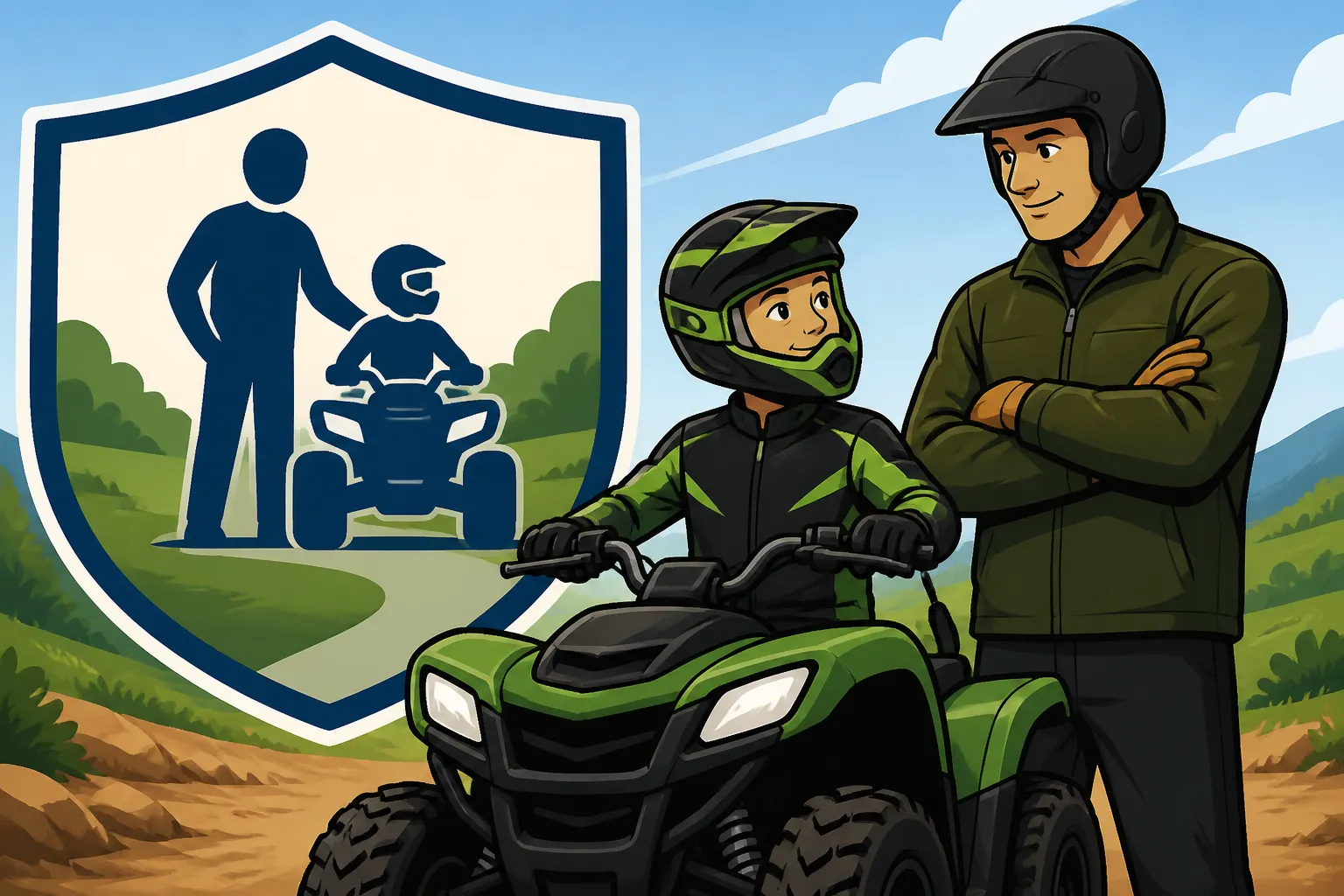
In New York, general supervision is an adult’s oversight of a young rider when the adult does not necessarily have to operate the same ATV or ride alongside the child. The adult must be responsible for the rider and close enough to supervise the activity. It is not permission for a child to ride alone while the adult is elsewhere or unavailable.
The adult’s role is more than being present at the property. They should know where the rider is going, be able to keep track of the ride, and be close enough to respond if something goes wrong. A child riding out of sight on a distant section of a large property may not be under meaningful supervision just because a parent is at home.
The distinction between general and direct supervision matters. Direct supervision is the closer form of oversight: the adult accompanies the young rider or is immediately present while the riding takes place. General supervision can allow more distance, but it still requires an adult to actively oversee the ride. It is not the same as simply giving permission.
Most important, general supervision is not a blanket exception to New York’s youth-riding rules. A rider must still meet the requirements that apply to their age, machine, safety certificate, and location. A young rider who may operate a machine under one set of conditions might not be allowed to ride the same machine, or ride at all, under different conditions.
Use these distinctions as a practical starting point:
| Term or condition | What it means in practice | What it does not mean |
|---|---|---|
| General supervision | An adult takes responsibility and remains close enough to oversee the ride | The child may ride anywhere or out of reach |
| Direct supervision | The adult stays immediately involved and accompanies or closely oversees the rider | A substitute for age, machine, or location rules |
| Adult permission | A parent or guardian agrees to the ride | Proof that the ride is legal |
| Safety certificate | Evidence that a rider completed required ATV safety training, where applicable | A general license to ride any ATV in any location |
If you are sorting out the age rules, start with What New York Requires of Riders Under 16. The details can vary by age and circumstance, so do not rely on the phrase “under supervision” alone to decide whether a particular ride is allowed.
How age and a safety certificate affect supervision
New York’s rules distinguish among young riders rather than applying one simple supervision standard to everyone under 16. A rider’s age can affect whether they may operate an ATV, what kind of oversight is required, and whether a safety certificate is relevant. The machine’s suitability and the place where it will be ridden also matter.
A safety certificate is an important part of the rules for eligible young riders, but it does not erase other restrictions. It does not automatically allow a child to ride an oversized machine, use a public trail without meeting the applicable conditions, or go out without the adult supervision required for that situation. For a broader explanation of the training requirement, see The New York ATV Safety Certificate Explained.
Age 14 is a useful point to examine closely because the rules and supervision conditions can change as a rider gets older. A certificate may be relevant to what a 14-year-old is allowed to do, but you still need to check the machine and riding location. The age-specific explanation in New York Rules for a Rider Aged 14 can help clarify that situation. A 15-year-old should not assume that the rules are identical; see New York Rules for a Rider Aged 15.
| Before the ride | Why it matters |
|---|---|
| Confirm the rider’s age | Different age groups may face different operating and supervision requirements |
| Check whether a safety certificate is required | A certificate may be part of the conditions for a young rider |
| Identify the exact machine | A rider’s eligibility may depend on machine size or type |
| Confirm where the ride will happen | Private land, public land, and trails can have different rules |
| Decide who is supervising | The adult must meet the applicable age and supervision conditions |
| Check local and landowner restrictions | A legal machine and eligible rider still need permission to use the land |
Do not assume that completing a safety course means a young person can ride independently. Nor should you assume that an adult’s presence makes any machine appropriate. Supervision and training address different concerns: an adult oversees the ride, while a safety course teaches skills and safe decision-making.
The age floor also deserves attention. New York restricts operation by very young children, and adult supervision does not necessarily make an otherwise prohibited ride legal. Read Why Ten Is the Youngest a Rider Can Be before treating an adult’s presence as the only requirement. When a child is close to an age threshold, confirm the current rule rather than relying on a birthday estimate or another family’s experience.
What the supervising adult should do
Good supervision is specific. The adult should know the machine, the route, the rider’s experience, and the conditions that could create trouble. Saying “stay on the property” is not enough if the child has no clear boundaries or the adult cannot tell where the machine has gone.
Before setting out, agree on where the rider may go, when they must return, and what they should do if they get lost, stuck, or have a mechanical problem. Make sure the young rider knows not to continue onto a road, trail, or neighboring property without permission. On a large parcel, choose a route that the adult can reasonably monitor.
The adult should also consider whether the child can actually control the ATV. A machine that is too powerful, heavy, or large for the rider can be unsafe even when the child has training and an adult nearby. Match the machine to the rider’s size and ability, and use the manufacturer’s guidance when evaluating fit. Supervision cannot compensate for poor control or equipment that is unsuitable for the rider.
A practical pre-ride check includes:
- Confirm eligibility. Check the rider’s age, certificate status, and the rules for the intended location.
- Choose an appropriate machine. Make sure the rider can reach and use the controls and can manage the machine safely.
- Set a boundary and route. Identify where the child may ride and which areas are off limits.
- Agree on check-ins. Establish when the rider should return or report in, especially on a large property.
- Use protective equipment. Require a properly fitted helmet and other suitable protective gear.
- Check the ATV. Inspect the brakes, tires, controls, lights, and other basic safety items before the ride.
- Stay available. Keep the supervising adult close enough to monitor the activity and respond.
Supervision should change with conditions. A route that is manageable in daylight on familiar, dry ground may be a poor choice after rain, in low visibility, or near traffic and steep terrain. A child who is tired, upset, or unfamiliar with the machine may need closer oversight—or should not ride that day.
An adult should not treat the ride as supervised if they are distracted, impaired, or too far away to respond. The child should know how to stop the machine safely and how to get help. But emergency instructions are not a replacement for keeping the ride within a reasonable range.
Where the ride takes place changes the answer
A private property ride is not automatically exempt from every rule, and a public trail is not simply private riding with more space. New York’s requirements can depend on where the ATV is operated, while landowners and trail operators may impose additional limits. Permission to use land also does not by itself make a young rider eligible to operate a machine there.
On private land, confirm that the owner has authorized the ride and that the rider meets the conditions that apply to that property and machine. A parent’s property may be different from a neighbor’s land, a hunting lease, or a farm where the owner has allowed access. If the ride crosses a boundary, the permission and applicable rules may change. For permission issues, see New York Landowner Permission Rules.
Public land and organized trail systems require extra care. A safety certificate, adult supervision, registration, insurance, or a trail permit may each be relevant, depending on the rider and location. Meeting one requirement does not satisfy the others. Check the specific trail system’s rules before transporting a young rider there, and do not assume that a private-property arrangement carries over to a public route.
The machine itself can also affect where it may go. A small youth ATV and a full-size quad are not interchangeable for eligibility or safety purposes. A side-by-side may have different registration and access issues from an ATV. If you are unsure whether a particular vehicle is eligible, review Can You Register a Side-by-Side in New York? before planning a trail ride.
A child riding as a passenger raises a separate question from a child operating the ATV. Do not use the supervision rules for an operator to decide whether a child may ride as a passenger. The machine must be designed and equipped for a passenger, and separate age and passenger restrictions may apply. See New York Rules for a Child Passenger before carrying a young rider.
A useful way to avoid confusion is to check four things separately:
- The rider: age, training, and ability.
- The machine: size, design, registration status, and passenger capacity.
- The location: private land, public land, or a particular trail system.
- The adult: whether they meet the applicable supervision requirement and can remain meaningfully involved.
If any answer is unclear, pause before the ride. Check the current New York rules and the rules of the landowner or trail operator. The safest interpretation is not that an adult nearby makes every ride acceptable; it is that supervision is one part of a set of conditions that must all fit together.
Disclaimer
This article is for general informational purposes only and does not constitute professional advice. Laws, prices and regulations vary by location and change over time. Consult a qualified professional for guidance on your specific situation.