Sharing a County Trail With Hunters
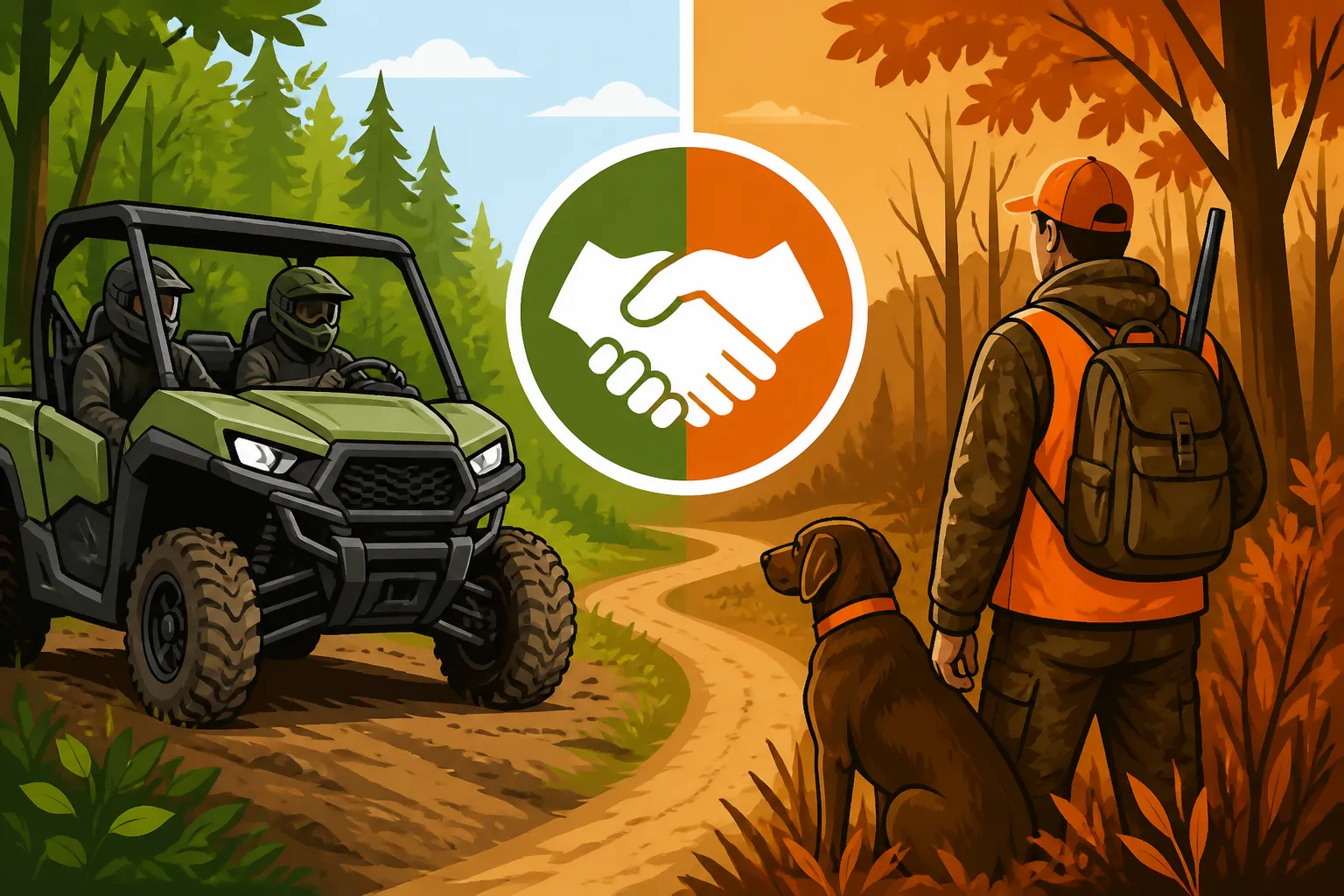
A county ATV trail can pass through hunting country, and a quiet ride may suddenly share space with someone carrying a firearm or tracking game. The safest approach is not to assume the trail is open, empty or covered by one statewide rule. Check the local trail operator’s notices, stay on the marked route and make your presence easy to see and anticipate.
Why ATV riders and hunters meet on county trails
New York’s county and club trail systems may cross or run beside private land, forests, farm property and other areas where hunting takes place. The same route can serve different users at different times of year. A trail that is open for ATV use may also be near an active hunting area, but that does not mean every nearby road or piece of land is open to either activity.
The details depend on who manages the trail and what permissions or agreements apply. A county permit, club membership or registration does not automatically give you permission to leave the route, enter adjoining land or use a trail after it closes. Likewise, a hunter’s access to land does not necessarily mean that a trail is closed to riding. Check the rules for the specific trail and property rather than trying to infer them from what you see on the ground.
Hunting activity may also change within a season. Hunters can arrive before daylight, walk away from a staging area, or use a trail to reach a field or woods. You might not see anyone until you are close. A parked vehicle or an empty trailhead does not prove that a route is unused, and a hunter may be positioned out of sight from the trail.
For ATV riders, this calls for a little more planning than simply checking whether the machine is registered. Review New York Rules for Riding During Hunting Season and the operator’s current trail information before loading up. The local rules may specify closures, permitted uses, or seasonal changes that are not obvious from an older map.
The central distinction is between a route being legally open to ATVs and a route being comfortable or sensible to ride at a particular time. If an operator has closed a trail, do not use it. If it is open but hunting activity is clearly underway, slow down, increase visibility and consider taking another route. The aim is to respect both the access agreement and the people using the surrounding land.
A permit also has a limited purpose. A county trail permit can authorize access to the trail system it covers, subject to that system’s conditions. It does not make every county road, private lane or neighboring property available to ride. New York does not have one statewide trail pass that opens all riding areas, so riders need to know which operator controls the route. New York ATV Trail Permits Explained covers the difference between trail access and other requirements.
| What you are checking | What it tells you | What it does not establish |
|---|---|---|
| County or club trail notice | Whether the operator currently allows ATV use on that route | Whether adjacent land is open to riding or hunting |
| Trail permit or club access | Whether you meet that system’s access conditions | Whether a separate trail system is included |
| ATV registration | Whether the machine is registered as required | Whether the route is open or the machine is allowed on it |
| Hunting-season information | Whether hunting activity or special restrictions may apply | Whether an ATV closure exists on a particular trail |
| A gate, sign or barrier | That access may be restricted or conditions have changed | That it is safe to go around or use another route nearby |
This distinction matters especially for riders visiting from another state. An out-of-state registration may be recognized under applicable reciprocity rules, but registration recognition is not a county trail permit and does not override local closures. See New York Reciprocity for Out-of-State Registrations before assuming that paperwork for your machine also provides access to a particular trail.
Check access, closures and permit conditions before riding
Start with the organization that manages the trail you plan to use. That may be a county office, a trail club, a private park or another operator. Look for current notices, not only a map saved from a previous trip. A mapped route can be temporarily closed for hunting conflicts, landowner requests, maintenance, weather, logging or other reasons.
Check more than the general opening status. Look for:
- Seasonal dates and any temporary closure notices.
- Restrictions on particular trail segments or connecting roads.
- Whether the route is open to all permitted riders or limited to members.
- Whether the permit applies to the route you plan to ride.
- Parking and staging rules, including any limits on overnight parking.
- Instructions about closed gates, detours or landowner requests.
- Contact information for the operator in case a notice is unclear.
A trail system can cross several properties, and its status may depend on landowner agreements. One landowner’s permission does not grant access to the next parcel. Stay on the designated route and follow posted signs even when a side road looks like an obvious continuation. The principles in New York Club Trail Rules and New York Trail Etiquette With Landowners apply whether or not hunting is taking place.
If a trail map shows a route but the gate is closed or a sign says no ATV access, treat the sign as the controlling information unless the operator confirms otherwise. Do not assume that a closure is meant only for hunters, only for vehicles, or only for a different season. Do not move a barrier or take a shoulder, field edge or logging road as a substitute route.
When the operator’s information is unclear, ask before riding. A direct question is more useful than trying to interpret a vague social-media post or relying on what another rider did last weekend. Ask whether ATVs are allowed on the specific segment, whether a seasonal closure is in effect, and whether there are any temporary restrictions tied to hunting or landowner access.
New York’s riding rules and hunting rules do not collapse into one general permission. A trail permit does not authorize hunting, carrying a firearm in a way that violates applicable law, or using land outside the authorized route. Hunting access also does not authorize ATV use on a closed or restricted trail. Riders who plan to hunt from or travel by ATV should separately review New York Rules for Carrying a Firearm on an ATV and New York Rules for Retrieving Game by ATV. Those activities can involve different legal and land-access questions from simply riding a permitted trail.
A practical pre-ride check
Use this short routine before each outing, especially during a period when hunting is likely:
- Identify the trail operator. Confirm which county, club or property manager controls the route.
- Check the latest notice. Look for closures, detours and restrictions for the day you intend to ride.
- Confirm your access. Make sure your permit or membership applies to the route, and that your registration and other required documents are in order.
- Plan a second route. If hunting activity or a closure makes the first choice unsuitable, have a lawful alternative rather than improvising on site.
- Tell your group the plan. Agree on speed, spacing, meeting points and what to do if the trail is closed or blocked.
- Carry useful information. Keep the trail map, operator contact details and emergency contact information accessible, even where phone service may be weak.
A permit is one part of preparation, not a substitute for checking conditions. The operator may update access information after a printed map was made or after you bought a pass. Before you travel, review New York Trail Closures to Check First as well as notices from the trail system itself.
Share the route safely when hunting is underway
A rider may not be required to wear the same hunting clothing as a hunter, but visibility is still a sensible safety measure. Wear bright, high-visibility outer clothing that stands out against the trees and brush. Avoid relying on camouflage or dark colors. Add reflective details if you expect low light, and keep your lights in good working order. A helmet and other protective riding gear remain important, too; visibility does not replace protective equipment.
Hunters may be dressed in blaze orange or another high-visibility color when required by the applicable hunting rules. That does not mean you can assume every person in the woods will be easy to see. The rules and conditions may vary by hunting activity, and someone can be concealed behind brush, a tree or terrain. Your riding plan should allow for an unexpected person or vehicle around a blind corner.
Use a controlled speed, especially near trail junctions, fields, parking areas, gates and places where the trail narrows. A speed that feels comfortable on an empty, familiar route can leave too little time to react when a person steps onto the trail. Reduce speed before a blind bend rather than waiting until you can see around it. Keep a safe following distance so the group can stop without a pileup if the lead rider encounters a hunter.
Give people space. If you see a hunter on or beside the trail, slow to a crawl or stop at a safe distance. Turn down unnecessary engine noise if possible without creating a hazard, and wait for a clear signal or a safe opportunity to pass. Do not drive close to a person, tree stand, hunting blind or parked vehicle simply because the trail is open. A little patience is preferable to surprising someone who may be handling equipment or concentrating on a shot.
Avoid using the horn or shouting as a routine way to announce yourself at close range. A sudden loud noise may startle someone. If a warning is needed because a person has not seen or heard you, use a calm voice or another measured signal from a safe distance. Do not approach a hunter from behind or walk into an area where you cannot tell whether they have noticed you.
Group riding needs additional care. Riders should travel at a pace that keeps the group together without crowding. The lead rider should signal slowdowns and stops in a way the group understands, and each rider should pass the message back. Avoid spreading out so far that the last rider enters a hunting area without knowing there is activity ahead. If someone needs to stop, move the group to a safe place off the traveled portion of the route without leaving the authorized corridor.
These habits help reduce noise and confusion:
- Keep the group orderly and avoid unnecessary revving.
- Do not race, spin tires or make repeated passes near a hunting area.
- Do not stop across a trail or block access for other users.
- Keep dogs under control and do not let them chase wildlife or approach hunters.
- Do not leave litter, food or equipment on the trail.
- Stay on the signed route, even if a wider shoulder looks like an easier place to pass.
- Give way calmly and avoid arguing about who has priority.
The trail is shared space, but it is not a place to confront someone over a disagreement. If a hunter asks you to stop or says the route is closed, do not escalate the encounter. If you can safely stop, do so. Then verify the trail’s status with its operator. A rider cannot establish access rights by arguing on the trail, and a hunter cannot necessarily change a county or club’s posted access rules by making a verbal demand. The operator is the right contact for a dispute about trail status.
The same applies if another rider is behaving unsafely. Keep your distance and report the concern to the trail operator when you can do so safely. If there is an immediate threat or a serious injury, contact emergency services. Do not put yourself in danger by trying to intervene in a conflict involving a firearm.
What to do when a trail encounter becomes a problem
A brief, calm encounter is usually straightforward: slow down, stop if needed, give the other person space and pass only when it is clearly safe. More complicated situations call for a measured response. A hunter may be carrying equipment, tracking an animal or standing in a place where a machine cannot turn around easily. A rider may be on a narrow trail with several machines behind them. Make the next action predictable.
If a hunter is close to the route, stop before reaching them and wait. Do not try to squeeze between the person and their equipment. If the trail is wide enough and the hunter has clearly acknowledged you, pass slowly and leave as much room as practical. If the hunter has not noticed you, wait rather than approaching to get their attention at close range.
If you reach a closed gate or a sign that conflicts with the map, do not cross the barrier or ride around it. Turn back if you can do so safely, and contact the operator for clarification. A trail closure can be temporary, but the fact that it may be temporary is not permission to ignore it. Keep [New York Rules for Riding Public Land] in mind when a route passes into public property: public ownership by itself does not mean that ATV riding is allowed.
If someone says you are trespassing, stop riding forward and avoid an argument. Ask calmly whether the trail is closed or whether you have left the marked route. If the route is unclear, return to the last signed section when safe and contact the trail operator. A permit or map may help clarify where you were authorized to ride, but it does not justify continuing into land where access is disputed.
If you see a firearm pointed in your direction, hear shots nearby, or believe someone poses an immediate danger, prioritize distance and safety. Do not approach the person, attempt to handle a firearm or continue toward the activity. Leave by a safe route if possible and contact emergency services if there is an immediate threat or injury. For a non-emergency trail-access dispute, contact the managing organization rather than trying to settle the question in the woods.
If a person is injured, help only to the extent that it is safe. Make the scene visible to other riders, stop traffic if you can do so without putting yourself at risk, and call emergency services. Provide the trail name, nearest marker or junction, and any location information available from your map. Remote trail systems may not have reliable cell coverage, so knowing a trail’s access points before riding can make it easier to describe where help is needed.
A hunter who has recovered game may also be near the trail. Do not assume that you can follow them, help move the animal with your ATV or leave the trail to go around. Hunting and game-retrieval rules are separate from trail access. The applicable rules are covered in New York Rules for Retrieving Game by ATV; check those rules and the landowner’s permission before taking part.
For riders visiting New York, the same practical expectations apply even when their home state has different trail customs. Carry the documentation required for your machine, confirm the local trail permit requirements, and follow New York’s access conditions. New York Rules for a Visiting Rider can help sort out visitor requirements, while the county or club remains the authority for its own trail system.
The most useful response to uncertainty is to pause rather than improvise. A few minutes spent confirming access is better than riding into a closed area, startling a hunter or creating a dispute that could have been avoided.
Frequently Asked Questions
Can I ride a county ATV trail during hunting season?
Sometimes. Hunting season does not automatically close every county ATV trail, and an open ATV trail does not necessarily close hunting access. Check the trail operator’s current notices and follow any posted or communicated closure.
Does my county trail permit let me ride onto land beside the trail?
No. A trail permit generally applies to the trail system and conditions it covers. It does not automatically grant permission to enter adjoining private property, public land closed to ATVs or another trail system.
Should ATV riders wear blaze orange near hunters?
High-visibility clothing is a sensible precaution, particularly in wooded areas and low light. Check the current hunting and riding rules for any specific requirements that apply to your activity. Do not assume that your clothing makes it safe to ride at speed.
What if a hunter tells me a marked trail is closed?
Stop and avoid arguing. Do not cross a barrier or continue into a disputed area. Verify the route’s status with the county, club or other organization that manages it.
Does an out-of-state registration include access to New York county trails?
No. Registration reciprocity concerns whether an out-of-state machine’s registration may be recognized; it does not replace any trail permit or local access requirement. Check both before riding.
Disclaimer
This article is for general informational purposes only and does not constitute professional advice. Laws, prices and regulations vary by location and change over time. Consult a qualified professional for guidance on your specific situation.