New York Fines for Riding a Closed Trail
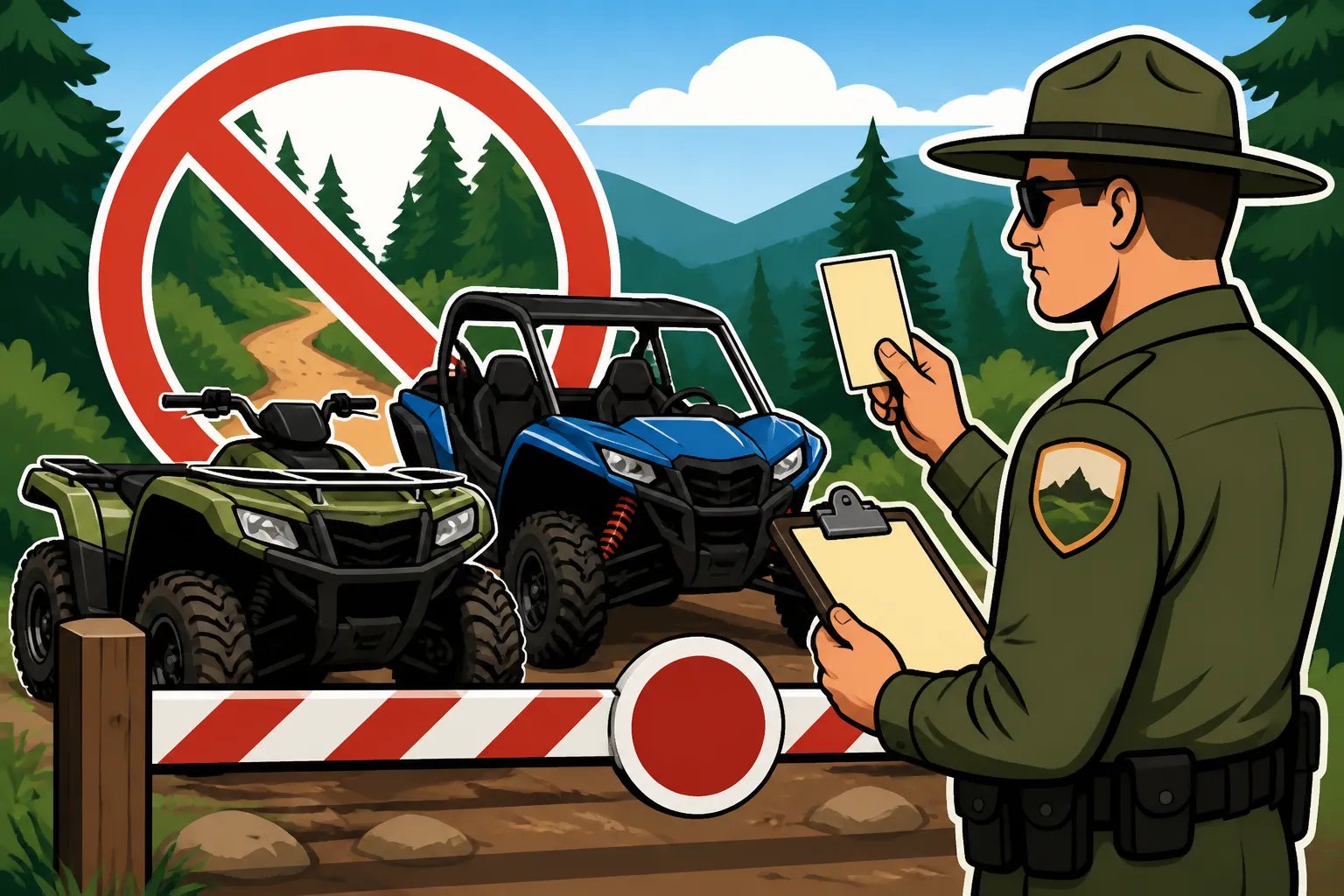
Riding a closed trail in New York can bring more than a warning: the consequences depend on who manages the land, why it is closed, and what rules apply there. A registration or county trail permit does not give permission to use every route. Here’s how to understand the risk, avoid an accidental violation, and respond if you receive a ticket.
What riding a closed trail means in New York
A trail may be closed to ATVs because of seasonal conditions, trail damage, maintenance, a landowner’s decision, or a restriction set by the agency or organization responsible for it. The closure might apply to one segment, an entire network, or a particular type of vehicle. A route that appears on an old map may no longer be open.
This matters because New York does not have one statewide trail pass that makes every trail available to riders. Access can depend on local rules, landowner agreements, club membership, and the conditions stated for a particular trail system. A permit or registration that is valid elsewhere does not cancel a closure.
| Situation | Why riding may be a problem | What to check |
|---|---|---|
| A sign or gate says the trail is closed | The closure is an explicit notice not to enter or continue | The sign, gate, and any posted detour |
| A trail is closed for mud, thaw, or maintenance | Riding can violate the closure and damage the route | The county, club, or land manager’s current notice |
| A private landowner withdraws access | Permission to cross the property may no longer exist | Whether the route has been rerouted or reopened |
| Your permit does not cover that trail | A permit for one system does not automatically grant access to another | The permit’s covered routes and conditions |
| A map shows a trail that is now closed | Maps can lag behind real conditions | Current local notices and signs at the trailhead |
A closure can be temporary or indefinite. For example, a trail may be shut after heavy rain to prevent deep ruts, then reopened when the surface is firm enough. A logging operation, damaged bridge, or landowner request may also lead to a closure or reroute. Unless the responsible manager has clearly announced that access has resumed, do not assume that a familiar trail is open.
The location and identity of the manager matter. A route may run across private land under an agreement with a club or county. The club may post the trail, but the underlying property is still private. If the landowner ends permission, the route may close even if a map or older sign has not yet been updated. See What Happens When a Landowner Pulls Trail Permission for more on how that can affect trail access.
A permit is not a blanket authorization. In a county system, it may apply only to designated routes and be subject to local operating dates, posted restrictions, or closures. Club membership may provide access to certain club trails, but it does not authorize riding on a closed segment or land outside the agreement. For more on how local access works, see County Permits Instead of a State Sticker and New York Rules on Club Trails.
The same principle applies to out-of-state riders. An out-of-state registration may help satisfy registration rules where accepted, but it does not grant permission to ride a closed New York trail. Registration, trail access, and permission to use a specific route are separate questions. Does New York Honor an Out-of-State Registration?
Possible fines and other consequences
There is no single fine that applies to every closed-trail incident. The outcome can depend on the land, the applicable state or local rule, the wording of a ticket, and whether the rider also trespassed or caused damage. An officer or land manager may issue a citation, but the amount and process depend on the specific alleged violation. Check the notice and the relevant issuing authority for current requirements rather than relying on a general estimate.
A ticket for riding where access is prohibited may be only one part of the problem. If a rider enters private property without permission, the incident may also raise trespass issues. If riding damages a trail, gate, sign, or other property, additional consequences may be possible. Do not assume that paying or resolving one citation automatically settles any separate claim or charge.
Riding past a closure can also affect access beyond the individual ride. Trail systems often rely on landowner agreements and volunteer maintenance. Repeated violations or damage can contribute to a landowner closing a route to everyone. This is especially important on trails that cross private property, where continued access depends on keeping the agreement in good standing. See Landowner Agreements That Keep Trails Open.
The reason for a closure does not necessarily change whether you should obey it. A rider might believe the trail is dry enough, the repair is finished, or the gate is easy to go around. That judgment is not a substitute for permission from the manager. Even a short ride through a closed section can violate the restriction, and going around a gate may make the situation worse by taking you off the marked route or onto land where you have no access.
Consequences can also arise from riding in a place that is closed to motor vehicles generally, not just from ignoring a trail notice. New York’s public lands have different access rules, and a marked route in one area does not mean nearby land is open. For example, do not treat the presence of a trail on a map as permission to enter a restricted area. [New York Rules for Riding Public Land] explains why land status and designated access matter.
A permit, insurance card, or registration document may be required for other parts of a ride, but carrying those documents does not excuse a closed-trail violation. A rider can be properly registered and insured and still be riding where access is prohibited. Likewise, an open trail can have its own permit requirements. Think of closure status and paperwork as separate checks.
How to avoid a closed-trail citation
The safest approach is to verify the route shortly before leaving, then follow posted directions on the ground. Trail information can change between planning and ride day, particularly after rain, thaw, maintenance, or a landowner request.
- Identify the trail manager. Find out whether the route is managed by a county, club, park, or another land manager. Do not assume a statewide source has the latest information for every local trail.
- Check current closure notices. Look for updates from the responsible county or club, including notices about seasonal openings, weather closures, reroutes, or work on the trail.
- Read the permit conditions. Confirm which trail system and routes your permit covers, when it is valid, and whether local restrictions apply. A permit for one network may not cover a neighboring route.
- Pay attention at the trailhead. Follow signs, gates, and barriers even if a map suggests that the route continues. A closure sign can reflect a newer decision than an older map.
- Stay on the marked route. Do not detour around a closure onto private property or an unmarked road. A detour is valid only if the manager has designated it as an open route.
- Turn around when information is unclear. If a gate is closed, a sign is missing, or the route’s status cannot be confirmed, choose a known open trail rather than guessing.
Trail maps are useful for planning, but they are not always live updates. If a route crosses private land, a public map may not show a recent change in the landowner agreement. Check the trail system’s latest notices and the signs where you enter. Checking a County Notice Before You Load and New York Trail Conditions Before You Ride cover useful pre-ride checks.
Closures can also be seasonal. A route that is normally open may close during spring thaw, after a storm, or when maintenance is underway. Riding around a wet or damaged section can create ruts that take time and volunteer work to repair. If the trail manager lists a closed period or asks riders to stay off the route until it reopens, wait for the reopening notice instead of trying to judge conditions yourself.
When riding with a group, make sure every rider has the same current route information. A lead rider who knows about a closure cannot prevent a violation if the rest of the group follows an outdated track or continues past a junction. Agree on a turnaround plan before the ride, and do not let schedule pressure turn a closed segment into a shortcut.
What to do if you receive a ticket
Stay calm and comply with lawful directions. Avoid arguing roadside about whether the trail should be open or whether a sign was clear. You can ask politely what rule or restriction the officer believes was violated, but save a detailed dispute for the process described on the ticket or by the issuing authority.
Before leaving the area, note the location and conditions as accurately as you can. Record the trail name, nearby junctions, the direction of travel, the time, and whether there were signs, gates, or barriers. If it is safe and lawful to do so, keep photographs of posted notices and the route entrance. Do not move, remove, or damage signs or barriers.
Read the ticket carefully. It should identify the alleged violation and give instructions for responding. Deadlines, payment options, and hearing procedures can vary, so follow the information on the notice and confirm any unclear details with the issuing court or agency. Ignoring a ticket can create additional problems, even if you believe the citation was mistaken.
If the ticket involves private property, trail damage, or more than one alleged violation, consider getting advice from a qualified professional familiar with the relevant rules. Keep copies of your permit, registration, map, closure notice, and any communications with the trail manager. Those records may help clarify what route you used and what information was available.
If you believe the closure was not properly marked or the route was listed as open, explain the facts through the stated appeal or hearing process rather than returning to the trail to prove a point. A missing or unclear sign may be relevant to how an incident is reviewed, but it does not automatically establish that riding was allowed. Be accurate about what you saw, and do not alter photos, maps, or other records.
After the matter is resolved, confirm the trail’s status before planning another ride there. A citation does not reopen a route, and a route that is eventually reopened may have new conditions or a designated detour. When access is uncertain, choose a different system with clear current permission. The practical rule is simple: a valid permit gives access only where and when the trail manager allows it.
Disclaimer
This article is for general informational purposes only and does not constitute professional advice. Laws, prices and regulations vary by location and change over time. Consult a qualified professional for guidance on your specific situation.