Why Your County Sets the Real Rate
An ATV can have the same sticker price at two New York dealerships and still produce different tax totals. The difference is usually the local sales tax, which sits on top of the statewide portion. Here’s how to think about the rate that applies, what can change the taxable amount, and what to check on a dealer quote before you commit.
The county rate is added to the statewide rate
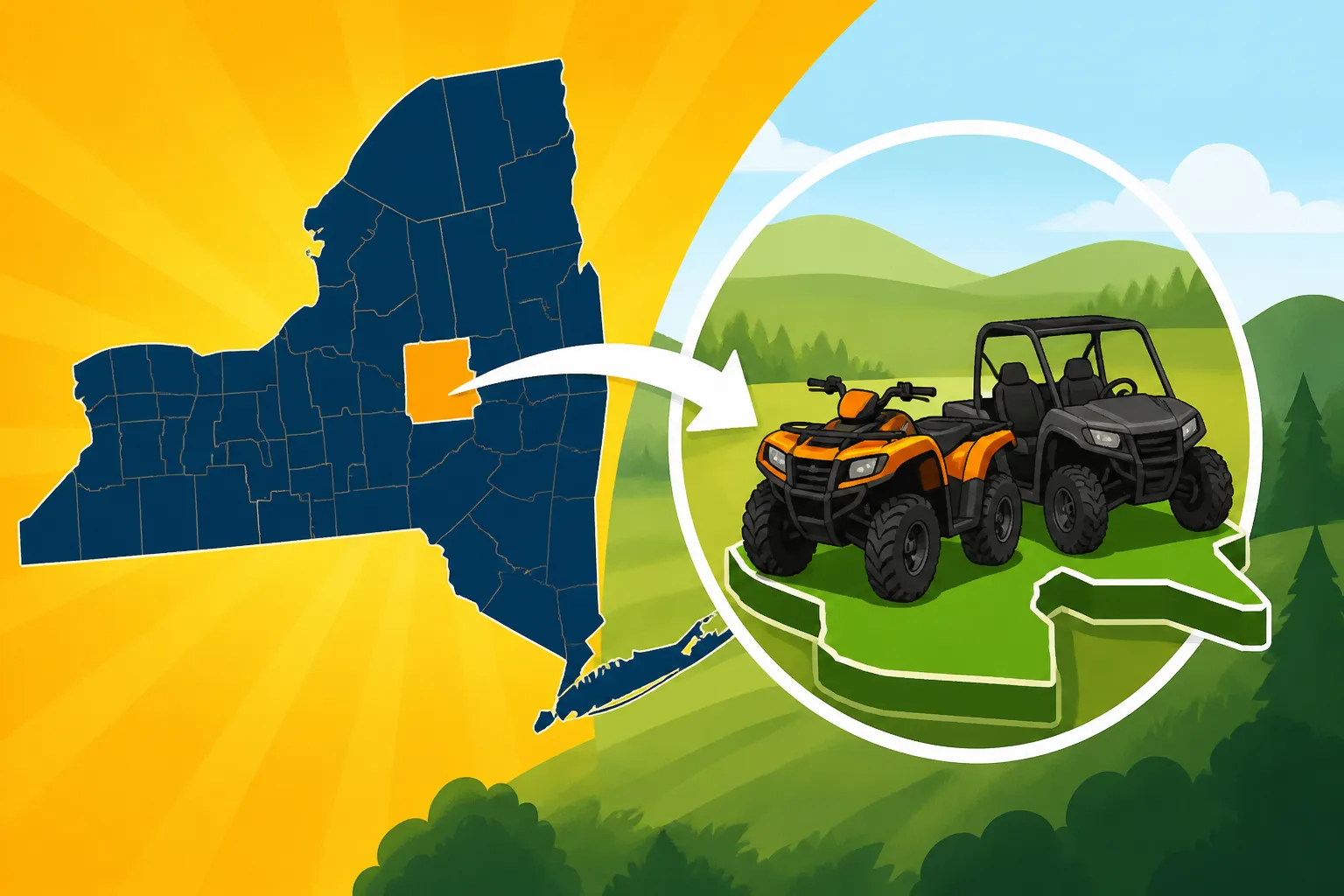
New York sales tax has a statewide component and a local component. County and city authorities may impose local sales taxes, so the combined rate depends on the jurisdiction that applies to the transaction. That is why the rate where you buy or receive an ATV can matter as much as the statewide rate.
The county is a useful starting point, but it may not tell the whole story. Some places have additional local taxes, and the applicable rate can depend on the precise location used for the sale. Two buyers in the same broad region might not necessarily see identical totals. For the statewide portion and the way local taxes fit alongside it, see New York’s 4 Percent State Sales Tax and County Rates on Top in New York.
Think of the total rate as a combination, not a single county-wide number:
- State sales tax: The statewide portion that applies across New York.
- Local sales tax: The portion set by the relevant county and, where applicable, other local jurisdictions.
- Combined rate: The total used to calculate sales tax on a taxable purchase.
The combined rate can change when a local tax changes. A rate remembered from a previous purchase, or copied from an old quote, may no longer be right. Check the current rate for the relevant location before relying on a calculation. New York ATV Sales Tax Rate gives more context on the statewide and local pieces.
The local share can make a noticeable difference because it applies to the taxable purchase amount. For example, imagine two buyers each have a taxable ATV purchase of $10,000. If one transaction is subject to a hypothetical combined rate of 7% and the other to a hypothetical rate of 8%, the sales tax would differ by $100. Those rates are only examples; they are not rates for any specific New York county.
That difference is one reason the advertised price is not enough to compare two offers. A quote with a lower machine price could still have a higher total after tax and other charges. Ask for the out-the-door amount, with the machine price, taxable items, sales tax, and fees shown separately.
Which location determines the local rate
The practical question is not simply, “What is my county’s rate?” It is, “Which tax jurisdiction applies to this specific sale?” The answer may depend on how the transaction is completed, including where the buyer takes possession or where the machine is delivered. For a registration-related purchase, the details may also depend on the process used to report or pay the tax.
A dealership can usually tell you which locality it is using for the quote. Ask directly, and check that the location makes sense for your transaction. If a machine is delivered to an address outside the dealership’s locality, do not assume the dealership’s local rate automatically applies—or assume that your home county’s rate always controls. Ask the dealer how it determined the tax and confirm the answer with an official New York tax source if the situation is unusual.
| Purchase situation | What to ask about the local rate |
|---|---|
| You buy from a dealer and take the ATV home | Which locality is the dealer using for the sale? |
| The dealer delivers the ATV | Is the delivery location used to determine the local tax? |
| You buy from a seller in another county | Does the sale location, delivery, or another transaction detail determine the rate? |
| You buy from a private seller | How and where will any sales or use tax be reported or paid? |
| You bring an ATV into New York from elsewhere | What tax applies when you register or otherwise report the purchase? |
These are questions to ask, not a universal formula. A dealer’s sales process, the buyer’s location, delivery arrangements, and the way the purchase is reported can affect which rules are relevant. A useful follow-up is to request the locality name or tax jurisdiction used on the paperwork rather than accepting a number without context.
For a county-by-county starting point, see New York ATV Sales Tax by County. Use that information as a check, not as a substitute for confirming the precise jurisdiction tied to your transaction. The rate table or calculation method can change, and the transaction facts still matter.
It also helps to separate sales tax from registration. Registration is a different requirement from the tax on the purchase, even if the two come up during the same visit or paperwork process. If a dealer or office handles both, ask for each amount to be identified separately. Registering an ATV in New York explains the registration side.
How the tax changes your purchase total
Sales tax is generally calculated on the taxable amount of the transaction using the applicable combined rate. The amount shown on the purchase agreement may not be identical to the machine’s advertised price. A trade-in, accessories, and other charges can affect the amount you pay or the base used for the tax calculation, depending on how the transaction is structured and how the charge is treated.
A simple way to compare offers is to start with the same set of figures for each dealer:
- Machine selling price: Ask for the agreed price before tax.
- Trade-in allowance: Have the dealer show the allowance separately, if you are trading a machine.
- Taxable amount: Ask what amount the dealer is using to calculate tax.
- Sales tax: Confirm the combined rate and locality shown on the paperwork.
- Other charges: Request an itemized list of dealer, delivery, setup, and registration-related amounts.
- Out-the-door total: Compare the amount you would actually pay, not just the advertised price.
Suppose the taxable amount is $10,000 and the applicable combined rate is a hypothetical 8%. The tax would be $800. If a qualifying trade-in changes the taxable amount, the tax calculation may change too. Do not assume that every trade-in or every amount a dealer lists as an allowance receives the same treatment. Ask the dealer to show how it calculated the tax and review the rules described in New York ATV Trade-In Tax Credit and Taxing the Price Less the Trade in New York.
The same care applies to add-ons. A helmet, winch, plow, delivery, setup service, or other item may be listed separately, bundled into a package, or handled in a way that affects the invoice. Avoid trying to infer the tax treatment from a sales conversation alone. Ask which charges are included in the taxable amount and why.
A dealer document or administrative fee is another line to check. It is not the same thing as sales tax, and a fee appearing next to the tax line does not automatically mean it is taxed the same way. Ask the dealer to identify each charge and explain how it is treated. New York ATV Dealer Documentary Fee and Why a New York Doc Fee Is Not Taxed cover that issue in more detail.
When comparing offers, the most helpful document is an itemized written quote. If one dealer gives only a monthly payment and another gives a full breakdown, the second quote is easier to evaluate. A monthly payment can hide differences in tax, fees, down payment, loan length, and financing cost. Compare the transaction totals first, then consider financing separately.
Dealer purchases, private sales, and out-of-state machines
A dealer purchase is often simpler to follow because the dealer prepares the sales paperwork and may collect or report the tax as part of the transaction. Still, the buyer should check that the invoice identifies the taxable amount, the rate, and the tax paid. If the tax is handled later through another process, ask what proof you will receive and what steps remain your responsibility.
A private sale is not automatically tax-free just because the seller is an individual. A buyer may still have a sales or use tax obligation, and the process for reporting or paying it can differ from a dealer sale. Before handing over money, ask how the purchase will be documented and what tax information or payment may be required when you handle the next step. Buying a Used ATV in New York and New York ATV Bill of Sale Requirements can help with the broader paperwork questions.
Out-of-state purchases need the same separation between the selling price and the tax due in New York. A seller in another state may collect a tax, but that does not by itself answer whether New York tax is due or whether any credit applies. Keep the bill of sale and any tax receipt, and confirm the process before the sale if you plan to bring the machine into New York. Registering an Out-of-State Machine in New York explains the registration questions involved.
When a seller says “tax is included,” ask what that means. It could mean the quoted total includes tax collected for the transaction, or it could simply be a casual way of describing an asking price. Get the amount and the tax treatment in writing. If tax has been paid elsewhere, retain proof rather than relying on a verbal assurance.
For an ATV bought from a dealer in New York, also check that sales tax is not being confused with the registration cost or a one-time plate charge. Those are separate parts of the purchase and ownership budget. A quote may combine them in its total, but it should still identify them clearly. For ongoing ownership costs beyond the purchase, see What an ATV Costs to Own in New York.
How to verify a rate before you sign
A short check before signing can prevent a frustrating disagreement at the counter. Rates can change, and a seller may calculate tax using a location or taxable amount that you did not expect. You do not need to become a tax specialist; you do need enough detail to ask a clear question and verify the answer.
Use this checklist:
- Ask for the location used. Request the county and locality or other jurisdiction used to determine the rate.
- Confirm the combined rate. Do not compare only the statewide portion.
- Check the taxable amount. Make sure the quote explains how the price, trade-in, and other charges were handled.
- Request an itemized invoice. Look for separate lines for sales tax, fees, registration, and any add-ons.
- Check current official information. Use New York’s official tax information or contact the relevant office when the location or transaction is not straightforward.
- Keep your paperwork. Save the quote, bill of sale, invoice, and receipts for any tax paid.
If the dealer’s rate seems different from what you expected, first check whether you are comparing the same locality and the same type of transaction. A county-level figure may not include every local component, or it may refer to a different location than the one used for your purchase. Ask the dealer to show the basis for its calculation. If the explanation still does not line up, pause before signing and verify the rate with an official source.
Do not rely only on a search result, an old receipt, or a neighbor’s purchase. A neighbor might have bought in a different locality, had the ATV delivered somewhere else, or completed a different type of transaction. Even a correct rate from a prior year is not a guarantee that it remains current.
The best way to compare dealerships is to request matching, itemized quotes based on the same machine, trade-in assumptions, and delivery arrangements. Then compare the total cost and check the tax line independently. Your county is often the biggest clue to the local rate, but the relevant jurisdiction and the structure of the transaction determine what belongs on the final bill.
Frequently Asked Questions
Does the dealer’s county always set the ATV sales tax rate?
Not necessarily. The dealer’s location may be relevant, but delivery, where the buyer takes possession, and the way the transaction is reported can matter. Ask which locality the dealer used and confirm it for your situation.
Is the local sales tax included in the ATV’s advertised price?
Usually, an advertised price should not be treated as the final out-the-door amount unless the seller clearly says what it includes. Ask for an itemized quote showing the machine price, tax, and other charges separately.
Does buying an ATV from a private seller avoid sales tax?
Not automatically. A private purchase may still involve a sales or use tax obligation. Confirm how the purchase must be documented and where any tax must be reported or paid.
Can a trade-in reduce the tax I owe?
A qualifying trade-in may affect the taxable amount, but eligibility and calculation details matter. Ask the dealer to show the tax calculation and review the applicable New York rules before relying on an estimated credit.
Disclaimer
This article is for general informational purposes only and does not constitute professional advice. Laws, prices and regulations vary by location and change over time. Consult a qualified professional for guidance on your specific situation.