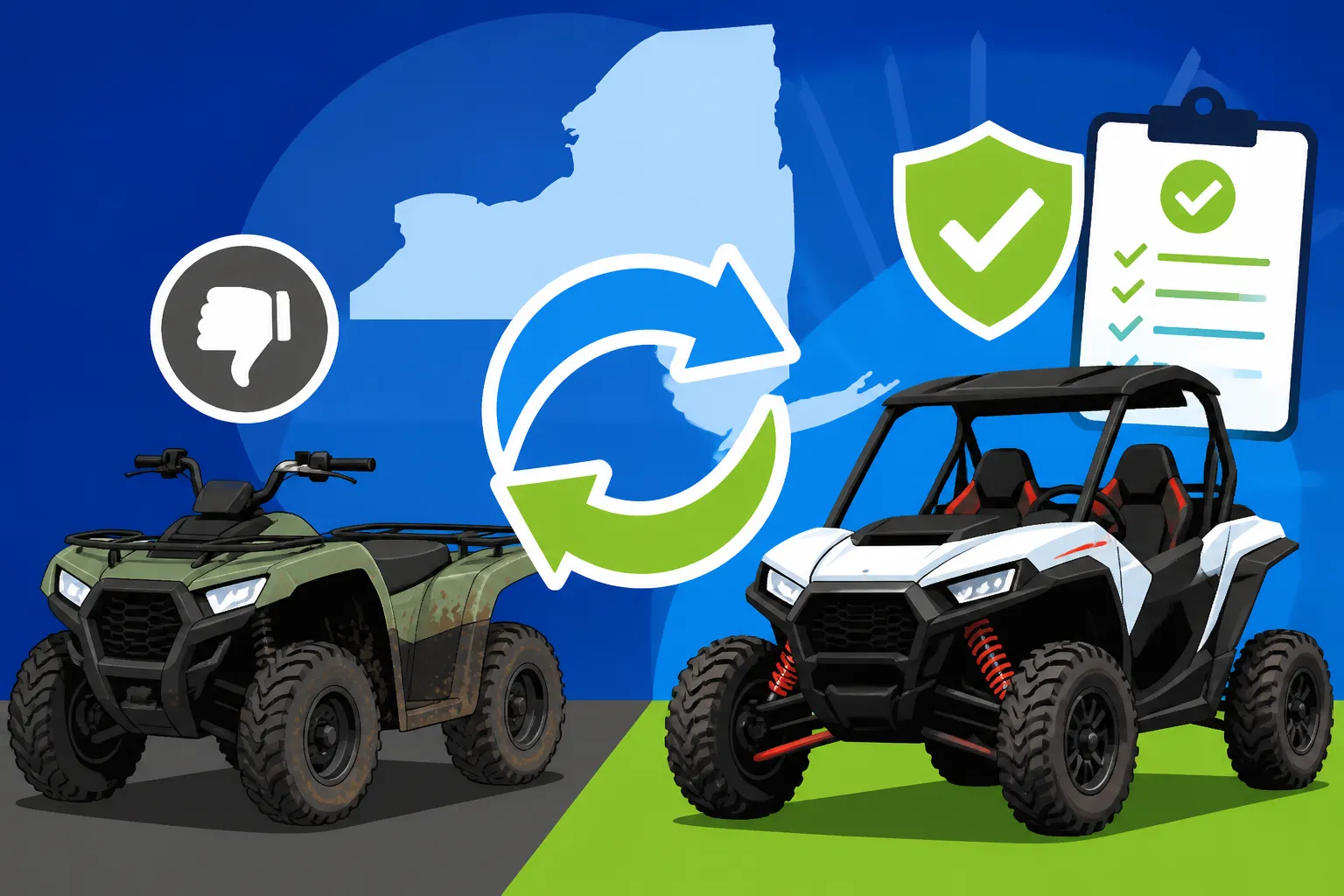
New York Trade-In Rules on an ATV
Trading in an ATV can reduce the sales tax on your next machine, but the dealer’s offer is only part of the calculation. In New York, the transaction structure, loan payoff and paperwork can all affect what you actually save. Here’s how to understand the trade-in credit, compare it with a private sale and check the numbers before you sign.
How an ATV trade-in can change your New York sales tax
A trade-in may reduce the amount of a new machine’s purchase price that is subject to sales tax. The key is that the dealer accepts your current ATV as part of the same purchase transaction. The trade allowance is deducted from the taxable purchase amount; it does not erase the tax or reduce the machine’s advertised price.
For a simple illustration, suppose a dealer sells you an ATV for $8,000 and offers $3,000 for your trade. If the trade qualifies for the New York trade-in treatment, the taxable amount tied to the ATV purchase would generally be calculated using the $5,000 difference, before other taxable items or charges are considered. The actual tax depends on the applicable state and local rates and the details of the deal.
This is why a trade-in can be worth more than a separate cash offer that looks similar. The trade allowance can lower the taxable amount on the replacement machine, while a private sale usually does not change the tax due on your dealer purchase. The credit is about how the transaction is treated for sales-tax purposes, not a special cash rebate from the state.
For a broader overview of how tax applies when you buy a quad, see New York ATV Sales Tax. The trade-in calculation is one part of that overall purchase cost.
The basic calculation
A simplified way to think about the calculation is:
- Start with the taxable purchase amount for the replacement ATV.
- Subtract the dealer’s eligible trade-in allowance.
- Apply the relevant sales-tax rules to the resulting taxable amount.
- Add any other taxable charges as required for the transaction.
This is a useful way to understand the logic, but it is not a substitute for the dealer’s complete tax calculation. The final taxable amount can depend on the contract, the items included in the sale and how the dealer records the transaction. Ask for a written breakdown that shows the trade allowance and the sales-tax calculation separately.
If the trade allowance is larger than the taxable purchase amount, do not assume the unused portion becomes a refund or a credit on a later ATV purchase. A trade-in allowance is generally applied within the transaction in which the dealer accepts it. Ask the dealer how any excess would be handled before you agree to the deal.
What the tax reduction is—and is not
The sales-tax benefit does not necessarily mean the dealer is giving you a better overall deal. A dealer might offer a generous trade allowance while setting a higher price on the replacement ATV, or offer a smaller trade allowance while discounting the new machine. The total amount you pay matters more than any one figure on the worksheet.
A trade-in also does not automatically reduce registration costs, insurance costs, financing charges or every fee in the transaction. Those items may be calculated separately. Keep the sales-tax benefit in the right category: it may lower the taxable purchase amount, but it is not a general discount applied to every expense.
When comparing offers, look at the out-the-door total, the balance you will owe after any down payment, and the tax calculation. A large trade number can make a deal look attractive even when the overall price is less favorable.
When the trade-in treatment may apply
The important distinction is between a dealer trade-in that is part of a purchase and a sale that happens separately. When a dealer takes your ATV as a trade toward another machine in the same transaction, the dealer can document the allowance and apply the relevant tax treatment. If you sell your old ATV to someone else and later buy from a dealer, the sale to the private buyer is usually a separate event. It does not automatically become a trade-in for the dealer purchase.
For the practical details of this tax benefit, see New York ATV Trade-In Tax Credit and New York Trade-In Credit on a Machine. The short version is to have the dealer put the trade and the purchase together on the paperwork rather than relying on a verbal promise that the sale will “count as a trade.”
Keep the trade and purchase connected
A trade-in should appear clearly on the purchase agreement or dealer worksheet. It should identify the machine being traded and show the allowance the dealer is giving for it. The purchase documents should also show the machine you are buying, the applicable sales-tax calculation and any other amounts included in the deal.
If the dealer buys your ATV for cash on one date and you buy a replacement later, that may not be treated the same as an ATV traded in as part of one purchase. Likewise, selling the old machine privately and using the money as a down payment is not the same as a dealer trade-in for sales-tax purposes. The down payment may reduce the amount financed, but it does not necessarily reduce the taxable purchase price.
If you are arranging separate transactions, ask the dealer how the sale will be documented and how tax will be calculated before you agree. Do not rely on a salesperson’s informal description of the arrangement. The written contract is what lets you see how the dealer handled the transaction.
Confirm the ATV is eligible for the treatment
The details can matter if the machine being traded is not an ATV, if the replacement is a different type of vehicle, or if the transaction involves unusual circumstances. Do not assume that every item of property traded to a dealer will qualify for the same tax treatment as an ATV traded toward another ATV. Ask the dealer to confirm how the trade is classified and how that affects the taxable amount.
This is especially worthwhile when trading a side-by-side, a snowmobile or another recreational machine, or when purchasing a machine from a dealer in a different state. The name used in a sales conversation is not enough to establish the tax treatment. Have the dealer explain the calculation on the paperwork.
If the machine you want is a UTV or side-by-side, check the registration issue separately from the trade-in tax question. New York’s registration rules do not make every side-by-side eligible for registration; see Why Most Side-by-Sides Cannot Be Registered in New York. A tax credit on a purchase does not make a machine registrable.
The dealer’s role
A dealer handling the sale should provide an itemized transaction record that makes it possible to see the purchase price, trade allowance and tax calculation. You do not need to accept a single combined figure without explanation. Ask for the figures to be shown separately, especially if the trade allowance appears to have changed during negotiations.
The dealer may also need to inspect the machine, verify its identifying information and determine whether it can accept the ATV with any loan or ownership issues still unresolved. Those steps are separate from the tax calculation, but they can affect whether the trade can be completed when planned.
Trade value, loan payoff and equity are different numbers
Three figures commonly get blurred together during a trade:
- Trade allowance: what the dealer agrees to credit for your ATV.
- Loan payoff: what is required to clear any loan or lien on it.
- Equity: the difference between the trade allowance and the payoff.
The allowance is not necessarily the amount you receive as cash, and it is not necessarily the amount available to put toward the replacement machine. If you owe money on the ATV, the payoff must be dealt with as part of the transaction.
When you have positive equity
Suppose the dealer allows $4,000 for your ATV and the payoff is $2,500. The difference is $1,500 in positive equity. That amount may be applied toward the replacement purchase, subject to the contract’s terms.
For sales-tax purposes, do not assume the dealer will use only the $1,500 equity as the trade allowance. Ask the dealer to show both the gross trade allowance and the loan payoff on the worksheet, along with the sales-tax calculation. The treatment of the trade allowance should be clear rather than hidden inside the amount financed.
Positive equity can make a replacement machine easier to finance, but it does not make a weak deal strong. Compare the new ATV’s price, the trade value and the total amount you will owe. A high allowance paired with a high purchase price may leave you worse off than a lower allowance paired with a lower purchase price.
When you owe more than the trade is worth
If your payoff is greater than the trade allowance, you have negative equity. For example, a $3,000 trade allowance against a $4,000 payoff leaves a $1,000 shortfall. The dealer may require you to pay that amount, or it may be included in the new financing if the lender and contract permit it.
Negative equity is not the same thing as a trade-in allowance. Ask the dealer to show the allowance and payoff as separate entries, then show exactly where the shortfall goes. If it is added to the new loan, you are borrowing more than the price of the replacement machine after the other transaction amounts are included.
That shortfall can also make future trades harder. You may begin the next ownership period owing more than the ATV is worth. Before rolling a balance into a new loan, compare the total amount financed and the repayment terms with the cost of keeping the current machine or making a larger cash payment.
Do not let the discussion of a monthly payment obscure the underlying figures. A lower payment can result from borrowing over a longer period, not from a better trade. Ask for the cash price, trade allowance, payoff, down payment, amount financed and total repayment amount in writing.
A loan payoff may take time
If the ATV has a loan, contact the lender or ask the dealer how it will obtain an official payoff figure. The balance shown on a recent statement may not be the exact amount needed to close the loan on the day the transaction is completed. Interest and processing time can affect the payoff.
Ask who will send the payoff, when it will be sent and how you will receive confirmation that the lien has been cleared. Keep copies of the purchase documents and any lender confirmation. If the loan is not paid as expected, contact the lender promptly rather than assuming the dealer has finished the process.
For a machine that is financed, the trade-in’s paperwork and payoff need to line up. See Registering a Financed Machine in New York for related registration considerations.
Trade-in or private sale: compare the whole result
Trading at a dealer is usually simpler: the dealer evaluates the ATV, records an allowance and handles the transfer as part of the purchase. A private sale may bring a higher price, but it takes time and leaves you responsible for arranging the sale and documenting the transfer. The private sale also generally does not create the same trade-in tax reduction on a separate dealer purchase.
| Issue | Dealer trade-in | Private sale |
|---|---|---|
| Sales-tax effect on replacement | May reduce the taxable purchase amount when eligible and handled as part of the purchase | Usually does not reduce the taxable amount on a separate dealer purchase |
| Sale price | Dealer sets an allowance based on its inspection and resale plans | You set or negotiate a price with the buyer |
| Convenience | Often completed alongside the new purchase | Requires finding a buyer and arranging a separate handoff |
| Loan payoff | Dealer may coordinate payoff, but you should verify it is completed | You and the buyer must coordinate any payoff and lien release |
| Paperwork | Dealer normally prepares transaction documents | You must keep a bill of sale and other ownership records |
| Timing | Can be quick if the dealer accepts the machine and paperwork is ready | May take longer and depends on finding a buyer |
| Negotiation | Trade value and replacement price can be negotiated together | Sale price and replacement purchase are negotiated separately |
The table is a starting point, not a guarantee that one option is always better. The best choice depends on the dealer’s actual allowance, the likely private-sale value, the tax effect, any payoff and how much time and risk you are willing to take on.
Compare net value, not just the offer
To compare a private sale with a trade, estimate the net result of both options. For a trade, account for the dealer’s allowance and any sales-tax reduction, then subtract any loan payoff and other amounts you must pay. For a private sale, estimate the likely sale proceeds, account for any loan payoff and compare the dealer purchase tax with the tax calculation for the trade scenario.
Do not treat an advertised private-sale price as guaranteed. A buyer may negotiate, ask for repairs or walk away after inspecting the ATV. A dealer may offer less because it expects to inspect, repair, store and resell the machine. That lower offer may still be reasonable if the convenience and tax treatment are valuable to you.
If you want to compare a private transaction in more detail, New York ATV Dealer Versus Private Sale covers the broader differences. For a private sale’s documentation, see New York ATV Bill of Sale Requirements.
Don’t sell first without checking the replacement deal
A common planning mistake is selling the old machine privately before getting a firm purchase worksheet for the new one. Once the private sale is complete, you may lose the ability to use that machine as a dealer trade-in. You may still have the sale proceeds for a down payment, but a cash down payment does not necessarily create the same tax treatment.
Before you commit to either path, ask the dealer for two written estimates:
- A purchase estimate with the ATV traded in.
- A purchase estimate with no trade, showing the price and tax calculation separately.
Then compare the estimates with a realistic private-sale amount, not the highest price you hope to receive. This makes the tax benefit visible and helps reveal whether the dealer’s trade allowance or replacement price changes between scenarios.
Paperwork for trading an ATV in New York
ATVs in New York generally do not have a conventional vehicle title. That means a buyer or dealer may rely on other documents to establish ownership and identify the machine. The absence of a title does not mean you can skip paperwork or hand over the ATV without a record of the transaction.
Before heading to the dealer, gather the documents you have and ask what the dealer will accept. Requirements can vary with the machine’s history, where it was purchased and whether a loan or lien is involved. Do not assume that registration alone proves every fact the dealer needs.
Collect ownership and identification records
Bring the current registration if you have it, purchase records, a bill of sale or other ownership documents, and any records identifying the ATV. Have the machine’s VIN or frame number available. Dealers may need to inspect the identifying number and compare it with the information in your paperwork.
If the VIN is difficult to read, do not alter or restamp it. Ask the dealer what documentation it needs and whether it can inspect the number before the day you plan to complete the deal. A mismatch between the machine and the documents can delay or prevent the trade.
For more on ownership documentation, see New York ATV Proof of Ownership Requirements. If you are buying a used machine rather than trading one, Buying a Used ATV in New York explains why it is important to check the paperwork before money changes hands.
Bring loan and lien information
If the machine has a loan, bring the lender’s contact information and the account details needed to request a payoff. A dealer may ask for authorization to contact the lender. Get a written explanation of how the payoff will be handled and how any difference between the allowance and payoff will appear in the sale documents.
If you believe the loan is paid off but the records still show a lien, resolve that question before completing the trade if possible. The dealer may not accept the ATV until the lien status is clear. A verbal assurance that an old loan is closed may not be enough when the records do not match.
Make the handover specific
The trade paperwork should identify the ATV being transferred and include the agreed allowance. Keep a copy of the signed contract and any separate bill of sale or transfer document. Record the date and keep the dealer’s contact information. Do not leave the transaction with only a receipt showing a total price for the new machine.
Ask what happens to the ATV’s registration and plate. Do not assume the dealer will transfer your registration to the replacement machine or that you can use the old plate without checking. New York registration and plate rules are separate from the tax treatment of the trade. For the registration side, see New York ATV Registration Transfer.
How to check the dealer’s numbers before signing
A clear worksheet should let you follow the deal from the selling price to the amount due. If the figures are bundled together, ask for an itemized version. You are not being difficult by asking how the trade, tax and payoff were calculated; those are the numbers that determine whether the deal makes sense.
Check these entries
Review the worksheet for:
- The agreed selling price of the replacement machine.
- Any separately listed dealer charges or optional items.
- The ATV being traded and its allowance.
- Any loan payoff or lien amount.
- Any positive or negative equity applied to the deal.
- The amount used to calculate sales tax.
- The sales-tax amount and the rate or jurisdiction used.
- Your cash down payment, if any.
- The amount financed and any financing terms.
The precise entries and layout vary, but the logic should be understandable. Ask the dealer to explain any figure that is not clear. For example, if the worksheet lists a trade allowance and a payoff but does not show where the difference went, request a revised breakdown.
Dealer charges can affect the total transaction in different ways. Do not assume that every fee is treated identically for sales-tax purposes. Ask which charges are taxable and why, and compare the answer with the written calculation. New York Dealer Fees You Can Refuse and New York ATV Dealer Documentary Fee provide context on dealer charges.
Make sure the tax calculation uses the right trade amount
Check that the allowance shown on the worksheet matches what you negotiated. If the salesperson offered one amount during discussion but the paperwork shows another, pause and resolve the difference before signing. Also confirm that the dealer has not confused the allowance with your equity after subtracting a loan payoff.
The tax calculation should be visible enough for you to understand how the trade affected it. If you cannot tell whether the trade-in was applied, ask the dealer to show the taxable amount before and after the allowance. If the dealer says a trade qualifies but the tax line appears unchanged, ask why. There may be other taxable items or a transaction detail that explains the result, but it should not be left unexplained.
Use the same approach when comparing dealers. A worksheet with a larger trade allowance is not automatically the cheaper deal. Compare the replacement machine’s selling price, the tax, the payoff and every added charge.
Watch for add-ons and bundled amounts
Accessories, protection products, delivery, setup and other add-ons may be included in a dealer’s quote. They can increase the overall cost, and some may affect the sales-tax calculation. Ask whether each item is optional, what it costs and whether it is already included in the advertised price.
If you do not want an optional item, ask for it to be removed before signing. If the dealer says an item cannot be removed, ask whether the price can be adjusted or whether another machine is available without it. Make sure the final contract reflects what you agreed to buy.
Keep copies and follow up
Before leaving, keep copies of the purchase agreement, trade-in document, payment records and any paperwork related to a loan payoff. If the dealer will complete a payoff or send ownership documents later, ask when that should happen and how you can confirm it.
Review the final paperwork at home while the transaction is fresh. If a number differs from what you were shown, contact the dealer promptly and keep a written record of the conversation. Clear documentation is especially useful if there is a later question about the trade allowance, tax calculation or payoff.
A practical plan for a better trade-in decision
You can make the decision easier by separating valuation, tax and financing instead of negotiating them as one monthly payment.
- Find your paperwork. Gather registration, purchase or ownership records, VIN information and any loan documents.
- Get the payoff. If there is a loan, ask the lender for a current payoff process and confirm how long the figure is valid.
- Get an independent sense of value. Compare similar machines by condition, age, equipment and maintenance history. Treat asking prices as reference points rather than guaranteed sale prices.
- Ask the dealer for a written trade offer. Have the dealer identify the ATV and show the allowance separately from the replacement machine’s price.
- Request a no-trade estimate. This helps show whether the replacement price changes when the trade is removed.
- Compare a realistic private sale. Include likely negotiation, time, paperwork and any loan payoff, not just the best possible sale price.
- Review tax and fees. Ask how the trade changes the taxable amount and which other charges are included in the calculation.
- Compare total cost and financing. Look beyond the monthly payment to the amount financed, repayment terms and any negative equity.
- Read the contract before signing. Make sure the figures and the agreed terms match.
A dealer trade can be the right choice even if the allowance is lower than a private-sale price. The tax effect, speed and convenience may make the difference worthwhile. A private sale can also make sense if the likely extra proceeds outweigh the trade’s tax advantage and the added effort. The useful comparison is the net cost of replacing the machine, not the trade figure by itself.
If you are still deciding what type or size of machine to buy, consider the registration rules before agreeing to a purchase. A trade-in tax benefit does not solve a registration problem, and a machine that does not meet New York’s requirements may limit where you can use it.
Frequently Asked Questions
Does a New York ATV trade-in lower sales tax?
It may reduce the taxable purchase amount when a dealer accepts the ATV as a qualifying trade-in as part of the same purchase transaction. Ask the dealer to show the allowance and tax calculation separately.
Does selling my ATV privately count as a trade-in?
Usually not for the dealer purchase’s trade-in calculation. A private sale is a separate transaction, even if you use the money as a down payment on another ATV.
Does my loan payoff reduce the trade-in allowance?
The allowance and payoff are separate amounts. The payoff affects the equity you have in the ATV and what happens to the remaining balance, so make sure both figures appear separately on the worksheet.
Do I need an ATV title to trade in New York?
New York ATVs generally do not have conventional titles, but the dealer may still need documents to verify ownership and identify the machine. Ask what records it needs before completing the trade.
Should I choose the trade-in with the highest allowance?
Not necessarily. Compare the replacement price, tax, payoff, fees and financing together. A high allowance can be offset by a higher selling price or other costs.
Disclaimer
This article is for general informational purposes only and does not constitute professional advice. Laws, prices and regulations vary by location and change over time. Consult a qualified professional for guidance on your specific situation.