County Rates on Top in New York
Buying an ATV in New York can mean paying more than the advertised price, and the local sales tax depends on more than the county where a dealer’s showroom sits. Understanding the state and local parts of the bill helps you compare quotes, check the taxable amount and spot a calculation that needs explaining.
How county sales tax fits into an ATV purchase
New York sales tax has a statewide component and local components. The statewide sales tax rate is 4%; counties and certain cities or special tax districts may add local sales tax. The combined rate is what matters when you calculate the tax on a purchase.
That is why two buyers looking at the same ATV price may see different tax totals. Their transactions may be subject to different local rates, depending on the rules that apply to the sale. The county rate is a useful starting point, but it may not tell the whole story if a city or special district also applies.
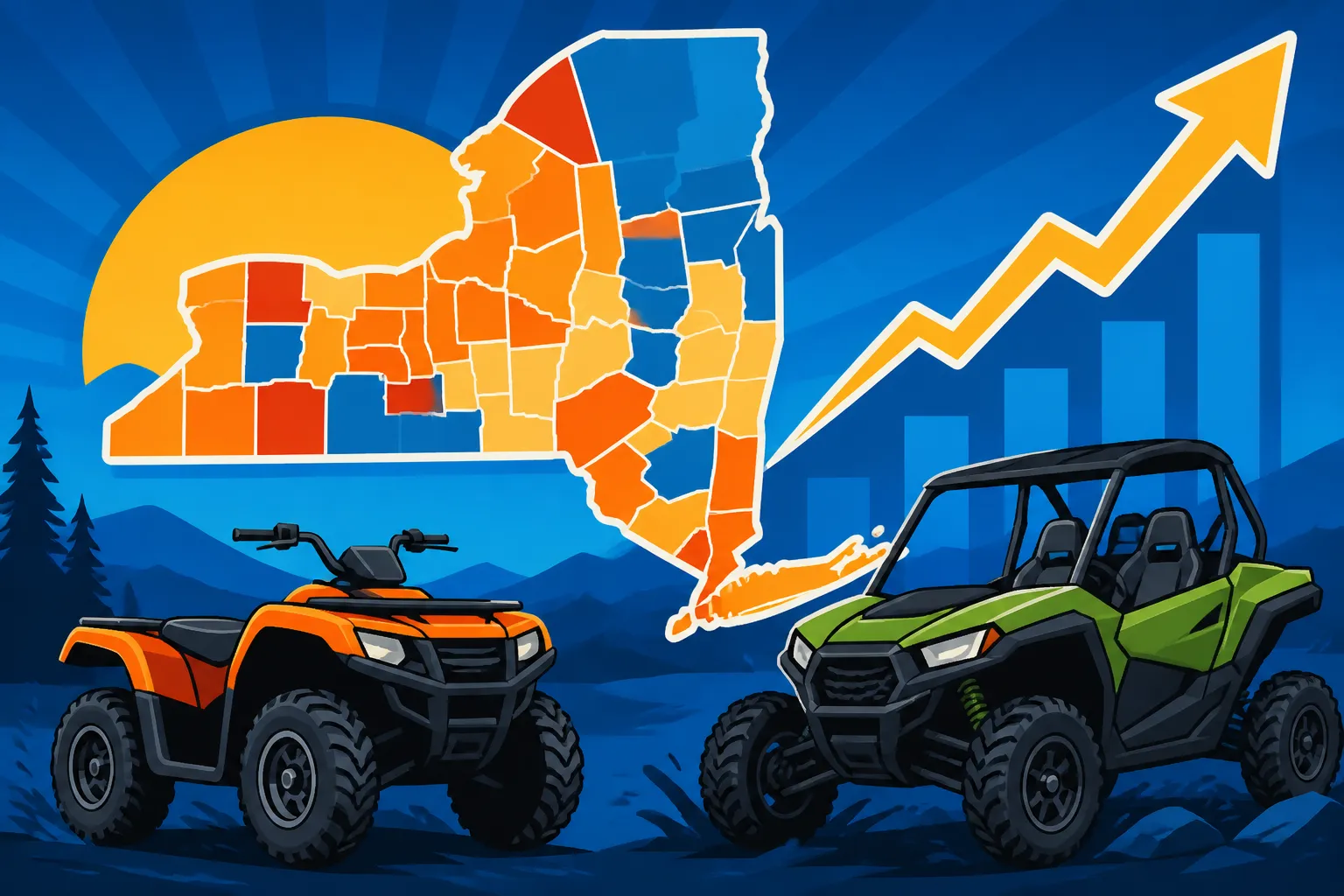
For a general overview of the state and local parts of the calculation, see New York ATV Sales Tax Rate. For a county-by-county perspective, New York ATV Sales Tax by County can help you frame the question, but always confirm the rate for the actual transaction rather than relying on a general comparison.
The showroom county is not always the deciding factor
A common assumption is that the tax rate is automatically set by the county where the dealer is located. That is not a safe assumption for every transaction. The local rate can depend on how the ATV is sold and where the buyer lives or registers it. A dealer may also deliver the machine rather than hand it over at the showroom.
When you get a quote, ask the dealer which location was used to determine the local rate and why. Give the dealer your correct address and explain whether you will collect the machine or have it delivered. If the quote is based on a different location, ask the dealer to identify the rule or official calculation used.
The broader point behind Why Your County Sets the Real Rate is that the buyer’s jurisdiction can matter more than the dealer’s street address. Treat the showroom location as one detail to check, not as proof that the right rate has been used.
Local tax can include more than a county rate
People often call the local part “county tax,” but the total local rate may include more than a county levy. Depending on the location, city or special district taxes may also be relevant. The combined state-and-local rate is what affects the sales tax line on your purchase documents.
That distinction matters if you live in a city, near a county boundary or in an area with a special tax district. A neighbor in the same county could have a different applicable local rate because their address falls in a different local jurisdiction.
For a reliable answer, check the current rate using the New York State Department of Taxation and Finance’s official sales tax information or ask the dealer to show how it determined the rate. If the dealer’s figure differs from a rate you found online, confirm that both calculations use the same address and the same type of transaction.
How to estimate the tax before you sign
A useful first estimate starts with the taxable amount, not just the advertised price. The basic calculation is:
Taxable amount × combined state and local sales tax rate = estimated sales tax
The taxable amount is often the machine’s purchase price, adjusted for any eligible trade-in credit and any other items that tax rules treat as part of the sale. The exact treatment of extras can depend on what they are and how they appear on the invoice, so ask for an itemized quote rather than assuming every line is handled alike.
For a simple illustration, imagine a taxable purchase amount of $10,000 and a hypothetical local rate of 4%. Adding that hypothetical local rate to the 4% statewide component gives a combined rate of 8%. The estimated tax would be $800. This is a made-up example for showing the arithmetic, not a rate for any particular New York county or city.
The formula is straightforward; choosing the right local rate and taxable amount is where mistakes or misunderstandings can arise. You can use New York Sales Tax on an ATV Purchase as a companion topic when comparing the purchase tax with the rest of the transaction.
Ask for the tax calculation in writing
Before paying a deposit or signing a purchase agreement, ask for a written, itemized quote. It should make clear:
- The machine’s selling price
- Any trade-in allowance
- Any separately listed accessories, setup or delivery charges
- The local jurisdiction or address used for the tax calculation
- The combined rate and the sales tax amount
- Other charges, such as registration or dealer fees
The quote lets you check the math and ask about a specific line instead of trying to interpret a single “out-the-door” figure. If the tax rate is shown without the location used, ask the dealer to add that information.
Also check whether the quote assumes a trade-in. A tax estimate that includes a trade-in allowance may be lower than the tax on the same machine bought without one. If you later decide to sell your old quad privately instead, the tax calculation may change.
Keep tax separate from other ownership costs
Sales tax is only one part of the amount due at purchase. Registration, insurance, equipment, financing costs and trail access can add to the cost of owning and riding the machine, but they are not all the same kind of charge. A dealer’s out-the-door number can combine several items, making it hard to tell what is tax and what is not.
Review the quote line by line. Ask which items are taxes, which are government charges, and which are dealer or optional charges. A separate line does not automatically mean a fee is optional or tax-free; ask what it covers and how it is treated. For context on one common charge, see New York ATV Dealer Documentary Fee. If you are comparing a dealer quote with a private sale, New York Dealer Fees You Can Refuse may help you identify which questions to ask about dealer charges.
Do not assume the sales tax amount is wrong just because it is higher than a quick estimate. The estimate may use a different local rate or taxable amount. But do not accept an unexplained number either. Ask the dealer to show the figures used.
How the rate and taxable amount change in different purchases
The same ATV can produce different tax totals depending on the buyer’s location, the purchase structure and whether a trade-in is part of the deal. These scenarios are worth checking before you settle on a price.
| Purchase situation | What to check |
|---|---|
| Buying from a New York dealer | Ask which address or jurisdiction sets the local rate, and request the rate and tax amount on the quote. |
| Dealer delivers the ATV | Confirm how delivery location affects the local tax calculation for your transaction. |
| Collecting the ATV yourself | Ask whether the buyer’s address, collection location or another rule determines the local rate. |
| Trading in another machine | Check whether the trade-in allowance reduces the taxable amount and appears correctly on the paperwork. |
| Buying from a private seller | Confirm how and when sales or use tax must be reported and paid. |
| Buying outside New York | Ask how New York tax applies when the machine is brought into the state and whether tax paid elsewhere can be credited. |
Buying from a dealer in another county
A dealer may be across a county line and still sell to a buyer who lives elsewhere. Do not assume the dealer’s county rate automatically applies, and do not assume your home county rate applies without checking the transaction details. Ask the seller to explain how the sale is sourced for local tax purposes and which address was used.
This can be especially useful when comparing two dealers. A lower advertised price may not produce a lower total after local tax and other charges. Compare quotes using the same buyer address, the same delivery or pickup arrangement and the same assumptions about trade-ins and accessories.
If the quote changes when you provide your address or choose delivery, ask the dealer to show the revised calculation. The goal is not to pick whichever location gives the lower number. It is to make sure the tax is calculated under the correct rules.
Buying from a private seller
A private sale does not necessarily mean the purchase is free of New York sales tax. The buyer may need to report the transaction and pay the required tax as part of the registration process or through the applicable state procedure. Ask what proof of purchase and payment is needed before you hand over money.
Keep the bill of sale, payment records and any other documents that show what you paid. If the machine’s paperwork is incomplete, resolve the registration and ownership questions before buying; sales tax is only one part of making the machine usable. New York ATV Dealer Versus Private Sale covers other practical differences between those ways of buying.
A private seller usually cannot provide the same itemized dealer invoice as a dealership. That makes clear records even more important. Confirm the reported purchase amount and tax instructions with the New York State Department of Taxation and Finance or the relevant registration office rather than guessing at the process.
Buying outside New York or bringing a machine into the state
If you buy an ATV outside New York and bring it here, do not assume that paying tax to the seller ends every New York tax obligation. New York may require use tax when taxable property is brought into the state for use, depending on the transaction and tax already paid. The details can depend on where the purchase occurred, where the machine is used and what tax was collected.
Keep the out-of-state invoice and proof of any tax paid. Ask how New York treats that payment and whether it can be credited against tax due here. If no tax was collected, check the reporting and payment process before registering the ATV.
This is a good time to review New York ATV Sales Tax by County alongside the state’s current official guidance. A general county rate chart cannot answer every question about an out-of-state purchase, but it can help you understand the local-rate part once the correct jurisdiction has been determined.
Trade-ins, fees and common calculation errors
A trade-in can reduce the amount on which sales tax is calculated when it is accepted as part of the dealer transaction and qualifies under the applicable rules. For example, if the selling price is $10,000 and an eligible trade-in allowance is $2,000, the taxable amount may be calculated on $8,000 rather than the full $10,000. The local rate is then applied to the taxable amount.
The example is only an illustration. The dealer should show the sale price, trade-in allowance and taxable amount separately on the paperwork. For more detail, see New York ATV Trade-In Tax Credit and Taxing the Price Less the Trade in New York.
A private sale of your old machine is different from trading it in at the dealer. If you sell the old ATV to another person and then use the money toward a dealer purchase, do not assume the private sale reduces the taxable amount of the new ATV. Ask the dealer how the transaction is being documented and whether the trade-in treatment applies.
Common mistakes to avoid
Using the dealer’s county without checking the transaction. The showroom’s county may not be the only relevant location. Ask which address or jurisdiction determined the rate.
Using a rate from an old online discussion. Local sales tax rates can change. Confirm the current combined rate with an official source or have the dealer explain its calculation.
Applying the rate to the wrong amount. A trade-in, accessory, setup charge or other line may affect the taxable amount. Ask for the taxable subtotal and how it was calculated.
Treating every fee as sales tax. Registration charges, dealer fees, optional products and taxes are different things. Ask that each be identified separately.
Assuming an out-of-state tax payment settles the matter. Keep the receipt and confirm whether New York tax is still due or whether a credit applies.
Comparing quotes with different assumptions. Quotes are not directly comparable if one includes delivery, a trade-in or accessories and another does not. Ask each dealer to price the same machine and use the same assumptions.
Questions to ask the dealer
A brief conversation can clear up most uncertainty. Ask:
- What address or jurisdiction did you use to determine the local sales tax rate?
- What combined rate did you apply, and what is the taxable amount?
- Does this quote include delivery, accessories, setup or other charges?
- How is my trade-in reflected in the taxable amount?
- If I buy out of state or from a private seller, what tax steps should I confirm before registration?
- Can I get the full calculation on an itemized written quote?
If an answer is unclear, check the official state tax guidance rather than relying only on an informal estimate. For a wider look at purchase costs, New York ATV Sales Tax Rate is useful alongside New York ATV Dealer Documentary Fee and the itemized dealer quote.
Frequently Asked Questions
Does the county where the dealer is located set my ATV sales tax rate?
Not necessarily. The relevant local rate can depend on the buyer’s address, how the sale is completed and other transaction details. Ask the dealer which location it used and confirm the result with official state information.
Is New York’s 4% statewide rate the whole sales tax?
No. The 4% is the statewide component. Local taxes may be added, so the combined rate can be higher and can vary by jurisdiction.
Does a trade-in lower the sales tax?
An eligible trade-in accepted as part of a dealer transaction may reduce the taxable amount. Ask the dealer to show the allowance and revised taxable subtotal on the paperwork. Selling your old machine privately is not necessarily treated the same way.
Do I owe tax if I buy an ATV from a private seller?
A private sale may still create a New York sales or use tax obligation. Confirm how to report and pay it, and what documents you need, before registering the ATV.
Can I rely on a county tax chart I found online?
Use a chart as a starting point, not as final confirmation. Rates can change, and a chart may not account for a city, special district or the details of your purchase. Verify the current rate and applicable jurisdiction.
Disclaimer
This article is for general informational purposes only and does not constitute professional advice. Laws, prices and regulations vary by location and change over time. Consult a qualified professional for guidance on your specific situation.