New York’s 100-Foot Rule Near Homes at Night
There's nothing quite like the freedom of hitting the trails on your ATV, especially when the sun starts to dip below the horizon and the world gets that serene, quiet glow. But that peaceful night ride can quickly turn into a headache, not just for you but for your neighbors, if you're not careful about noise. This guide is all about navigating New York's specific rules concerning ATV noise near homes after dark, helping you enjoy your ride without disturbing the peace or landing yourself in trouble.
Understanding New York's 100-Foot Rule for Night Riding
New York State, like many places that embrace outdoor recreation, has a clear understanding that while ATVs are a blast, they can also be noisy. This is especially true when folks are trying to sleep or enjoy a quiet evening at home. That's where the "100-foot rule" comes into play, aiming to strike a balance between rider enjoyment and residential peace. It's not just a suggestion; it's a part of the law designed to keep communities harmonious.
What the Rule Actually Means for Riders
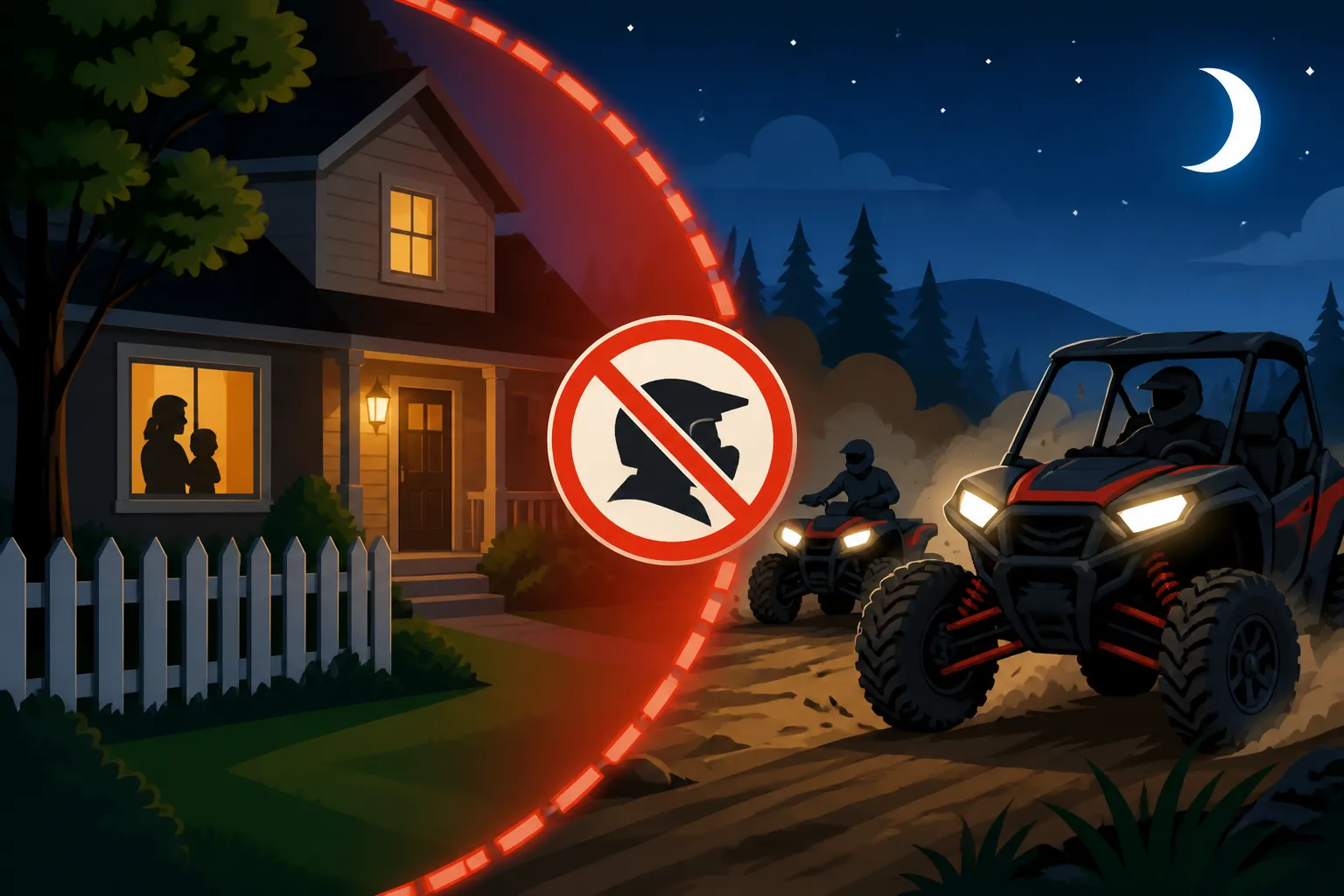
At its core, New York's 100-foot rule dictates that from one half-hour after sunset to one half-hour before sunrise, or any time between midnight and 6 AM (whichever is more restrictive), you cannot operate an ATV within 100 feet of a dwelling. This isn't just about avoiding direct noise; it's about minimizing the disturbance that your machine can create in residential areas during designated quiet hours. The rule applies whether you're on a public trail, private land, or even your own property. If your riding path brings you within that 100-foot radius of someone's home during these hours, you're breaking the rule.
Think about it this way: even if you're just putting your machine away after a long day of riding, if you have to drive it down a path that runs close to a neighbor's bedroom window at 11 PM, you could be in violation. It’s not just about speed or aggressive riding; the simple presence and operation of the machine within that specific distance and timeframe are what trigger the rule. It's a measure to prevent nuisance noise when people are generally trying to wind down or sleep.
Why This Rule Exists: Peace and Quiet
The reason for this rule is pretty straightforward: noise complaints. Imagine living next to an ATV trail or a large property where riders frequently operate late into the evening. The distinct sound of an ATV, especially under the still blanket of night, carries far and can easily disrupt sleep, startle pets, or simply shatter the tranquility of a quiet neighborhood. This rule is a direct response to the need to protect the peace and quiet of residents, ensuring they can enjoy their homes without constant disruption from recreational vehicle noise.
This isn't an arbitrary rule put in place to punish riders; it's a practical measure for community living. Landowners, local residents, and even people who enjoy ATVs but don't ride late into the night can appreciate the value of a peaceful evening. When riders consistently ignore these types of regulations, it often leads to stricter local ordinances, trail closures, and a general negative perception of ATV enthusiasts. The 100-foot rule is a preventative measure, hoping to foster good relationships between riders and non-riders by clearly defining acceptable boundaries for night operation.
Navigating the Rule on Different Types of Land
Understanding the 100-foot rule is one thing, but knowing how it applies when you're actually out riding can feel a bit more complex. Whether you're on your own sprawling acreage, navigating a designated club trail, or even just crossing a section of land that borders a residential area, the rule follows. It's less about the ownership of the land and more about the proximity to a dwelling.
Riding on Private Land You Own
Many ATV owners assume that if they're on their own private property, they're free to do as they please, any time of day or night. And while you certainly have more freedom on your own land, the 100-foot rule can still apply if your property borders residential areas. If your riding loop or even your driveway brings you within 100 feet of your neighbor's house, even if you're still on your side of the fence, you could be in violation during the restricted hours. It's a common misconception that property lines provide a shield against noise regulations, but the law considers the impact on the dwelling, not just the property boundary.
Consider a scenario where you have a large backyard that's perfect for a short loop. If one side of that loop runs within 75 feet of your next-door neighbor's house, and you're out riding at 1 AM, you're technically breaking the rule. Even if your machine is quiet, the law doesn't differentiate based on muffler type; it's about the proximity and time. This is also why [Riding Your Own Property Under New York Law] still requires you to be mindful of your neighbors. It's always a good idea to scout your private riding areas and identify any potential "hot zones" where you might come too close to a neighbor's home, especially if you plan to ride after dark. Communication with neighbors can also go a long way in preventing complaints, even if you stay just outside the 100-foot buffer.
Riding on Club Trails and Designated Areas
New York is fortunate to have some fantastic club trails and designated riding areas, like those found in Lewis County and on the Tug Hill Plateau. These trails often wind through diverse landscapes, sometimes passing near seasonal camps, scattered homes, or even small hamlets. For these trails, the 100-foot rule means clubs and trail administrators must carefully plan routes and designate specific hours of operation. You might find sections of a trail system that are completely closed to night riding because they inevitably come too close to a residence.
It's not uncommon for clubs to have agreements with landowners that explicitly limit riding hours, especially in sections that border homes. As a rider, it's your responsibility to be aware of these restrictions. Always check trail maps and signage for specific operating hours, and if a section of trail is marked "Day Use Only" or has specific quiet hours, assume it's because of rules like the 100-foot distance to dwellings. Ignoring these posted rules not only puts you at risk of a citation but also jeopardizes the landowner agreements that keep those trails open for everyone. Remember, a single complaint can lead to a landowner withdrawing permission, closing off a vital section of a trail network.
Consequences of Ignoring the 100-Foot Rule
Ignoring New York's 100-foot rule for ATV operation near homes at night isn't just a minor oversight; it can lead to tangible and often frustrating consequences. Many riders might not even be aware of the rule, or they might underestimate its importance, but the state takes these regulations seriously because they directly impact quality of life for residents.
Potential Fines and Legal Headaches
The immediate consequence of violating the 100-foot rule is often a monetary fine. Law enforcement, whether it's a local sheriff's deputy, state trooper, or environmental conservation officer, has the authority to issue tickets for such violations. The specific amount of the fine can vary, but it's never a trivial sum, and it’s certainly more than you'd want to spend on a peaceful night ride. These aren't just minor infractions; they're codified in the Vehicle and Traffic Law (VTL), and officers can, and do, enforce them. [New York Fines for an ATV Violation] can quickly add up, turning a fun outing into a costly mistake.
Beyond the initial fine, repeated violations or particularly egregious incidents could lead to more severe penalties. While unlikely for a first offense, persistent disregard for the law might even influence future permit applications or lead to other legal entanglements. Plus, a citation can be a significant hassle, requiring court appearances, time off work, and the general stress of dealing with the legal system. It's far easier, and cheaper, to simply be aware of the rule and plan your rides accordingly than to deal with the fallout of ignoring it. Consider what an officer checks when you're pulled over; your adherence to these rules is part of that assessment [What an Officer Checks Roadside].
The Impact on Community Relations and Trail Access
Perhaps even more significant than the direct legal consequences is the long-term impact on community relations and, ultimately, trail access for all riders. Every time an ATV rider violates the 100-foot rule, it generates a complaint. These complaints accumulate, fueling negative perceptions of ATV users in general. When enough residents are disturbed by nighttime noise, they often petition local governments to enact stricter ordinances, impose curfews, or even close entire sections of trails.
This isn't an abstract threat; it's a real and ongoing challenge for ATV clubs and advocates who work tirelessly to maintain and expand riding opportunities. [New York Rules for Riding Private Land] often depend on good faith agreements with landowners. A few inconsiderate riders can sour these relationships, leading landowners to revoke access and permanently shut down trails that have been open for years. It creates a ripple effect where the actions of a few individuals can severely restrict the enjoyment of many responsible riders. Maintaining good community relations by respecting rules like the 100-foot buffer is crucial for the future of ATV riding in New York.
Practical Tips for Respecting the Rule and Your Neighbors
As riders, we have a collective responsibility to be good stewards of the trails and good neighbors to those living near them. Adhering to the 100-foot rule and other noise regulations isn't just about avoiding fines; it's about preserving our access to the incredible riding New York has to offer. A little planning and thoughtful maintenance can go a long way.
Planning Your Night Rides Wisely
The best defense against violating the 100-foot rule is proactive planning. Before you even think about heading out after dark, take a moment to review your intended route on a map, or even better, scout it during daylight hours. Identify any dwellings that fall within that 100-foot buffer and plan your ride to avoid those areas during restricted nighttime hours. Sometimes, a small detour or a slight adjustment to your staging area can make all the difference. [New York Rules for Riding After Dark] extends beyond just lighting, emphasizing careful consideration for others.
Furthermore, remember that state law sets a minimum standard. Individual towns, villages, and counties in New York often have their own noise ordinances that can be even stricter than the state's 100-foot rule. Always check with local authorities or your specific trail club for any additional regulations. [Checking Your Town's ATV Ordinance Before You Ride] is a crucial step before any ride, especially if you're exploring a new area or riding close to populated zones. If in doubt, it's always safer to err on the side of caution and end your night ride earlier, well before the restricted hours begin. This not only keeps you compliant but also shows respect for the community.
Equipment and Maintenance Considerations
While the 100-foot rule focuses on distance and time, the actual noise output of your ATV is a major contributing factor to potential complaints. Maintaining your machine's exhaust system is paramount. A stock muffler in good condition is designed to meet specific noise standards, but over time, baffles can wear out, or damage can occur, making your machine significantly louder. Regularly inspect your muffler for leaks, cracks, or loose components. Replacing worn-out parts or upgrading to a quieter, aftermarket exhaust system (like those offered by SuperATV, which focuses on performance and sometimes offers quieter options) can drastically reduce your machine's noise signature. Just make sure any aftermarket parts you choose are legal and meet federal and state noise standards. [Mufflers Under the Federal Noise Standard] are an important aspect of keeping your machine compliant.
Beyond the muffler, consider your tires. Aggressive, knobby tires, while great for traction in mud and rocks, can produce a surprisingly loud hum on hard-packed surfaces or pavement, adding to the overall noise profile. While you might not change tires just for night riding, being aware of all sources of noise from your machine can help you make more informed choices. The goal is to be as quiet and respectful as possible, ensuring that your passion for riding doesn't come at the expense of your neighbors' peace. Regular maintenance ensures all [New York Equipment Requirements for ATVs] are met.
Broader New York Night Riding Regulations
The 100-foot rule is a significant piece of the puzzle when it comes to night riding, but it's by no means the only regulation you need to consider. New York State has a comprehensive set of laws designed to ensure safety and minimize disturbance during nighttime ATV operation. Being a responsible rider means understanding these broader rules as well.
Lighting Requirements for Riding After Dark
Operating an ATV after dark in New York comes with very specific lighting requirements. Your machine must be equipped with at least one headlight that emits a white light visible from a distance of 200 feet, and at least one taillight that emits a red light visible from 400 feet. These lights are not just for your visibility to others, but also for your own safety, allowing you to see obstacles, trail conditions, and other riders in front of you. [Headlight and Taillight After Sunset] are absolute necessities.
Riding without proper lighting is a serious safety hazard and a direct violation of state law. An officer stopping you on a trail after dark will undoubtedly check for these functioning lights. Beyond the legal requirement, consider adding auxiliary lighting if you frequently ride at night, especially in challenging terrain. Better visibility means a safer, more enjoyable ride for everyone. Just ensure any additional lights don't blind oncoming riders or operate in a way that creates a nuisance.
General Noise Ordinances Beyond the 100-Foot Rule
While the 100-foot rule is specific to ATVs near dwellings at night, it's important to remember that general noise ordinances can still apply. Many municipalities have bylaws that prohibit excessive or unreasonable noise at any time, but especially during late evening or early morning hours. This means that even if you're technically outside the 100-foot buffer from a dwelling, if your ATV is excessively loud, you could still be in violation of a local noise ordinance.
These general rules are often subjective, relying on an officer's judgment or a neighbor's complaint about "disturbing the peace." It reinforces the importance of keeping your machine well-maintained, as discussed earlier. A properly muffled ATV is less likely to draw complaints, regardless of distance. This is also a factor when considering [New York Rules for Riding Near an Ice Shanty], where noise can carry significantly across open, frozen water. Being mindful of these broader regulations and practicing common courtesy by keeping your machine as quiet as possible helps foster a positive image for all ATV enthusiasts and ensures that riding opportunities remain open.
| Rule Aspect | Daytime Riding (Sunrise to Sunset) | Nighttime Riding (Sunset to Sunrise) | Key Takeaway |
|---|---|---|---|
| 100-Foot Rule | No specific statewide rule based on distance to dwellings for noise, but general noise ordinances apply. | Cannot operate within 100 feet of a dwelling. Applies 1/2 hour after sunset to 1/2 hour before sunrise OR midnight to 6 AM (whichever is more restrictive). | Be extremely mindful of proximity to homes after dark. |
| Lighting | Not required. | Mandatory: At least one white headlight (200 ft visibility) and one red taillight (400 ft visibility). | Always check lights before a night ride. |
| Muffler/Noise | Required to have an adequate muffler meeting federal standards. | Same as daytime; however, noise is amplified at night and closer scrutiny applies due to the 100-foot rule. | Maintain muffler and consider quieter options for night. |
| Local Ordinances | Always check local town/county rules; can be stricter than state law. | Crucial to check local rules; many have stricter curfews or outright bans on night riding. | State law is the minimum; local laws can add more restrictions. |
| Impact | Less likely to cause direct noise complaints unless exceptionally loud. | High potential for noise complaints, fines, and negative community impact. | Proactive planning and neighborly respect are essential. |
Disclaimer
This article is for general informational purposes only and does not constitute professional advice. Laws, prices and regulations vary by location and change over time. Consult a qualified professional for guidance on your specific situation.