New York Riding in Spring Mud
A trail that felt firm in February can turn into a deep, soft rut after a few warm afternoons, especially when the ground below is still frozen. In New York, spring riding depends on local trail openings, landowner permission, and changing ground conditions. This guide explains how to check access, recognize risky mud, protect trails and machines, and decide when it’s better to wait.
Why New York trails get fragile in spring
Thawing ground is not the same as dry ground
Spring can be misleading. Snow may be gone from a trail, and the first stretch might feel solid under your tires, while the soil beneath it is still saturated from melting snow and seasonal thaw. Water has nowhere to go when the ground is frozen or already soaked, so a machine can press into the soft surface even when the trail looks rideable.
The problem often gets worse over a short distance. A sunny, exposed section may dry faster than a shaded hollow or a low spot that collects runoff. On trails around Tug Hill, for example, conditions can vary between open stretches and wooded areas. A route that was manageable on a dry, cool morning may become soft after several hours of sun, rain, or repeated traffic.
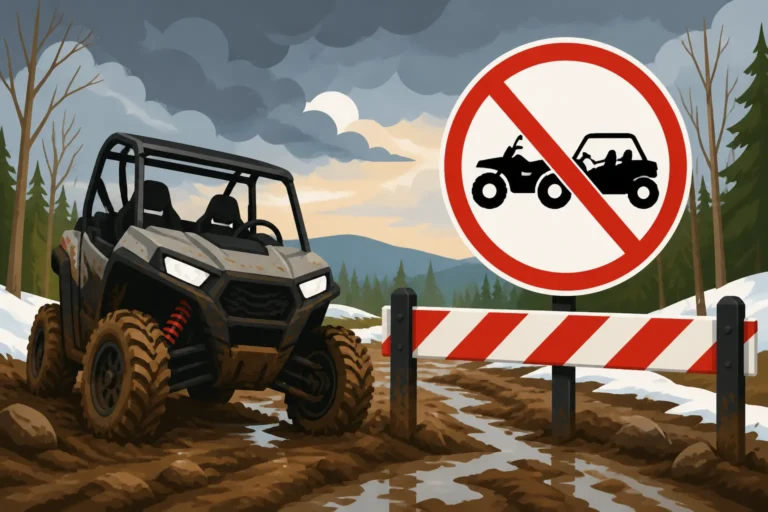
This is why spring trail closures are not just a scheduling inconvenience. A tire that sinks and spins can loosen soil, widen a rut, and push water into the damaged track. The next rider may have to go around it, creating a second path. What starts as one muddy patch can become a much wider and more difficult repair for trail volunteers.
Ruts and standing water are signs to slow down
A shallow wet spot is not automatically a reason to turn around, but deep, fresh ruts are a warning. If the ground gives way under light pressure, water is pooling across the route, or your tires are digging instead of rolling, continuing through can cause damage. Spinning the throttle to escape a rut usually makes it worse by loosening more soil and deepening the track.
The same goes for repeated attempts to bypass a muddy section. Riding around a puddle may seem like the gentler choice, but it can flatten plants and widen the trail corridor. Stay on the designated route, and do not create a new line through brush, a field, or the edge of a trail to avoid a soft spot. If the marked route is too wet to ride without digging in, turning back is often the least harmful option.
For a more detailed look at how thaw can damage a route, see [Spring Thaw and Rutted Trails]. The basic rule is simple: if the machine is leaving deep marks, throwing mud, or struggling to make steady progress, stop before the damage spreads.
A closure is a real limit, not a suggestion
New York does not have one spring opening date that applies to every ATV route. Access can depend on a county trail system, a riding club, a town, a private landowner, or another managing organization. One route may be open while a nearby trail remains closed. Even familiar routes around Lewis and Oswego counties can have different conditions and access rules.
A closure notice should be treated as a clear instruction not to ride that section. Riding around a gate, moving a barrier, or entering from a side road does not make a closed trail open. Closures may be in place to protect soft ground, allow repairs, respect a landowner’s agreement, or address another local concern. A machine crossing a closed section can put future access at risk for everyone.
Check [New York Trails Closed in Mud Season] and [Why Conditions Can Delay Opening Day] before planning a spring ride. Conditions can change after a map or calendar was last updated, so confirm the route’s status with the county, club, or trail manager responsible for it.
How to check whether a route is open
Start with the organization that manages the trail
Before loading the machine, identify who controls the route you want to ride. A county trail system may publish information through a county recreation or parks office, while a club trail may rely on updates from the club that maintains it. A landowner or municipality may also set access conditions. The closer the information comes to the organization responsible for the route, the more useful it is for making a decision.
Look for details that apply to the actual trail, not just the general riding area. A system may have an open section, a closed connector, and a trail that is temporarily unavailable because of soft ground. “The area is open” does not necessarily mean every segment is open. If the notice is unclear, contact the organization or club rather than assuming the route is available.
A useful starting point is [New York Trail Closures to Check First]. For planning, [New York Trail Maps From a County] can also help you understand the local network. Keep in mind that a map shows where a route is, not necessarily whether it is open today.
Use maps as a planning aid, not as permission
A digital mapping app can make it easier to plan a route, see connections, and avoid getting turned around. onX Offroad can be useful for reviewing mapped routes and organizing a ride, especially when you are unfamiliar with an area. Still, an app’s displayed route should not be treated as proof that a trail is open or that you have permission to ride it.
Before setting out, compare any app-based route with information from the local trail manager. Check that the trail is authorized for your type of machine, that it is open for the season, and that any required local permit or membership is in order. Trail access can change because of weather, maintenance, landowner decisions, or local rules, and a map may not reflect a recent change immediately.
It also helps to save the official information you find before leaving home. Mobile service can be limited in wooded or rural areas, including parts of Tug Hill. Keep an offline map if your mapping app offers that option, but carry enough information to identify the route and the relevant local contact without relying on a live connection.
Verify every section of a planned loop
A loop may cross more than one trail system or land-management area. One section can be open while the next is closed, and a route that looks continuous on a screen may include a connector that requires separate permission. Check each segment rather than treating the whole loop as a single trail.
Pay attention to gates, seasonal signs, and markers when you arrive. Do not assume that a gate left open means the trail is open to recreational riding; it may be open for maintenance, farming, or another authorized use. Likewise, a closure sign takes precedence over an older map or a route saved from a previous trip.
Use [Following County Trail Markers] as a reminder to stay on the marked route, and read [Landowner Agreements That Keep Trails Open] to understand why access can depend on respecting the conditions set for a particular property. When signs and online information appear to conflict, pause and confirm with the managing organization instead of guessing.
How to plan a safer spring ride
Choose a route that matches the conditions
When trails first begin to open, a shorter ride close to the staging area is usually easier to manage than a long route across several towns. If conditions deteriorate, you can turn around without having to navigate a distant section or rely on a long return through soft ground. A modest plan also gives you room to adjust if a road crossing, connector, or trail segment is closed.
Think about the machine and the route together. A heavy machine can sink more readily into soft ground, and a wider machine may not be permitted on a narrow trail. New York’s registration rules and the trail system’s access rules are separate questions, so check that your machine is eligible for the route as well as properly registered. For machines near the state’s width limit, see [New York Trails for a Narrow Machine] and [New York Rules for a Machine Over 70 Inches].
Keep the day’s weather and recent rainfall in mind. A route that drains well after a dry spell may behave differently after rain or rapid snowmelt. If the trail manager has not posted a clear update and the ground is visibly soft at the trailhead, a different outing may be the better choice.
Make a turnaround plan before you ride
Decide in advance what conditions will make you stop or turn back. For example, you might agree as a group to turn around if a tire begins sinking, the trail is badly rutted, a closure sign appears, or the route requires leaving the marked path. Setting those limits before anyone is stuck in a muddy section can prevent pressure to push ahead.
Ride with enough distance between machines to avoid bunching up in a soft area. If the first machine needs to stop, the following riders should have room to stop without sliding into the same rut. Keep speeds controlled and avoid abrupt acceleration, which can spin tires and throw soil. A steady pace and good judgment are more useful than trying to power through every obstacle.
Tell someone where you plan to ride and when you expect to return, particularly if you are heading into an area with limited cell service. Bring basic recovery and safety equipment appropriate to your machine and route, but do not use recovery gear as a reason to attempt a trail that is closed or too wet. If a group member becomes stuck, recover the machine without widening the trail or damaging nearby vegetation.
Use a quick pre-ride check
A simple check before leaving home can prevent a frustrating trip to a closed trailhead. Confirm the trail is open, check local permit or membership requirements, review the weather, and make sure every rider understands the planned route. If you are riding with children or new riders, choose a route that lets the group turn around easily and keep everyone together.
At the trailhead, look for current signs and observe the ground. A wet parking area does not always mean the whole route is impassable, but fresh deep tracks, standing water, or a posted closure deserve attention. If you cannot establish that the trail is open, do not ride in to find out. Ask the local manager or select another authorized route.
| Before you ride | What to check | Why it matters |
|---|---|---|
| Trail status | Current notice from the county, club, or manager | Spring access can change by route |
| Local requirements | Permit, membership, registration, and applicable equipment rules | Access rules may differ among systems |
| Weather and ground | Recent rain, thaw, standing water, and visible ruts | Soft ground can be damaged quickly |
| Route | Open segments, connectors, and return options | A loop may include a closed section |
| Group plan | Turnaround conditions and emergency contact | Helps riders make a calm decision when conditions worsen |
Riding responsibly when a trail is open
Stay on the authorized line
An open trail is not an invitation to ride wherever the ground looks firm. Stay within the marked route and respect signs, gates, and property boundaries. Going around a wet patch can cut into vegetation or private land, while widening the route can make it harder for the trail organization to maintain a clear, durable corridor.
If you encounter a closure or a section that is too soft, turn around rather than searching for an unmarked bypass. Do not follow tracks into woods or fields simply because another rider has gone that way. Those tracks may be unauthorized, may cross private property, or may lead to a route that is closed for a reason.
Avoid riding through a wet section at speed. Fast, forceful riding can throw mud and deepen ruts, and it makes it harder to respond to an unexpected washout or obstacle. If a route is open but a particular spot is deteriorating, leave it as you found it if you can do so without causing further damage, and report the problem to the managing organization.
Give space to trail work and other users
Spring is often a busy period for people checking routes, clearing debris, and repairing winter damage. Slow down when you approach workers, parked equipment, or a maintenance crew. Follow any temporary directions and do not move barriers or pass through an area that has been closed for work.
Some routes share space with landowners or other permitted users. A farm lane may serve working property, and a trail agreement may depend on riders leaving gates and access points as instructed. Keep noise and speed under control near homes and farm operations, and never assume that a visible trail crossing means you can travel beyond the marked route.
Trail organizations and local riders can lose access when users ignore signs or damage soft ground. Respecting closures protects more than the trail surface: it helps maintain the relationships that allow a route to remain available. For practical riding reminders, [New York Trail Etiquette With Landowners] is a useful companion read.
Clean and inspect the machine afterward
Mud can hide damage. After a ride, look over the tires, wheels, skid plates, guards, and underside of the machine. Remove packed material that could hold moisture or interfere with moving parts, and check for branches, stones, or other debris caught around the wheels or suspension. If the machine has been through water or heavy mud, follow its owner’s manual for cleaning and inspection guidance.
Be thoughtful about where you wash it. Do not send muddy runoff into a storm drain, stream, wetland, or neighboring property. A controlled wash area and appropriate disposal practices help keep sediment and contaminants out of local waterways. Clean the machine before moving to a different riding area when practical, so you do not carry mud, seeds, or debris with you.
For a more detailed cleanup checklist, see [Washing a Machine After a Muddy Loop]. If a spring ride leaves deep ruts or damages a marked section, let the local club or trail manager know where it happened. A clear report can help the people responsible for the route assess whether it needs repair or a temporary closure.
When waiting is the better riding decision
Recognize when conditions are beyond a quick adjustment
A trail that is merely damp may still support careful riding if it is officially open and the ground remains firm. A trail that is saturated, deeply rutted, or actively collecting water is different. If the machine’s tires are sinking, the route is being churned up, or riders are repeatedly getting stuck, continuing is likely to worsen the damage and make recovery harder.
Do not let the effort of getting to the trailhead dictate your choice. It is frustrating to tow a machine across New York, arrive ready for a ride, and find a closure or poor conditions. But the fuel, time, and planning already invested do not make a closed trail available. Turning around can be disappointing; repairing a damaged route or losing access to it can affect an entire riding season.
If you are uncertain, ask the local trail organization and be specific about the route and the conditions you see. A general question such as “Is Tug Hill open?” may not be enough if different sections are managed separately. Ask whether your intended trail is open to your machine and whether recent rain or thaw has changed access.
Keep a backup plan
A spring ride does not have to depend on pushing through a questionable trail. Before leaving, identify an alternative activity or a different authorized area, and check its access separately. If no suitable route is open, postpone the ride and use the day to inspect equipment, review maps, or prepare for later in the season.
When checking alternatives, avoid assuming that private land, town roads, farm lanes, or public land are automatically open to ATVs. Access depends on the rules for that location, the landowner’s consent where applicable, and the type of route. Never use an unmarked path as a substitute for a closed trail.
New York’s spring riding season can be uneven: one weekend may bring firm ground in one place and saturated trails a short drive away. Treat every route as its own decision. Confirm access, ride only where permitted, and turn around when the ground cannot support your machine without damage. That approach helps protect the trails—and the landowner relationships—that make future rides possible.
Disclaimer
This article is for general informational purposes only and does not constitute professional advice. Laws, prices and regulations vary by location and change over time. Consult a qualified professional for guidance on your specific situation.