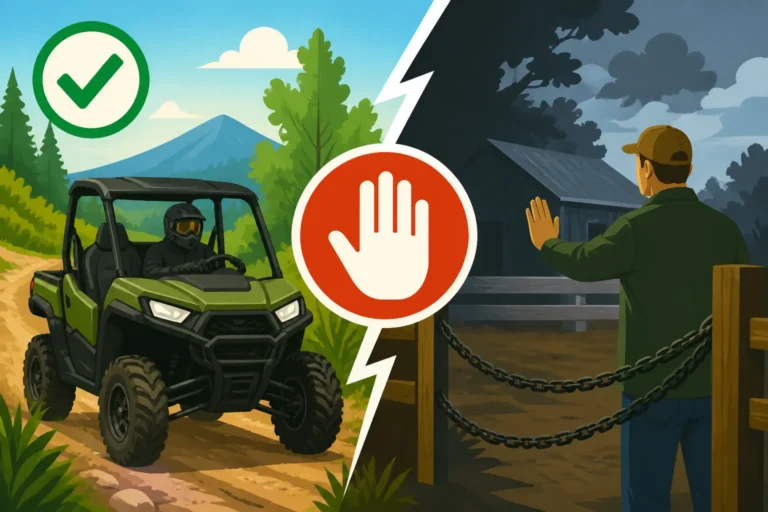
Day Passes Sold Only in September
A September-only ATV day pass can derail a New York riding trip if you assume you can buy one at the trailhead in July or October. The key is understanding that a day pass is a local trail-access product, not a statewide permit. This guide explains what to check, how to plan around the limited sales window, and what you still need before unloading your machine.
What a September-only day pass means
A local access option, not a statewide ATV pass
New York does not have one universal trail pass that automatically opens every riding area. Trail access can depend on who manages the route, whether a club or county system requires a permit, and what agreements are in place with the landowners. A day pass advertised for September therefore applies to the specific system that offers it, under that system’s rules. It does not grant permission to ride elsewhere in Oswego County or across the state.
That distinction matters when you are planning a trip around Central Square, Sandy Pond, or other parts of Oswego County. Nearby routes may be connected in a rider’s mind but governed by different clubs, landowners, or permit arrangements. Before traveling, identify the exact trail system and confirm that the pass you intend to buy covers the route you plan to ride. [New York's 100 Miles of New York Trail] gives broader context on Oswego County riding, but the local pass rules still need to be checked for your chosen system.
A day pass is also different from machine registration, insurance, and a county or club permit. Those requirements do not disappear just because you are buying temporary trail access. A registered machine may still need the appropriate local permit to use a particular network, while a trail pass by itself does not make an unregistered or uninsured machine compliant with New York requirements. For the basics of trail access beyond one county, see [New York ATV Trail Permits Explained].
The sales month may be narrower than the riding season
“Sold only in September” describes when an eligible rider can buy the pass, not necessarily when the pass can be used. Those are separate details. A pass might be valid for a defined date or period, or it may follow conditions set by the organization selling it. Don’t infer its validity from the sales month alone; confirm the start date, end date, permitted riding days, and any other restrictions before paying.
This can catch people who already have a weekend on the calendar. They may assume a day pass will be available when they arrive in August, or expect to purchase one at a local gas station, staging area, or trailhead. If the sales window really is limited to September, those assumptions could leave the whole group without authorized access. Ask the trail manager whether passes must be purchased in advance, whether sales are online or in person, and whether there is a designated pickup location.
It is equally important not to treat an old social post or a previous season’s announcement as confirmation of the next sales window. Local access arrangements can change as landowner agreements, trail conditions, and club operations change. Check the current notice from the organization responsible for the trails before making a nonrefundable booking or towing your machine across the state. [When New York Trail Permits Go On Sale] explains why permit timing is worth checking before the trip rather than after you arrive.
How to plan around the September sales window
Confirm the details before booking your ride
Start by identifying the specific network you want to ride, not simply searching for “Oswego County ATV trails.” Find the club, county office, or trail organization responsible for the route and ask where the September-only day pass applies. If several organizations operate nearby trails, ask them to distinguish their boundaries. A pass for one system may not cover an adjoining route, even if the trail appears continuous on a map.
Then confirm the purchase process in plain terms. Ask when sales open and close, whether the pass is for one rider or one machine, what information you need to provide, and whether the permit must be displayed on the machine. If you plan to ride with friends, make sure every rider understands whether each person needs a pass or whether a pass is associated with each vehicle. Never assume that one person’s purchase covers the whole group.
Write down the answer and save the announcement or receipt where you can find it on ride day. A practical planning note might read: “Which system? What dates is the pass valid? Where do I buy it? What does it cover? What other documents must I carry?” Those questions help avoid a familiar travel-day scramble: everyone is dressed, the trailer is unloaded, and then someone realizes that the access pass was available only through a different club or during a different period.
Build a backup plan if you miss the window
If September has passed, don’t assume that a pass can be bought late, transferred, or replaced with a different permit. Contact the trail operator and ask whether any lawful option remains for the dates you want. If there is no available access product, choose another riding area whose rules you have confirmed rather than trying to enter through a side road or following another group onto the trail.
A backup can mean moving the trip to a system with a different access process, postponing the ride until the next opportunity, or choosing a private park where access is arranged directly with the operator. Each option has its own rules, so verify the exact riding area, machine requirements, and opening conditions before you travel. New York's County Trail Systems Compared can help you think about the differences between local networks, while [New York Pay-to-Ride Parks] points to another category of riding area to investigate.
Mapping tools can help you understand distances and organize a route, but they cannot tell you that you have permission to ride a particular trail. onX Offroad can be useful for reviewing a route and saving navigation information before you leave, especially when phone coverage is unreliable. Treat any map as a planning aid, not as proof that a trail is open or included in your pass. Confirm access with the organization that manages the route.
| Detail to confirm | Why it matters | What to ask |
|---|---|---|
| Trail system covered | Nearby routes may have separate managers or access rules | Which named trails or areas does this pass cover? |
| Sales dates | The pass may not be available at the trailhead or outside September | What are the exact purchase dates and sales channels? |
| Validity dates | Sales month and riding dates are not necessarily the same | What dates can I ride with this pass? |
| Rider or machine coverage | A pass may apply to a person, machine, or defined group | Does each rider or vehicle need a separate pass? |
| Display instructions | The pass may need to be visible or carried | Where should it go, and what proof should I carry? |
| Other requirements | A trail pass does not replace registration or insurance | What documents must I have with me while riding? |
| Trail status | A permitted route may still be closed because of conditions or landowner needs | Are the trails open on my planned date? |
What a day pass does not replace
Registration, insurance, and machine eligibility
A local day pass is about access to a particular trail system. It is not a substitute for state registration or any insurance requirement that applies to your ride. Before leaving home, make sure the machine is registered as required and that you can show the relevant paperwork. Visitors should not assume that an out-of-state plate or policy makes every New York requirement irrelevant. Review [New York ATV Reciprocity With Other States] if you are bringing a machine from outside New York.
Machine eligibility can matter too. Some New York registration rules distinguish between traditional ATVs and larger side-by-sides, and not every machine that can be driven on private property qualifies for registration as an ATV. Before buying a trail pass for a wide or heavy UTV, verify that the machine is eligible for the registration and trail use you have in mind. A pass seller may not be responsible for determining whether your machine meets state requirements. See Can You Register a Side-by-Side in New York? for that separate issue.
Insurance and documentation are easy to overlook when the trip is mostly about trails. Keep proof accessible, not buried beneath gear in the trailer. If someone else is bringing the machine, ask them to check their own registration and coverage rather than relying on the group organizer to sort it out at the staging area. A day pass can authorize local trail access, but it cannot cure a missing document or make an otherwise ineligible machine legal to ride.
Trail access does not mean permission to ride anywhere nearby
A pass should never be treated as permission to leave the marked route. Local trail systems may cross private land under specific agreements, and that permission can be limited to marked corridors, certain dates, and particular uses. Riding around a closed gate, cutting across a field, or following an unmarked shortcut can jeopardize access for everyone if it violates the landowner’s agreement.
Pay attention to signs and temporary closures, even if your map shows a route. Trails can close because of weather, maintenance, logging, landowner requests, or other local conditions. A route that was open during a previous visit may not be open during your next one. Check the trail manager’s latest updates and obey posted directions on the ground. If a connection is closed, turn back rather than trying to create a detour through private land.
Route information from onX Offroad or another mapping app can help you prepare, but the app should not overrule trail signs, club notices, or direct instructions from a land manager. Save the contact details for the organization that issued your pass. If you encounter a confusing closure or a boundary question, stop and ask before continuing. This is especially helpful when a trail crosses several parcels or the route’s markings become hard to follow.
Making a September ride go smoothly
Check conditions and access again close to departure
Once you have confirmed the pass and your paperwork, check trail status again shortly before leaving. A permit purchase does not guarantee that every trail will be open on your chosen day. Heavy rain, soft ground, maintenance work, or a landowner’s request may change which routes are available. If you are traveling from another part of New York, that last check can save hours of towing toward a closed system.
Ask about staging locations, parking, and any check-in process. A pass may need to be collected before you reach the trailhead, or the organization may direct riders to a particular lot. Confirm whether trailers can be left there and whether overnight parking is permitted. Don’t block farm access, private drives, or gates while looking for a place to unload. In rural areas, a driveway that looks unused may still be a working entrance.
Bring the items you may need to show: pass or receipt, registration, and proof of insurance as applicable. Keep them in a secure, easy-to-reach place, and make sure every rider knows where they are. If your group is split between vehicles, share the trail manager’s contact information and the location of the staging area. A saved map can help with navigation, but a clear plan for where to meet is useful if phones lose signal.
Ride in a way that protects local access
A September pass may be a small part of a larger effort to keep local trails available. Respect the route markers, stay on the authorized trail, and give farm equipment and other trail users room. If the route crosses a working farm, expect machinery, livestock, gates, and changing conditions. Close gates only as instructed, and never assume that a quiet field is an unused riding area.
Keep noise and speed under control near homes, businesses, and trail entrances. Avoid spinning tires in soft ground or creating a new path around a muddy section. Those shortcuts can damage the trail and make landowners less willing to keep routes open. If a section appears unsafe or badly damaged, turn around and report it to the trail organization instead of trying to force your way through.
Group leaders can set expectations before the first machine starts. Tell everyone which trails are included, where the group will stop, and what to do if someone gets separated. Make it clear that the pass does not authorize riding outside the signed network. Local groups and volunteer organizations often do the work that keeps routes usable, so following their rules is part of being a responsible visitor. For more on how those efforts support the network, see Volunteer Clubs That Cut Oswego Trail.
Avoiding common day-pass mistakes
Don’t confuse a September purchase with September-only riding
The phrase can be easy to misread. A pass sold only in September is not automatically valid for the whole month, nor does the wording necessarily mean that riding is limited to September. The sales period, the pass’s validity period, and the trail system’s operating season are three different things. Ask the organization to spell out each one before you plan around it.
Likewise, don’t assume that buying a pass in September means you can use it on any date later in the season. It may cover a specific day, a defined period, or a particular access arrangement. If you are planning a weekend with several machines, confirm the dates and coverage for each pass. Keep a record of the exact terms provided by the seller, especially if the purchase is made in person and the rules are explained verbally.
If the trail operator’s wording is unclear, ask a direct question: “If I purchase this in September, which exact dates can I ride, and which trails are included?” That is more useful than relying on a headline or a secondhand description. Clear answers protect you from arriving with a valid purchase that does not match your intended riding day.
Don’t assume the trailhead is a sales counter
Some riders plan to settle every detail after unloading. That is risky when pass sales are limited to a particular month or handled through a specific organization. A staging lot may be an access point, not a place to buy permits. A nearby store may sell passes for another system, or may not carry them at all. Confirm the authorized seller and purchase method before you leave.
Also avoid treating an online map, an old club post, or a friend’s previous trip as the final word. Maps help you understand where trails appear to run; they do not establish current permission. A friend may have ridden under a different pass, during a different season, or through an arrangement that is no longer in effect. Use onX Offroad or another navigation tool to prepare your route, then verify access with the trail manager.
When the pass is unavailable, don’t ride first and hope to explain later. Unauthorized access can create problems for you and for the landowners and volunteers who help maintain the system. Ask about a permitted alternative, or choose another destination with rules that fit your dates. A little checking before the drive is much easier than discovering at the trail entrance that the trip cannot go ahead.
Disclaimer
This article is for general informational purposes only and does not constitute professional advice. Laws, prices and regulations vary by location and change over time. Consult a qualified professional for guidance on your specific situation.