New York Riding in Summer
A summer ride in New York can turn frustrating fast when a trail is muddy, a gate is closed, or a machine does not meet the route’s requirements. This guide explains how to plan a legal, comfortable ATV ride, choose an appropriate riding area, prepare for summer conditions, and check the rules before unloading your machine.
Choose a riding area that matches your plans
New York does not have one statewide network of ATV trails that you can simply ride from county to county. Access depends on the landowner, local trail agreements, posted routes, and any county or club permit requirements. That means the best destination for a summer weekend is not necessarily the closest one; it is the place where your machine is allowed and the route is open.
Compare county trails and private riding areas
Lewis County and Tug Hill are well-known places to begin researching a northern New York ride. The broader region includes trail routes that may pass through private land under agreements, so a line on a map does not automatically mean you have permission to ride it. Check the county or trail organization’s current map and notices before setting out, and follow posted closures even if a route appeared open when you planned your trip.
Oswego County also has club and county trail options, while Tall Pines ATV Park near Andover offers a different kind of experience on a private riding property. The distinction matters: a private park may have its own admission, operating rules, staging arrangements, and trail layout, while a county or club system may require a local permit or membership. Neither kind of access should be assumed to include every nearby road or trail.
| Riding option | What to check before leaving home | Often a good fit for |
|---|---|---|
| County or club trail system | Trail openings, permit rules, club access, staging locations, and route restrictions | Riders planning a longer route or weekend trip |
| Private ATV park | Admission and operating rules, hours, machine restrictions, and available facilities | Riders who want a managed riding area |
| Private land with permission | Clear permission from the owner and any conditions they set | A local ride on land you are specifically allowed to use |
| Public road or public land route | Whether that exact road or route is legally designated and open to ATVs | Short, permitted connections rather than general roaming |
For a first visit, identify a specific starting point rather than relying on a vague destination such as “Tug Hill.” Check how you will reach the staging area, where a trailer can be parked, and whether fuel or other services are nearby. A route can be open while its usual parking area is full, restricted, or temporarily unavailable. For broader planning, see [New York's County Trail Systems Compared] and [Best Places to Ride an ATV in New York].
Confirm access instead of trusting a map alone
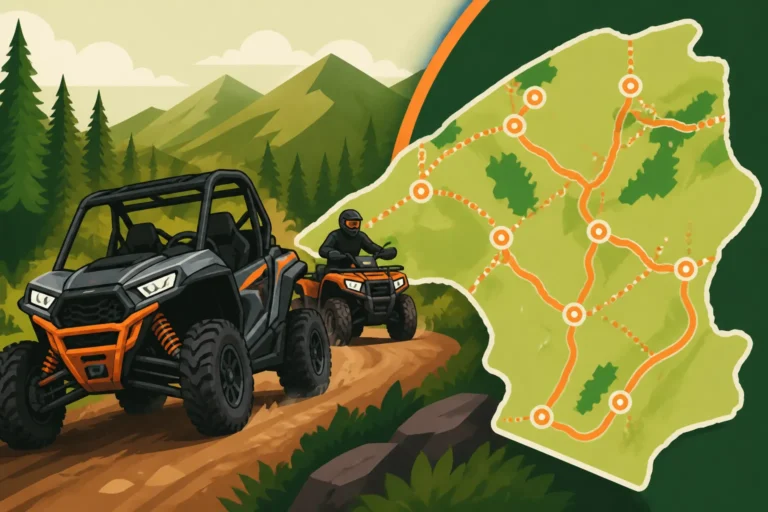
Mapping apps can help you understand the shape of an area, but they cannot replace current local access information. A trail line may cross private property, follow a corridor that is closed to ATVs, or reflect an old route that has since changed. Tools such as onX Offroad can be useful for organizing a trip and reviewing mapped terrain, but treat the map as a planning aid—not permission to ride.
Before you load up, compare your route with the county’s or trail organization’s official information. Look for notices about seasonal openings, construction, landowner disputes, logging, washouts, or weather closures. If a map and a sign disagree, follow the sign and the current direction from the organization responsible for the route. When you are uncertain whether an unfamiliar spur is open, turn around rather than treating silence on the map as approval.
It is also worth checking where a route ends. A trail connection does not automatically permit you to continue along a town road, cross a field, or enter state land. Private land access depends on permission, and access can change when a landowner closes a route or an agreement ends. [New York Trail Maps From a County] and [New York Trail Conditions Before You Ride] are useful topics to review before choosing a route.
Prepare for summer trail conditions
Summer gives riders longer daylight and warmer temperatures, but it does not guarantee dry, easy trails. A rainy week can leave low spots soft, while a hot stretch can mean dust, dehydration, and heat stress. In parts of northern New York, a route can change noticeably after a storm or a stretch of heavy use.
Check weather, closures, and ground conditions
Look beyond the forecast for your departure town. A ride around the Tug Hill Plateau, for example, may encounter different weather and ground conditions from a staging area farther south. Rain earlier in the week can leave standing water or soft trail edges even when the day you ride is sunny. In summer, thunderstorm forecasts deserve particular attention: exposed trail sections and open fields are poor places to wait out lightning.
Check for closures close to departure and again before entering the riding area. Trail operators may temporarily close a section because of damage, landowner concerns, maintenance, or conditions that make continued use harmful. Avoid creating new routes around a closure. Cutting around a gate can widen damage, disturb adjoining property, and jeopardize access for everyone who follows.
If a route is unusually wet, consider postponing the ride or choosing a permitted alternative. Spinning tires through a soft section can deepen ruts and make the trail harder to maintain. A ride that feels disappointing to cancel is still better than turning one muddy stretch into damage that contributes to a longer closure. For seasonal planning, consult [New York Riding Seasons and Trail Openings] and [New York Trails Closed by Weather].
Plan for heat, bugs, and changing daylight
Carry more drinking water than you expect to need, and take regular breaks in shade when possible. Heat can sneak up on riders who are focused on navigating a long loop, especially when wearing a helmet and protective gear. If someone in the group becomes unusually tired, dizzy, nauseated, confused, or develops a severe headache, stop riding and take the symptoms seriously. Do not assume that pushing on to the next trailhead is the safest choice.
Insect protection can make a summer ride far more comfortable. Northern New York’s woods can have black flies earlier in the warm season and ticks in grassy or brushy areas. Use clothing that covers exposed skin where practical, follow product directions for any repellent, and do a tick check after the ride. A light-colored long-sleeved layer may feel counterintuitive on a warm day, but it can reduce direct sun and help protect against brush and insects.
Daylight lasts longer in summer, but riders still get delayed. A mechanical issue, a wrong turn, or a slow group can turn a relaxed afternoon into a ride near dusk. Set a turnaround time, not just a planned destination, and make sure your group has working lights for emergencies. Do not count on cell service throughout a rural trail system; download or save useful route information in advance. [Black Flies in a Northern June] and [Deer Ticks on a Summer Ride] cover two seasonal nuisances worth preparing for.
Make sure your machine and paperwork are ready
A machine that runs well at home is not automatically ready for a full day on unfamiliar trails. Before leaving, check its tires, brakes, lights, fuel, and any cargo or tow equipment you plan to use. Also confirm that the machine is eligible for the type of riding you intend to do. In New York, registration rules can be especially important for UTV and side-by-side owners.
Check machine eligibility before planning a route
Do not assume that every ATV-style vehicle or side-by-side can be registered as an ATV in New York. Width and weight limits can affect whether a machine qualifies, and a trail system may have additional restrictions of its own. This is a frustrating issue to discover after buying a machine or driving several hours to a trailhead, so check the applicable state requirements and local route rules before making plans.
A machine’s brand name or “off-road” label does not by itself establish that it is legal on a particular New York route. Measure and verify the machine using the relevant rules, and do not rely only on a dealer’s general statement that it is suitable for trail riding. Start with [Why Most Side-by-Sides Cannot Be Registered in New York] and [New York's 70-Inch Width Limit] if you ride a UTV or a wide ATV.
If you own a machine that cannot be registered for the intended use, riding it only on land where you have permission may still be an option, depending on the circumstances and applicable rules. That is not the same as having access to public roads or an organized trail network. Sort out that distinction before traveling; a private property ride and a county trail ride are different plans with different access conditions.
Review registration, insurance, and required equipment
Confirm that the registration is valid and that the plate and required decal are present and readable. Carry the paperwork you may need to show during a stop, and make sure the registration details match the machine. An out-of-state registration should not be treated as a blanket exemption from New York’s requirements. Visitors should review [New York ATV Reciprocity With Other States] and confirm what applies to their situation.
New York requires ATV liability insurance in circumstances where the law applies, and visitors should not assume that an existing policy automatically satisfies the state’s requirements. Ask your insurer whether the policy covers the machine and the planned riding activity, and carry proof of coverage. The rules can apply even when the ride is on a trail rather than a public road. Review [New York's Mandatory ATV Insurance] before the trip.
Do a basic pre-ride inspection: check tire condition and pressure, brakes, throttle return, steering, lights, and visible fluid leaks. Secure racks and cargo so nothing can shift into a wheel or fall onto the trail. Bring a small repair kit suited to your machine, along with a charged phone, a first-aid kit, and any essential medication. For equipment and rider rules, consult [New York ATV Equipment Requirements] and the trail operator’s own guidance.
Ride with respect for landowners and other trail users
Many New York trails depend on private landowners who allow a route to cross their property. A single rider ignoring a gate or creating a new path can put an entire section of trail at risk. Good trail etiquette is not just about being considerate; it helps preserve the agreements that make riding possible.
Follow signs, gates, and posted directions
Stay on the marked route and respect signs even when the closed section looks passable. Do not ride around a gate, through a field, or onto a logging road unless that route is explicitly open to your machine. Avoid widening a trail to get around mud or obstacles. If conditions are poor, turn around or use a route that is officially open.
Be especially careful where trails pass near farms or active work areas. A marked route may cross land used for crops, livestock, forestry, or equipment access. Keep speed controlled, leave gates as you find them, and do not stop where you block a driveway or working route. If you encounter a landowner or worker, a courteous greeting and a willingness to follow directions go a long way.
Noise and dust can affect nearby residents and other trail users, particularly during a dry summer. Ease off the throttle near homes, trailheads, and places where people may be walking or working. Pack out all trash, including small items that are easy to overlook, such as drink caps and broken tie-downs. [New York ATV Trail Etiquette With Landowners] and [Landowner Agreements That Keep Trails Open] offer more context on why these everyday choices matter.
Share the trail and keep the group manageable
Expect to meet other riders, hikers, maintenance crews, or vehicles on routes where those uses are permitted. Slow down when visibility is limited and approach blind corners cautiously. Give people space, avoid spraying dust or mud, and follow local instructions for passing. A group should ride at a pace that works for its least experienced member rather than letting faster riders disappear ahead.
Before starting, agree on a simple group plan. Choose a lead rider who knows the route and a sweep rider who stays behind the group. Pick regrouping points, make sure everyone understands the route, and decide what to do if someone has a breakdown or loses sight of the others. On a long day, a short check-in at each stop can prevent small problems from becoming stressful.
Plan fuel conservatively. A route that looks short on a map can take much longer when it includes slow sections, stops, or detours. Do not assume a gas station is located beside the trail, and do not carry fuel in a way that is unsecured or unsafe. Let someone who is not riding know your general destination and expected return window, especially if your route has limited cell coverage.
Build a realistic summer ride plan
A good summer outing does not have to cover the most miles or include the longest possible loop. It should fit the group, the machine, the weather, and the access rules. Leaving room for breaks and a change of plan often makes the day more enjoyable than trying to squeeze in every trail on the map.
Use a simple pre-ride checklist
The night before, verify that your chosen trail system is open and that you have the correct permit or access arrangement. Check your machine’s registration and insurance paperwork, confirm that your machine meets the route requirements, and save the official map and relevant notices. If you are traveling to a private park, check its operating rules directly rather than assuming that rules from a county system apply there.
On the morning of the ride, check the weather again and inspect the machine before loading. Bring water, food, protective gear, a first-aid kit, and basic supplies for minor repairs. Secure the machine properly on the trailer and make sure the tow vehicle has enough fuel for the trip. A short checklist is useful because many avoidable problems happen while people are rushing to get out the door.
At the staging area, confirm you are parked in the right place and review any posted notices. Make sure every rider knows the planned route, turnaround time, and regrouping points. If a sign shows that a section is closed, adjust the plan there; do not rely on a downloaded route to override a closure.
Match the day to the riders in your group
For a first-time visitor, a shorter out-and-back route can be easier to manage than a complex loop. It gives the group a chance to learn the terrain and check how everyone is handling the heat, trail surface, and machine. Families with younger riders should plan around the least experienced person, follow age and supervision requirements, and build in frequent breaks. Do not let a child’s confidence or a parent’s familiarity with another state’s rules substitute for checking New York requirements.
A mixed group of ATVs and UTVs should verify that every machine is permitted on the route. A trail that is suitable for a narrow ATV may not be appropriate for a wider vehicle, and being able to fit between trees is not the same as having legal access. If the group cannot confirm that all machines meet the route’s restrictions, choose a different destination or split the ride.
Finally, leave time to get back before dark and to clean the machine after muddy or dusty conditions. Washing the machine helps you inspect for damage and remove debris, but be mindful of where wash water and mud go. A relaxed return, a quick condition check, and a note about anything that needs repair make the next ride easier to plan.
Disclaimer
This article is for general informational purposes only and does not constitute professional advice. Laws, prices and regulations vary by location and change over time. Consult a qualified professional for guidance on your specific situation.