Bringing a Machine From Ontario
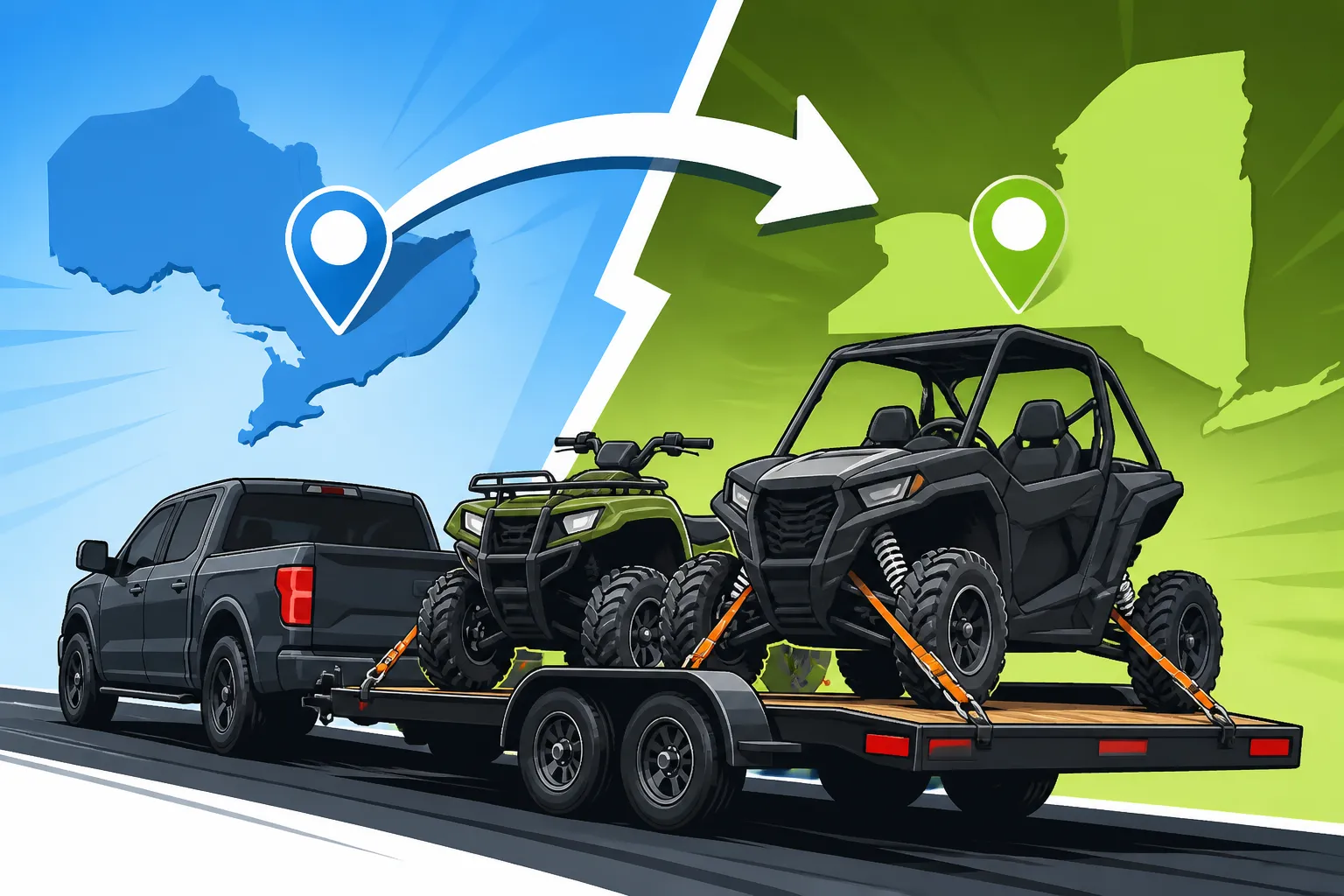
Bringing an ATV or UTV from Ontario, Canada, into New York State can feel like navigating a maze, especially with differing vehicle classifications and documentation standards. Many riders discover that what's perfectly acceptable for riding north of the border doesn't always translate smoothly when trying to get registered here in the Empire State. This guide will walk you through the specifics of what you need to know and do to get your machine legal for New York's trails.
Understanding the Cross-Border Conundrum for Your Quad
It's easy to assume that if your ATV or UTV is registered and ready to ride in Ontario, it'll be a straightforward process to get it set up in New York. Unfortunately, that's not always the case, and many riders find themselves hitting unexpected roadblocks at the DMV. The key lies in understanding the subtle, yet significant, differences in how these vehicles are handled by the authorities in each region.
Why Ontario's Rules Differ from New York's
Ontario has its own set of rules and classifications for off-road vehicles (ORVs), which include ATVs, side-by-sides, and dirt bikes. While you register your ORV with the Ontario Ministry of Transportation (MTO) and get a permit and plate, the underlying legal framework and definitions can vary quite a bit from what New York's Department of Motor Vehicles (DMV) uses. For example, some side-by-sides that are easily registered and ridden on designated trails or even certain road shoulders in Ontario might not fit New York's strict definition of an "ATV" at all, which then impacts their ability to be registered here. It's not just about having a valid registration; it's about whether the type of machine itself qualifies under New York law.
The Lack of a Traditional Title for ATVs in Both Places
One of the most common points of confusion for people moving machines between Ontario and New York is the concept of a vehicle "title." In New York, for instance, ATVs are generally considered non-titled vehicles, similar to snowmobiles. This means you won't receive a traditional certificate of title like you would for a car or truck. The same often holds true for ATVs in Ontario; while you get a permit and a vehicle permit number, it's not the same as a traditional certificate of ownership or title in the sense that many other states or provinces might issue. This lack of a formal "title" document can make proving ownership a bit more challenging when you're trying to establish your machine's history, especially if the last owner in Ontario didn't have a perfectly clear chain of documentation. Don't worry, New York has a process for [New York ATV Registration Without a Title], but it relies heavily on other forms of proof. Understanding this distinction is crucial because it shifts the focus to other documents for establishing ownership when you go to register your machine.
Navigating New York's Registration Requirements for an Ontario Machine
When you're ready to register your ATV or UTV that's coming in from Ontario, the New York DMV isn't going to simply take your Ontario registration at face value. They need specific documentation to ensure the machine is yours, meets their criteria, and that all necessary fees and taxes are paid. This often means gathering a few key pieces of paperwork and being prepared to show definitive proof of ownership.
Essential Documents You'll Need to Bring
Getting your machine registered in New York starts with having all your ducks in a row paperwork-wise. You'll need more than just your Ontario registration slip. The New York DMV will generally ask for:
- Proof of Ownership: This is paramount, especially since neither jurisdiction typically issues a traditional title. Your original bill of sale from when you purchased the machine in Ontario is critical. If you bought it from a private seller, a detailed, signed bill of sale is even more important. If you don't have a formal bill of sale, or if you're the second or third owner and the paperwork chain is broken, you might need to present your Ontario registration certificate (the permit portion) along with an affidavit of ownership. It's always a good idea to have a clear, legally sound bill of sale, and services like LawDepot can help you generate a professional document to ensure all the necessary details are covered, even for a private sale.
- Proof of Identity: A valid New York State driver's license or non-driver ID card.
- Proof of Residency: Documents showing you reside in New York, such as a utility bill or bank statement.
- Proof of Insurance: You must have New York-compliant ATV insurance before you can register your machine. We'll dive into this more, but make sure it's from an insurer authorized to do business in New York.
- The Machine's Information: Be ready with the make, model, year, and crucially, the Vehicle Identification Number (VIN).
Having everything prepared can save you a lot of time and potential frustration at the DMV counter. For a complete list, you can check [New York ATV Registration Paperwork].
Proving Ownership Without a New York Title
Since New York doesn't title ATVs, and Ontario's system also avoids a traditional "title," how exactly do you prove that the machine belongs to you when you step up to the DMV counter? This is where your bill of sale becomes the undisputed champion. Whether you bought your quad new from a dealer in Ontario or used from a private individual, that bill of sale is your primary evidence of legal possession. It should clearly list the buyer's and seller's names and addresses, the date of sale, the purchase price, and a full description of the ATV, including its VIN.
If your bill of sale is from an individual in Ontario, it's particularly important that it's clear and unambiguous. If you bought the machine many years ago and only have a sparse handwritten note, you might run into issues. In such cases, having your valid Ontario registration permit (the one you get from the MTO) can act as supplementary proof, demonstrating that the vehicle has been legally associated with you in Canada. If you're concerned about the legitimacy or completeness of your existing bill of sale, especially after a private party transaction, consider using a reputable online legal document service like LawDepot to generate a formal, compliant bill of sale that you can have signed by the seller (if possible) or use as a template for future transactions. This is a common hurdle for many, and getting it right ensures a smoother process for [Proving Ownership Without a Title in New York].
The VIN Tracing Requirement
This might sound a little old-school, but it's a critical step: the New York DMV often requires a pencil tracing of your ATV's VIN. This isn't just a quirky request; it's a security measure to prevent fraud and ensure that the VIN you're presenting on paper matches the actual frame number of the machine. To do this, you'll need a piece of paper and a pencil. Locate the VIN on your ATV's frame (it's usually stamped into the metal, often on the right-hand side of the frame near the engine, but consult your owner's manual if you can't find it). Place the paper over the VIN and rub the side of the pencil lead across the paper until the numbers and letters are clearly visible as an impression. This tracing acts as a physical verification for the DMV. It's a small step, but easily overlooked, and can cause delays if you show up without it. [Why New York Wants a Pencil Tracing of the VIN] is a frequently asked question, and now you know why!
Understanding New York's ATV and UTV Definitions
This is arguably the most crucial section for anyone bringing a machine from Ontario, especially a side-by-side or a larger ATV. New York State has a very specific legal definition for what constitutes an "All-Terrain Vehicle" (ATV), and if your machine doesn't fit within these parameters, it simply cannot be registered as an ATV here. It doesn't matter how you registered it in Ontario; New York's definition is what counts.
The Crucial 70-Inch Width Limit for ATVs
Many riders are surprised to learn that New York has a strict width limit for ATVs. To be registered as an ATV in New York, your machine cannot exceed 70 inches in overall width. This is a major sticking point for many modern side-by-sides (UTVs) and even some larger, utility-focused ATVs that are designed for stability and comfort.
Think about popular machines like many of the Polaris Ranger or Can-Am Defender models. While they are incredibly capable and widely used in Ontario, many of these vehicles easily measure 72 inches or more in width. If your machine, measured from the outermost point of its tires or fenders (whichever is wider), goes over that 70-inch mark, it will not qualify for ATV registration in New York. This is a common frustration for riders who bought their side-by-sides expecting to use them on New York trails, only to find they're too wide for the legal definition. You can explore this further in [New York ATV Width Limit for Registration] and [Why Most Side-by-Sides Cannot Be Registered in New York].
The 1,000-Pound Weight Limit
In addition to the width restriction, New York also imposes a weight limit for ATVs. Your machine, when unladen (without passengers or cargo), cannot exceed 1,000 pounds to be registered as an ATV. This is another area where many modern machines, especially side-by-sides, frequently exceed the limit.
Many utility UTVs, two-up ATVs, or performance-oriented side-by-sides designed for carrying multiple passengers or heavy loads can weigh significantly more than 1,000 pounds right off the factory floor. If your machine tips the scales over this limit, it will not be eligible for ATV registration in New York. Before you even think about trail riding, it’s critical to check your vehicle's specifications from the manufacturer to see if it meets both the width and weight criteria. Don't just guess; look it up! More details are available in [New York ATV Weight Limit for Registration].
What if Your Machine Exceeds These Limits?
This is the hard truth that many cross-border riders face: if your ATV or UTV exceeds either the 70-inch width limit or the 1,000-pound weight limit, it simply cannot be registered as an ATV in New York State. This means it cannot be legally operated on any public lands, designated ATV trails, or roads in New York, even if you have an Ontario registration or a New York ATV plate for another machine.
Currently, there isn't a separate, widely available registration category for UTVs or larger ORVs in New York that allows them the same access as legal ATVs. This often leaves owners with limited options, primarily restricting their use to private property with the landowner's explicit permission. It's a tough pill to swallow for many, especially those who bought a side-by-side specifically for exploring the vast natural beauty of New York. While there have been discussions and proposals for [New York UTV Registration Rules], these have not yet become law, meaning the current restrictions remain firmly in place. It's a significant consideration to make before you bring your machine across the border, as an unregistered, non-conforming machine will essentially be confined to your own property.
The Registration Process and What Happens Next
So, you've confirmed your Ontario machine meets New York's stringent width and weight limits, and you've gathered all your ownership documents. Now it's time to head to the DMV to finalize the registration. The process itself is fairly straightforward once you have all the necessary components, but understanding each step will help you be prepared.
Where to Go and What Forms to Fill Out
To register your ATV, you'll need to visit a New York State Department of Motor Vehicles (DMV) office. You can find your nearest location on the DMV website. Be sure to arrive with all your documentation in hand: your bill of sale (and maybe your Ontario registration as supporting evidence), proof of identity, proof of residency, your New York ATV insurance ID card, and, crucially, that pencil tracing of your VIN.
The primary form you'll need to fill out for a non-titled vehicle like an ATV is Form MV-51B, "Statement of Transaction for Sales Tax for Casual Sale of Vehicles." This form serves multiple purposes: it captures the sales tax information if applicable (more on that in a moment), and it also acts as a declaration of ownership for machines without a traditional title. You'll also likely need an MV-82, "Vehicle Registration/Title Application," but the MV-51B is especially important for non-titled quads. It's really the cornerstone for registering these types of machines. [Which DMV Form Registers a Non-Titled ATV in New York] will walk you through the specifics.
When you present your bill of sale, the DMV will calculate any applicable New York State sales tax. Even if you paid sales tax in Ontario, New York may still require you to pay the difference if New York's rate is higher than what you paid, or the full amount if no tax was paid in Ontario (though this is less common for registered vehicles). You will also pay the registration fee and a one-time plate fee. The [New York ATV Registration Cost] covers these initial expenses.
Insurance Requirements for New York Riding
Before the New York DMV will even consider registering your ATV, you absolutely must have New York-compliant ATV insurance in place. This isn't just a suggestion; it's a legal mandate. Even if you have a valid Ontario insurance policy for your machine, it likely won't satisfy New York's requirements unless your Canadian insurer is also authorized to write policies in New York and specifically provides the required coverage.
New York law requires minimum liability coverage to protect others in case you're at fault in an accident. This typically includes specific dollar amounts for bodily injury and property damage. Without this proof of insurance, your registration application will be denied. It’s highly recommended to contact a New York-authorized insurance provider before you head to the DMV to get a policy set up. This ensures you're covered from day one and avoids any last-minute scrambles. For more details, check out [New York ATV Insurance Requirement].
Receiving Your New York Plate and Decal
Once you've successfully navigated the paperwork, paid the fees, and provided proof of insurance, the DMV will issue you a New York ATV registration certificate, a metal ATV plate, and a validation decal.
The metal plate is designed to be mounted on the rear of your machine. New York law specifies that it must be securely attached in a clearly visible location. This often means bolting it to a rear rack or a dedicated license plate bracket. The validation decal, which indicates the current registration year, must be affixed to the upper left corner of the plate. It's a small sticker, but crucial for roadside checks. Make sure both the plate and the decal are visible and kept clean so law enforcement can easily identify your registration. You can learn more about [New York ATV Plates and Where They Mount] and [Where to Stick a New York ATV Validation Decal]. Always keep your registration certificate with you when riding.
Ontario vs. New York ATV Registration Overview
To summarize some of the key differences and requirements, here's a handy comparison:
| Feature | Ontario ORV Registration | New York ATV Registration |
|---|---|---|
| Traditional Title | Generally not issued; uses a "Vehicle Permit" (registration) | Generally not issued; considered a "non-titled" vehicle |
| Primary Proof of Ownership | Bill of sale, Vehicle Permit (registration) | Clear bill of sale, affidavit of ownership, previous registration |
| Width Limit | Varies by ORV class; wider machines are often registerable | Strict 70 inches for ATVs |
| Weight Limit | Varies by ORV class; heavier machines are often registerable | Strict 1,000 pounds (unladen) for ATVs |
| Designated UTV Category | Specific categories for side-by-sides (UTVs) exist | No separate, widespread registration for UTVs; must fit ATV definition |
| VIN Verification | Generally checked by dealer/MTO | Often requires a pencil tracing at the DMV |
| Insurance | Mandatory for public land use | Mandatory from a NY-authorized insurer for registration and riding |
| Expiration | Annually on a set date (e.g., your birthday) | Annually on August 31st |
Bringing your beloved machine from the beautiful trails of Ontario to New York is absolutely doable, but it requires a bit of homework and adherence to New York's specific rules. The biggest hurdles are almost always the strict width and weight limits for what New York considers a registrable ATV, along with having impeccable proof of ownership. By being prepared and understanding these nuances, you can ensure your quad is ready to hit the trails legally in the Empire State.
Disclaimer
This article is for general informational purposes only and does not constitute professional advice. Laws, prices and regulations vary by location and change over time. Consult a qualified professional for guidance on your specific situation.