Registering Before Trail Season Opens
That first hint of spring in New York, when the last patches of snow cling stubbornly to shaded spots but the sun feels warmer on your face, often sparks a familiar yearning: to get out on the trails. For ATV riders, this means prepping your machine, maybe checking those tires and that oil, and dreaming of the mud and dirt. But all that excitement can turn to a deflating feeling if you realize your ATV's registration isn't current, and opening day for your favorite trails is creeping closer. We've all been caught in that last-minute scramble, and it's a frustrating situation that can easily sideline your early season plans. This guide is dedicated to helping you understand the New York ATV registration process, especially how to proactively manage it so you're trail-ready the moment the gates open, avoiding any preventable delays.
Why Getting Your ATV Registered Before Trail Season Is Crucial in New York
There’s a common misconception that because you mostly ride your ATV in the spring, summer, and fall, you only need to worry about its registration when those seasons are active. In New York, however, the registration system has a fixed expiration date that often catches riders off guard, leading to last-minute rushes and missed opportunities. Understanding this system is the first step to a stress-free trail season.
The Urgency of New York's August 31 Expiration
Unlike vehicle registrations that often expire on your birthday or the anniversary of your purchase, New York ATV registrations have a universal expiration date: August 31st. This is a crucial detail that many riders overlook, leading to their registration lapsing right in the middle of prime riding season or long before the next spring rolls around. If your registration expires on August 31st and you don't renew it, you're effectively unregistered for the entire fall, winter, and the crucial start of the following spring trail season.
Imagine the frustration: you've been counting down the days to April 1st, or whenever your local trails typically open, only to remember in March that your registration expired months ago. Now you're facing a mad dash to the DMV, potentially encountering delays, all while your buddies are already airing up their tires. Being aware of this fixed date means you can plan ahead, renewing your registration well before it expires, even if you put your machine away for the winter. This proactive approach ensures you're never caught off guard when the trails beckon. You can dive deeper into this topic by reading [New York's August 31 Expiration].
Avoiding the Pre-Season Rush and Potential Delays
As the weather breaks and spring approaches, countless riders across New York suddenly remember their ATV registration needs attention. This creates a predictable bottleneck at local Department of Motor Vehicles (DMV) offices. Everyone, it seems, has the same idea at the same time: get registered, get ready. This influx of applications can significantly slow down processing times, turning a quick trip to the DMV into a frustrating wait, or delaying mail-in applications for weeks.
Beyond just the volume of applications, errors on paperwork are a leading cause of delays. A forgotten signature, a missing piece of identification, or an incorrectly filled-out form means your application gets sent back, pushing you further down the line. If this happens during the peak pre-season rush, you could miss weeks of riding time while you correct the issue and resubmit. By taking care of your registration in the quieter off-season, perhaps in the fall or winter, you avoid the crowds and allow ample time to resolve any unexpected hiccups without feeling the pressure of a looming trail opening. Taking time to properly fill out the forms and ensure all supporting documentation is in order can save you a world of trouble.
Understanding Trail Permit Requirements
It’s important to remember that simply having a valid New York ATV registration isn’t always enough to hit the trails. Many of the fantastic riding opportunities across the state, especially those managed by counties or local clubs, require an additional trail permit. For instance, the extensive Lewis County ATV Trail System, a popular destination, mandates its own permit for access. The catch? You cannot obtain one of these essential trail permits without first possessing a current and valid New York ATV registration.
This means that if your ATV registration has lapsed, you're in a double bind. You'll need to sort out your state registration before you can even apply for the necessary local trail permits. This layering of requirements underscores why staying on top of your registration is paramount. Imagine finally getting your ATV registered, only to find out it'll be another week or two before your Lewis County permit arrives. It’s a frustrating delay that can be easily avoided by ensuring your primary registration is always current. For more details on what permits entail, you can check out [Lewis County ATV Trail Permit Cost and Rules].
Navigating the New York ATV Registration Process
The process of registering an ATV in New York can seem a bit convoluted, especially for first-time owners or those coming from other states with different rules. However, once you break it down, it's quite manageable. The key is to gather all the right information and forms upfront to ensure a smooth transaction.
Gathering Your Essential Documents
Before you even think about heading to the DMV, you need to have your ducks in a row. The most critical piece of documentation for an ATV in New York is proof of ownership. This is often where confusion arises, as New York State does not issue titles for ATVs. Instead, your proof of ownership usually comes in the form of a bill of sale or a previous registration document. If you’re buying a used machine from a private seller, a detailed bill of sale is absolutely essential. This document should include the seller's and buyer's full names and addresses, the ATV's make, model, year, and crucially, its Vehicle Identification Number (VIN) or frame number. It's wise to use a comprehensive template, perhaps even one found through services like LawDepot, to ensure all necessary information is captured to prevent any issues at the DMV. A well-drafted bill of sale is your best friend when proving ownership without a title. To learn more about this specific requirement, refer to [New York ATV Bill of Sale Requirements].
In addition to proof of ownership, you’ll need proof of identity (like a driver’s license), and proof of New York ATV insurance. New York State law mandates that all ATVs operated off your own property must be insured. So, secure an insurance policy before you head to the DMV; you’ll need the insurance card or a copy of the policy declaration page. Finally, the DMV often requires a pencil tracing of the ATV's VIN. This might sound old-fashioned, but it’s a non-negotiable step to verify the machine's identity. Simply place a piece of paper over the VIN (usually stamped on the frame) and rub a pencil across it to transfer the impression. This tracing ensures that the VIN you're presenting matches the physical machine. For details on why this tracing is needed, check out [New York ATV VIN Tracing Requirement].
Completing the Right Forms
Once you have your documents in hand, the next step is to correctly fill out the required New York DMV forms. For ATVs, which are considered non-titled vehicles in New York, the primary form you’ll be using is the MV-51B, known as the "Vehicle Registration/Title Application (for Non-Titled Vehicles)". It’s a common mistake for people to look for an ATV-specific form or even a standard vehicle title application, but the MV-51B is the one you need. Understanding its specific sections is key to a hassle-free registration.
On the MV-51B, you'll clearly mark that you are applying for an ATV registration. You’ll need to fill in all the details of your ATV—make, model, year, VIN—and provide your personal information as the owner. Be meticulous with the VIN; even a single digit wrong can cause your application to be rejected. There will also be a section to provide your insurance information, including the company name and policy number. Double-check everything, especially if you’re completing it by hand. An accurately filled-out MV-51B, accompanied by all the supporting documents, will significantly expedite your registration. For a full breakdown of this important form, refer to [New York's Form MV-51B Explained].
Where and How to Submit Your Application
With all your documents and forms ready, you have a couple of options for submitting your ATV registration application. The most common and often recommended method, especially if you anticipate any questions or potential issues, is to visit your local New York State Department of Motor Vehicles (DMV) office in person. While the main DMV locations can handle this, many county clerk offices also process ATV registrations, which can sometimes mean shorter wait times and more personalized assistance. Before you go, it's always a good idea to check their specific hours and if they require appointments for registration services. Going in person allows you to get immediate feedback if something is incorrect, potentially saving you weeks of back-and-forth through the mail. You can find more specific information on where to go by looking at [New York ATV Registration at a County Office].
Alternatively, you can submit your application by mail. This option might be convenient if you live far from a DMV or county office, but it comes with the risk of delays if any part of your application is incomplete or incorrect. If mailing, always send copies of your documents, not originals, and consider using certified mail for tracking purposes. You'll need to include payment for the registration fees, which cover the initial registration and the one-time plate fee. The registration fee helps fund trail maintenance and administration, while the plate itself is a singular expense. Be sure to include your proof of insurance and the VIN tracing with your mailed application. For a breakdown of the costs involved, including the registration and plate fees, consult [New York ATV Registration Cost].
Common Hurdles and How to Smooth Your Path to the Trails
Even with the right documents and forms, navigating the ATV registration process in New York can present a few specific challenges. Being aware of these common pitfalls can help you avoid unnecessary delays and frustrations, ensuring you're ready to ride without a hitch.
The Perils of Outdated Information and Forms
In the age of instant information, it's easy to fall prey to outdated advice or incorrect forms found online. Many websites, forums, or older guides might reference forms that are no longer current or provide information that doesn't apply to New York's specific ATV regulations. For instance, some sources might mistakenly suggest you need a title for your ATV, leading you down a fruitless path. This is particularly problematic because New York does not issue titles for ATVs, making the bill of sale your primary proof of ownership. If you show up at the DMV with the wrong form or based on faulty information, your application will be rejected, forcing you to start over and costing you valuable time, especially as trail season approaches.
To avoid this, always prioritize information directly from the official New York State Department of Motor Vehicles website. They are the authoritative source for all current forms and regulations. Before printing anything or filling out a form, cross-reference it with the DMV's site to ensure you have the latest version. This simple step can save you immense frustration and prevent delays that could keep you off the trails. You can read more about why other forms might be cited incorrectly in [Why Online Guides Cite the Wrong ATV Registration Form].
Proving Ownership Without a Title
As we've mentioned, one of the biggest points of confusion for ATV owners in New York is the absence of a title. If you've previously owned cars or motorcycles, you're accustomed to a title being the definitive proof of ownership. For ATVs, it's different. Your valid bill of sale is paramount. This document needs to be clear, legible, and contain all the essential information: the seller's and buyer's names and addresses, the date of sale, the purchase price, and a complete description of the ATV, including its VIN. If you purchased your ATV from a private seller, and they themselves never registered it, you'll need that original bill of sale from their purchase, or a chain of bills of sale, to prove the machine's history of ownership. This can sometimes be tricky, which is why detailed, official documentation is so important.
If you're creating a bill of sale for a private transaction, consider using a reliable template. Resources like LawDepot can provide standardized, legally sound bill of sale forms that help ensure you capture all necessary details, minimizing the chance of rejection at the DMV. Having a professionally structured document makes a strong case for your ownership, even without a state-issued title. Always keep multiple copies of this crucial document, as it serves as your primary proof. For more on how to prove ownership in New York when there's no title, see [Proving Ownership Without a Title in New York]. What if you bought a machine that was never registered by a previous owner? [Buying a Quad Nobody Ever Registered] can help guide you through that specific challenge.
Understanding Width and Weight Limits for Registration
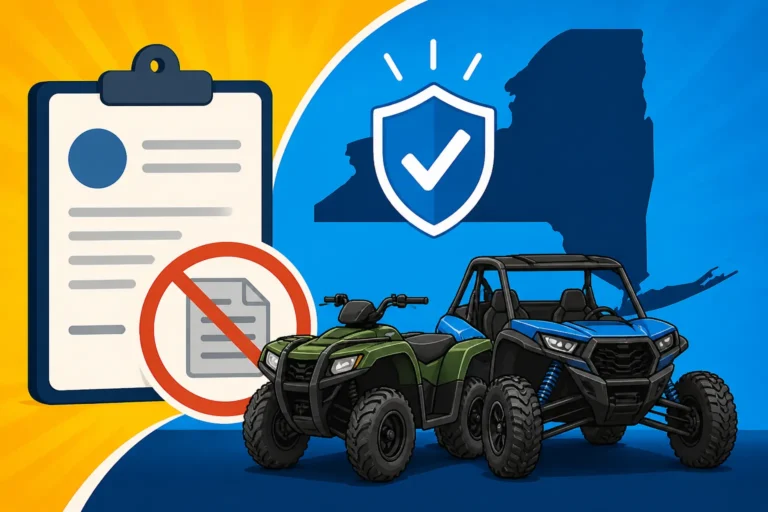
This particular hurdle often catches side-by-side (SxS or UTV) owners by surprise, and it's a critical one that determines whether your machine can even be registered as an ATV in New York. New York State law defines an ATV with strict limits: it must not exceed 70 inches in width and must not weigh more than 1,000 pounds. These are not suggestions; they are hard limits for what can be classified and registered as an "ATV" in the state. Many modern side-by-sides, designed for stability and comfort, easily exceed these dimensions.
It's a disheartening scenario: you purchase a new, powerful side-by-side, only to find out at the DMV that it's too wide or too heavy to be registered under New York's ATV definition. This effectively means you cannot legally ride it on public lands, designated trails, or even cross public roads in New York. The machine might be perfectly capable, but if it doesn't meet those specific state criteria, it simply cannot get an ATV plate. This is why it is absolutely essential to check the specifications of any machine you intend to buy before you make the purchase, especially if you plan to ride it beyond your private property. Measure it, weigh it if you can, and compare it against these strict limits. Learning more about [New York's 70-Inch Width Limit] and [Why a Modern Side-by-Side Fails the Test] can help you make an informed decision and avoid a very costly mistake.
What Happens If You Miss the Window?
Life happens, and sometimes, despite your best intentions, your ATV registration might lapse before you get around to renewing it. Whether it's a simple oversight or a delay in gathering paperwork, understanding the consequences and how to rectify the situation is crucial for getting back on the trails legally and safely.
Riding an Unregistered ATV and Its Consequences
Operating an unregistered ATV on any public land, designated trail, or public road in New York State is a serious offense. It’s not just a slap on the wrist; it can lead to significant fines, and in some cases, your machine could even be impounded. An officer checking your plate at a trailhead or during a routine stop will quickly identify a lapsed registration, and you’ll be facing a ticket for sure. Beyond the immediate legal trouble, riding unregistered also creates a major liability issue. If you're involved in an accident while operating an unregistered ATV, your insurance company might deny coverage, leaving you personally responsible for damages and medical bills, which can be financially devastating.
Moreover, if you're caught riding on a trail system that requires a county or club permit, having an unregistered machine will also prevent you from obtaining that permit. This means you’re essentially locked out of legal riding areas. The financial and legal repercussions far outweigh the minor inconvenience of getting your registration sorted out. It's a risk simply not worth taking, especially when the solution is relatively straightforward. You can get a clearer picture of potential penalties by looking at [New York Fines for an Unregistered ATV].
Renewing a Lapsed Registration
If your New York ATV registration has expired, don’t panic, but don’t delay either. The good news is that New York State generally does not impose a penalty fee for simply renewing a lapsed ATV registration, unlike some other vehicle registrations. You won't face extra charges for being late, but you will need to pay the standard annual registration fee for the current registration period. The downside, of course, is that you cannot legally operate your ATV until the registration is current again. So, while there isn't a financial penalty for being late, the practical penalty is being unable to ride.
The process for renewing a lapsed registration is essentially the same as a regular renewal. You'll need to submit your renewal application (often sent by mail from the DMV, or you can download it online), proof of current New York ATV insurance, and the appropriate fee. It's really just a matter of getting the paperwork in order for the current year. Once everything is processed, you'll receive your updated registration sticker, and you'll be good to go. The key is not to let the lapsed status deter you from taking action promptly. Your machine might be sitting idle in the garage for a bit longer, but with proper renewal, you’ll be back on the trails legally. For more on the annual registration process, check out [New York's Annual ATV Registration] and [Letting a New York ATV Registration Lapse Over Winter].
The Benefit of Year-Round Registration
While it might seem tempting to let your ATV registration lapse during the off-season, especially if you store your machine away for the winter, maintaining year-round registration actually offers significant benefits and peace of mind. Firstly, it simplifies your life immensely. By renewing your registration when it's due (remembering that August 31st expiration!), regardless of the season, you eliminate the last-minute scramble and potential delays when spring riding calls. Your machine is always ready for any spontaneous trail adventures, unexpected warm weather rides, or even if you decide to sell it mid-winter.
Secondly, year-round registration ensures continuous insurance coverage. While you might be able to pause your policy, a continuous policy often avoids gaps that could lead to questions or higher premiums when you restart. More importantly, it ensures you’re covered if any unforeseen incident occurs while the ATV is stored or being moved, even if it's not being actively ridden. Finally, the annual registration fee is a relatively modest investment when compared to the potential fines, legal troubles, and missed riding opportunities that can arise from having an expired registration. A continuous, current registration is a smart habit that supports safer, more responsible, and ultimately more enjoyable ATV ownership in New York.
| Document / Scenario | New ATV from Dealer | Used ATV (Private Sale) | Inherited ATV |
|---|---|---|---|
| Proof of Ownership | Manufacturer's Cert. of Origin / Dealer Bill of Sale | Bill of Sale (Seller & Buyer Info, VIN, Price, Date) | Death Certificate, Will/Probate Docs, MV-51B |
| Proof of Identity | Yes | Yes | Yes |
| Proof of Insurance | Yes | Yes | Yes |
| Completed MV-51B Form | Yes | Yes | Yes |
| Pencil Tracing of VIN | Yes | Yes | Yes |
| Sales Tax Payment | Yes | Yes | No (if inherited) |
| Old Registration (if any) | No | Yes (if previously registered) | Yes (if registered) |
Disclaimer
This article is for general informational purposes only and does not constitute professional advice. Laws, prices and regulations vary by location and change over time. Consult a qualified professional for guidance on your specific situation.