Buying at an Estate Sale
Finding a great deal on an ATV at an estate sale can feel like hitting the jackpot, but the excitement can quickly turn to frustration when you realize the unique challenges of proving ownership and getting it registered in New York. This guide is here to walk you through the often confusing process of purchasing an ATV from an estate, ensuring you have all your ducks in a row for a smooth registration experience.
Navigating the Unique Challenges of Estate Sale ATV Purchases in New York
Estate sales are a treasure trove for finding used recreational vehicles, and ATVs are no exception. The draw is often the chance to snag a well-maintained machine at a good price. However, buying an ATV from an estate in New York comes with its own set of particular hurdles, primarily due to how ATVs are treated (or rather, not treated) in terms of titling. Unlike cars, New York does not issue titles for ATVs, which means proving ownership usually relies on a chain of registration documents and bills of sale. When you add the layer of an estate, where the original owner is no longer present to sign off on things, it gets even more complicated.
The biggest challenge isn't just finding the right ATV; it's ensuring you can legally claim it as yours and then register it with the New York Department of Motor Vehicles (DMV). You’re not just dealing with a seller; you’re dealing with an estate, which operates under specific legal guidelines. This means you’ll need more than just a handwritten receipt to satisfy the DMV. Think about it: the person who owned the quad is gone, and now a legal representative is handling their affairs. This requires a different level of documentation to transfer ownership properly, especially for an item that lacks a formal title. You’ll need to be diligent and perhaps a little patient, but with the right preparation, it’s absolutely doable.
The Missing Title Dilemma and Estate Sales
In New York, most ATVs don't come with a traditional title like a car or truck. This is often a huge point of confusion for buyers and sellers alike, especially for those new to the ATV world. Without a title, the primary proofs of ownership for an ATV are typically a bill of sale and the most recent registration document. When you're dealing with an estate, this situation is compounded because the original owner, the person whose name was on that last registration, is deceased. The estate representative (executor or administrator) now stands in their shoes, but they must demonstrate their legal authority to sell the deceased's assets.
This lack of a formal title means that the DMV scrutinizes the ownership transfer documents even more closely. They want to see a clear and unbroken chain of ownership, even without a title. For an estate sale, this means the representative needs to provide proof of their authority to act on behalf of the deceased owner. It's not enough for them to simply say they're selling it; they need official court documents. This is where understanding the legal side of estate administration becomes crucial for you as a buyer. Without these proper documents, you could end up with a great ATV but no legal way to register it for trail riding, turning your supposed jackpot into a very expensive lawn ornament.
Essential Documents for a Smooth Transfer of Ownership
When you’re buying an ATV from an estate sale, your goal is to gather enough documentation to convince the New York DMV that you are the rightful new owner. This often means collecting documents that go beyond a simple bill of sale. Think of it as building a legal case for your ownership claim. The more official paperwork you can provide, especially that which demonstrates the estate representative's legal authority, the smoother your registration process will be. Don't be afraid to ask for these documents; any legitimate estate sale will have them readily available.
Remember, the DMV's main concern is preventing fraud and ensuring proper ownership. Since [New York Has No Form MV-82ATV] for ATVs, and they don't issue titles, the responsibility falls squarely on you to present a comprehensive package of proof. This might feel like a lot of hoops to jump through, but it's essential for protecting your investment and getting out on the trails.
The Bill of Sale: More Than Just a Receipt
A robust bill of sale is always paramount when buying a used ATV, but it’s even more critical in an estate sale scenario. This document formally transfers ownership from the seller (in this case, the estate) to you. It should include specific details like the date of sale, the purchase price, the full names and addresses of both the buyer and the seller (the estate, represented by the executor/administrator), and a detailed description of the ATV. Crucially, the ATV's Vehicle Identification Number (VIN) must be clearly stated on the bill of sale. A good practice is to also include the make, model, and year of the machine.
When dealing with an estate, the "seller" on the bill of sale won't be the deceased individual. It needs to be the name of the estate, and it must be signed by the appointed executor or administrator. Beneath their signature, it should clearly state their legal capacity (e.g., "Jane Doe, Executor of the Estate of John Smith"). Using a reputable template, perhaps one you can find on sites like LawDepot, can help ensure all the necessary legal language is included. Don't accept a vague handwritten note; insist on a clear, typed, and comprehensive bill of sale. This is your primary proof of purchase and a vital link in your ownership chain. You can learn more about what's needed by looking into [New York ATV Bill of Sale Requirements].
Proving the Seller's Authority: Death Certificate and Estate Documents
This is the special sauce for estate sales. Beyond the bill of sale, you absolutely need documentation that proves the person selling you the ATV has the legal right to do so on behalf of the deceased owner. This usually involves two key pieces of paperwork:
- Death Certificate: A copy of the deceased owner’s death certificate confirms the individual is no longer alive and that their estate is now in control of their assets.
- Letters Testamentary or Letters of Administration: These are court-issued documents that officially appoint an executor (if there was a will) or an administrator (if there was no will) to manage the deceased's estate. This is your definitive proof that the person signing your bill of sale has the legal authority to transfer property. Without these, the sale is not legally binding from the estate's side, and the DMV will likely reject your registration application. You may even be able to find templates or guidance on understanding these types of legal documents through resources like LawDepot if you're trying to figure out what you're looking for.
Insist on seeing originals or certified copies of these documents. A photocopy is usually fine for you to keep for your records, but the DMV might want to verify the legitimacy of the executor’s authority. This documentation is crucial for [Registering an Inherited Machine in New York] and showing the DMV that the ATV is indeed coming from a legitimate estate process.
The Last Registration Document
While New York doesn't issue titles, they do issue registrations. The most recent registration document in the deceased owner's name is incredibly helpful, as it establishes the previous legal owner. This document, often an MV-51B form, confirms that the ATV was legally recognized by the state as belonging to the deceased.
If the estate representative can provide this, it strengthens your case immensely. It creates a clear link: the deceased owned it (shown by registration), the estate now legally controls it (shown by Letters Testamentary/Administration), and the estate is selling it to you (shown by the bill of sale). If they can't find the physical registration, don't despair entirely, but it does make your job a little harder. The DMV may be able to look it up using the VIN, but having the physical document simplifies things greatly. Always ask for this, as it’s a direct link to the ATV’s history within the state system.
Here's a quick checklist of documents to aim for:
| Document Type | Purpose | Must Have For Estate Sale? | Notes |
|---|---|---|---|
| Bill of Sale | Formal transfer of ownership from estate to buyer. | Absolutely | Must include VIN, purchase price, estate name, executor's signature & capacity. |
| Death Certificate | Confirms original owner is deceased. | Yes, copy required | Shows the need for estate administration. |
| Letters Testamentary/Admin | Legal proof the seller is authorized to act for the estate. | Absolutely | Court-issued document, essential for DMV acceptance. |
| Last ATV Registration | Establishes prior legal ownership by the deceased. | Highly Recommended | Simplifies DMV verification of prior ownership. |
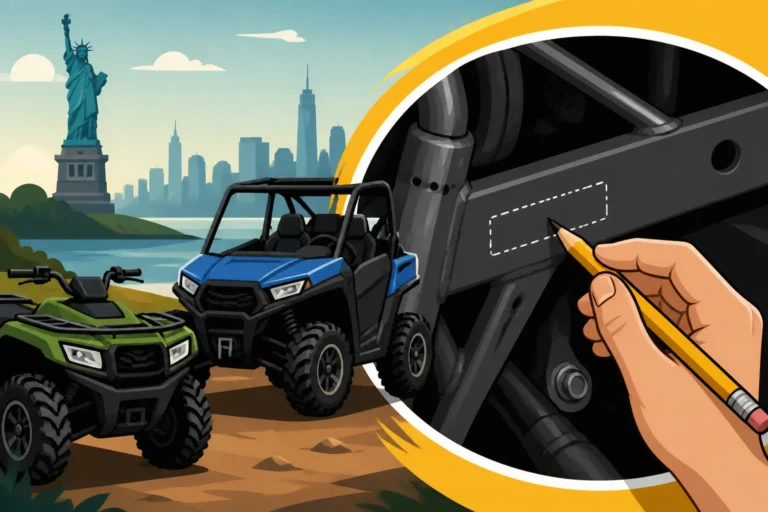
| VIN Tracing | Physical proof of the ATV's unique identification. | Yes, for DMV | [Why New York Wants a Pencil Tracing of the VIN] for registration. |
| Proof of Insurance | Required for registration and riding. | Yes, for registration | You will need to obtain your own policy. |
Steps to Ensure a Smooth ATV Registration Post-Purchase
Once you've successfully navigated the estate sale and have possession of your new (to you) ATV along with all the critical paperwork, the next phase is getting it officially registered with the New York DMV. This process, while similar to registering any used ATV, has some nuances specific to an estate sale purchase. Being prepared for these steps will save you a lot of time and potential headaches at the DMV counter.
Remember that [New York's August 31 Expiration] for ATV registrations means you'll want to get this done well before the popular riding season kicks off. Don't wait until the last minute, especially if any paperwork issues arise.
Verifying the ATV's Compliance and History
Before you even think about heading to the DMV, take a moment to verify a few crucial things about the ATV itself. First, double-check the VIN on the machine against the VIN on your bill of sale and any other documents. Discrepancies here can halt your registration dead in its tracks. You'll need to know [New York ATV VIN Tracing Requirement] for the registration application. The DMV will require a pencil tracing or a clear photo of the VIN for many non-titled vehicles.
Next, consider the physical dimensions of the ATV. New York has specific rules about what qualifies as an ATV for registration purposes, including a [New York ATV Width Limit for Registration] of 70 inches and a [New York ATV Weight Limit for Registration] of 1,000 pounds. Many modern side-by-sides, for example, exceed these limits and cannot be registered as ATVs in New York. While you might have found a great deal, if the machine is too wide or too heavy, you won't be able to register it for trail use in New York, regardless of your perfect paperwork. This is a common pitfall, so measure before you buy!
It's also a good idea to ensure there are no undisclosed liens on the ATV. While less common without a title, it's still possible for a creditor to have a lien on personal property. You can ask the estate representative if they are aware of any liens, and a thorough bill of sale should state that the property is being sold free and clear of encumbrances. While not foolproof, it's a layer of protection.
Visiting the DMV with Your Stack of Paperwork
With your ATV compliance checked and your ownership documents in hand, it's time to visit your local New York DMV office. Make sure you bring all of your supporting documents: the detailed bill of sale signed by the estate's executor/administrator, a copy of the death certificate, the Letters Testamentary or Letters of Administration, and the last registration if you have it. Don't forget your VIN tracing or clear photo!
You’ll also need to fill out the appropriate DMV forms for registration. Since ATVs are non-titled vehicles, you'll typically be using the forms designated for such vehicles, which can be found on the DMV website. Be prepared to show proof of New York ATV insurance, as it's mandatory to have coverage before you can register your machine. You can find guidance on this on sites like LawDepot if you need to understand the legal requirements around insurance. Without current insurance, you won't get a plate.
The DMV clerk will review all your documents. This is where having everything organized and clearly demonstrating the chain of ownership from the deceased, through the estate, and to you will pay off. They might have questions, so be ready to explain the situation clearly. Patience is key here; it's not an everyday transaction for them either. Once approved, you'll pay the necessary fees, receive your new registration, and get your [New York ATV Plates and Where They Mount]. Congratulations, you're ready to ride!
Potential Pitfalls and How to Avoid Them
Even with the best intentions and diligent research, buying an ATV from an estate sale can present a few unexpected challenges. Being aware of these potential pitfalls beforehand can help you either avoid them entirely or navigate them successfully if they arise. The key is to ask questions, verify information, and don't be afraid to walk away if something feels off. Your peace of mind and legal ownership are worth more than a "deal."
Estate sales are usually run by professionals or family members who are trying to liquidate assets efficiently, but mistakes or oversights can happen, especially with items like ATVs that have unique registration rules.
Incomplete or Missing Estate Documents
One of the most common issues you might encounter is incomplete or missing documentation from the estate. Perhaps the executor hasn't yet received their official Letters Testamentary, or they can't locate the death certificate. They might only have a copy of a will but not the court order formally appointing them. In such cases, the person trying to sell you the ATV simply doesn't have the legal authority to do so.
How to avoid: Insist on seeing the official Letters Testamentary or Letters of Administration before you finalize the purchase and hand over any money. If they don't have these documents, the sale cannot legally proceed from the estate's side, and you will not be able to register the ATV. You might consider putting down a small, refundable deposit contingent on the seller providing all necessary legal documents within a specified timeframe. If they can't produce them, you walk away. Don't rely on promises; get the documents in hand.
Unregistered or Previously Problematic ATVs
Sometimes, an ATV might be for sale from an estate because the deceased owner never bothered to register it, or there was some prior issue that prevented registration. While [Proving Ownership Without a Title in New York] is possible, an ATV that has never been registered adds another layer of complexity. The DMV wants to see a history, and if there's no previous registration, you'll need an even more ironclad bill of sale and proof of prior acquisition by the deceased.
How to avoid: Always ask for the last registration document. If the estate representative says there isn't one, ask why. Was it a farm-only machine (though [Registering a Farm Quad in New York] is still required if it's used off your own land)? Was it a youth machine that was never ridden off private property? Understanding the history can help you gauge the difficulty of future registration. If the history is too murky, or if the VIN appears to have been tampered with, it's a huge red flag and you should reconsider the purchase. A quick search of the VIN (if available) can sometimes reveal if the machine was ever reported stolen.
Physical Machine Non-Compliance with NY Regulations
As mentioned earlier, New York has strict physical requirements for what it considers an ATV for registration purposes. Many popular UTVs or side-by-sides exceed the 70-inch width and 1,000-pound weight limits. It's heart-wrenching to find a fantastic deal on a machine only to discover you can't register it in New York for trail riding because it's simply too big. This means you'd only be able to ride it on private property, which severely limits its utility.
How to avoid: Always measure the ATV yourself (width and dry weight, if possible) or verify its specifications against the manufacturer's published data before you commit to buying. Don't take the seller's word for it, as they might not be aware of New York's specific regulations. You want to make sure the machine truly fits the definition of an ATV for New York registration purposes. It's a small step that can save you a world of disappointment and wasted money. Always consult the DMV's most current regulations or resources like LawDepot if you have questions about vehicle definitions.
Disclaimer
This article is for general informational purposes only and does not constitute professional advice. Laws, prices and regulations vary by location and change over time. Consult a qualified professional for guidance on your specific situation.