General Supervision by Someone Eighteen or Over
General Supervision by Someone Eighteen or Over
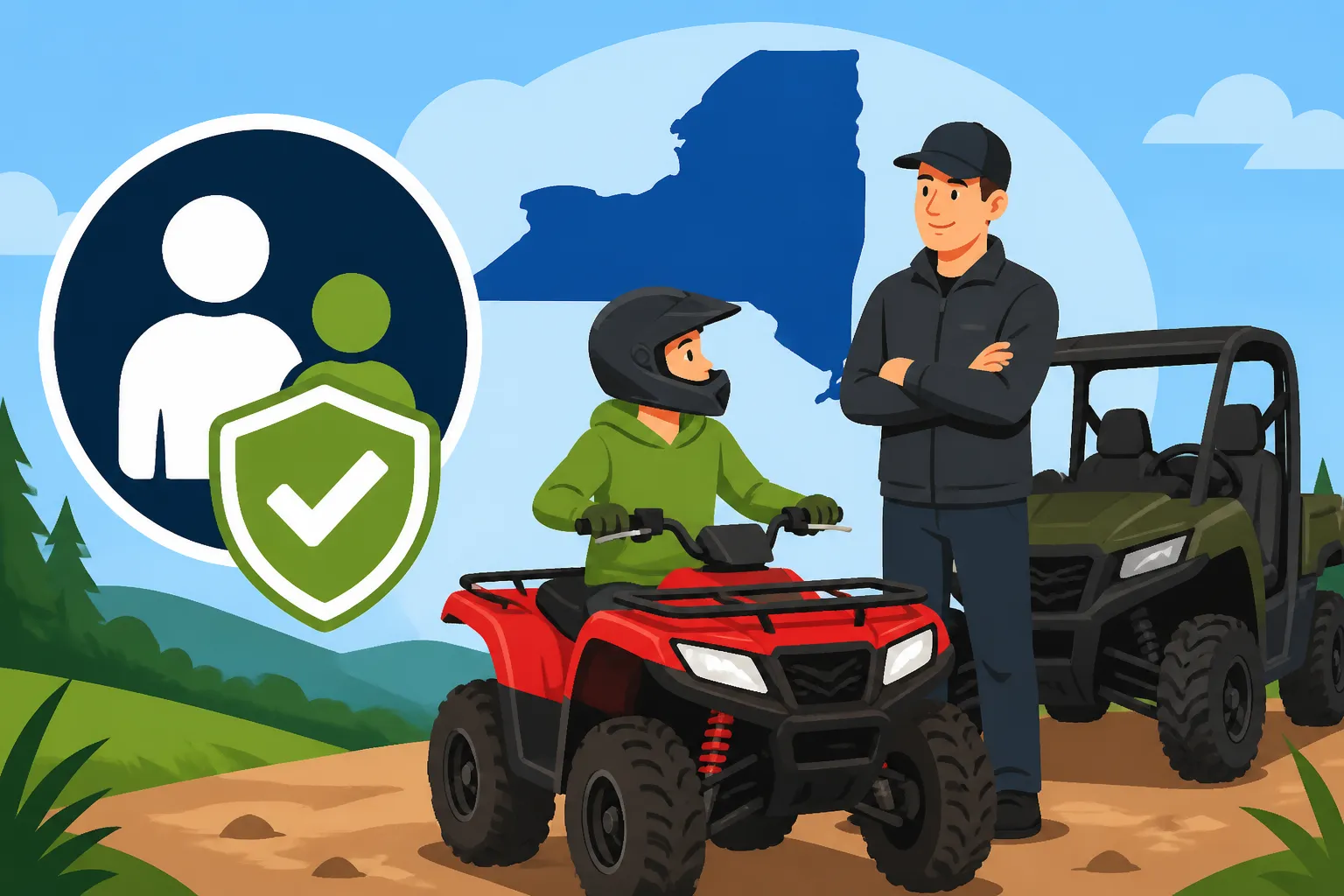
If a rider under 16 is heading out on an ATV in New York, “an adult will be nearby” may not be enough. The rules depend on the rider’s age, where the ATV will be used and whether a safety certificate is required. This article explains what general supervision means in practice, what it does not authorize and how to plan a ride more safely.
What General Supervision Means in New York
New York’s rules for young ATV riders use the idea of general supervision by someone who is at least 18. That requirement is important, but it should not be mistaken for a blanket permission to ride anywhere. Supervision addresses who must oversee a young operator; it does not automatically make a particular trail or road open to ATVs.
In practical terms, the supervising adult should be actively responsible for the young rider. That means knowing where the rider is, paying attention to changing conditions and being close enough to respond if the rider is in trouble. A person who simply agrees to supervise and then leaves, becomes unreachable or takes no interest in the ride is not providing meaningful oversight.
General supervision does not necessarily mean the adult must ride on the same ATV. Nor does it automatically mean the adult must be a passenger, follow directly behind every turn or control the machine. But “general” should not be read as “from anywhere.” A responsible adult should be able to monitor the outing and intervene promptly if conditions call for it.
New York’s rules do not provide a simple distance that fits every situation. A child riding slowly on a familiar, private field is different from a young operator on a busy, unfamiliar trail system. Use a conservative standard: the adult should be close enough to keep track of the rider, communicate clearly and reach them without an unreasonable delay.
It also matters that the supervisor is an adult, not just an older sibling or friend. A 17-year-old does not meet an 18-and-over requirement, even if they have more ATV experience than the younger rider. The adult should understand the route, the machine and the conditions, and should be prepared to stop the ride when something becomes unsafe.
A useful distinction is:
- Legal oversight: A qualifying adult is responsible for the young rider where supervision is required.
- Active supervision: The adult can monitor the ride, communicate and respond.
- Permission to ride: The machine, rider and location meet their separate legal requirements.
Meeting one of these does not prove the other two are satisfied. For a broader age-based overview, see New York Supervision Rules for Minors and What New York Requires of Riders Under 16.
Who Must Supervise and When
The rider’s age is central to deciding whether an adult must supervise. New York has separate rules for young operators, and a parent or guardian should not assume that the same arrangement applies to every child or every location. Review New York Minimum Age to Ride an ATV alongside the requirements for the specific place where the machine will be operated.
For a rider under 16, treat supervision by an adult at least 18 as the default unless a clearly applicable exception allows otherwise. Any exception should be checked carefully. It may depend on the rider’s exact age, the property and whether the operator holds the required safety certificate. Do not assume that having a certificate by itself removes the supervision requirement everywhere.
| Situation | What the adult should check |
|---|---|
| Young rider on private property | Who owns or leases the land, whether the rider qualifies for any exception and whether the adult can actively supervise |
| Young rider on a club or county trail | Whether the rider meets age and certificate rules, whether the route is open and whether a responsible adult will accompany or monitor the outing |
| Young rider crossing or riding near a road | Whether ATVs are permitted there and what additional crossing or road rules apply |
| Youth riding a rented machine | The rental operator’s age and supervision rules, along with New York law and any trail-access conditions |
| Adult cannot stay with the group | Whether another qualified adult has clearly accepted responsibility and can supervise the rider |
A parent does not necessarily have to be the supervising adult. The key question is whether the person supervising meets the age requirement and is genuinely responsible for the young rider. Before the outing, agree on who is supervising, where the rider may go, how the group will stay in contact and what circumstances mean the ride ends.
If several adults are present, avoid assuming that someone else is watching. Name the supervisor directly. This matters at trailheads and during group rides, where people may split into different groups, stop at different places or change routes. If the assigned adult leaves, the ride plan should change too.
A rider’s safety certificate and the adult’s role are related but separate issues. A certificate may be needed for a young operator, but it does not take the place of supervision when supervision is required. Conversely, having an adult present does not necessarily satisfy a separate certificate requirement. See The New York ATV Safety Certificate Explained for more on what the certificate covers.
The adult’s job is more than being nearby
Good supervision starts before the engine is turned on. The adult should know the machine’s size and controls, check that it fits the rider and set limits that the rider can follow. If a young operator cannot comfortably reach the controls, understand the route or stop the ATV safely, adult presence does not solve that mismatch.
During the ride, the adult should keep the rider in sight or maintain another reliable way to know where they are, based on the conditions and the ride plan. Do not rely on a phone signal in an area where service may be weak. Agree on a meeting point and a simple stop procedure before setting out.
Supervision also means being willing to say no. Mud, steep slopes, water crossings, fast-moving traffic and unfamiliar terrain can make a route unsuitable for a child even when the child is legally allowed to ride. If the adult cannot keep the rider within the agreed limits, end the ride or choose a safer area.
Why Supervision Does Not Make Every Place Open to ATVs
One of the easiest mistakes is to treat adult supervision as a general pass to ride. It is not. A supervising adult cannot make a closed trail legal, give a rider permission to cross private land or turn an undesignated public road into an ATV route.
Before leaving home, confirm that the location permits ATV use. New York does not treat all public land as open riding territory, and a route that appears on an online map may be closed, restricted or subject to local conditions. County and club trail systems can have their own access terms. Landowner permission matters where a route crosses private property.
Road use is another separate issue. Some roads may be designated and posted for ATVs, while others are not open to them. Crossing a road and riding along it are not the same thing; each has its own rules. A supervising adult does not override those restrictions. Review New York’s Designated and Posted Roads and New York Rules for Crossing a Public Road before planning a route that involves pavement.
Trail access may also involve registration, insurance, a county permit or club-specific requirements. Those requirements apply independently of the young rider’s supervision arrangement. Visitors should not assume that an out-of-state registration automatically satisfies every New York requirement; New York Reciprocity for Out-of-State Registrations explains the issue.
A practical pre-ride check is:
- Confirm the location is open to ATVs. Check current notices from the county, trail operator or landowner, especially after bad weather or during seasonal closures.
- Check the rider’s age-related requirements. Verify whether the rider needs a safety certificate and whether an adult must supervise in that setting.
- Confirm the machine is permitted. A machine that is too wide or otherwise outside the applicable rules may not be allowed on the route.
- Check access documents. Confirm registration, insurance and any local permit or membership conditions.
- Set the supervision plan. Decide who is responsible, where the young rider may go and what to do if the group becomes separated.
This may seem like a lot for a short ride, but it prevents a common misunderstanding: “The adult was with the child” does not answer whether the rider had permission to use that land or route.
How to Plan a Ride With a Young Operator
A solid plan matches the rider, machine, route and supervisor. Start with the child’s abilities, not the length or difficulty of the trail. A young rider who has practiced on a familiar, open area may still be unprepared for narrow trails, steep grades, deep mud or traffic crossings.
Match the machine to the rider
The ATV should be appropriate for the rider’s size and skill. The operator must be able to reach and use the controls correctly, steer and brake without struggling, and stop safely. A machine that feels manageable to an adult may be too large, powerful or heavy for a young operator.
Do not use the adult’s confidence as a substitute for the child’s control. A young rider should practice starting, stopping, turning and using the controls in a low-risk area before joining a trail ride. If the rider cannot perform these tasks consistently, choose a smaller machine or postpone the outing.
A safety certificate is useful preparation, but it cannot make an unsuitable machine suitable. It also cannot make a difficult route appropriate for a beginner. Review New York Youth ATV Size Rules when choosing a machine, and follow the manufacturer’s age and size guidance.
Choose a route the adult can supervise
A route should be manageable for both the young operator and the supervising adult. Consider visibility, trail width, intersections, water, other users and places where riders could take different paths. On a long or unfamiliar route, agree on checkpoints and do not let the young rider continue out of sight with no way to communicate.
Avoid a plan that relies on everyone keeping up with the fastest rider. A child should not feel pressured to ride beyond their ability just to stay with a group. If the group splits, the supervisor should remain with the young operator or explicitly transfer responsibility to another qualified adult before the split.
Trail conditions can change quickly. Rain may create slick ground, thawing may leave deep ruts, and a trail may be closed after a washout or landowner request. Check local notices before loading the machine and again if conditions change. The adult should be ready to turn back rather than insist on completing a planned loop.
Set communication and stop rules
Before starting, explain a few clear rules the rider can remember:
- Stay with the assigned adult or within the agreed limits.
- Stop when signaled, and wait in a safe place.
- Do not leave the trail or explore a side route without permission.
- Tell the adult immediately about a problem, fall or change in the machine’s handling.
- Stop if visibility, weather or trail conditions make the ride difficult.
Use communication that works in the area. A phone may be helpful, but it should not be the only safety plan where service is unreliable. Younger riders should know where to wait if separated and should not continue riding in search of the group.
Protective equipment and safe riding practices remain important whether or not the law requires a particular item in the situation. A correctly fitting helmet and protective clothing can reduce risk, but gear does not prevent every injury. The adult should check fit before the ride, not assume that equipment borrowed from another rider will fit properly.
Common Mistakes About Adult Supervision
Several misunderstandings recur when families plan ATV outings. Avoiding them makes the legal requirements easier to follow and the ride safer.
Mistake: “The adult is somewhere on the property, so the child is supervised.”
A property boundary does not tell you whether the adult can monitor or help the rider. A supervisor should know where the young operator is and be able to respond. If the child is out of sight for an extended period, the adult may not be providing meaningful oversight.
Mistake: “The adult has to ride on the same machine.”
General supervision should not automatically be treated as a passenger requirement. Whether a passenger may ride is a separate question, and a passenger must have a proper seat designed for that purpose. Do not add a passenger to a machine that is not built to carry one.
Mistake: “A certificate means the child can ride alone anywhere.”
A certificate does not override location restrictions, registration or insurance rules, and it should not be assumed to erase a supervision requirement in every situation. Check the rules that apply to the rider’s age and location. New York Trail Access for Riders Under 16 is also relevant when the plan involves a trail system.
Mistake: “The adult can supervise more than one child from far away.”
An adult may be responsible for a group, but the group must still be manageable. If riders have different experience levels or take separate routes, one adult may not be able to monitor everyone effectively. Keep the group together or assign another qualified adult before riders split up.
Mistake: “Private land means there are no rules.”
Private property can change which restrictions apply, but it does not erase every safety or legal obligation. The owner’s permission, the rider’s age, the machine and the circumstances still matter. A parent’s land is not a reason to ignore training, equipment or safe-operation practices.
Mistake: “A road crossing is covered because an adult is present.”
Supervision does not authorize a crossing that would otherwise be prohibited. The adult should select a lawful crossing and make sure the young rider understands the stop-and-cross procedure. Never assume a road is open to ATV travel because other riders use it.
Mistake: “The young rider can follow whoever is ahead.”
A rider may not know whether the person ahead is the designated supervisor or whether the group has changed course. Make the supervision arrangement explicit. The young operator should know which adult is responsible and what to do if that person is no longer nearby.
The safest approach is to treat supervision as an ongoing responsibility, not a box checked at the trailhead. The adult should remain attentive from the start of the ride until the young operator is safely off the machine.
Frequently Asked Questions
Does the adult supervising a young rider have to be the child’s parent?
Not necessarily. The supervisor must meet the applicable age requirement and genuinely take responsibility for the rider. Agree on who is supervising before the ride begins.
Does a safety certificate replace adult supervision?
Do not assume that it does. Certificate rules and supervision rules are separate, and any exception should be confirmed for the rider’s age and location. A certificate also does not grant access to a closed or restricted route.
Can an 18-year-old supervise a rider under 16?
An adult who is 18 meets the age threshold described by the supervision rule. The adult must still provide meaningful oversight and ensure the ride complies with other applicable rules.
Can a young rider use a trail if a supervising adult is present?
Only if the rider and machine meet the requirements for that trail and the route is open to ATV use. Adult supervision does not replace registration, insurance, permits, landowner permission or trail-access rules.
Disclaimer
This article is for general informational purposes only and does not constitute professional advice. Laws, prices and regulations vary by location and change over time. Consult a qualified professional for guidance on your specific situation.