What New York Charges Visitors to Ride
Visitors often arrive in New York with a valid ATV registration and still find that it does not cover access to every trail. The costs depend on where you plan to ride: registration, insurance, county or club trail access, and private-park fees are separate things. This guide explains which charges may apply, how reciprocity works, and what to check before unloading your machine.
What visitors may have to pay to ride in New York
There is no single statewide trail pass that gives every ATV visitor access to every New York trail. Depending on your route, you may need to pay nothing beyond your usual trip expenses, buy a county-specific permit, join a club, or pay a private riding area’s admission charge. Registration and insurance are separate requirements, not substitutes for trail access.
The main costs to budget for
A visitor’s riding costs usually fall into several categories. Some are legal or administrative requirements; others are set by the trail system, club, park, or property owner. A useful starting budget includes:
- A valid registration for the machine, either from your home jurisdiction or, if needed, New York
- Required insurance
- A county or trail-system permit where one is required
- Club membership or a club-related access fee where applicable
- Day-use or admission charges at a private riding park
- Fuel, lodging, food, and routine trip expenses
Not every ride involves every item. A visitor using a private property with permission may face a different set of costs from someone riding a marked county trail system. A private park may charge admission while a county route may require a local permit. One payment does not automatically cover the other.
That difference is easy to miss when planning from home. A rider may see that an ATV is registered and insured, assume everything is ready, then discover at a trailhead that local access has separate rules. Before traveling, identify the trail system by name and check its own access requirements.
Registration is not a trail permit
Registration identifies the machine for legal operation under applicable rules. It does not necessarily grant access to a county trail network, club trail, private property, or riding park. Likewise, buying a trail permit does not make an unregistered machine legal to operate where registration is required.
Think of the requirements as separate checkpoints. Registration concerns the machine and its authority to be operated. Insurance concerns financial protection and legal compliance. A trail permit or park admission concerns permission to use a particular riding area. You may need to satisfy all three before a ride.
For a broader overview of the state registration question, see Does New York Honor Out-of-State Registration?. If you are still sorting out where to register a machine that comes from elsewhere, Registering an Out-of-State Machine in New York explains the separate registration process.
There is no universal visitor price
The phrase “What does New York charge visitors?” sounds as if there should be one answer. There isn’t. The state does not offer one all-purpose pass that automatically opens every county, club, or private riding area to visitors.
Instead, costs are set in different places. A county or trail operator may have a permit system. A club may require membership for access to certain routes. A private park may charge by the day or use another admission structure. Those amounts and conditions can change, so check the operator’s own information before you go rather than relying on an old forum post or a price quoted for a different trail system.
How out-of-state registration and reciprocity work
Visitors often ask whether they must register their ATV again in New York. The answer depends in part on whether the machine has a valid registration from its home jurisdiction and whether that jurisdiction has an ATV registration system. Do not assume that a vehicle plate, title, or proof of purchase is the same as ATV registration.
When a home-state registration may be recognized
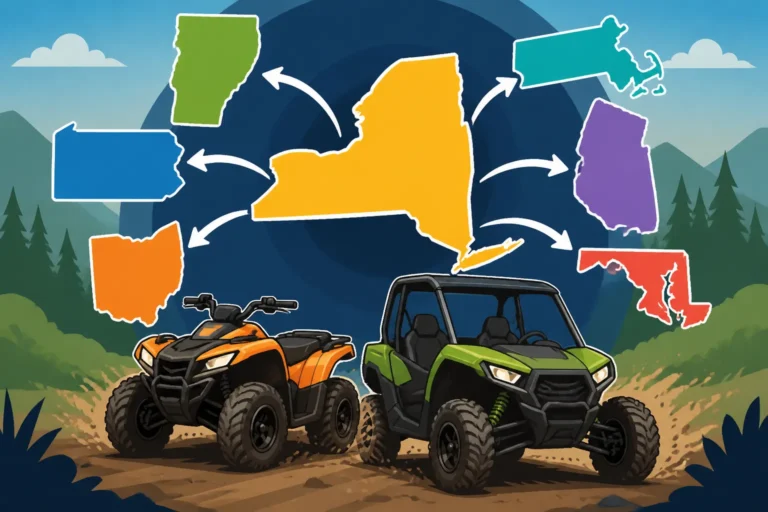
New York generally recognizes a qualifying out-of-state ATV registration for a visitor, subject to the applicable rules. That can spare a visitor from obtaining a second registration solely because the ride crosses a state line. But recognition of registration does not waive New York’s operating rules or automatically provide trail access.
Keep the machine’s valid registration document available while riding. If your home jurisdiction issues a registration certificate, plate, decal, or other proof, bring the form of proof required there and make sure it is current. A photo on a phone may be convenient, but it is not a safe replacement for whatever documentation the rules require you to carry.
Reciprocity is also narrower than many riders expect. It addresses the machine’s registration status; it does not mean New York accepts every out-of-state rule as a substitute for its own. New York requirements about insurance, helmets, equipment, road crossings, age, passengers, and where riding is permitted can still apply.
What if your home jurisdiction does not register ATVs
Some visitors come from places where the registration process is different, limited, or unavailable for their type of machine. That is a situation to resolve before the trip, not at the trailhead. If the home jurisdiction does not issue ATV registration, do not assume that a bill of sale or an ordinary vehicle registration will satisfy New York requirements.
Contact the appropriate New York registration office or consult the relevant state guidance about whether the machine must be registered in New York before it is operated. The answer may depend on the machine and the facts of the visitor’s situation. Start early enough to gather ownership documents and any forms the process requires.
This issue matters especially for riders transporting a machine from a state with no ATV registration program. The practical question is not only “Can I ride it here?” but also “What document proves the machine is eligible to be operated here?” For that situation, see What a Visitor Does When Their State Issues No Plate and Registering Here Before You Ride.
Reciprocity does not make every trail open
A valid registration can satisfy one important requirement and still leave you with no permission to ride a particular route. County systems, clubs, private parks, and landowners may each have their own access rules. A visitor with an out-of-state plate may still need a local permit, a club membership, a day pass, or written permission.
The reverse is also true. Paying a county permit charge does not override a closed trail, a landowner’s restriction, or a state rule. Trail access can depend on the route, the season, the machine’s dimensions, and whether the trail operator has permission to use the land.
Before you leave, confirm both sides of the question: whether your registration is accepted for New York operation and whether your chosen riding area accepts your machine and permit status. The guide Riding New York With an Out-of-State Plate covers the visitor-registration issue, while New York Rules for a Visiting Rider helps frame the broader rules that still apply.
County permits and trail access
New York’s trail access is local rather than one-size-fits-all. A permit associated with one county or trail system should not be treated as a pass for the entire state. Even neighboring riding areas may have different rules, seasons, trail maps, and arrangements with clubs or landowners.
Why the county or trail operator matters
A trail system is built and maintained through local agreements, permissions, and operations. A route may cross public roads, club land, private parcels, or land made available under a specific agreement. That is why the access policy for one system may not match the policy for another.
When you research a destination, identify the actual trail system rather than stopping at the county name. Find out which organization manages access, which trails the permit covers, whether visitors can buy access, and whether the route is open during your planned dates. A county website, trail operator, or local club may be the place to confirm those details.
This extra research can feel tedious when you are already arranging a trailer, lodging, and time off. It is still better than driving several hours and discovering that your permit covers a different system or that the route you planned to ride is closed. The page County Permits Instead of a State Sticker explains why a local permit system should not be confused with a statewide pass.
Permits, club memberships, and day access
Some trail systems use permits for access; some may connect access with club membership; others have restrictions that vary by trail or season. A visitor should check whether the available product is a permit, a membership, a day pass, or a combination—and what that purchase actually allows.
Do not rely on an old permit sticker from a previous trip. Access rules, seasons, and trail arrangements can change. Confirm that a permit applies to the current riding period and to the specific route you intend to use. If you are buying through a club or an operator, ask whether the payment covers the machine, the rider, a particular trail network, or a defined period of access.
A common source of confusion is assuming that a trail permit is per person when it is actually tied to a machine, or the other way around. Bring the information for every ATV in your group and check how the operator treats additional machines. The relevant question is not simply “How much is the permit?” but “What exactly does this permit authorize?”
Lewis County as an example, not a statewide rule
Lewis County is a well-known destination for ATV riding, and its trail system has its own access arrangements. Its permit process is an example of why visitors need to check local rules directly. A Lewis County permit should not be assumed to cover trails elsewhere in New York, and another county’s permit should not be assumed to work in Lewis County.
Access arrangements can also involve clubs and the agreements that keep trails open across private land. If a route is available through a club system, the club’s current rules can matter just as much as the county-level information. Read the current instructions for the particular riding area and verify where the permit must be displayed or carried.
For destination-specific details, start with Which Trails a Lewis County Permit Covers and Where to Buy a New York ATV Trail Permit. Use those as prompts to verify the current local process, not as a reason to assume that every New York county follows the same system.
Comparing the costs you may encounter
The easiest way to avoid a surprise is to separate legal requirements from trail-access charges and ordinary trip expenses. The table below is a planning tool, not a fee schedule. The amount and rules depend on the provider and location, so confirm details before traveling.
| Cost or requirement | Who sets it | When it may apply | What to verify |
|---|---|---|---|
| ATV registration | New York or the home jurisdiction | When registration is required and no recognized valid registration covers the machine | Whether your out-of-state registration is accepted and what proof to carry |
| Insurance | Insurer and applicable state rules | When New York’s insurance requirement applies to the ride | Whether the policy meets New York requirements and whether proof must be carried |
| County or trail-system permit | County, trail operator, or associated organization | On a trail system that requires local access authorization | Which trails it covers, its validity period, and whether it is per machine or rider |
| Club membership | The club or trail organization | Where membership is required or linked to access | Whether visitors can join, which trails are included, and whether extra access steps apply |
| Private park admission | The park operator | When riding at a privately operated area | Admission terms, machine rules, operating hours, and any reservation requirements |
| Lodging and camping | The accommodation provider | When staying near the riding area | Whether trailers and machines can be parked there and whether extra restrictions apply |
| Fuel and maintenance | Fuel and repair providers | On nearly every trip, especially remote rides | Distance between services, fuel needs, and whether basic repairs are available nearby |
Registration expenses are separate from visitor trail charges
A visitor whose home registration is accepted may not need to pay for a New York registration just to ride in the state. That does not mean the entire trip is free of New York-related charges. Local trail access can still require a permit or other payment, and insurance obligations still need to be addressed.
If your machine needs New York registration, the applicable registration process may involve its own charges and paperwork. Those are different from county trail access. Keep the two questions separate when estimating expenses: first determine whether the machine is properly registered; then find out what the riding destination charges for access.
The distinction also helps when comparing two trip plans. One plan might use a county trail network with a local permit; another might spend the day at a private park with its own admission rules. Neither is automatically more expensive in every case. Compare the complete costs for your group and machines rather than one isolated charge.
Insurance is not an access pass
Insurance is a legal and practical issue, not a trail ticket. A visitor should check that the policy covers the ATV and meets the requirements that apply in New York. Do not assume that a policy’s existence is enough; coverage details and proof requirements matter.
Ask the insurer whether the policy applies while riding in New York and what documentation to carry. Keep proof accessible, especially if you are riding in a group where one person handles paperwork for several machines. If you are unsure whether a policy from another state meets the relevant requirement, resolve that question with the insurer before the trip.
The guide Insurance a Visitor Must Still Carry addresses this issue specifically. It is worth reviewing before you ride, because a county permit does not replace insurance and an insurance card does not grant access to a trail.
Park admission differs from a county permit
Private riding parks set their own admission and operating rules. A park may charge for day access, impose machine or rider requirements, or require advance planning. Those terms are not interchangeable with a county trail permit.
If your group is choosing between a private park and a county route, compare the experience as well as the charge. A park may offer a defined riding area and a clear admission process. A county trail network may provide longer routes but require you to understand local maps, closures, and permit coverage. Check whether parking, camping, or other facilities are included or handled separately.
For a private area, contact the operator directly before loading up. Confirm that the park is open to visitors, that your type of ATV is allowed, and whether the access arrangement works for every machine in your group. A social-media post from a prior season is not a reliable substitute for current operating information.
How to plan a visitor ride without surprise charges
A good plan begins with the destination, not the fee. Once you know where you want to ride, you can identify its permit rules, insurance expectations, and practical costs. This order prevents the common mistake of paying for one part of the trip before confirming that it fits the rest.
Step one: choose the exact riding area
Start by naming the county trail system, club network, park, or private property you plan to use. “We’re riding in northern New York” is too broad to determine access requirements. Even within the same general region, two trail systems can use different permits and seasons.
Check the trail map and the operator’s current information. Confirm the trailhead, where to park, which routes are open, and whether your machine fits applicable width or other restrictions. A trail map is especially useful for identifying whether the planned loop crosses areas managed under different rules.
If your route may cross county lines, ask whether the permit remains valid across the whole route. Do not assume that a multi-county ride uses one access system. The guide Two Counties, Two Permits explores why crossing a boundary can change the access requirements.
Step two: confirm registration and insurance
Check the machine’s registration documents before the trip. Make sure the registration is current, the identifying information matches the machine, and you understand what form of proof must be carried. If your home jurisdiction does not issue ATV registration, or the machine is not currently registered, investigate the New York requirements well before departure.
Contact the insurer to confirm coverage for riding in New York and ask what proof you should carry. If different people in your group own different machines, each rider should verify their own paperwork rather than assuming one policy or document covers everyone.
Keep documents organized and easy to reach. A small waterproof document pouch can help protect paperwork from rain, mud, and the general mess of loading and unloading. If you are assembling basic trip supplies, a retailer such as Amazon may have options for map sleeves or waterproof pouches, but choose something that keeps documents legible and secure rather than treating it as a substitute for the required originals or proof.
Step three: check access rules for every machine
Do not assume that every machine in a group is treated the same. A narrow ATV, a youth machine, and a wide side-by-side may face different eligibility rules or trail restrictions. Check the trail operator’s permitted machine types and any width or equipment limits before buying access.
Ask how the permit is assigned. It may be associated with a machine, rider, or defined period, and additional machines may require separate authorization. For a family or group bringing multiple ATVs, this small detail can affect both the cost and whether everyone can ride.
If you are riding a side-by-side, pay particular attention to eligibility. New York’s ATV definition and width rules can limit which machines can be registered under the ATV framework. A trail permit cannot make an otherwise ineligible machine eligible for registration or road use. See Can You Register a Side-by-Side in New York? before committing to a trip with a UTV.
Step four: confirm dates, closures, and purchase details
Trail access is seasonal and can change with weather, landowner decisions, maintenance, or local operations. Check the opening and closing information close to your departure date. Mud, flooding, or other conditions may lead to closures even when a route appears on a map.
Ask where and how permits are sold, whether they can be purchased in advance, and whether proof must be displayed on the machine. If the process requires a decal, find out where it belongs and whether the operator provides instructions. Do not wait until the parking lot to learn that a permit must be obtained elsewhere.
Write down the contact details for the trail operator or club. If a gate is closed or a route marker is unclear, having an official contact can prevent a confusing situation from turning into an accidental trespass. Keep your plan flexible enough to shift to another legal riding option if the destination is closed.
Common visitor situations and how to handle them
The right answer can look different depending on where you are coming from and how you plan to ride. These scenarios show why registration, insurance, and access should be checked separately.
A Pennsylvania rider visiting for a weekend
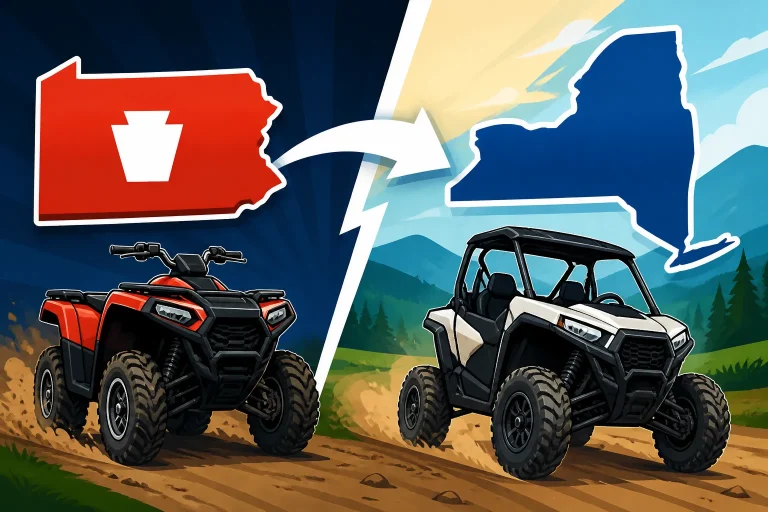
A visitor arriving from Pennsylvania should bring current registration proof and confirm that the registration is recognized for New York riding. The rider should also verify insurance coverage and identify whether the chosen trail system requires a local permit, club access, or another form of authorization.
If the plan is to ride in Lewis County, the visitor should read the current Lewis County permit instructions rather than assuming a state registration is enough. If the plan includes a private park, the operator’s own admission and vehicle rules apply instead. The same machine may therefore face different access requirements depending on where it is unloaded.
The rider should also check New York operating rules. Reciprocity does not mean that Pennsylvania rules follow the machine across the border. New York requirements regarding equipment, helmets, insurance, road crossings, and trail use still need attention. See Riding New York on a Pennsylvania Registration for the registration-specific question.
A visitor whose home state has no ATV plate
A rider whose state does not issue an ATV plate should not improvise with a plate from another vehicle or assume that a sales receipt is sufficient. Before traveling, find out how New York treats that situation and whether registration in New York is required.
The rider should gather ownership documentation early. Proof of purchase, prior registration records, or other ownership papers may be relevant to a registration application, but requirements depend on the circumstances. Checking before departure gives time to resolve missing information instead of discovering a paperwork problem at a trailhead.
Even after the registration question is settled, the visitor still needs to check insurance and trail access. These are separate hurdles. A local permit does not resolve a registration gap, and completing a registration process does not automatically provide county or park access.
A group bringing several machines
Groups often budget around the lead rider’s permit and forget to check how access is counted. If each ATV needs its own permit, a single group purchase may not cover all machines. If the access rules are rider-based, the group may need to account for each person instead.
Before traveling, make a list of machines, owners, registrations, and riders. Confirm that each machine is permitted on the planned trails and find out how the operator handles additional machines. This is particularly important if one machine is a side-by-side or has a different width or configuration from the others.
A shared checklist can prevent last-minute confusion. One person can verify the trail system’s rules, but each owner should confirm registration and insurance for their own ATV. Keep documents separated by machine so it is clear which paperwork belongs to which vehicle.
A visitor planning to ride only on private land
Private land does not automatically mean permission is unnecessary. A visitor needs the landowner’s permission, and other legal requirements may still apply depending on where and how the machine is operated. A private property arrangement is not a blanket exemption from every New York rule.
Ask the landowner exactly where riding is permitted and whether there are boundaries, time restrictions, or other conditions. Do not assume that permission to use one field includes nearby woods, a neighboring parcel, or a road connecting two areas. If the property is part of a commercial park, follow the operator’s rules rather than relying on informal assumptions.
This plan may not involve a county trail permit, but that does not make it cost-free or rule-free. Confirm the property arrangement, insurance, registration status, and any operating restrictions before riding. The guide Permission Before You Ride Someone’s Land is a useful companion for visitors considering private property.
Practical tips for avoiding access and fee problems
Even careful riders can get tripped up by vague directions, outdated information, or a misunderstanding about what a permit covers. A few simple habits make the trip easier and reduce the chance of paying for the wrong thing.
Get the permit details in writing
When information is unclear, ask the county, club, park, or operator for clarification and keep the response. A short email or saved copy of official instructions can help settle questions about coverage, purchase locations, machine eligibility, or required display.
Pay particular attention to the exact name of the permit and the trails it covers. “County permit” can sound broad, but the access may be limited to a particular network or period. If a trail system uses multiple organizations, ask which one handles the route you intend to ride.
Save the receipt and any permit confirmation with your riding documents. If the permit is a sticker or decal, follow the placement instructions. If it is digital or paper-based, find out whether it must be carried, shown at a checkpoint, or presented in another way.
Keep maps and contact information accessible
A map can help you stay on authorized routes and avoid wandering onto private or closed land. Use the map from the trail operator where possible, and check for updates before the ride. A map downloaded earlier may not show a recent closure or reroute.
Paper backup can be useful in areas where cell reception is unreliable. A waterproof map case, phone pouch, or printed contact sheet can protect the information from weather and trail grime. Amazon may be one place riders look for basic storage accessories, but the key is selecting a format that remains usable when wet or dusty.
Do not treat a map as permission to ride every line shown on it. Follow signs, gates, and closures, and respect landowner restrictions. When trail markers conflict with an old map, stop and confirm the route rather than guessing.
Avoid last-minute assumptions about payment
Some providers may sell permits online, while others may direct visitors to a local office, club, or retailer. Some may require advance arrangements. Verify the purchase process before you leave home, especially if you expect to arrive outside regular business hours.
Ask whether the listed charge includes any related access or whether separate payments are needed. For example, a permit may not include parking, camping, park admission, or a club membership. If you are traveling with several riders, confirm whether the charge applies per person, per machine, or per group.
Carry a payment method accepted by the operator and keep a record of the transaction. If you are buying access at a local shop, check opening hours and location. Riders often focus on the trailhead and overlook the fact that the permit must be purchased somewhere else first.
Build a modest maintenance and safety kit
An access permit gets you onto an authorized trail; it does not prepare your machine for a remote ride. Bring basic supplies suited to the machine and the route, such as a first-aid kit, tire repair supplies, tools, water, and a way to contact your group if riders become separated.
A compact tire gauge and repair kit can be helpful for routine trail issues. Amazon and local powersports shops may carry these kinds of supplies, but check that the items match your machine and that someone in the group knows how to use them. A poorly matched tool kit is not much help when a tire loses pressure miles from the staging area.
Plan fuel conservatively and share your route with someone who is not riding. Keep an eye on weather and trail conditions, and turn back if the route is no longer safe or open. A little preparation is less frustrating than having to cut a ride short because a basic need was overlooked.
Visitor planning checklist
Before loading the trailer, work through this checklist for the specific destination and each machine in your group:
- Identify the exact trail system, park, or private property you plan to use.
- Check the operator’s current access rules, dates, and closure information.
- Confirm whether the machine’s home registration is accepted in New York.
- If there is no qualifying home registration, resolve the New York registration question before riding.
- Confirm that the insurance policy applies in New York and carry the required proof.
- Find out whether access requires a county permit, club membership, day pass, or park admission.
- Check whether the permit applies per machine, rider, group, or defined period.
- Verify that every machine, including any side-by-side, is eligible for the route.
- Ask where to buy access and how to display or carry proof.
- Save the trail map, operator contact details, receipts, and paperwork where they are easy to reach.
For families and groups, assign one person to confirm local trail access and ask every machine owner to handle their own registration and insurance check. This avoids the awkward moment when the group reaches the staging area and discovers that one ATV has paperwork while another does not.
The most reliable budget is the one built around a named destination. New York does not charge every visitor one universal amount to ride. You may need accepted registration, insurance, and a local access payment, or you may face a private park’s separate admission rules. Verify each item with the organization responsible for it, and keep those requirements distinct when planning your trip.
Disclaimer
This article is for general informational purposes only and does not constitute professional advice. Laws, prices and regulations vary by location and change over time. Consult a qualified professional for guidance on your specific situation.