Riding Your Own Property Under New York Law
It's a classic scenario, isn't it? You've worked hard, you've invested in a fantastic ATV, and you've got a decent chunk of land out in the beautiful New York countryside. Naturally, the first thought is, "This is my property, I can ride how and when I want!" While that feeling of freedom is completely understandable and a huge part of the allure of owning an ATV, New York State law actually has a few things to say about riding even on your very own acreage. This guide is going to break down those often-surprising nuances, helping you understand your rights and responsibilities so you can enjoy your machine without a single worry.
The Fundamental Freedom: What New York Law Says About Your Own Land
There's a deep-seated American ideal about property rights, and it certainly feels like owning land should grant you absolute freedom within its boundaries. For ATV enthusiasts in New York, a big part of that freedom does exist. Generally speaking, New York law is much more relaxed about ATV operation on private land than on public roads or designated trails. You have a significant amount of leeway to enjoy your machine.
Your Right to Ride: The Baseline
The good news is that you absolutely have the right to ride your ATV on your own private property in New York. The state's primary concern with ATVs largely centers around public safety, environmental protection, and preventing nuisance on public lands and shared roadways. When you're on your own land, these concerns are significantly reduced because you, the landowner, are typically the one taking on the associated risks and responsibilities. This is why you won't find the same strict enforcement of all state-mandated rules (like registration in some cases) when your wheels are exclusively on your own dirt. It’s about recognizing that private property comes with certain inherent freedoms and responsibilities that differ from public use.
For many, this is precisely why they purchase larger plots of land – to create their own riding paradise without having to worry about permits, trail closures, or crowded public areas. Whether you're just putting around checking fences, working on a few small trails you've carved out, or teaching a younger rider the ropes, your private land is the safest and most flexible place to do it. Just remember, while the state gives you considerable freedom here, that freedom isn't entirely unlimited, and it certainly doesn't absolve you of all responsibility, especially if others are involved.
Local Ordinances: The Unexpected Curveball
Here’s where things can get a little tricky, and it's something many landowners overlook: local laws. While New York State law provides a general framework, towns, villages, and even some counties have the authority to enact their own ordinances that can further regulate ATV use within their specific boundaries. These local rules can cover a surprising array of issues, often more restrictive than state law for private property.
For example, a town might have specific noise ordinances that apply universally, meaning that even if you're on your own hundred acres, if your ATV is excessively loud at certain hours, you could be in violation. Some towns might even have restrictions on the hours of operation for noisy machinery, including ATVs, to maintain peace and quiet in residential or mixed-use areas. It’s not common for towns to outright ban ATV use on private land, but they can certainly impose limits on how and when you ride. Imagine you're out enjoying a late evening ride on your property, only to find a neighbor has called the local sheriff because your machine is disturbing the peace – it happens. It’s always a good idea to check with your local town or village clerk’s office for any specific ordinances that might impact your riding. Ignoring these local rules won't win you any friends in the community, and it could lead to fines or complaints that sour your riding experience.
Registration and Insurance: Do They Apply On Your Property?
This is perhaps one of the most common questions and a source of considerable confusion for ATV owners in New York. The simple answer is: it depends on your intentions. If your ATV never leaves your private property, the rules are significantly different than if you ever plan to venture onto public lands or designated trails. Understanding this distinction is key to staying compliant without unnecessary hassle.
The Registration Question: On Your Land Only
If your ATV is exclusively used on your own private property, and you never, ever intend to ride it on any public land, public roadway, or designated trail, then New York State law generally does not require you to register it with the Department of Motor Vehicles. This is a huge relief for many folks who bought a quad purely for work around their farm, hunting on their own acreage, or just for recreational laps in their back forty. There's no need to deal with the paperwork, the [New York ATV Registration Cost], or the annual renewal fees if it stays put.
However, the moment those tires touch anything considered public – even just crossing a town road to get from one part of your property to another (which is explicitly illegal without registration and other requirements, by the way) – you've stepped into the realm where registration becomes mandatory. It’s a very clear line. If you think there's even a one percent chance you might use it off your private land, getting it registered from the start is the safest bet. Think of it this way: your ATV is essentially an unregistered piece of farm equipment if it stays on your land. It only becomes a vehicle requiring state oversight when it interacts with the broader public domain. This also ties into the reason [Why New York Issues No ATV Title] – because many ATVs are considered off-road vehicles that might never see public use.
New York's Mandatory ATV Insurance: The Crucial Loophole
Now, this is where it gets interesting, and it's a critical point many private land riders miss. New York State has a mandatory ATV insurance law. Period. However, there's a very specific clause within this law that provides a vital exemption for those riding exclusively on private property. The law states that liability insurance is required for any ATV operated in New York State, unless it is operated solely on the owner's private land.
So, if your ATV never leaves your land, you are not legally required to carry ATV liability insurance under New York law. This is a significant piece of information because ATV insurance can be a substantial annual cost. However, and this is a massive "however," choosing not to insure your ATV, even if it's only on private land, is a huge risk. If you, a family member, or a friend gets injured on your property while riding that uninsured ATV, you could be personally liable for medical bills, lost wages, and pain and suffering. Your homeowner's insurance might offer some limited liability coverage, but often it has exclusions for motorized vehicles, especially those designed for off-road use. It is always wise to consult with your insurance agent about your specific homeowner’s policy and to consider a dedicated ATV policy for peace of mind, even if it's not legally mandated for your particular use case. Imagine a scenario where a friend is riding your uninsured quad, takes a bad turn, and ends up with a broken leg. Without a dedicated ATV policy, that liability could fall squarely on you. It's a risk most sensible people wouldn't want to take.
Safety First: Helmets and Age Restrictions on Private Land
Safety should always be the number one priority, no matter where you ride. While New York State has stringent laws regarding helmets and age for public ATV use, these regulations often get a bit fuzzy when you're on private property. It's easy to assume "my land, my rules," but some state safety standards still apply, and others, while not legally mandated, are simply smart choices.
Helmet Rules: It's Your Call (Mostly)
For ATV riders on public land in New York, the [New York Helmet Law for ATV Riders] is crystal clear: everyone, regardless of age, must wear an approved helmet. There are no exceptions for adults. This is a non-negotiable rule when you're out on a designated trail or crossing a public road.
However, when you're on your own private property, New York State law generally does not mandate helmet use for riders aged 16 and older. This means if you're an adult riding your own quad on your own land, you legally don't have to wear a helmet. While this offers a sense of personal freedom, it's a freedom that comes with immense risk. Head injuries are devastating, and even a low-speed tip-over can result in serious trauma. Any experienced rider will tell you that a helmet is the most crucial piece of safety gear you own, regardless of the terrain or your skill level. Just because the law allows it doesn't make it safe or smart. For riders under 16, even on private property, the state’s helmet laws still generally apply, as the focus is on protecting minors. So, if you're letting your teenager ride, a helmet isn't just a good idea, it's likely still a legal requirement.
Age Restrictions and Supervision: Protecting Younger Riders
New York State has specific age restrictions for ATV operation on public lands, often requiring a safety certificate and supervision for riders under 16. The question then becomes, what about on private land? While the direct enforcement might be less aggressive than on public trails, the spirit of the law, and certainly the moral responsibility, still applies.
For children under 10, New York law effectively prohibits them from operating an ATV anywhere, including private land. For riders aged 10-15, the rules get a bit more nuanced. While they might not need a [New York ATV Safety Certificate Requirements] if riding solely on private land they own or are permitted to ride on, they do still require direct supervision by someone at least 18 years old. This isn't just a suggestion; it’s about preventing serious accidents involving minors. A parent or guardian could face significant liability if an unsupervised child is injured, even on their own property. It’s also important to remember that ATVs are not toys; they are powerful machines that require mature judgment and physical capability. Always match the machine to the rider's size and skill. A 90cc quad is very different from a 450cc sport machine, and putting a small child on an overpowered ATV, even in a field, is an accident waiting to happen.
Noise, Nuisance, and Neighbors: Keeping the Peace
Your private property might feel like your own kingdom, but it's rarely an island. The reality for most landowners in New York is that they have neighbors, and those neighbors have a reasonable expectation of peace and quiet. This is where ATV use on private land can quickly lead to friction, even if you’re technically within your rights. Being a good neighbor is often as important as following the letter of the law.
Mufflers and Spark Arresters: State Requirements and Courtesy
New York State law has specific requirements for ATV equipment, even if you’re only riding on private land. All ATVs must be equipped with a muffler that is in good working order and meets federal noise standards. You cannot modify your exhaust system to make it louder than the original factory specifications. In addition, a spark arrester that is approved by the U.S. Forest Service is also generally required. These are not just public trail rules; they're generally applied to all ATV operations across the state.
| Equipment Feature | State Law Requirement (General) | Why It Matters on Private Land |
|---|---|---|
| Muffler | Must be in good working order, no modifications to exceed federal noise standards. | Prevents excessive noise that can disturb neighbors and lead to complaints. |
| Spark Arrester | Must be U.S. Forest Service approved. | Crucial for preventing wildfires, especially in dry conditions near wooded areas, protecting your property and surrounding lands. |
Running an ATV with a loud, modified exhaust, often called a "straight pipe," might feel cool, but it's a surefire way to annoy everyone within earshot. While you might not get pulled over on your own land, a continuous stream of noise complaints from neighbors can lead to local authorities visiting your property. These visits can escalate into citations or even civil actions if the noise is deemed a public nuisance. It's far better to ensure your machine is well-maintained and compliant with noise regulations, using factory-spec or quiet aftermarket components (like those offered by SuperATV, which are often designed with compliance and quiet operation in mind) to maintain good relations with your community.
Respecting the Boundaries: Avoiding Accidental Trespass
Even on your own property, it’s incredibly easy to accidentally trespass onto a neighbor’s land, especially if your property lines aren’t clearly marked or if you’re riding through wooded areas. Property disputes are notoriously ugly, and an ATV can easily exacerbate them. One minute you’re enjoying a ride, the next you’re facing an angry neighbor accusing you of crossing their line, damaging their property, or disturbing their peace.
Always be absolutely certain of your property boundaries. If there's any doubt, err on the side of caution. Consider marking your property lines with visible markers or even fencing, especially in areas where you frequently ride. Getting permission from a neighbor to ride a specific section of their property is always a good idea, and it should always be in writing, if possible. [New York Trespass Rules for Riders] are clear: even if it's accidental, crossing onto someone else's land without permission is trespassing, and it can lead to fines, civil lawsuits, and severe damage to neighborly relations. The enjoyment of your ATV isn't worth a protracted dispute over a few feet of land.
Modifications and Equipment: What's Allowed (or Not) on Private Property
ATV owners love to customize their machines, and for good reason! Aftermarket parts can enhance performance, improve comfort, or simply make your quad look awesome. When you're riding solely on private property, you generally have a lot more freedom to modify your ATV than if you were preparing it for public trails or roads. However, there are still some practical and safety considerations, and a few state regulations that might still apply.
Width, Weight, and Engine Size: Less Restricted
One of the biggest headaches for New York ATV owners who want to ride public trails is the state's very restrictive [New York ATV Width Limit for Registration] and [New York ATV Weight Limit for Registration]. Many modern side-by-sides and even some larger ATVs simply don't qualify for registration because they exceed the 70-inch width or 1,000-pound weight limits. This can be incredibly frustrating for owners of machines like a Polaris Ranger 1000 or a Can-Am Maverick, who find they can't legally ride them on public land in New York.
The great news for private property riders is that these width and weight limits typically do not apply when you're operating your ATV or UTV exclusively on your own land. This means you can enjoy your wider, heavier, and more powerful machines without worrying about state registration constraints. If you’ve invested in a beefier UTV for farm work or simply prefer the stability of a wider stance, your private land is the perfect place for it. The same goes for engine size; while public land might have recommendations, there’s no specific state law that prohibits you from riding a high-displacement ATV on your own property. This freedom allows you to choose the best machine for your specific needs, whether that’s clearing brush, hauling firewood, or simply enjoying high-performance recreation.
Lighting and Other Safety Gear: Your Discretion, Your Risk
When riding on public trails or crossing roads, New York law mandates certain lighting requirements, especially after dark, including headlights and taillights. On your own private land, if you’re only riding during daylight hours, these might not be legally required by state law. However, common sense and personal safety should always dictate your equipment choices.
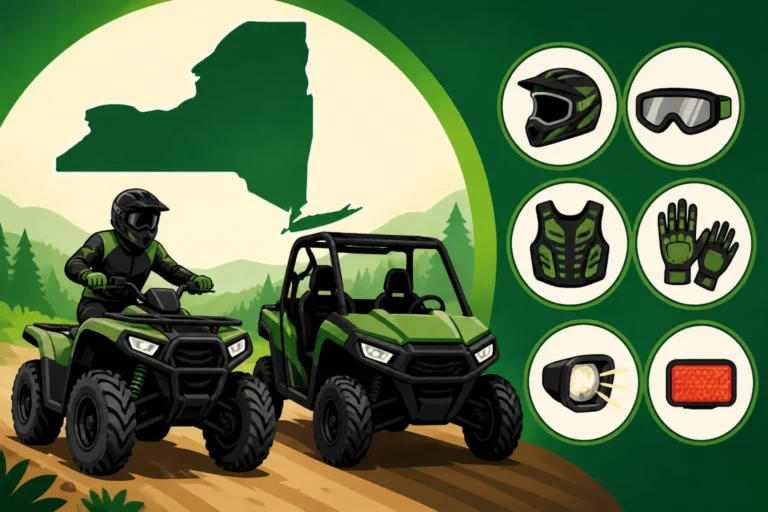
Consider adding extra lighting, like LED light bars (many available from SuperATV, known for their robust off-road accessories), if you ever plan to ride near dusk or dawn, or if you navigate dense wooded areas where sunlight might not fully penetrate. Visibility is key to avoiding obstacles and preventing accidents. Beyond lighting, think about other safety gear that might not be legally mandated for private land but is incredibly smart to have:
- Winch: Essential for self-recovery if you get stuck in mud or a ditch.
- First Aid Kit: Always a good idea, even for short rides.
- GPS/Map: Especially if your property is large or has complex terrain.
- Fire Extinguisher: A small one can prevent a minor engine fire from becoming a major problem.
- Skid Plates: Protecting the underside of your ATV from rocks and debris can save costly repairs. Many riders invest in heavy-duty SuperATV skid plates for this reason.
Remember, just because the law is less strict doesn't mean the risks are gone. In fact, a lack of official oversight often means you need to be more diligent about your own safety and preparedness.
Liability and Lending: When Things Go Wrong
It's unpleasant to think about, but accidents happen, even on familiar private property. When they do, the question of liability quickly comes into play. If someone is injured on your land while riding your ATV, who is responsible? This is a crucial area where understanding New York law and taking preventative measures can save you from significant financial and legal headaches.
Owner Liability: The Buck Stops With You
In New York, as the owner of an ATV, you bear a significant degree of responsibility for its safe operation, even if someone else is riding it on your private property. This is particularly true if the ATV is uninsured, improperly maintained, or operated by someone who shouldn't be riding it (e.g., an underage or unsupervised minor).
If you lend your ATV to a friend, family member, or even an acquaintance, and they get into an accident on your land, you could be held liable. This is known as "negligent entrustment" – meaning you allowed someone to operate a dangerous machine when you knew, or should have known, they were not competent, capable, or authorized to do so. For instance, if you lend your powerful sport quad to a friend who has never ridden an ATV before, and they crash, a court might find you partially or wholly responsible for their injuries. This liability extends to ensuring the machine itself is in safe operating condition. A broken brake line or faulty throttle that leads to an accident on your property could also make you liable for damages. This is why the conversation about insurance (even if not legally mandated for private land use) is so critical. Without it, your personal assets could be at risk.
Guest Riders and Waivers: Protecting Your Interests
If you regularly have friends or family over to ride on your private property, you might want to consider some proactive steps to protect yourself from liability. While not foolproof, these measures can provide a layer of defense.
One common practice is to have guests sign a liability waiver. This document acknowledges the inherent risks of ATV riding and states that the rider assumes those risks, releasing you from responsibility in case of an accident. While courts in New York generally uphold well-drafted waivers, they are not ironclad, especially if gross negligence can be proven on your part (e.g., providing an unsafe machine, or allowing an obviously impaired rider). Another important aspect is to clearly communicate rules and expectations. Before anyone gets on your ATV:
- Check their experience: Don't assume everyone is an experienced rider.
- Provide a safety briefing: Point out hazards on your property, explain ATV controls, and remind them of safety gear.
- Insist on safety gear: If you have extra helmets, offer them.
- Supervise properly: Especially for younger or less experienced riders.
- Never allow impaired riding: Alcohol or drugs and ATVs are a catastrophic combination.
It’s about showing you acted responsibly and took reasonable steps to ensure safety. Ultimately, the best protection is a robust ATV insurance policy that covers guests and property damage, whether legally required or not. [New York Fines for Riding Without Insurance] are substantial on public land, and while not directly applicable to private property, the financial repercussions of an uninsured accident on your land can be far greater.
Disclaimer
This article is for general informational purposes only and does not constitute professional advice. Laws, prices and regulations vary by location and change over time. Consult a qualified professional for guidance on your specific situation.